Get in touch with Talite Transformer Co., Ltd Company

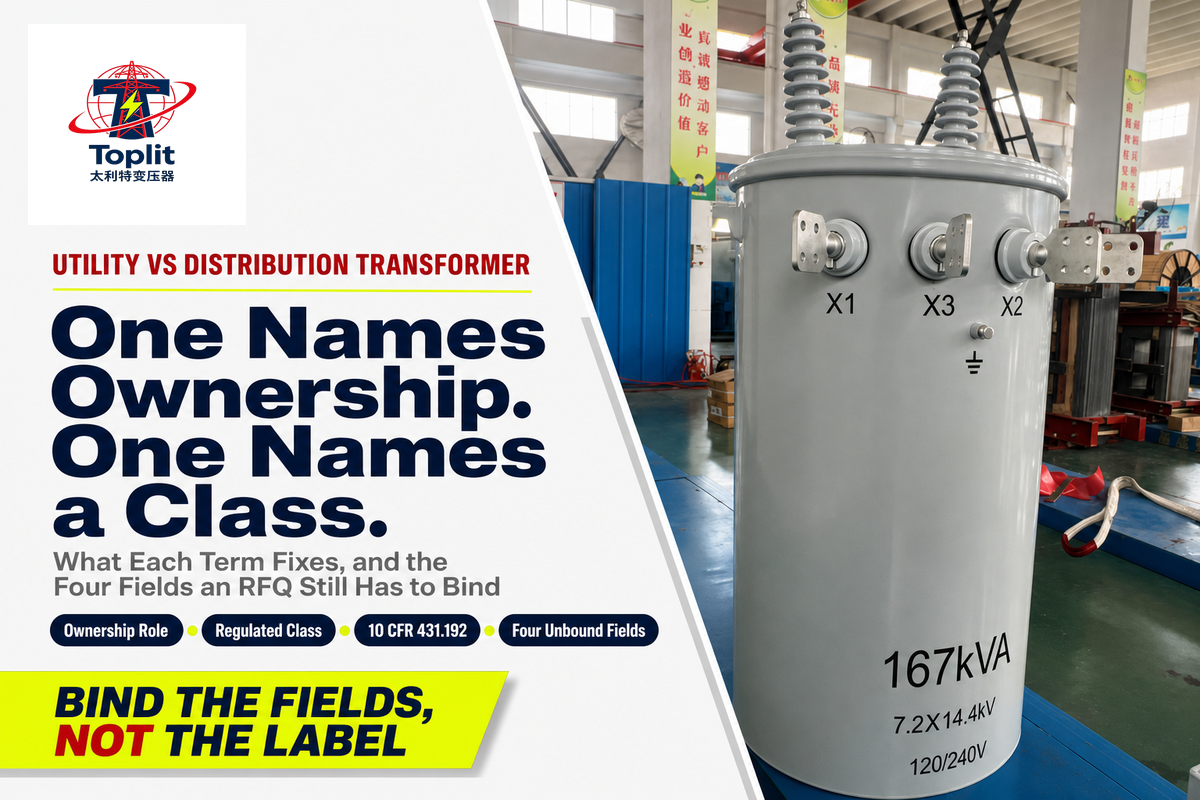
The utility transformer vs distribution transformer question is a comparison between a regulated equipment class and an ownership role, not a contest between two equipment types. “Distribution transformer” is a defined class with numeric bounds in federal regulation. “Utility transformer” is a role label naming who owns the unit and where it sits on the grid, and no standards or regulatory body defines it as an equipment class.
Most utility transformers are distribution transformers. Each word answers a different question, so a buyer who writes only one of them into a requisition has bounded only half of what a factory needs. This guide separates the two axes, shows what each term leaves open, and ends with the four lines an RFQ still has to carry. Readers who came here to learn the key differences between power and distribution transformers will find that comparison too, along with the reason no single number divides them in United States federal usage.
Fixed by the phrase “distribution transformer”Input voltage, output voltage, frequency and kVA band, under 10 CFR 431.192.Fixed by the phrase “utility transformer”Ownership and position relative to the service point. Nothing else.
Updated September 2026. Confirm current federal rules, adopted standard editions and the serving utility’s own requirements before a specification is issued.
Utility Transformer vs Distribution Transformer: The Short Answer
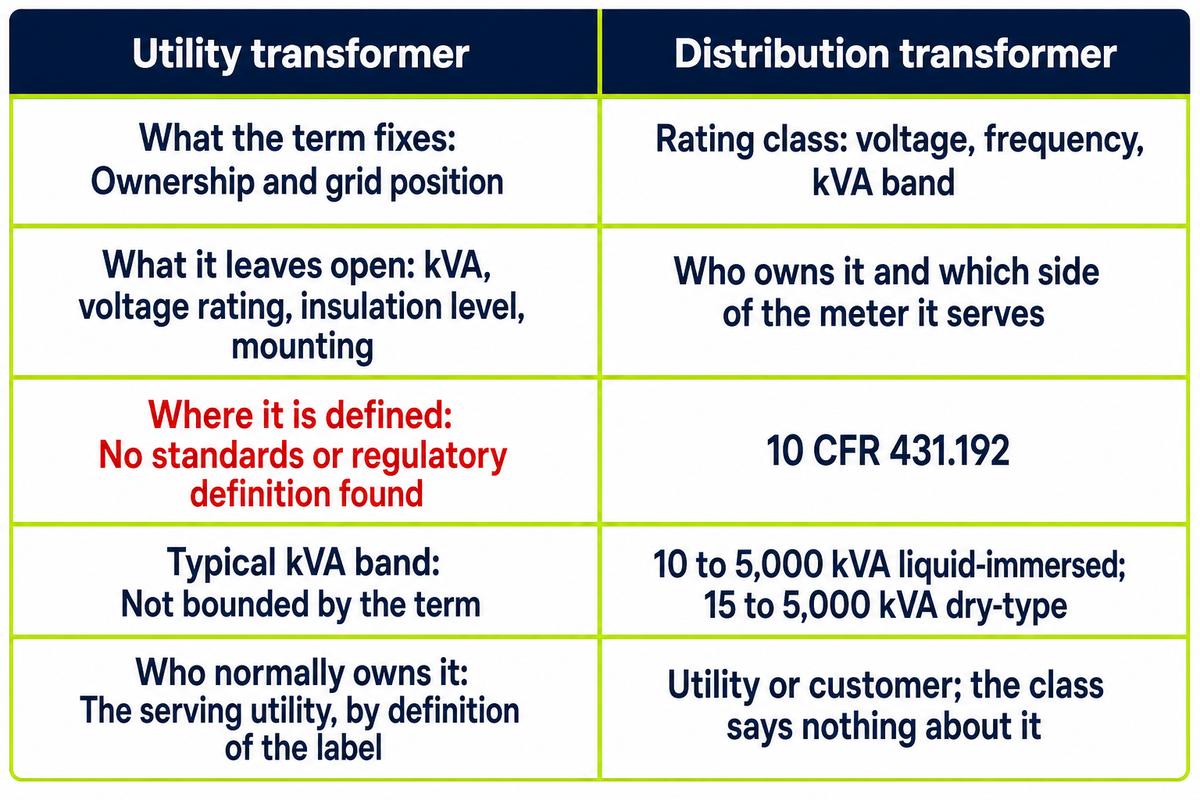
A distribution transformer is a regulated equipment class defined by input voltage of 34.5 kV or less, output voltage of 600 V or less, 60 Hz operation and a capacity band. A utility transformer is any transformer a utility owns ahead of the service point. One is a rating class; the other is an ownership position.
Both phrases describe the same electrical device in most conversations, which is why the differences between the two are easy to miss until a quotation stalls. Distribution transformers are used at the last step-down before the customer, and that’s precisely the position the word “utility” is usually pointing at. Trouble starts when someone treats the role label as though it constrained the hardware.
| Axis | Utility transformer | Distribution transformer |
|---|---|---|
| What the term fixes | Ownership and grid position | Rating class: voltage, frequency, kVA band |
| What it leaves open | kVA, voltage rating, insulation level, mounting | Who owns it and which side of the meter it serves |
| Where it is defined | No standards or regulatory definition found; one university facilities standard defines it | 10 CFR 431.192; product requirements in the IEEE C57.12 series |
| Typical kVA band | Not bounded by the term | 10 to 5,000 kVA liquid-immersed; 15 to 5,000 kVA dry-type |
| Who normally owns it | The serving utility, by definition of the label | Utility or customer; the class says nothing about it |
So the honest comparison isn’t equipment against equipment. It’s a class against a position inside that class. Everything below is a disambiguation, not a spec-sheet duel, and it ends with what you still have to write down. Commercial context for the role label is covered separately on the Talite utility transformer page.
What a Distribution Transformer Is, by Definition
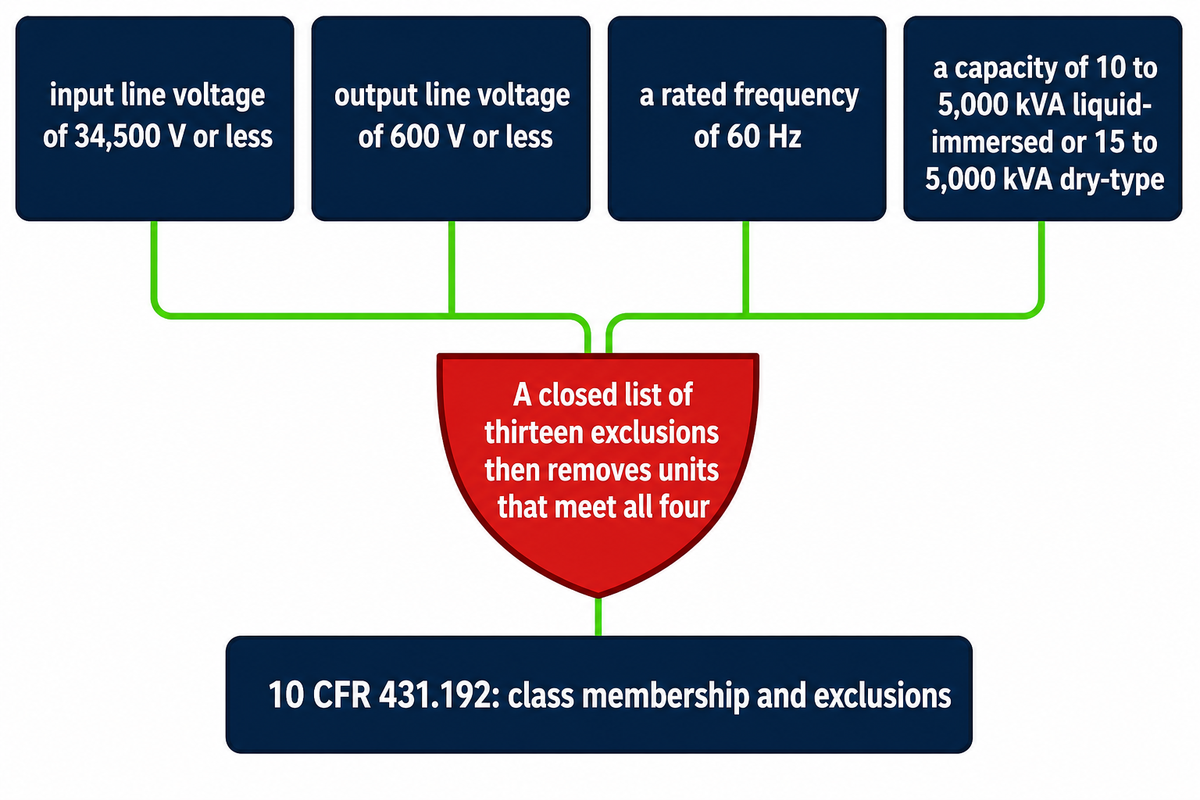
Under 10 CFR 431.192, a distribution transformer is designed to satisfy four numeric conditions at once: input line voltage of 34,500 V or less, output line voltage of 600 V or less, a rated frequency of 60 Hz, and a capacity of 10 to 5,000 kVA liquid-immersed or 15 to 5,000 kVA dry-type. A closed list of thirteen exclusions then removes units that meet all four.
The regulation also describes construction in its subclass definitions: a distribution transformer consists of a core and coil assembly held in a stated insulating medium, which is what separates the liquid-immersed subclass from the dry-type ones.
Every element of that definition is checkable. Any unit can be held against it and placed inside or outside the class without argument, which is the property the role label does not have. Voltage is what the regulation bounds, not input power, and it says nothing about core lamination material, winding metal, or how the primary and secondary are connected. That 600 V ceiling limits what leaves the secondary winding, so it constrains the voltage at which the unit hands electrical power to a customer, not the duty it can carry. The exclusions cover autotransformers, drive isolation, grounding, machine-tool control, non-ventilated, rectifier, regulating, sealed, special-impedance, testing, wide tap-range, uninterruptible power supply and welding transformers.
| Document | What it bounds | Stated limit |
|---|---|---|
| 10 CFR 431.192 | Class membership and exclusions | 34.5 kV in, 600 V out, 60 Hz, 10 to 5,000 kVA |
| IEEE C57.12.00-2021 | General requirements for liquid-immersed distribution, power and regulating transformers | One document covers all three; no kVA line between them |
| IEEE C57.12.20-2023 | Overhead-type product requirements | 500 kVA and smaller, high voltage 34 500 V and below |
| IEEE C57.12.34-2022 | Three-phase pad-mounted product requirements | Separate product scope from the overhead series |
| IEEE C57.12.38-2025 | Single-phase pad-mounted product requirements | Separate product scope again |
One trap deserves naming here. That 500 kVA figure in C57.12.20 is the scope ceiling of an overhead product standard, not a boundary of the class. Sibling standards cover other capacities in other mounting formats, and the federal efficiency tables keep calling units distribution transformers up to 5,000 kVA. Ratings, losses and test detail sit with the distribution transformer ratings and losses reference. This exclusion list matters again in the efficiency section below.
What “Utility Transformer” Actually Names in US Practice
In United States practice, “utility transformer” names a position in the electricity distribution system rather than a rating. No standards or regulatory body was found to define it as an equipment class. Organizations that do define it are the ones that buy and install equipment, and their definitions describe location, not specification.
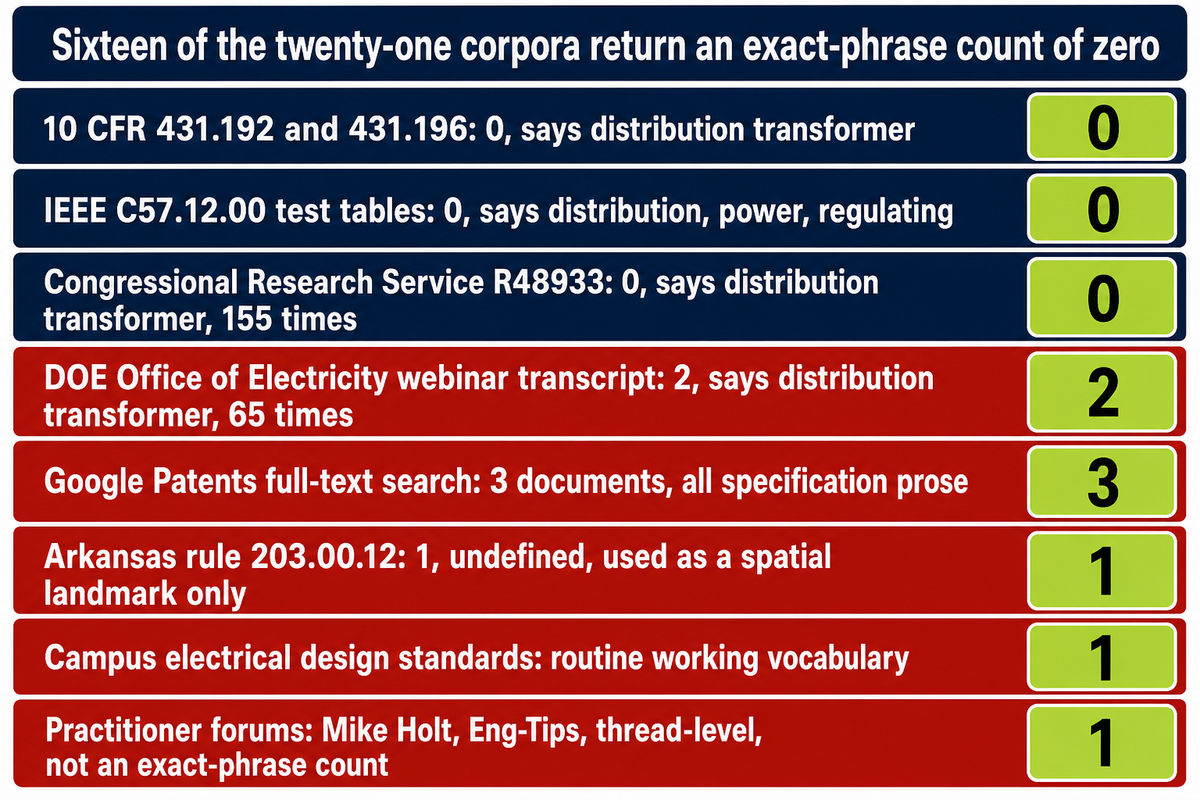
An absence claim needs positive evidence of search, so here’s the search. We took the exact phrase into twenty-one named corpora and counted it: the federal definitions and efficiency sections of 10 CFR Part 431, the IEEE C57.12.00 dielectric test tables, a municipal electric tariff, a national-laboratory technical brief, patent claim language, a whole-corpus patent full-text search and one patent specification read in full, a state commission rule, campus electrical design standards, two practitioner forums, two utility bid documents, a federal statistical glossary, three trade publications, a trade association reading of the 2024 rule, a federal press release, a federal project record, a legislative research report and a federal convening transcript. These are twenty-one documents any reader can open, assembled by this article’s own search path. They’re a checkable set, not a random sample and not a statistical result.
| Corpus | Nature | “utility transformer” | Word it uses instead |
|---|---|---|---|
| 10 CFR 431.192 and 431.196 | Federal efficiency regulation | 0 | distribution transformer |
| IEEE C57.12.00 test tables | Standards committee document | 0 | distribution, power, regulating |
| Idaho Falls municipal electric code | Municipal tariff, revised 2023 | 0 in the 10 of 15 pages parsed | City’s transformers, customer transformer |
| Berkeley Lab technical brief, 2024 | National laboratory | 0 in the 5 of 14 pages parsed | service transformer |
| EIA electricity glossary | Federal statistics | 0 | transformer, unqualified |
| Mount Pleasant / Ameren bid document, 2025 | Utility buying for its own grid | 0 | autotransformer, power transformer |
| Greenville Utilities Request for Bid 25-05 | Utility buying for its own grid | 0 | kVA, voltage pair, BIL, temperature rise |
| Congressional Research Service R48933 | Legislative research | 0 | distribution transformer, 155 times |
| T&D World, 2026 | Industry media | 0 | large transformer, smaller units |
| EC&M, 2016 | Industry media | 0 | service point, separately derived system, utility-owned conductors |
| POWER, 2026 | Industry media | 0 | power transformer, substation power, GSU |
| NRECA reading of the 2024 final rule | Cooperatives' trade association | 0 | distribution transformer |
| DOE press release on the proposed standards | Federal communications | 0 | distribution transformer |
| DOE categorical exclusion CX-035144 | Federal project record | 0 | power transformer, for a 30/40 MVA unit |
| Patent claim language | Claims text, Google Patents | 0 | distribution transformer in the description |
| US6667438B2 specification | Patent specification, read in full | 0 | distribution transformer, 12 times |
| DOE Office of Electricity webinar transcript | Federal convening record | 2 | distribution transformer, 65 times |
| Google Patents full-text search | Whole patent corpus, exact phrase | 3 documents, all specification prose | claims and definitions still 0 |
| Arkansas rule 203.00.12 | State commission rule | 1, undefined | used as a spatial landmark only |
| Campus electrical design standards | Facility owners buying equipment | Routine working vocabulary | used alongside distribution transformer |
| Practitioner forums: Mike Holt, Eng-Tips | Working engineers, posting by handle | Thread-level, not an exact-phrase count; the Eng-Tips thread’s own count is 0 | utility owned transformer, service transformer |
Sixteen of the twenty-one corpora return an exact-phrase count of zero, the patent claim language and the one specification read in full among them. The other five do not, and no two of them in the same way. Take the patent corpus first, because it cuts against this article: widen the search from claims to full text and the exact phrase does appear, in the specification prose of three documents. Not one of them uses it in a claim, and not one defines it. Arkansas’s rule uses the phrase once as an undefined landmark, in a sentence allowing an aluminum alloy “from the utility transformer to the building main disconnect switch”. Campus design standards use it as everyday vocabulary, and one Florida university standard defines it outright as “any pole-mount or pad-mount distribution transformer providing the final voltage transformation”. Practitioner forums carry two independent operating definitions, and two more come from that same Florida university standard and a 2016 EC&M analysis by Eddie Guidry, neither of which uses the phrase itself: four tests in all, no two alike, and not one of them naming a rating. The last non-zero corpus is the DOE Office of Electricity transformer convening transcript, which contains the string twice, both times inside the collocation “utility transformer loading” and listed beside “utility age distributions”, while the same 139,608-character document uses “distribution transformer” 65 times. An adjacent-word hit inside a list of utility attributes isn’t an equipment-class definition, and the claim this article defends survives it: no standard defines the phrase as an equipment class.
What emerges is not random sparseness. It is a clean split. Bodies that write rules use one vocabulary; the people running distribution lines, ordering hardware and hanging steel on a utility pole use another. This is why the label survives. It’s useful to whoever is describing a distribution network, and useless to whoever is buying hardware. Broader context on the utility-side role sits in the electric utility transformer guide.
The Ownership-Class Crosswalk: Mapping Every Term You Will Meet
It helps to put the chain in order first. Power generation feeds step-up transformers to increase voltage for long-distance transport. Substations bring it back down through a power system that ends in electrical power distribution at neighborhood scale, and those transformers deliver power to customers at utilization voltage, typically 120/240 V for a residential service and 277/480 V in a commercial building. The EIA account of how electricity reaches consumers walks that same chain without naming a single transformer sub-type, and the Berkeley Lab electric service sizing brief gives 120/240 V residential as the secondary level these units step down to. Step-down transformers at that final stage are where the role of distribution equipment is defined, by position rather than by size. Distribution voltages aren’t uniform across the country, which is one reason the vocabulary drifts: working engineers report 7.2/12.47 kV, 7.6/13.2 kV and 7.9/13.8 kV all in service today (Eng-Tips contributor cuky2000), reasoning from field practice rather than from a standard.
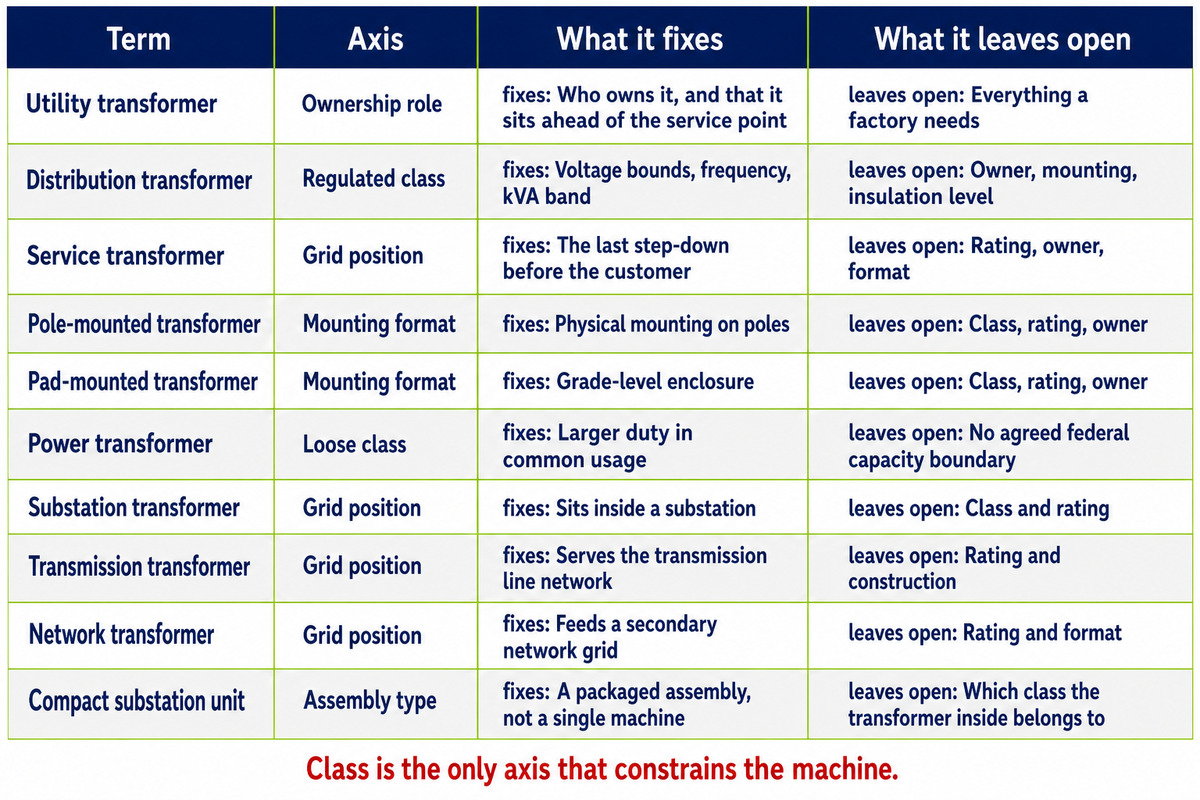
Every transformer term in circulation sits on one of four axes: ownership role, regulated class, mounting format or grid position. Placing a term on the right axis before arguing about it removes most of the disagreement, because two people are usually comparing terms that aren’t on the same axis at all.
| Term | Axis | What it fixes | What it leaves open |
|---|---|---|---|
| Utility transformer | Ownership role | Who owns it, and that it sits ahead of the service point | Everything a factory needs |
| Distribution transformer | Regulated class | Voltage bounds, frequency, kVA band | Owner, mounting, insulation level |
| Service transformer | Grid position | The last step-down before the customer | Rating, owner, format |
| Pole-mounted transformer | Mounting format | Physical mounting on poles | Class, rating, owner |
| Pad-mounted transformer | Mounting format | Grade-level enclosure | Class, rating, owner |
| Power transformer | Loose class | Larger duty in common usage | No agreed federal capacity boundary |
| Substation transformer | Grid position | Sits inside a substation | Class and rating |
| Transmission transformer | Grid position | Serves the transmission line network | Rating and construction |
| Network transformer | Grid position | Feeds a secondary network grid | Rating and format |
| Compact substation unit | Assembly type | A packaged assembly, not a single machine | Which class the transformer inside belongs to |
Read across the rows and one thing stands out: only a single row on this table carries numbers. Ownership, position and mounting are all descriptions of circumstance. Catalog pages sometimes fuse two axes into one phrase, utility distribution transformer, which names the class and then bolts an owner onto it; useful as a description, still not a specification. A power line running past a building tells you where a unit sits, and nothing about what’s inside it. Class is the only axis that constrains the machine, which is why power distribution arguments that stay on the other three axes never resolve.
One boundary condition has to be stated against this article’s own headline. Utility ownership alone doesn’t place a unit in the distribution class. Utilities also own substation, network and transmission transformers, and a 2025 federal project record has a municipal public service commission procuring a 30/40 MVA step-down unit for a new 115/13 kV substation, and the record itself calls that unit a power transformer. The same boundary runs the other way. In a 2016 EC&M case study, a refinery owned two 230/34.5 kV transformers, given there as 100 MW rather than the MVA a transformer nameplate carries, and the NEC service point sat at their 230 kV terminals, so the unit at the boundary was the customer’s, not the utility’s. Ownership and class are independent, and transmission substations are full of counterexamples to any tidy rule.
Power Transformer and Distribution Transformer: The Key Differences in Voltage Levels
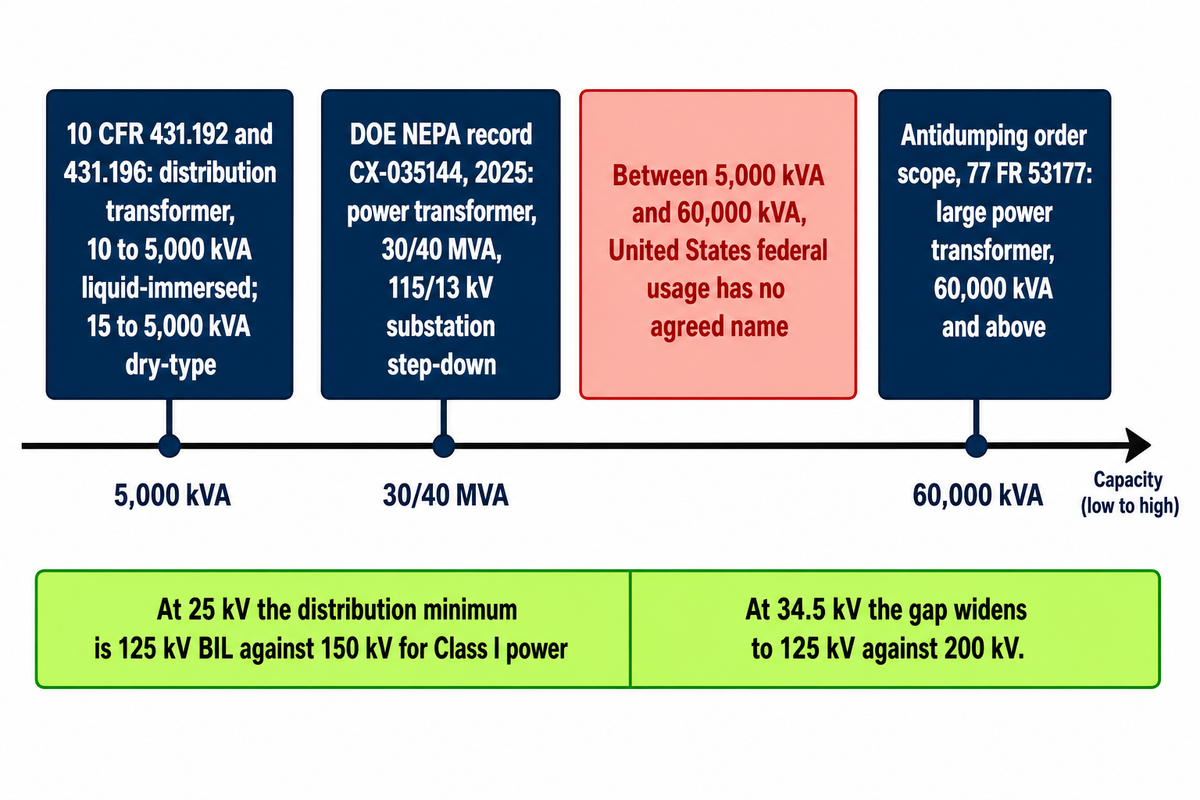
There is no single kVA or primary voltage number that separates power transformers from distribution transformers in United States federal usage. Three federal documents attach three different names to three different capacities, and between 5,000 kVA and 60,000 kVA the federal vocabulary has no agreed name at all.
Most readers actually want the power transformer vs distribution transformer comparison, and this is the section most comparison pages get wrong, because they publish a dividing number and cite nothing. Key differences between power and distribution equipment are real, but they are differences of duty and insulation level, not of one threshold. Two neighboring searches ask the same question in other words: distribution transformer vs transmission transformer, and utility transformer vs power transformer. Neither pairing is settled by a number either. Transmission and utility describe where a unit sits and who runs it, while distribution is the only one of those four words a federal rule defines. Here is how one government says it in three places.
| Federal document | What it calls the equipment | Capacity attached to that name |
|---|---|---|
| 10 CFR 431.192 and 431.196 | distribution transformer | 10 to 5,000 kVA liquid-immersed; 15 to 5,000 kVA dry-type |
| DOE NEPA record CX-035144, 2025 | power transformer | 30/40 MVA, 115/13 kV substation step-down |
| Antidumping order scope, 77 FR 53177 | large power transformer | 60,000 kVA and above, a trade-scope threshold |
Between 5,000 kVA and 60,000 kVA, United States federal usage has no agreed name. That 60,000 kVA figure is a trade-remedy scope boundary written to decide which imports an order covers, not an engineering definition of anything, and it should never be quoted as one.
Differences Between Power and Distribution Transformers by Voltage Class
The one place a standards document does separate the two is insulation coordination. In the IEEE Transformers Committee dielectric test tables for C57.12.00, distribution transformers and Class I power transformers share the same applied and induced test values at a given nominal system voltage, but not the same minimum BIL. At 25 kV the distribution minimum is 125 kV BIL against 150 kV for Class I power. At 34.5 kV the gap widens to 125 kV against 200 kV. Transformers differ there by what they must survive, not by how much they can carry.
The Difference Between Power Transfer and Distribution Duty
Duty is the usable distinction. Bulk power transfer at high transmission voltages is a different service from delivering usable power to a building, and equipment for generation and transmission is built for long-distance power flow between substations. Power transformers are used at those interfaces, and power transformers are generally loaded toward their nameplate for hours at a time. That is why power transformers are designed around a steady thermal duty, while distribution transformers may sit well below nameplate for most hours of the year. Distribution transformers operate under a profile set by occupancy rather than by a continuous rating. Both types are designed against the same general IEEE requirements document, and both types of transformers are made from the same families of core and winding material. Power transformers are typically specified with that continuous duty in mind, while distribution transformers often carry a short daily peak and coast through the rest of the day. Transformers often stay in service long enough that utilities plan replacement around age distributions and failure rates rather than around a nameplate date, a point made repeatedly in the DOE convening. Power transformers lose energy through core and winding losses in the same way distribution units do, yet the load point at which those transformers lose the least is chosen differently.
Differences Between Power Transformers and Their Distribution Counterparts
The practical consequence is a planning number. T&D World reported in February 2026 that large transformer lead times exceed 200 weeks while smaller units can take up to two years, and the Congressional Research Service relays an industry consultancy’s estimate that wait times for distribution transformers had decreased to 30 weeks by the second quarter of 2025 after a two-year wait prevailed through 2024. Those figures are not in conflict; they describe different classes. Name the wrong class and the schedule assumption you carry into a project is wrong by roughly a factor of six. Deeper coverage of the larger class sits in the power transformer duty and loading guide, and the built range is on the Talite power transformer page.
The Unbound-Field Test: 4 Fields Your RFQ Still Has to Bind
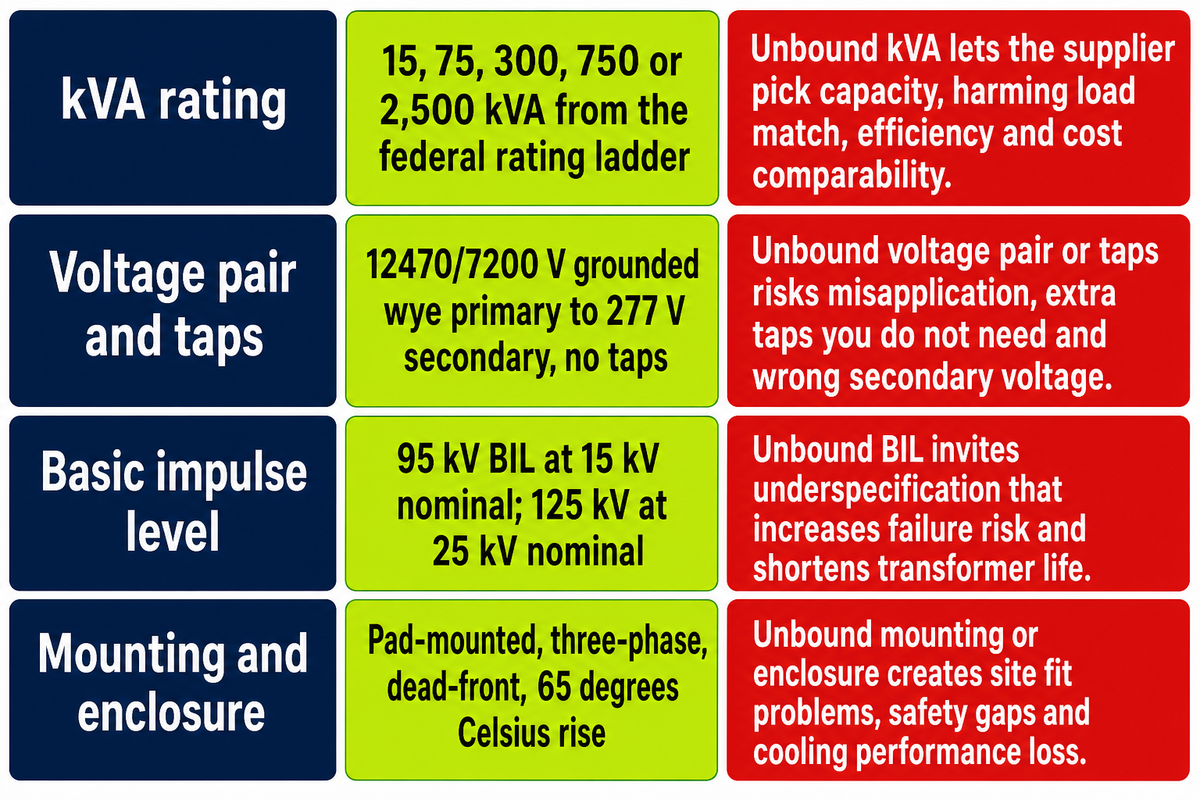
A requisition that says “utility transformer” has bound ownership and nothing else. Four fields decide whether a manufacturer can quote without a clarification round: kVA rating, the primary and secondary voltage pair with tap range, basic impulse insulation level, and mounting format with enclosure class.
Read your own RFQ line and ask which of the four fields it settles. If the answer is none, the line is a description, not a specification.
| Field | Example of a bounded value | Consequence of leaving it open |
|---|---|---|
| kVA rating | 15, 75, 300, 750 or 2,500 kVA from the federal rating ladder | Fourteen standard three-phase steps remain in play |
| Voltage pair and taps | 12470/7200 V grounded wye primary to 277 V secondary, no taps | “High voltage” alone spans 2,400 V to above 35 kV in real documents |
| Basic impulse level | 95 kV BIL at 15 kV nominal; 125 kV at 25 kV nominal | Design cannot start; the standard note says impulse levels must be specified before design |
| Mounting and enclosure | Pad-mounted, three-phase, dead-front, 65 degrees Celsius rise | A different product standard applies, so the quote is not comparable |
The BIL row is the one buyers underestimate. Basic impulse level is the parent parameter of a whole test set: chopped-wave values run 1.1 times BIL and switching impulse values 0.83 times BIL, so the number drives the design rather than describing it. Insulation level also has to be chosen against a real voltage rating, because loads fluctuate and the transformer must hold up under transient conditions that have nothing to do with full load current. The arithmetic that turns a connected load into a kVA number is not taught here; see transformer kVA sizing. Insulation coordination has its own reference at transformer BIL, and format choice at pole-mounted versus pad-mounted transformers. Pole-mounted transformers may suit an overhead radial feed while pad-mounted transformers suit an underground three-phase power service, and the choice changes which product standard governs.
Efficiency Rules Follow the Class, Not the Label
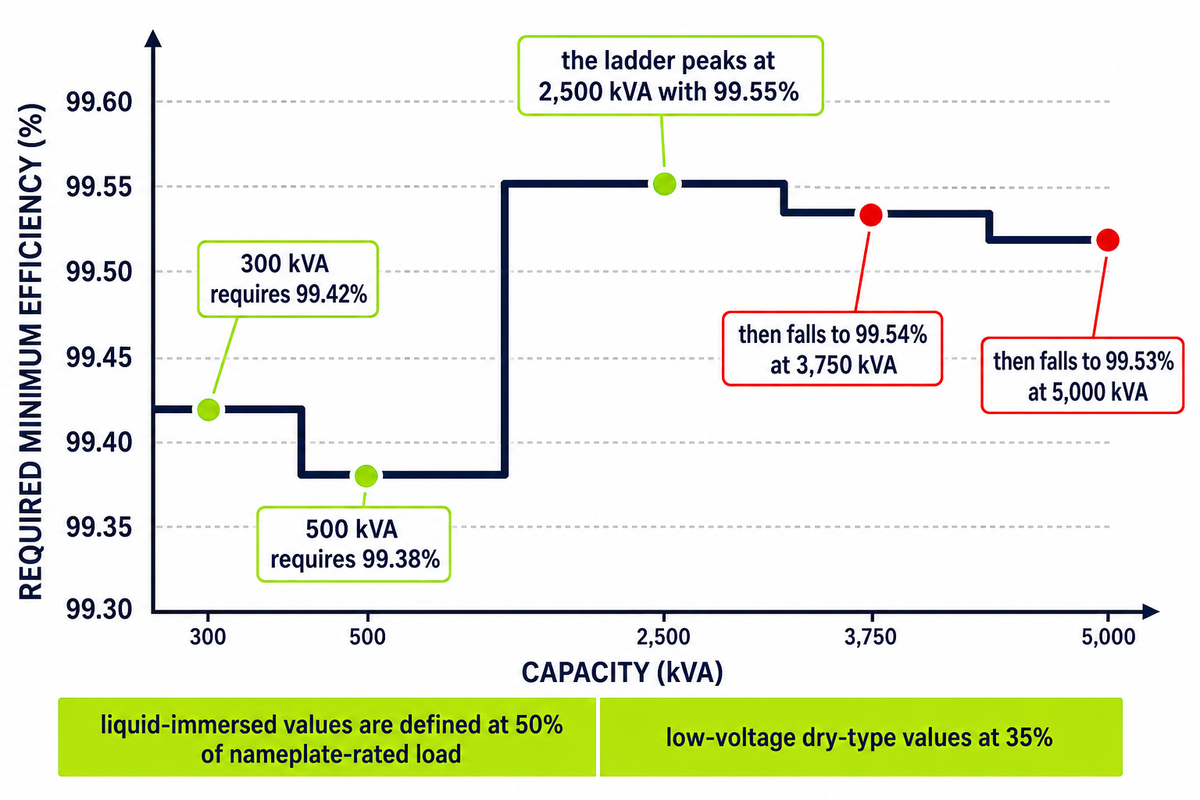
Federal efficiency standards attach to the defined class and the date of manufacture. Calling a unit a utility transformer has no bearing on whether the rule applies. In 10 CFR 431.192 and 431.196 the words “utility”, “owner” and “ownership” do not appear at all.
Nothing demonstrates the whole argument more cleanly than that absence. The rule is written as “a transformer of this class manufactured on or after this date shall have an efficiency not less than this value”, so the only questions are what the unit is and when it was made. Compliance with the amended standards is required on and after April 23, 2029, a date carried identically by the eCFR text of 10 CFR 431.196 and by the 2024 Federal Register final rule. Since distribution transformers in the 2029 tables run to 5,000 kVA in three-phase, that table alone retires the common claim that the class stops at 2,500 kVA.
Two things the efficiency tables actually say
- The ladder is not monotonic. According to the 2029 three-phase liquid-immersed table in 10 CFR 431.196, 300 kVA requires 99.42% and 500 kVA requires 99.38%. A larger machine carries a lower legal minimum. That reversal happens three times in the same column: the ladder peaks at 2,500 kVA with 99.55%, then falls to 99.54% at 3,750 kVA and 99.53% at 5,000 kVA.
- Those percentages are measured at a stated load point, not at full load. As documented in the same section, liquid-immersed values are defined at 50% of nameplate-rated load and low-voltage dry-type values at 35%.
That second point explains a claim that circulates on comparison pages: the assertion that distribution transformers deliver 50% to 70% efficiency. That 50%, as shown in the 431.196 table, is a load reference point and not an efficiency value. The same logic reaches the core material. In the account of NRECA, the electric cooperatives’ trade association and an interested party in the rulemaking, most distribution transformers use grain-oriented electrical steel today in residential and lower-load cooperative service, and the 2024 final rule will eventually move about a quarter of manufacturers to amorphous cores, with a large portion of units for some commercial loads and for certain new electric vehicle charging sites landing on amorphous steel. That reading turns on load and application. Distribution transformers perform the same conversion whichever side of the service point they sit on, and no clause anywhere in the two sections sorts them by owner. Two further boundaries belong here. The thirteen exclusions in 431.192 put some units outside the rule even when they meet every numeric condition. And in 2025 Congress revoked a separate certification, labeling and enforcement rule under the Congressional Review Act; the efficiency standards themselves were untouched. This section replaces a market-outlook section on purpose: trend data across this keyword cluster is stable to declining, so no growth figure is offered and none is invented.
Who Owns It Changes What You Buy
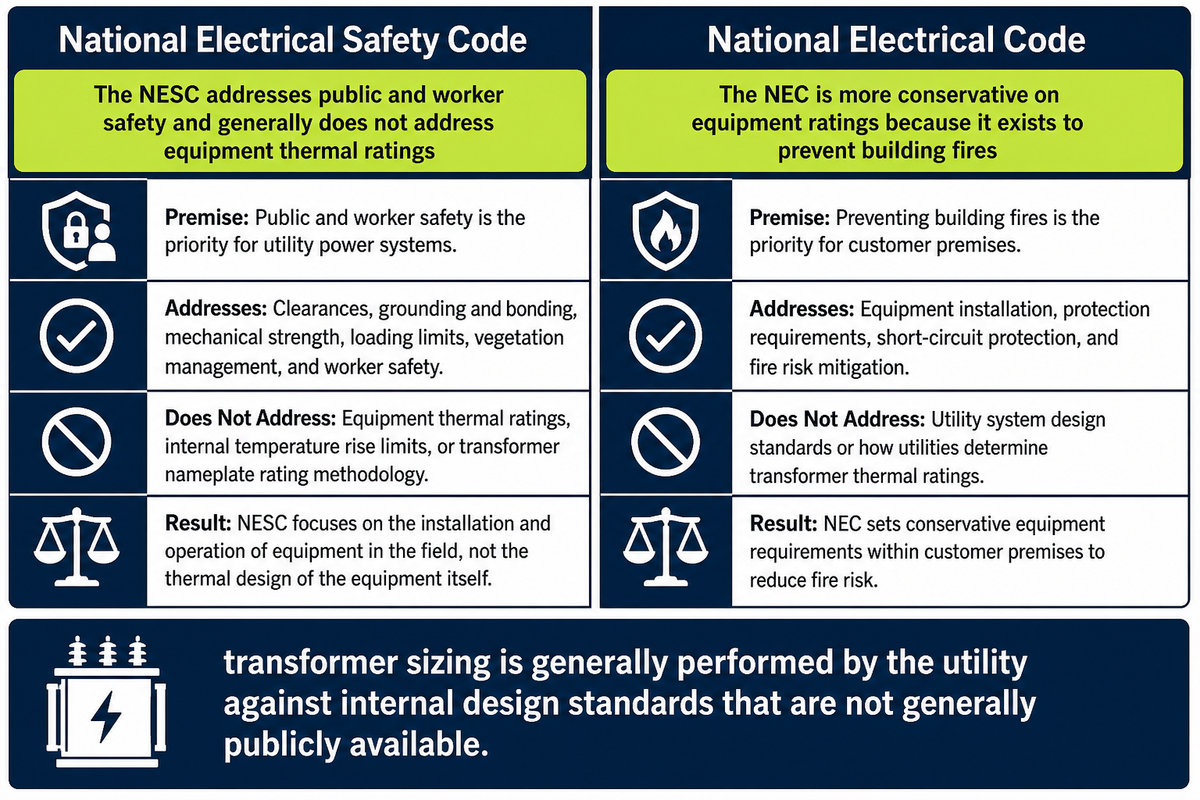
Ownership decides which rulebook governs the equipment, who writes the specification and who witnesses the tests. Utility-side infrastructure is generally governed by the National Electrical Safety Code rather than the National Electrical Code, and the two codes size equipment on different premises.
A 2024 Berkeley Lab technical brief states the mechanism directly. The NEC is more conservative on equipment ratings because it exists to prevent building fires, while the NESC addresses public and worker safety and generally does not address equipment thermal ratings, leaving utilities and manufacturers to set ratings from physical and environmental characteristics. That same brief notes that transformer sizing is generally performed by the utility against internal design standards that are not generally publicly available. That single sentence explains why no vendor page can publish a credible utility-side sizing table.
Ownership boundaries are also written down, and they move. One municipal electric code owns its system down to the meter for residential customers but down to the transformer for commercial customers, and its tariff sets transformer loss adjustments in both directions depending on which side of the electrical system the metering sits. The same code defines the point of delivery as the place where the customer’s conductors connect to the utility’s facilities, subject to what the service application approves, which is a contractual boundary rather than a fixed piece of hardware. Load distribution across a feeder is what drives a utility’s own placement and sizing decisions, while the power delivery obligation written into a tariff stops at the point of delivery and the customer supplies everything on the load side. Practical consequences follow: whose specification governs, who witnesses factory tests, whose circuit breaker protects the unit, and who holds spares. Talite’s full range sits under the distribution transformer product family.
How to Choose the Right Transformer and Word the Spec
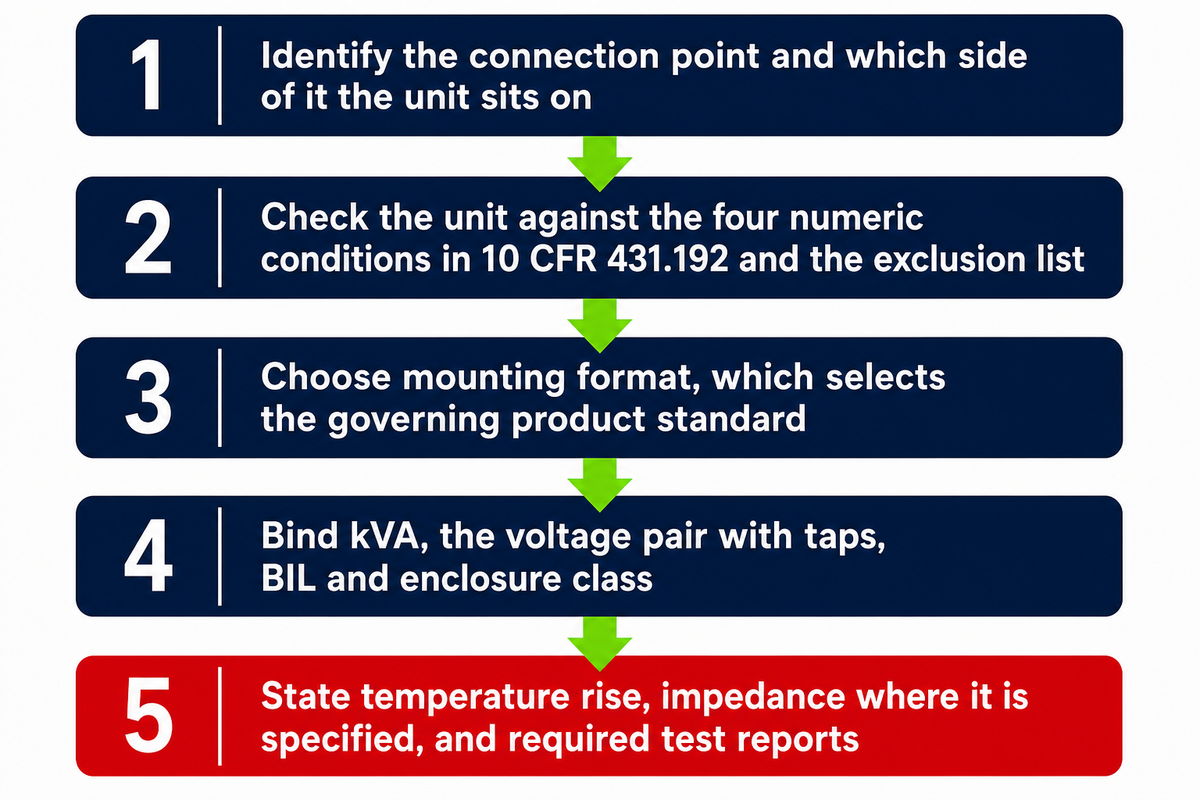
Choosing the right transformer starts with what you’re connecting, not with which of the two terms you prefer. What the transformer is used for, and where it sits, decides the class. Establish the connection point and ownership side first, then the class, then bind the four fields. Output is a spec line a factory can quote without asking a question.
Scale is the reason this matters. In a DOE Office of Electricity convening, participants put the different distribution transformer configurations nationwide at almost 40,000, against about 80,000 combinations that ten attributes can produce. On why one specification can’t serve them all, the transcript is blunt.
“…every utility has their own requirements at the moment.”DOE Office of Electricity, Distribution Transformer Webinar transcript
Against that distribution, a role label can’t converge on one machine. What follows is specification practice, not a measured time or cost saving.
Decision path
- Identify the connection point and which side of it the unit sits on.
- Check the unit against the four numeric conditions in 10 CFR 431.192 and the exclusion list.
- Choose mounting format, which selects the governing product standard.
- Bind kVA, the voltage pair with taps, BIL and enclosure class.
- State temperature rise, impedance where it’s specified, and required test reports.
Case A, utility-owned service transformer. Vague line: “utility transformer for a new service”. Bounded replacement, following the wording of a real public bid from a North Carolina municipal utility: 15 kVA conventional distribution transformer, single phase, 60 Hz, two-bushing cover-mounted, 12470/7200 V grounded wye primary to 277 V secondary, 95 kV BIL, 65 °C rise, no taps.
Case B, customer-owned pad-mounted unit. Vague line: “pad-mount utility transformer, 750 kVA”. Bounded replacement: three-phase pad-mounted distribution transformer to IEEE C57.12.34, 750 kVA, dead-front, with impedance stated and a minimum floor set, since the same public bid requires impedance values on pad-mounted units 750 kVA and larger to be not less than 4.5%. That bid also asks bidders to state delivery, manufacturer, place of manufacture, winding and core materials, guaranteed no-load and load losses at 85 °C, and certified test reports. Note what’s absent from a utility’s own purchase document: across 53,561 characters, the phrase “utility transformer” appears zero times. Supplier evaluation is a separate exercise, covered under utility transformer manufacturers.
According to company-provided background, Talite Transformer Co., Ltd. has worked in the power-equipment sector for more than three decades, was originally established as Jiangsu Fangteng Industrial Co., Ltd., and integrates research, production and sales in Nantong, Jiangsu. This is first-party company context, not independent proof of any product claim.
Send the bounded line, not the label
Bring the four fields once they are bound: kVA, the voltage pair with taps, BIL and mounting format. Talite can check that a customer-owned line reads as a specification rather than a description before it goes out for quotation, and the Talite utility transformer configurations page shows the built range behind it.
Frequently Asked Questions
What is the purpose of a utility transformer?
A utility transformer performs the final voltage transformation before the customer, on equipment the utility owns rather than the customer. Its purpose is positional: it steps distribution-line voltage down to the level the customer uses and ends the distribution path, which is a job description rather than an equipment rating.
The phrase describes a job and a position rather than a product class. One university facilities standard defines it as any pole-mount or pad-mount distribution transformer providing the final voltage transformation in the electric power distribution system, stepping the voltage on the distribution lines down to the level the customer uses. A single utility transformer may serve one customer or several dozen. The utility-side view of that role, including types and nameplate reading, is covered separately; this page is about what the label leaves unbound. Because the term is positional, it carries no rating information at all, which is why a purchase document written around it still has to name kVA, voltages, insulation level and mounting.
What is the difference between a power transformer and a distribution transformer?
Distribution transformers have a regulatory definition with numeric bounds: 34.5 kV or less in, 600 V or less out at 60 Hz, and a 10 to 5,000 kVA band depending on construction. Power transformers have no agreed federal capacity boundary, and between 5,000 and 60,000 kVA United States federal documents supply no settled name at all.
Under 10 CFR 431.192 a distribution transformer takes 34.5 kV or less in, puts out 600 V or less at 60 Hz, and falls in a 10 to 5,000 kVA band depending on construction. Above that band, federal usage splits: a 2025 DOE project record calls a 30/40 MVA, 115/13 kV unit a power transformer, while a trade order defines large power transformers as 60,000 kVA and above. Between 5,000 and 60,000 kVA there is no agreed federal name. Where a standards document does separate the two, it separates them by minimum basic impulse level at a given nominal system voltage rather than by capacity. Any page that gives you one clean dividing number is simplifying past what the documents support.
What are the typical sizes of utility transformers?
The label itself sets no size, but the federal rating ladder for the underlying distribution class is published and finite. Single-phase steps run from 10 kVA to 833 kVA and three-phase steps from 15 kVA to 2,500 kVA, with 3,750 and 5,000 kVA added in the 2029 compliance tables. Residential service typically sits at the low end of the single-phase ladder.
Single-phase steps run 10, 15, 25, 37.5, 50, 75, 100, 167, 250, 333, 500, 667 and 833 kVA. Three-phase steps run 15, 30, 45, 75, 112.5, 150, 225, 300, 500, 750, 1,000, 1,500, 2,000 and 2,500 kVA, with 3,750 and 5,000 kVA added in the 2029 compliance tables. Typical distribution ratings for a residential service sit at the low end of the single-phase ladder.
Is a utility transformer the same as a distribution transformer?
Usually the same physical unit, but not the same kind of statement. Most units called utility transformers are distribution transformers under the federal definition. The claim does not reverse, though, because customers own distribution transformers too, and a customer-owned unit is not a utility transformer.
The overlap is real but directional. One term reports ownership and position, the other reports class membership, so treating them as synonyms is safe in conversation and unsafe in a purchase order: the ownership label leaves kVA, voltage pair, insulation level and mounting entirely open, while the class label says nothing about who owns the unit. The same question answered from the utility side, where the role rather than the class is the subject, sits in the electric utility transformer guide.
What is the difference between a distribution transformer and a transmission transformer?
Position on the power grid, with no universally agreed voltage line between them. Transmission networks move bulk power between substations at higher voltage, while primary distribution lines carry it the last stretch at lower voltage. Where the boundary falls varies by utility: working engineers report 24 kV treated as transmission at one utility and 35 kV as distribution at another (Eng-Tips contributor davidbeach), with 45 kV and 69 kV both called subtransmission at two large utilities (Eng-Tips contributor oldfieldguy).
The inconsistency is not sloppiness. No United States federal document found in this article’s search draws the line, and the standards documents that do separate classes separate them by minimum basic impulse level at a given nominal system voltage rather than by a voltage threshold. For a buyer the practical consequence is the same one this guide keeps arriving at: name the connection point and the four bounded fields, not the category.
Which transformer is better for my project?
Neither term answers that, because neither one is a rating. Establish the connection point and which side of it the unit sits on, then bind the four fields that decide whether a factory can quote without a clarification round: kVA, the primary and secondary voltage pair with its tap range, BIL, and mounting format with enclosure class. Whichever unit those four lines describe is the right transformer.
The question hides a second one: better for which side of the service point. A utility-owned unit is bought against the serving utility's own internal standard, which is generally not published; a customer-owned unit is bought against a product standard the buyer can name, and mounting format is what selects which one governs. Settle those two and the correct transformer is whichever unit the four bound lines describe.
Transparency note
Every kVA, kV, BIL, percentage and date above was read from a primary document opened directly for this article. That absence claim in the utility transformer section rests on a term count across twenty-one named corpora, every one of them in the table above so a reader can repeat it; it is a checkable set, not a survey. Three limits are stated rather than hidden: the practitioner definitions cited are attributed to the individual contributors who posted them and are reported as reasoning, not as standards, and those threads carry no publication date; the Idaho Falls code and the Berkeley Lab brief were counted over the pages parsed, ten of fifteen and five of fourteen, not over the whole file; and no claim is made here about the 2026 National Electrical Code, because that text could not be retrieved. Four named frameworks in this article are Talite editorial tools, not IEEE, DOE or utility methods. No Talite pricing, lead time, capacity, certification or customer relationship is claimed anywhere on this page. Written by XCX.
Every kVA, kV, BIL, percentage and date above was read from a primary document opened directly for this article. That absence claim in the utility transformer section rests on a term count across twenty-one named corpora, every one of them in the table above so a reader can repeat it; it is a checkable set, not a survey. Three limits are stated rather than hidden: the practitioner definitions cited are attributed to the individual contributors who posted them and are reported as reasoning, not as standards, and those threads carry no publication date; the Idaho Falls code and the Berkeley Lab brief were counted over the pages parsed, ten of fifteen and five of fourteen, not over the whole file; and no claim is made here about the 2026 National Electrical Code, because that text could not be retrieved. Four named frameworks in this article are Talite editorial tools, not IEEE, DOE or utility methods. No Talite pricing, lead time, capacity, certification or customer relationship is claimed anywhere on this page. Written by XCX.
References & Sources
- 10 CFR 431.192, Definitions. Electronic Code of Federal Regulations (Tier 1)
- 10 CFR 431.196, Energy Conservation Standards and Effective Dates. Electronic Code of Federal Regulations (Tier 1)
- 89 FR 29834, Energy Conservation Standards for Distribution Transformers. Federal Register (Tier 1)
- Distribution Transformer Webinar Transcript. U.S. Department of Energy, Office of Electricity (Tier 1)
- Categorical Exclusion Record CX-035144. U.S. Department of Energy (Tier 1)
- R48933, Electricity Distribution Transformers: Supply, Tariffs, and Policy Options. Congressional Research Service. Read via the EveryCRSReport mirror, which is the copy these figures were taken from (Tier 1)
- Electric Service Sizing Technical Brief, 2024. Lawrence Berkeley National Laboratory (Tier 1)
- IEEE C57.12.20-2023, Overhead-Type Distribution Transformers, 500 kVA and Smaller. IEEE Standards Association (Tier 2)
- Large Power Transformers from the Republic of Korea, Scope of the Order. Federal Register, restating 77 FR 53177 (Tier 1)
- C57.12.00 Dielectric Test Tables. IEEE Transformers Committee, Dielectric Tests Subcommittee (Tier 2)
- 203.00.12 Ark. Code R. 003, Electric Service Rules. Arkansas, via Cornell Legal Information Institute (Tier 1)
- Title 8 Chapter 5, Electric Service, Ordinance 3547. City of Idaho Falls (Tier 1)
- Request for Bid 25-05, Transformers. Greenville Utilities Commission (Tier 3)
- Design, Construction and Renovation Standards v2020-1, page 205. University of Central Florida (Tier 2)
- Is It a Service or a Separately Derived System? EC&M, 2016 (Tier 3)
- As the US Speeds Up Grid Expansion, Transformers Must Keep Pace. T&D World, 2026 (Tier 3)
- DOE Finalizes Much-Improved Standard for Distribution Transformers. NRECA, the electric cooperatives' trade association and an interested party in the rulemaking (Tier 3)
- DOE Proposes New Efficiency Standards for Distribution Transformers, 2022. U.S. Department of Energy (Tier 1)
- US6667438B2, Padmount Transformer Enclosure. Google Patents (Tier 2)
- Utility-Owned vs Customer-Owned Transformers. Mike Holt Forums, contributor electrofelon; undated thread (Tier 4)
- What Is the Difference Between a Transmission System and a Distribution System. Eng-Tips, contributors davidbeach and oldfieldguy; undated thread (Tier 4)
- Glossary: Electricity. U.S. Energy Information Administration (Tier 1)
- Autotransformer Bid Specification, REV 2, 2025. Mount Pleasant Municipal Utilities, via the Iowa Association of Municipal Utilities (Tier 3)
- Transformers in 2026: Shortage, Scramble, or Self-Inflicted Crisis?. POWER, 2026 (Tier 3)
- US20150318796A1. One of the three patent documents whose specification prose carries the exact phrase. Google Patents (Tier 2)
- IEEE C57.12.00-2021, General Requirements for Liquid-Immersed Distribution, Power and Regulating Transformers. IEEE Standards Association (Tier 2)
Sources accessed September 2, 2026.
![Pad-Mounted Transformer: How It Works [2026 Guide]](https://toplit-transformer.com/wp-content/uploads/2026/08/pad-mounted-transformer-guide-featured-150x150.png)
![Single Phase Pad Mounted Transformer Guide [2026]](https://toplit-transformer.com/wp-content/uploads/2026/08/single-phase-pad-mounted-transformer-guide-featured-1-150x150.png)