Get in touch with Talite Transformer Co., Ltd Company
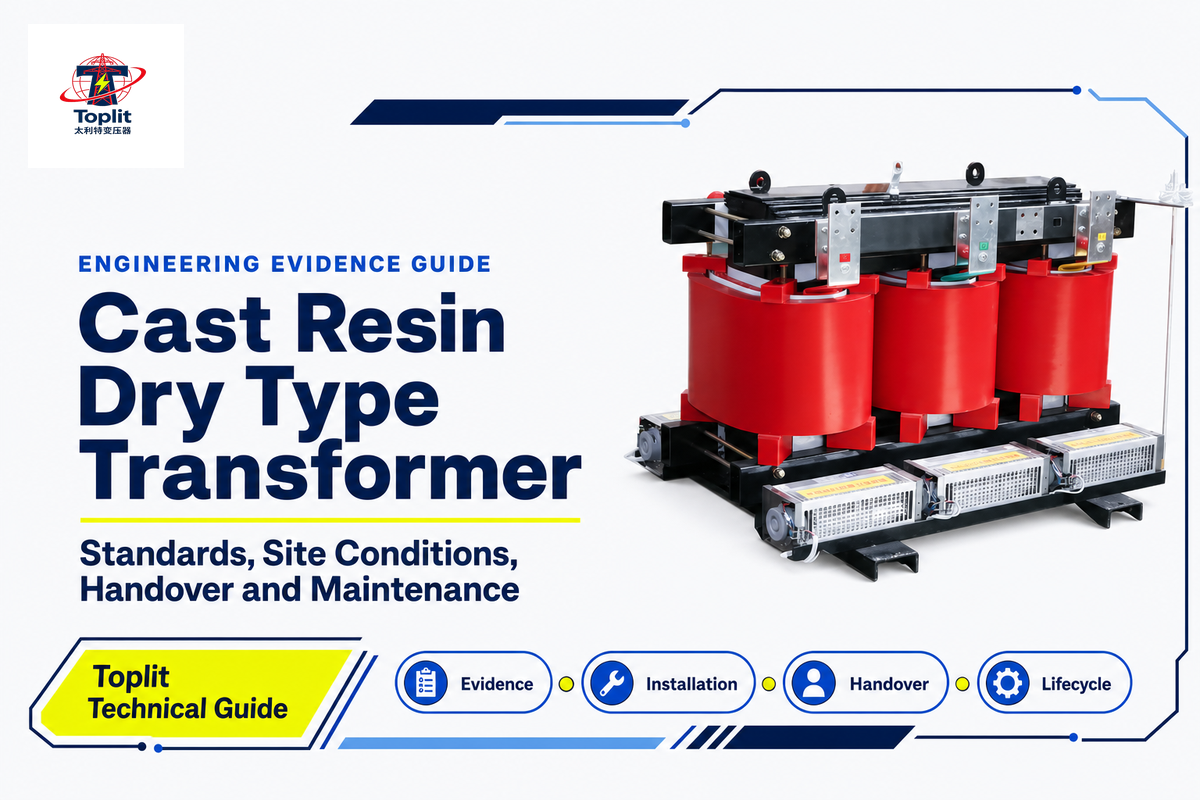
How to Verify a Cast Resin Dry Type Transformer Before Handover

Updated September 2026
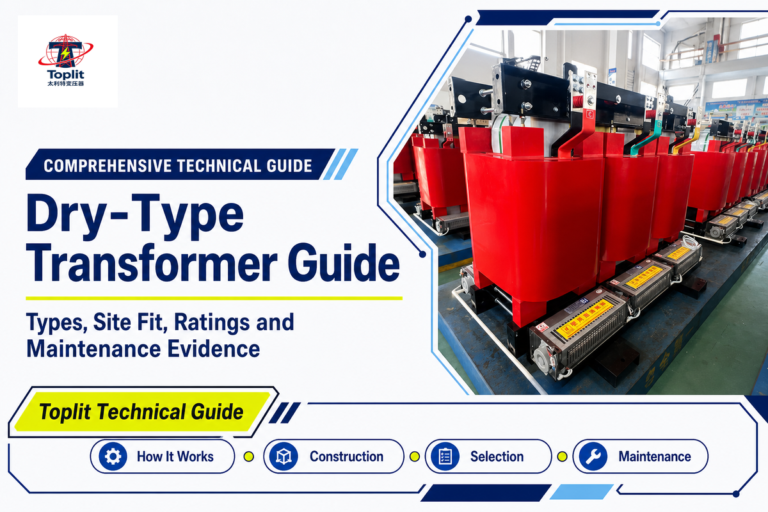
A cast resin dry type transformer is a dry-type unit whose relevant winding is encapsulated in a solid resin insulation system. That definition identifies construction; it does not prove enclosure, thermal design, environmental declarations, installation, testing, or handover suitability for a specific site.
TL;DRVerify three things together: the declared duty, evidence tied to the exact supplied design, and the installed condition. Keep harmonic loading, room airflow, receiving damage, commissioning exceptions, and destination rules visible until an authorized person approves energization.
A prospective customer seeking ratings, configurations, manufacturing options, or quote requests should use Toplit’s cast resin dry type transformer solution page. This document addresses a different issue. It shows engineers, contractors, and asset owners how to review evidence for a proposed or delivered unit without treating a construction label as project approval.
The primary idea is the Cast-Resin Evidence Triangle: construction, declared duty, and installed condition. Strong outcomes require all three corners. Good resin casting cannot compensate for an undisclosed harmonic load. Even a complete test report cannot compensate for blocked airflow. Even a correct room drawing cannot prove that the delivered serial-numbered unit arrived dry and undamaged.
72.5 kVIEC 60076-11 upper scope boundary
>1.1 kVAt least one winding in scope
2018Current IEC edition on the official page
3 linksDuty, exact evidence, installed condition
What Makes a Cast-Resin Transformer Different?
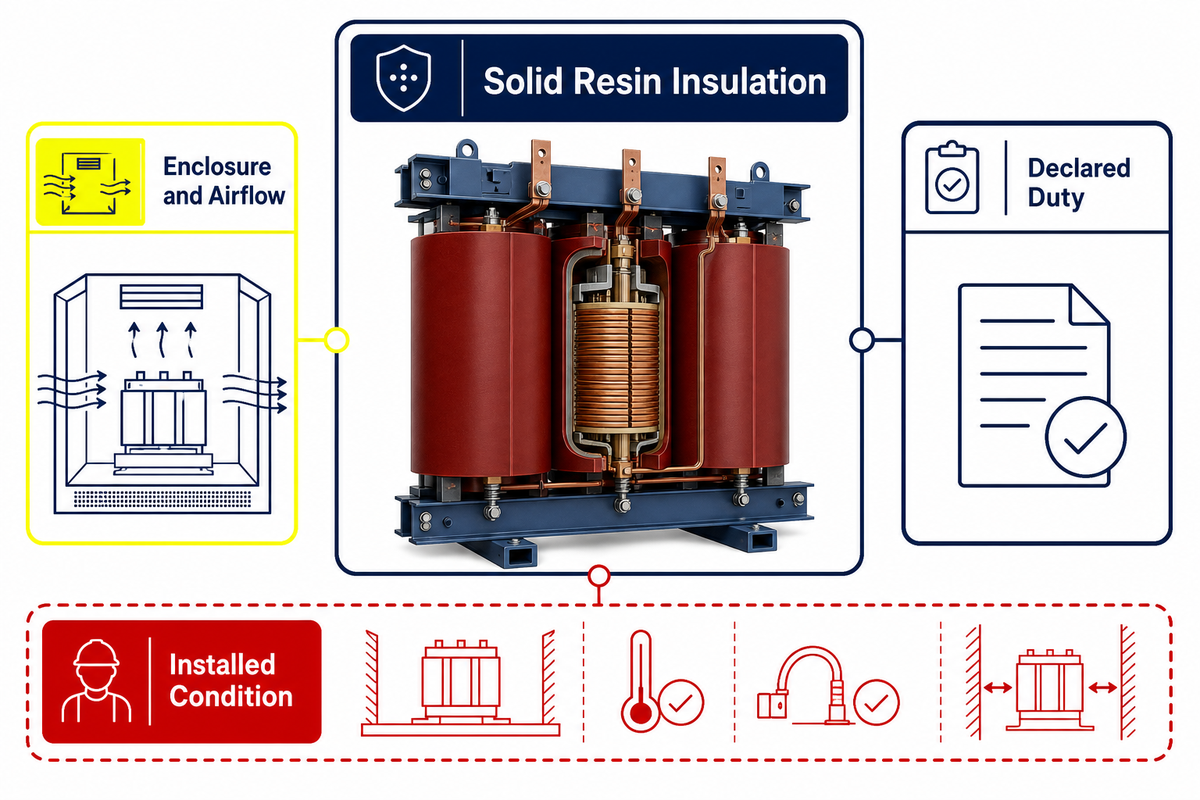
Direct answer: in a cast-resin transformer, the relevant winding is encapsulated in a solid resin insulation system rather than immersed in insulating liquid. That construction changes exposure, inspection, cooling, fire and spill context, but it does not settle enclosure type, site suitability, harmonic capability, maintenance needs, or acceptance criteria.
A cast resin dry-type transformer combines a transformer core, commonly built from silicon steel sheets, with primary and secondary winding assemblies. The dielectric resin system supports mechanical strength, while the enclosure and airflow govern heat dissipation by natural convection or forced cooling. These construction facts still do not prove project approval.
The phrase is often treated as a complete specification. It is not. The wider dry type transformer family contains materially different configurations. IEEE C57.12.01, for example, covers ventilated, non-ventilated, and sealed dry-type transformers with a highest-voltage winding of 601 V or higher. Air movement, enclosure behavior, contamination control, and service access can therefore differ even when two units are both called dry type.
3-Step Evidence Triangle Framework
Start with construction, then declared duty, then installed condition. Product language may describe a related encapsulated design as a cast coil transformer or epoxy resin transformer, but the exact material system and its evidence matter more than the shorthand. A cast resin transformer manufacturing process review should connect the windings and core, resin system, casting controls, curing, and specified partial discharge evidence to the supplied design. Consider the windings and core as part of the complete thermal and mechanical design. Where specified, partial discharge evidence must identify the tested design and acceptance basis. Do not use the absence of insulating liquid as an unqualified environmental claim; environmentally relevant decisions include materials, losses, service life, repair, and end-of-life handling.
UL’s 2018 announcement for UL 1446A is another useful boundary. It describes an insulation-system program above 1 kV for open-wound, cast-coil, resin-encapsulated, and pre-preg constructions. A program or standard reference tells you what was evaluated only when the exact evidence identifies the covered system, model, or construction. It isn’t a transferable certificate for every unit carrying a similar marketing name.
The first project question shouldn’t be, “Is cast resin good?” You should ask, “What declared site conditions and load conditions were used to choose this specific design, and what documents show the correspondence?” That wording moves the focus of the review from categories to evidence.
How Should You Read IEC Environmental, Climatic, and Fire Classes?
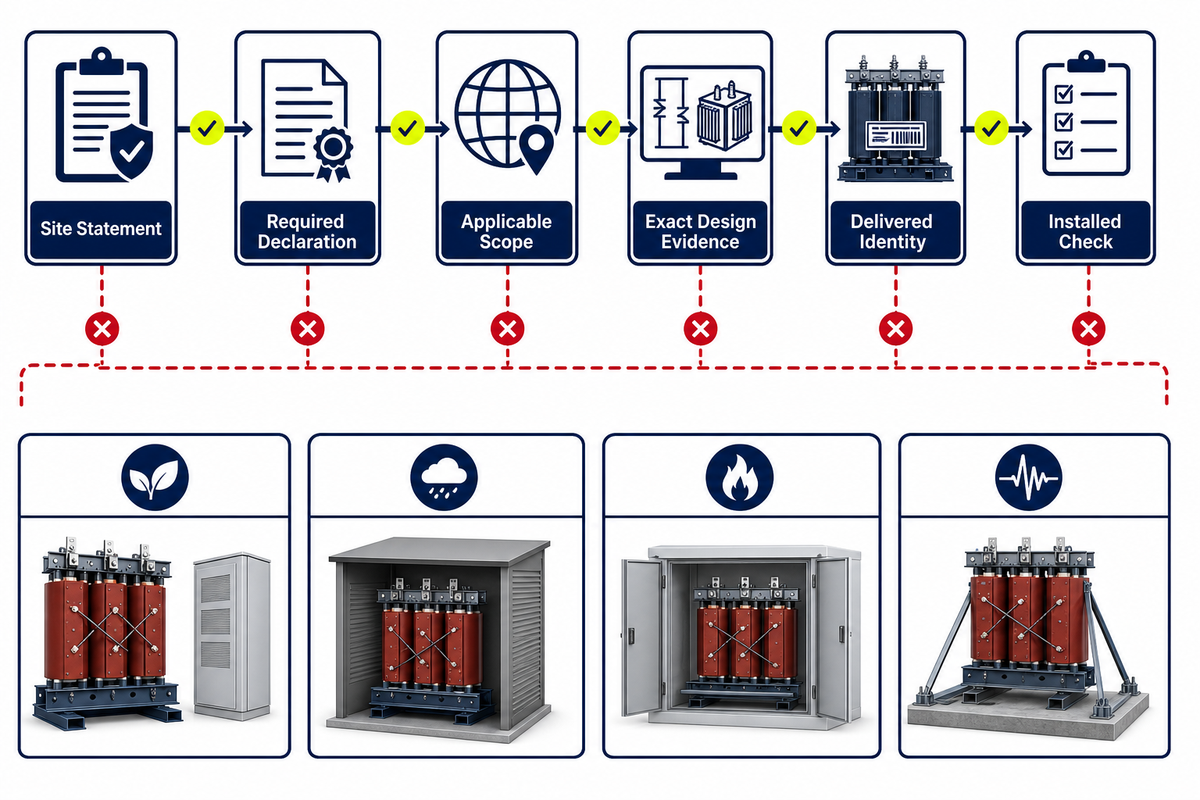
Direct answer: read an IEC class as a declaration with a defined scope, not as a universal badge. Connect the specified class to the site’s temperature, humidity, condensation, pollution, fire strategy, rating, and exact product evidence. Keep seismic qualification and other project properties separate.
The official IEC page states that IEC 60076-11:2018 is applicable to dry-type power transformers up to and including 72.5 kV, with at least one winding operating above 1.1 kV. It also provides a 2019 corrigendum, a 2020 interpretation sheet, and a stability date of 2029. Those dates assist a reviewer in determining which edition and corrections a declaration refers to. They do not verify that the delivered transformer corresponds to the declaration.
There’s also an obscure applicability boundary. The official page puts a 1,000 kVA limit on the application of fire-behaviour classes. A project above that limit can’t blindly take a class label from a lower rating and assume the same evidence. The same applies to seismic qualification: it’s a separate, declared property, not a hidden benefit of resin encapsulation.
Class-to-Site Proof Chain
Site statement → required declaration → applicable scope → exact design evidence → delivered-unit identity → installed-condition check. If one link is missing, record an exception instead of filling the gap with a brochure phrase.
The review can stay concise. State the site’s normal and exceptional conditions. Name the required environmental, climatic, fire, and seismic declarations separately. Verify if the rating and configuration are included in the scope of each declaration. Then link the declaration to a datasheet, drawing, test record or certificate that describes the design that was actually supplied.
11-Value Scope Boundary Matrix
The values below are evidence locators, not a universal specification. IEC’s page supplies 72.5 kV, more than 1.1 kV, and a 1,000 kVA fire-class boundary. IEEE’s scope supplies 601 V. UL’s program description uses more than 1 kV. One Hitachi Energy manual uses 15 °C, 30 cm, and 1,000 m for its covered designs. One ABB guide uses 30 °C, 40 °C, and 6 in. Every value must remain attached to its source, product family, and stated condition.
Cast Resin vs VPI vs Liquid-Filled: Where Does Each Fit?
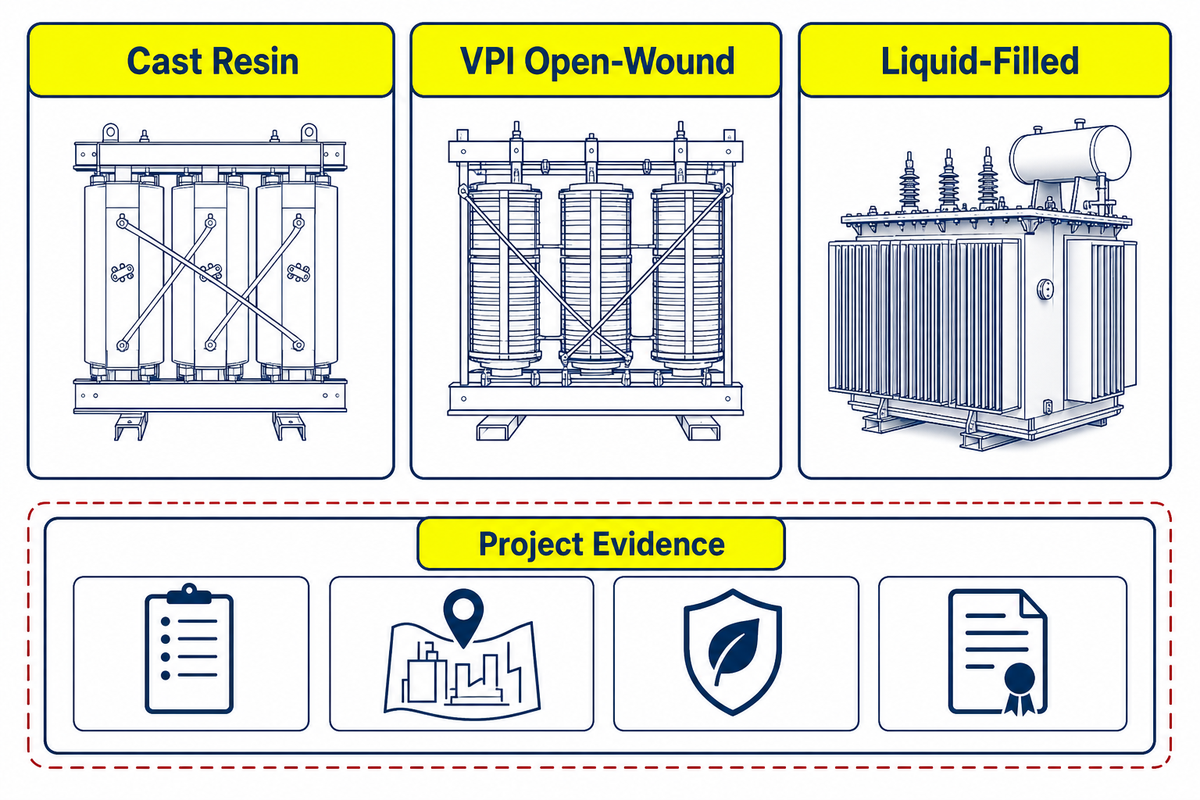
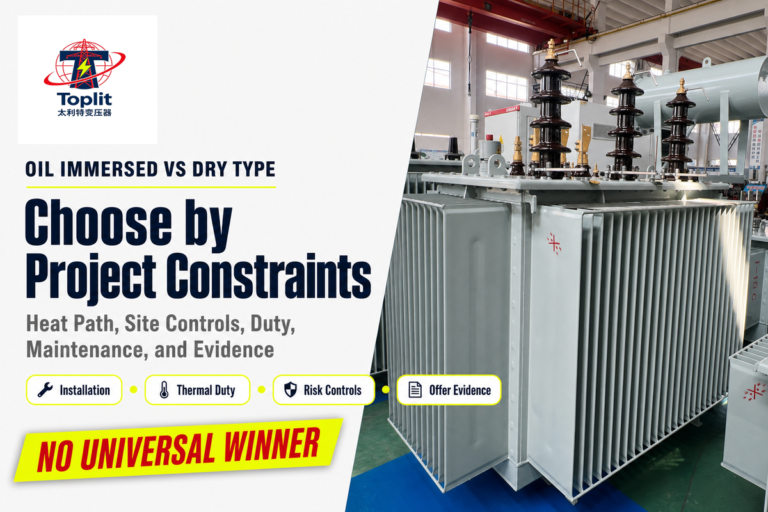
Direct answer: there’s no construction winner without a boundary condition. Cast resin, VPI or open-wound dry type, and liquid-filled construction shift fire and spill context, environmental exposure, cooling, inspection, repair strategy, rating envelope, and site infrastructure differently, so project evidence decides the fit.
The phrase cast resin transformer vs dry type compares a subtype with its wider family. More useful selection questions include cast resin vs VPI transformer and cast resin transformer vs oil transformer, each tied to actual site boundaries.
Across the wider types of transformers, compare cast resin with vacuum pressure impregnated designs, oil-filled transformers, and other liquid-filled transformers. Oil leakage and fire safety change the risk context, while dust and moisture, dust and debris, and indoor and outdoor exposure change enclosure and maintenance needs. An environmentally friendly or environmental protection claim still requires project evidence.
| Decision boundary | Cast resin review | VPI review | Liquid-filled review |
|---|---|---|---|
| Indoor fire strategy | Verify declared fire behavior and rating scope | Verify insulation and enclosure strategy | Verify liquid category, containment, and room rules |
| Moisture or condensation | Check enclosure, storage, heaters, and exact manual | Check winding exposure and contamination controls | Check tank, breathers, seals, and liquid management |
| Cooling path | Room and enclosure airflow remain critical | Ventilation and cleanliness remain critical | Heat rejection includes fluid and external cooling equipment |
| Harmonic load | Require waveform-based capability evidence | Require waveform-based capability evidence | Require waveform-based capability evidence |
| Inspection access | Check visible coil, supports, connections, sensors, and cooling paths | Check winding surface, bracing, connections, and cooling paths | Check tank, bushings, accessories, liquid, and cooling system |
| Repair strategy | Agree what is field-repairable and what requires factory review | Agree winding and insulation repair boundaries | Agree liquid, sealing, active-part, and workshop boundaries |
| Outdoor placement | Never infer it from “cast resin” alone | Never infer it from “dry type” alone | Verify tank, coating, accessories, and site exposure |
| Building interfaces | Air path, sound, access, cable loads, and fire design | Air path, contamination, access, and fire design | Containment, ventilation, drainage, access, and fire design |
| Acceptance evidence | Exact drawing, declarations, tests, manual, and site records | Exact drawing, insulation evidence, tests, manual, and site records | Exact drawing, liquid evidence, tests, manual, and site records |
When not to buy cast resin
Do not select cast resin solely because the transformer is indoors. Do not rely on a vendor’s superior or safe label. Pause when duty is incomplete, nonlinear loads lack a waveform or harmonic study, the rating falls outside a claimed classification boundary, or airflow and access remain unresolved. Also verify that the construction and local service network can support the required field-repair strategy.
Restraint is needed in the opposite direction as well. A difficult environment doesn’t disqualify cast resin. It creates evidence questions regarding the enclosure, condensation, contamination, altitude, temperature, seismic demands, and maintenance access. Use the cast-resin solution details for the given application only after the boundaries have been established.
Which Documents Prove Project Fit?
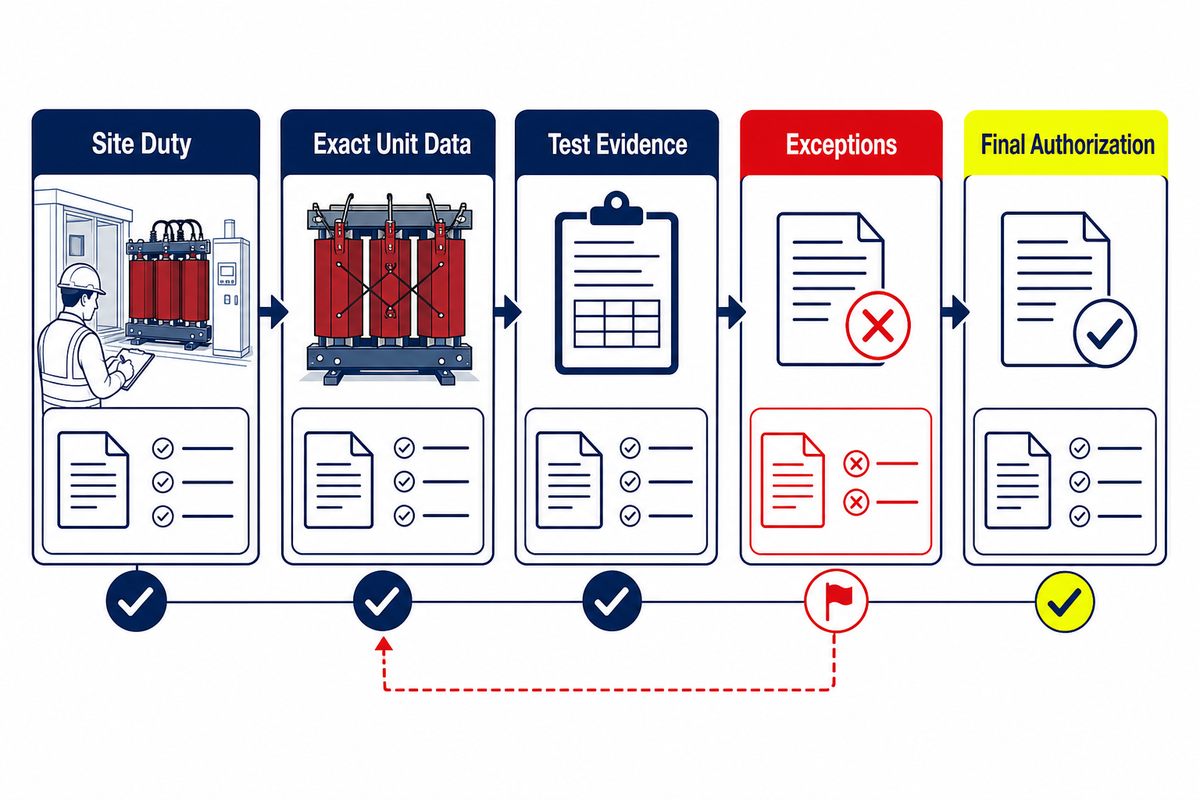
Direct answer: no single document proves project fit. Build a matched set that connects site duty, load waveform, design inputs, exact transformer data, declared classes, drawings, test evidence, installation instructions, delivered-unit identity, exceptions, and final authorization for one auditable decision.
That construction comparison narrows the options; the document set then proves whether the selected option fits the project.
The Evidence Triangle becomes auditable when each decision has a document owner. The following matrix isn’t a universal submittal list. It’s a way to expose missing links before they’re discovered during energization.
| Evidence type | Question it answers | Mismatch to flag |
|---|---|---|
| Site-duty statement | What environment and service are being designed for? | Generic “indoor” duty with no ambient, altitude, pollution, or condensation detail |
| Load and harmonic record | What current waveform and duty must the transformer carry? | Nonlinear loads appear in the system but not in transformer capability evidence |
| Approved datasheet | What exact design was selected? | Commercial family data substituted for project values |
| General arrangement drawing | How does the equipment meet the room and connection interfaces? | Cable forces, air openings, lifting, or access not coordinated |
| Class and compliance declarations | Which environmental, climatic, fire, seismic, or destination rules are claimed? | A class name appears without scope, edition, or exact-design traceability |
| Routine and specified test reports | What was tested and against which criteria? | Test code cited without acceptance limits or unit identity |
| Installation and operation manual | What conditions must be created and maintained? | Manual covers a product family other than the delivered design |
| Receiving and storage record | Did the unit arrive and remain in acceptable condition? | Damage, moisture, shock, or storage exceptions have no disposition |
| Commissioning and authorization record | Who accepted test results and unresolved exceptions? | A checklist is complete but responsibility to energize is not named |
IEEE C57.12.91-2026 describes its test code in a way that clarifies it won’t include transformer requirements or acceptance criteria. It requires that users define these criteria in other standards or based on user requirements. Therefore, “tested to a code” and “accepted for this project” may be related, but aren’t intended to be the same.
“This test code does not provide the requirements.”
Which Installation Conditions Change Real Performance?
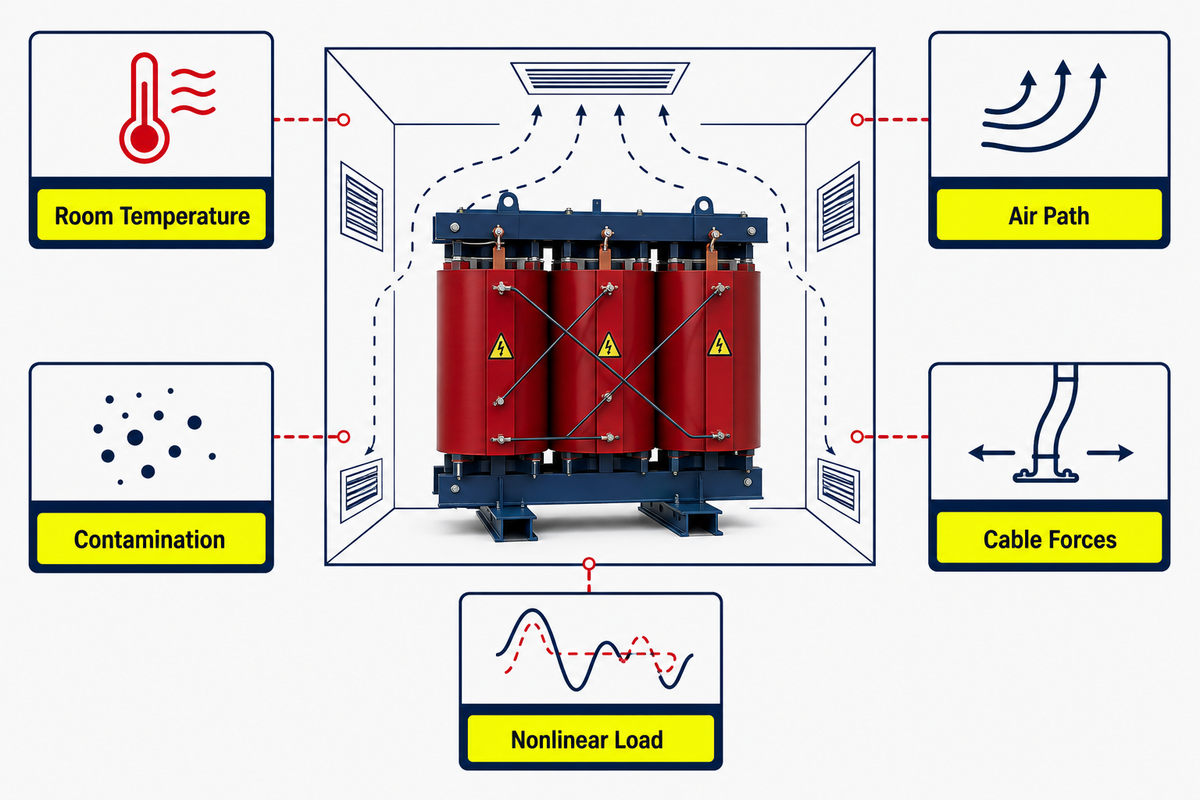
Direct answer: room temperature, altitude, air path, enclosure resistance, contamination, condensation, orientation, clearances, cable forces, grounding, vibration, and nonlinear load can change real performance. Credible values from another product family are not transferable settings. Use the exact manual and approved drawings for the supplied unit.
Those project documents become actionable only when the installed conditions match their assumptions.
In commercial buildings, critical applications, renewable energy, and modern power distribution, the transformer forms part of larger power distribution and power systems. A mismatch at protection, cooling, cabling, or access can create downtime even when the resin coil itself is sound.
Official manuals make this variation visible. One Hitachi Energy manual uses a 15 °C outlet-to-inlet air-rise criterion, 30 cm obstruction spacing, and a 1,000 m altitude boundary for its covered designs. An ABB guide for a different product family uses a 30 °C maximum 24-hour average ambient, 40 °C maximum surrounding air, and 6 in spacing. These are example limits for a given manual and should not be construed as limits for a Toplit project.
This shouldn’t be understood to mean that more numbers should be collected. It should mean that borrowed numbers shouldn’t be used in the installation. Room calculations should be based on airflow and heat loss assumptions for the transformer selected and its enclosure. Drawn views should show paths for air entering and leaving, air path obstructing elements, and means to prevent hot air from circulating. Controls for storage and condensation should be maintained until energization of the unit.
Electrical interfaces deserve the same discipline. Cable weight and force should not distort terminals. Earthing and bonding must match the drawing and local rules. Protection, temperature sensors, alarms, fans, and interlocks need end-to-end checks. For projects with significant converters, UPS systems, variable-speed drives, data-center loads, or other nonlinear loads, use IEEE C57.110-2018 or the applicable project method to evaluate nonsinusoidal-load capability. Resin encapsulation does not remove harmonic heating.
For broader voltage-context questions, Toplit’s medium-voltage dry type transformer overview can frame the equipment family. The final installation decision still belongs to the project drawings, calculations, exact manual, and authorized engineering review.
What Belongs in a Receiving and Commissioning Handover?
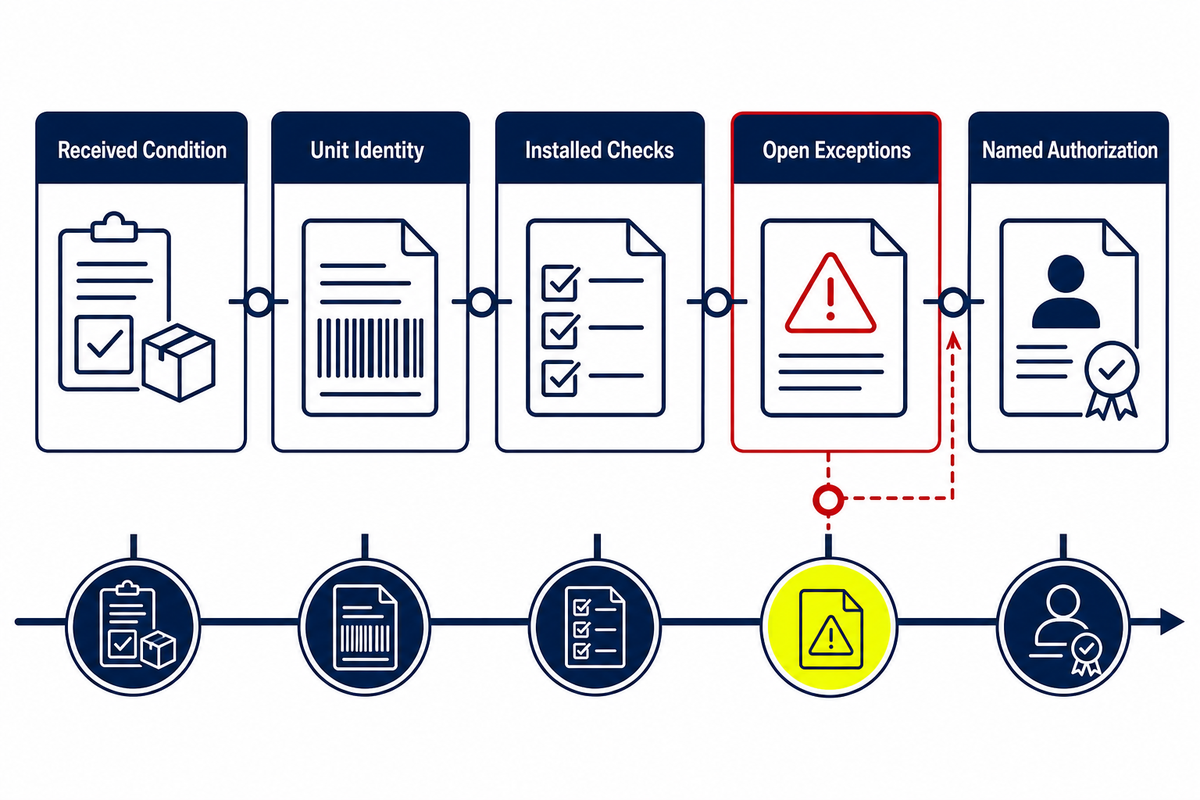
Direct answer: A handover should connect the documented received condition to authorized energization. Record identity, damage, moisture, storage, installation checks, test results, protection and monitoring functions, open exceptions, approved dispositions, responsible owners, and the person authorized to release the transformer.
Drawing-to-Energization Chain
- Freeze the approved duty, datasheet, drawings, manuals, and acceptance criteria.
- Match delivery documents, nameplate, accessories, and serial-numbered records.
- Inspect packaging, shock evidence, visible damage, contamination, and moisture exposure.
- Control storage and log any departure from the manual.
- Verify installed airflow, access, supports, terminals, earthing, protection, sensors, and auxiliaries.
- Run project-required inspections and tests using approved criteria.
- List every exception with an owner, disposition, due date, and recheck evidence.
- Obtain named authorization before energization.
ANSI/NETA ATS-2025 frames acceptance around field tests and inspections used to judge suitability for initial energization and continued service, with reference to applicable standards such as the official IEEE C57.12.91 test code, manufacturer tolerances, and design specifications. That framing remains useful where another acceptance standard applies. It keeps each result tied to criteria and prevents a collection of test sheets from being mistaken for a release decision.
Create a single exception register for receiving, storage, installation, and commissioning. Separate departmental punch lists conceal dependencies. Damage to an air duct, an unapproved cable load, and an alarm that has not been function-tested may look minor in isolation. Together they can invalidate the basis for energization. One shared register makes ownership and closure visible.
What Maintenance Does a Cast-Resin Transformer Still Need?
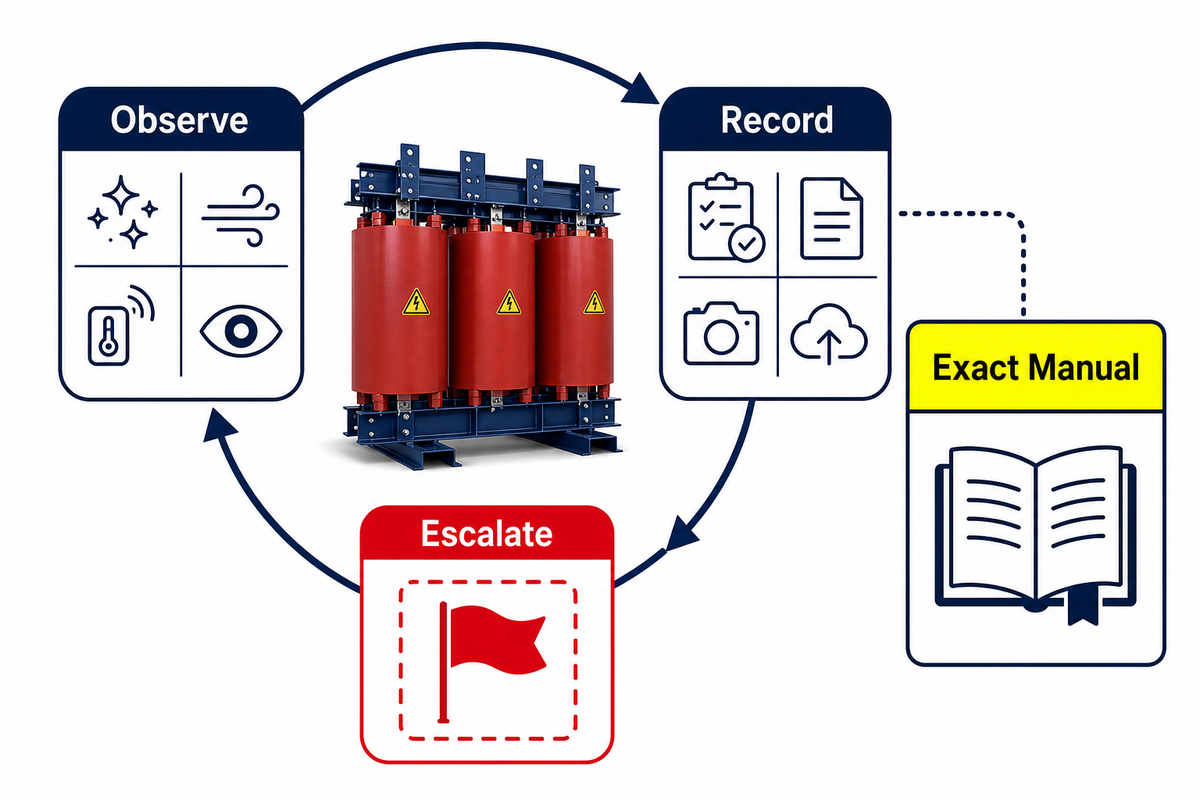
Direct answer: cast-resin construction removes insulating-liquid tasks, not maintenance itself. The exact program should cover safe isolation, cleanliness, cooling paths, supports, connections, corrosion, moisture, sensors, alarms, fans, unusual sound or odor, temperature trends, and documented escalation throughout the equipment service life.
IEEE C57.94-2025 is an active recommended practice covering installation, application, operation, and maintenance of dry-type distribution and power transformers. Its existence is a useful correction to the phrase “maintenance free.” The work and intervals still depend on the exact transformer, duty, environment, manufacturer instructions, and site safety procedures.
Do
- Observe and trend condition.
- Record contamination, temperature, sound, odor, and moisture changes.
- Use the exact manual and approved safety program.
- Escalate exceptions to an authorized person.
Do not
- Assume resin means no inspection.
- Copy torque, alarm, or cleaning intervals from another product.
- Clean energized equipment without an approved procedure.
- Close abnormal findings with a verbal explanation.
The Observe-Record-Escalate Care Matrix is deliberately conservative. Operators can observe changes within their assigned role. Records establish a baseline and show drift. Escalation sends an abnormality to the person authorized to identify the cause and decide. The article does not specify field settings, torque values, test voltages, or alarm thresholds because those values must come from the delivered design and approved procedures.
Where Are the Hidden Bottlenecks From Coil to Handover?
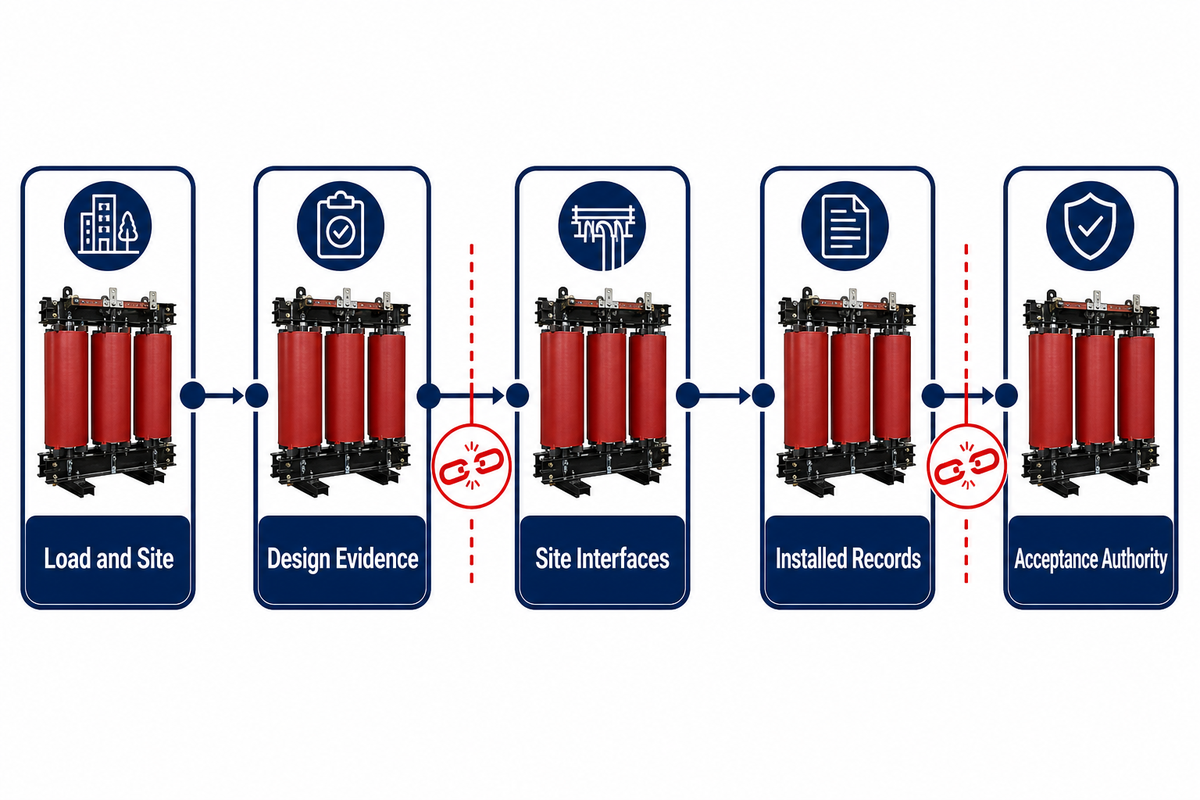
Direct answer: many delays occur at interfaces rather than in the resin coil itself: incomplete duty data, uncoordinated drawings, borrowed installation limits, receiving exceptions, late protection integration, missing destination evidence, and unclear authority to energize. Harmonic capability remains a separate internal thermal gate.
The maintenance matrix carries evidence into operation; the bottleneck map shows where ownership can still break that chain.
The Coil-to-Handover Hidden-Bottleneck Map has five nodes. First, the load and site statement must be explicit. Second, the transformer design and declarations must answer that statement. Fourth, receiving and commissioning records must capture the actual installed system condition, including approved interfaces, enclosure, controls, room, safety systems, and cables. Fourth, receiving and commissioning records must capture the actual state rather than the anticipated state. Fifth, one named authority must decide whether exceptions are acceptable.
Each of the components of the map can be technically correct, but the entire process can still fail. Procurement may accept a declaration that does not identify the supplied design even when the consultant specified the class correctly. The factory may have drawn correctly, but the contractor may have changed the cable route after approval. Commissioning may produce acceptable electrical results while a moisture exception from storage remains unresolved. Traceability joins good work across organizations.
Jurisdiction-specific requirements enter here. The current U.S. 10 CFR Part 431 record, for example, defines a distribution-transformer envelope with an input line voltage of 34.5 kV or less, output line voltage of 600 V or less, and a frequency of 60 Hz. Its dry-type capacity range runs from 15 kVA to 5,000 kVA, while listed configurations such as non-ventilated and sealed transformers are excluded from that definition. The current efficiency tables use 35% of nameplate-rated load as a reference point and include requirements applying from April 23, 2029. These numbers belong only to that U.S. rule.
34.5 kVInput boundary
600 VOutput boundary
60 HzFrequency condition
15 kVADry-type lower boundary
5,000 kVADry-type upper boundary
35%Efficiency reference load
Do not turn those limits into a global rule. Use them as a reminder to ask five project questions: destination, effective date, exact configuration, covered rating, and required evidence. Apply the same discipline to standards references. The IEC page’s 72.5 kV and 1.1 kV boundaries, its 1,000 kVA fire-class note, IEEE’s 601 V dry-type scope, and UL’s program above 1 kV are scope markers. None can replace the selected transformer’s approved data.
When Should This Guide Hand Off to Project-Specific Engineering?
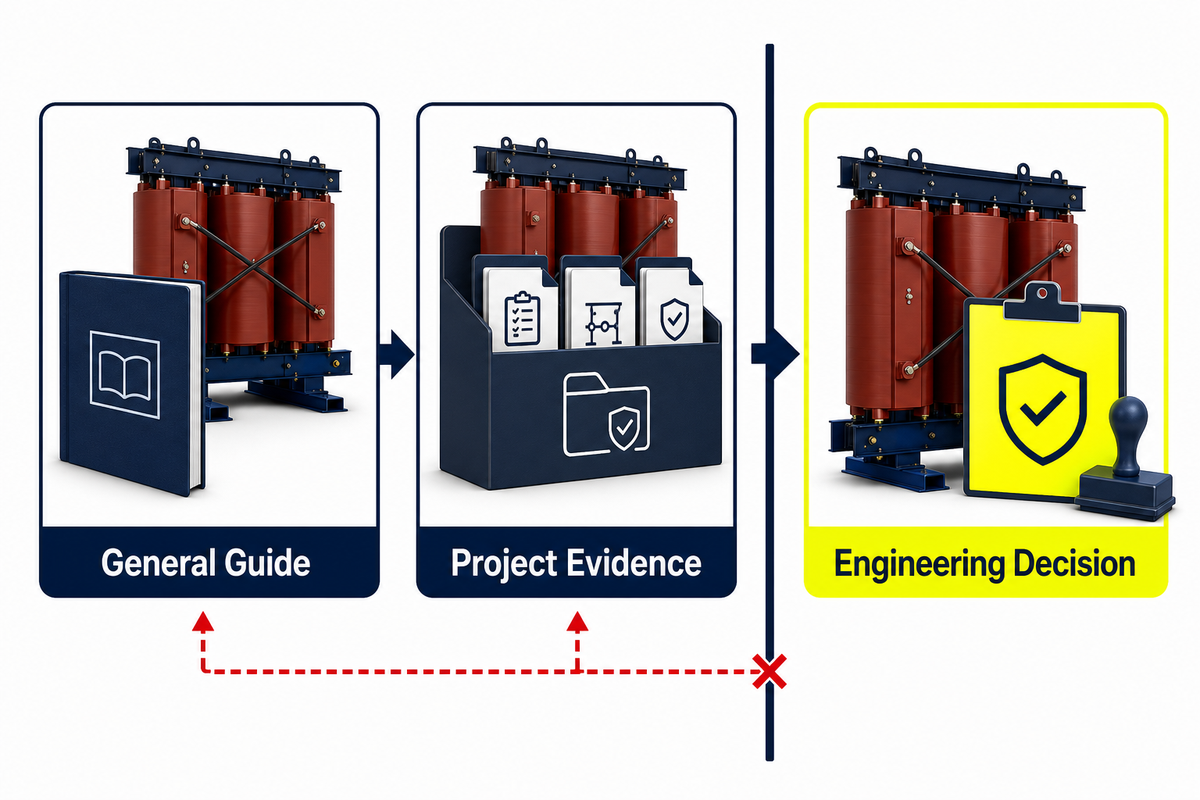
Direct answer: hand off whenever a decision depends on the actual load, rating, waveform, voltage, impedance, enclosure, room, protection, destination rule, class declaration, seismic demand, test limit, alarm setting, repair method, or unresolved exception. A guide can organize questions; it can’t approve a transformer.
The handoff package should show the site-duty declared, one-line-diagram, load-profile, relevant harmonics, approved datasheets, drawings, standards, and destination rules, along with the actual manuals, test requirements, receiving condition, open exceptions, and the requested decision. A complete package shortens review because the engineer does not need to reconstruct assumptions from emails.
For commercial configuration, use the dry type transformer RFQ builder to structure project inputs. For supplier due diligence, review Toplit’s company information and request evidence relevant to the exact project. Neither substitutes the engineer’s acceptance decision.
Discuss your project evidence package
Frequently Asked Questions
Is a cast resin transformer the same as every dry type transformer?
No. Cast resin describes an encapsulated winding construction within the broader dry-type family. Other dry-type designs include open-wound or VPI constructions, while configurations may be ventilated, non-ventilated, or sealed. Always verify the exact construction, enclosure, cooling path, rating, manual, load duty, and project evidence instead of treating “dry type” as one uniform design or approval category.
Does IEC 60076-11 approval prove suitability for my site?
No. A reference to IEC 60076-11 identifies a standards context, but site suitability still depends on the applicable edition, rating, declared environmental, climatic, fire, and seismic properties, exact-design evidence, load conditions, enclosure, installation, and acceptance criteria. The delivered-unit identity and installed condition must also match the approved documents, and each claimed class must remain inside its stated scope.
Are cast resin transformers maintenance free?
No. They don’t require insulating-liquid sampling or liquid-leak management, but they still need a condition-based program. Typical review areas include cleanliness, ventilation paths, connections, supports, grounding, moisture, corrosion, fans, sensors, alarms, temperature trends, and unusual sound or odor. Use the exact manual, record abnormal changes, and follow the site’s approved isolation and safety procedures before any inspection or intervention.
Can a cast resin transformer be installed outdoors?
Not by construction name alone. Outdoor applications require project-specific proof for the enclosure, condensation control, ambient exposure, and exact instructions.
Why do harmonics matter for a dry type transformer?
Nonsinusoidal load currents can increase winding and stray losses, change temperature rise, and reduce the usable capability of a design that was evaluated for a different current waveform. IEEE C57.110-2018 provides conservative calculation methods and application information for existing and newly specified transformers. Where converters, UPS systems, variable-speed drives, data-center loads, or similar equipment are material, include the expected load-current waveform or harmonic spectrum, loading profile, cooling configuration, and acceptance basis in the engineering review. A generic kVA rating doesn’t close that question.
What is the most important handover record?
No single record is enough. The most useful package is a traceable chain from approved duty and design through receiving condition, storage history, installed interfaces, test results, exception dispositions, and named authorization to energize. Start with the approved site statement and exact transformer documents. Add serial-numbered receiving evidence, protection and monitoring function checks, project-required test reports, and one shared exception register. Each exception should show the issue, owner, engineering disposition, due date, recheck evidence, and closure authority. This prevents a technically acceptable test result from hiding an unresolved moisture, airflow, cable-force, alarm, or documentation problem when responsibility moves from procurement to construction, commissioning, and operations.
Related Toplit Resources
- Dry type transformer category overview
- Cast resin transformer configurations and project options
- Open-wound dry type transformer overview
- Medium-voltage dry type transformer overview
References & Sources
- IEC 60076-11:2018 official publication record
- UL 1446A dry-type high-voltage transformer insulation-system announcement
- IEEE C57.12.01-2020 official standard record
- IEEE C57.110-2018 official standard record
- IEEE C57.94-2025 official standard record
- IEEE C57.12.91-2026 official standard record
- ANSI/NETA ATS-2025 scope
- 10 CFR Part 431 Subpart K, distribution transformers
Final takeawayA defensible handover does not ask the word “cast resin” to carry the whole decision. It connects the declared duty, exact evidence, installed condition, exceptions, and named authorization in one auditable chain.
Why we write this
About Toplit Engineering Insights
Toplit publishes transformer field guides from project routing, factory loss-data discipline, and specification review experience. We help engineering and procurement teams compare transformer types, voltage classes, installation constraints, and quotation evidence before they commit to a build.
- Oil-immersed, dry-type and pad-mounted transformer routes
- Loss data, rating schedules and factory evidence
- IEC / IEEE specification and site-input review
- Factory-direct transformer engineering support
Contact Profile
Talk with the Toplit Transformer Team
Company
Toplit Transformer Engineering Team
Toplit Transformer Engineering Team
Factory base
Hai'an, Nantong, Jiangsu, China
Hai'an, Nantong, Jiangsu, China
![Pad-Mounted Transformer: How It Works [2026 Guide]](https://toplit-transformer.com/wp-content/uploads/2026/08/pad-mounted-transformer-guide-featured-150x150.png)
![Single Phase Pad Mounted Transformer Guide [2026]](https://toplit-transformer.com/wp-content/uploads/2026/08/single-phase-pad-mounted-transformer-guide-featured-1-150x150.png)