Get in touch with Toplit Transformer Co., Ltd Company

Last updated: September 2026
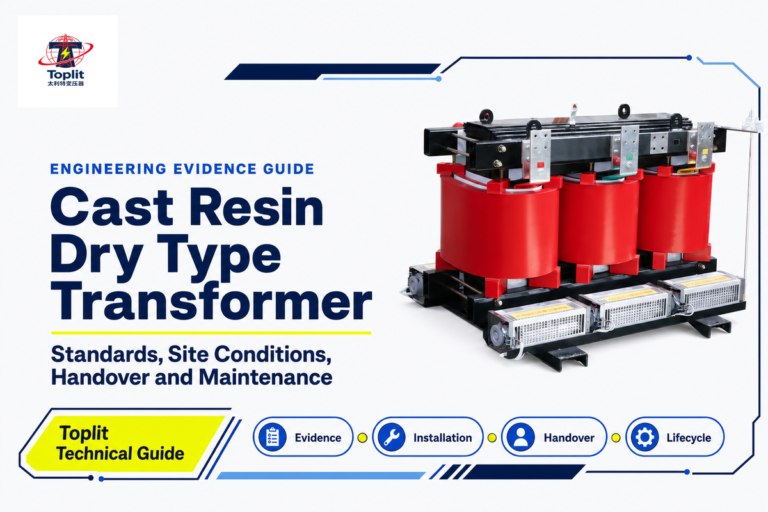
The best cast resin transformer manufacturers are selected by project duty: Legrand offers a data-center efficiency focus, Siemens Energy has dedicated converter families, and SEA publishes cold-climate classifications. Toplit provides a documented 1000 kVA, 11 kV model for specification-led comparison. This guide matches 20 manufacturers to practical purchasing requirements.
Quick Picks by Project Requirement
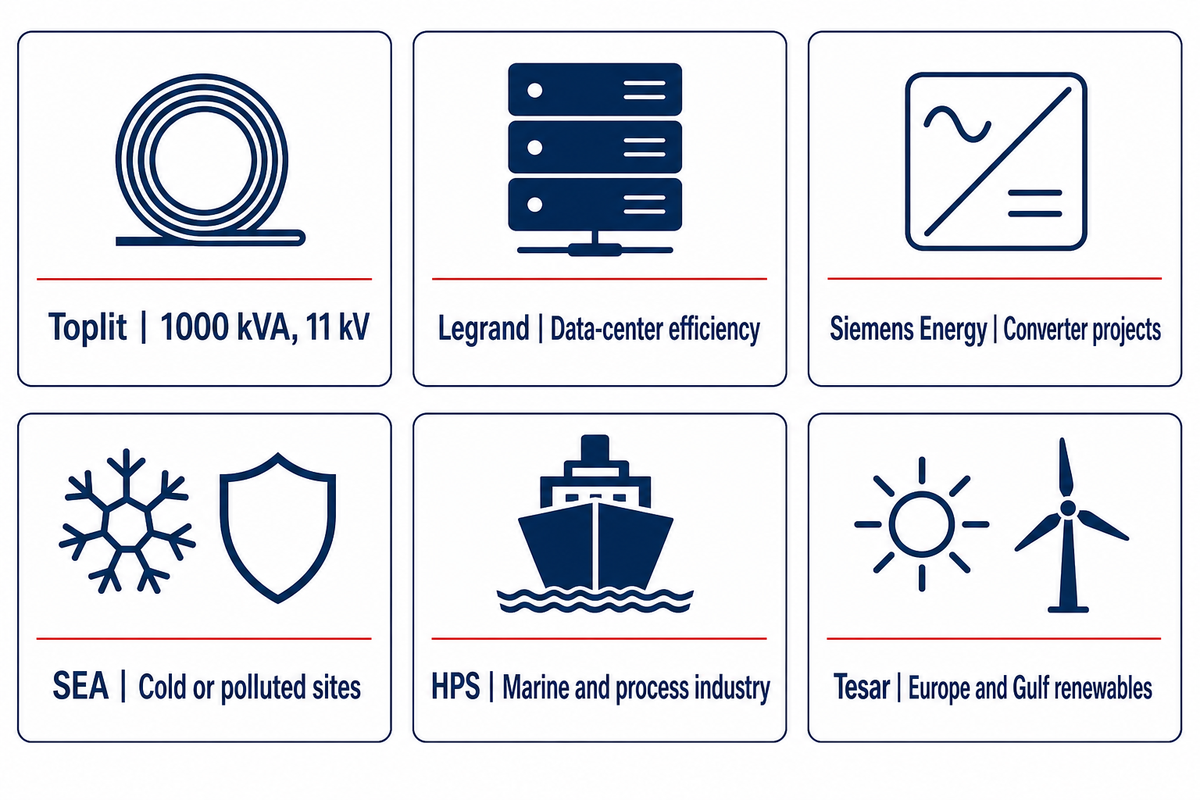
Best for specification-led 1000 kVA, 11 kV indoor projects: Toplit
Best for data-center distribution focused on Tier2 efficiency: Legrand
Best for high-rating industrial converter projects: Siemens Energy
Best for cold or heavily polluted infrastructure environments: SEA
Best for North American marine and process-industry specifications: Hammond Power Solutions
Best for European and Gulf renewable-energy projects: Tesar
Use the following examples to populate a preliminary short list around a particular product family, and then analyze the alternatives available. The following numbers are used for organization of this guide and don’t represent a ranking of market share, reliability, price or overall performance.
Disclosure: This guide is published by Toplit. We list ourselves first because this is our website, not because we claim to be the market leader. The other 19 manufacturers are grouped by what they’re best for, in no particular order within each group.
How We Selected These Cast Resin Transformer Manufacturers
We verified the information with the manufacturers’ web sites and other trusted public domains, in September 2026. We reviewed 28 candidates and short listed manufacturers with their own cast-resin or cast-coil products and web sites or other literature containing information on manufacturing. Consideration was given to winding construction, the published electrical limits, losses and impedance, partial discharge, environmental and fire ratings, enclosure types, tests, and the market applications. Manufacturing evidence was evaluated before geographical considerations. Company cards attribute technical capabilities to official web sites; broad corporate holdings don’t establish the capabilities of every factory. Details that couldn’t be found publicly are indicated by “Not publicly disclosed”.
How does a cast resin transformer differ from a VPI dry-type transformer?
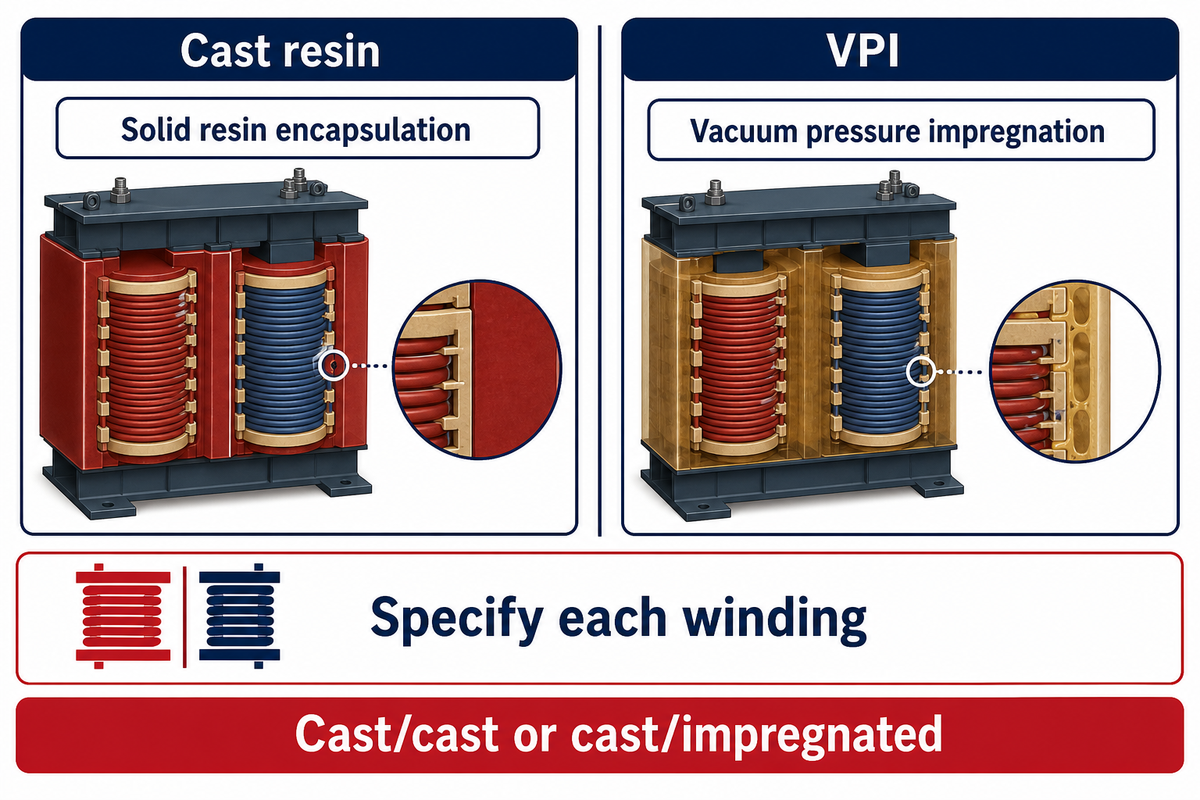
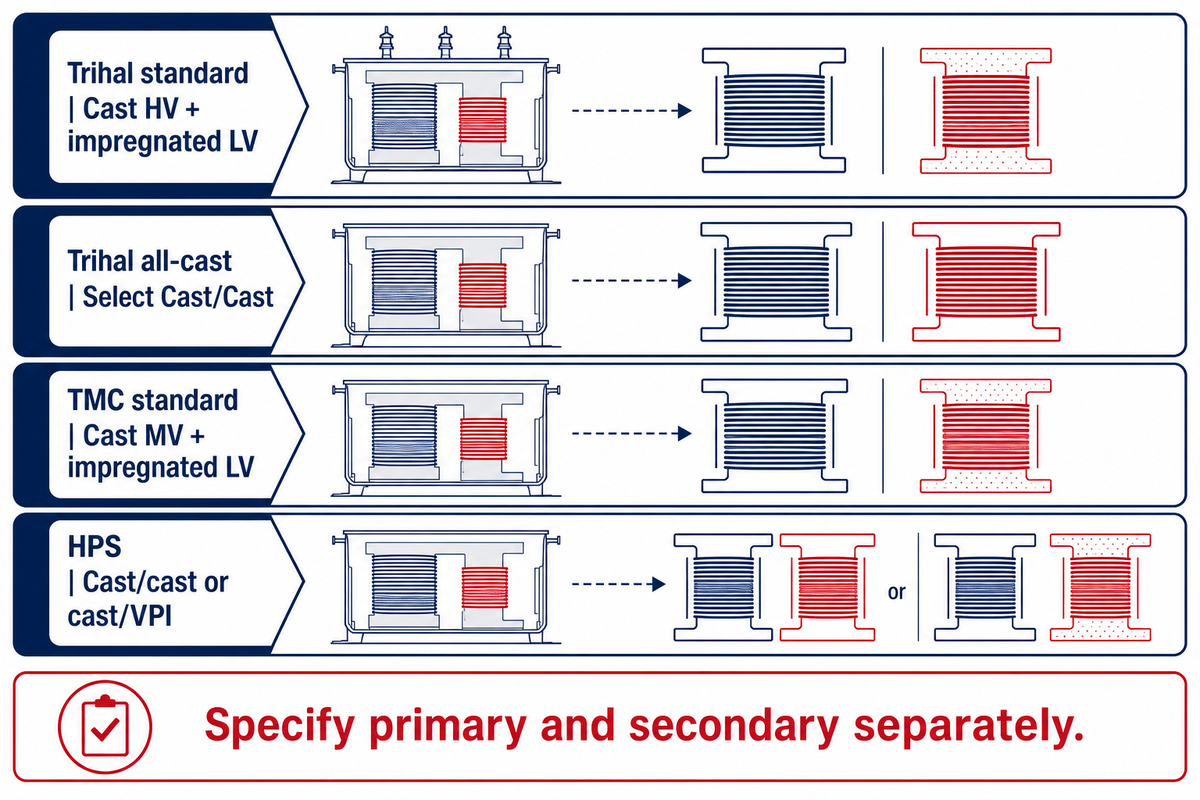
A cast resin transformer has windings encapsulated in solid resin; a VPI design uses vacuum pressure impregnation. The distinction belongs at winding level: TMC’s standard resin cast dry-type design has cast medium-voltage coils and impregnated low-voltage coils, while HPS offers cast/cast and cast/VPI combinations. Epoxy resin construction therefore doesn’t automatically mean both windings are cast, or that the unit can operate in any damp or corrosive environment.
Cast resin
- Construction: solid resin encapsulation of specified windings.
- Winding scope: cast/cast or cast/impregnated combinations.
- Selection: match the tested classes and enclosure to the site.
VPI
- Construction: vacuum pressure impregnation of windings.
- Winding scope: establish construction separately for primary and secondary.
- Selection: match the offered insulation system and enclosure to the site.
For a wider comparison of dry type transformer manufacturers, see our broader dry-type manufacturer guide. Buyers comparing construction choices can also review the dry-type product options. Here, inclusion requires an identified cast-resin family.
Compare 20 Cast Resin Transformer Manufacturers
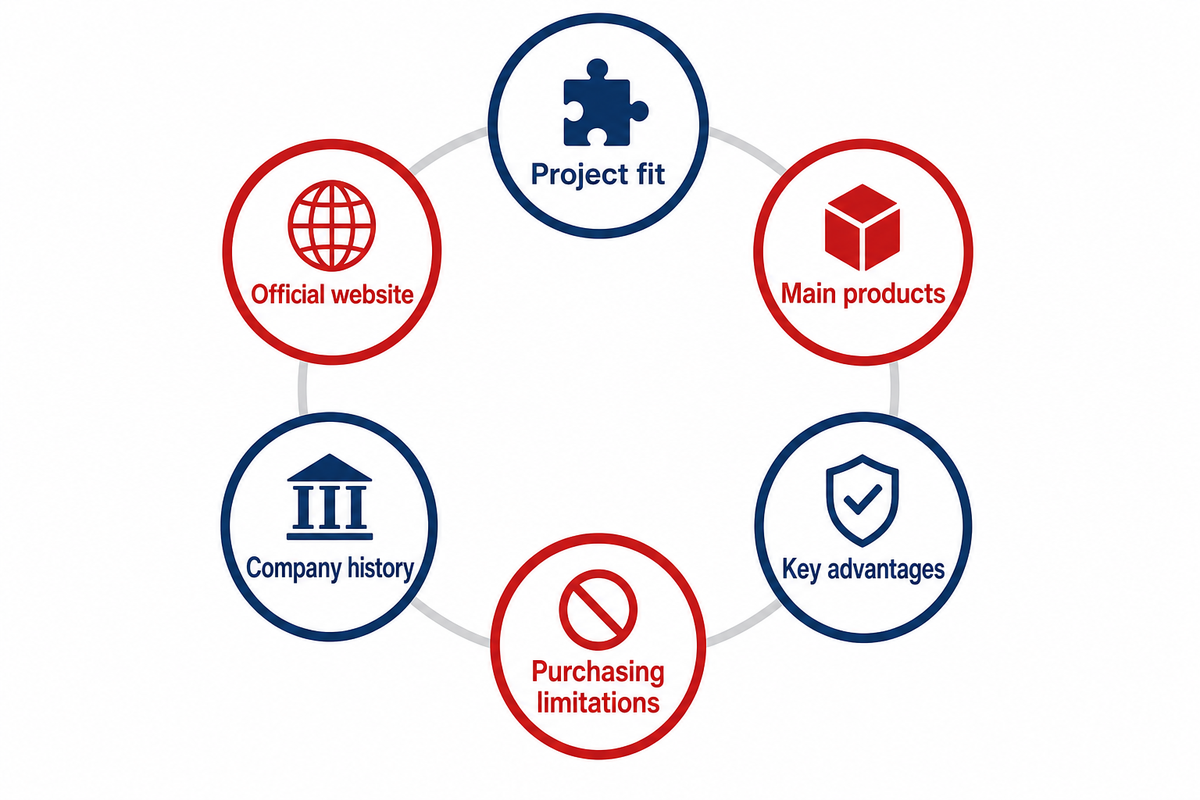
The table shows the main restrictions on company purchase decisions and the degree of fit to the application. The year the current company was founded, or the year of its documented business heritage, is indicated. Scroll to the right to view the full table. Web addresses are shown in text format.
| No. | Company Name | Headquarters | Founded Year | Best For | Brief Introduction | Main Products | Key Advantages | Potential Disadvantages | Official Website |
|---|---|---|---|---|---|---|---|---|---|
| 1 | Toplit | Nantong, China | Not publicly disclosed | 1000 kVA, 11 kV indoor distribution | Transformer brand publishing model-specific electrical data for specification-led purchasing. | SC(B)13-1000/11 cast-resin transformers | Published losses, impedance and vector-group options | Different secondary voltage needs a separate design offer | toplit-transformer.com |
| 2 | Hitachi Energy | Zurich, Switzerland | 2021 | Severe climates and changing loads | RESIBLOC producer using mold-free epoxy casting and integrated winding blocks. | RESIBLOC cast-resin distribution transformers | Multiple E/C classes; below 10 pC discharge | Published feature block reaches 36 kV HV | www.hitachienergy.com |
| 3 | Siemens Energy | Berlin / Munich, Germany | 2020 | Industrial converter and drive loads | GEAFOL manufacturer with separate distribution and converter offerings. | GEAFOL Neo, GEAFOL converter, CARECO | Converter family to 50 MVA; E3/C3/F1 | Copper specifications route to CARECO | www.siemens-energy.com |
| 4 | Schneider Electric | Rueil-Malmaison, France | 1871 | Building and critical-infrastructure distribution | Trihal producer with standard units and larger adapted designs. | Trihal cast-resin transformers | Standard to 3150 kVA; adaptations to 15 MVA | All-cast windings require Cast/Cast option | www.se.com |
| 5 | SGB-SMIT | Regensburg, Germany | 2008 | Multi-country wind and industrial procurement | Manufacturing group with fully encapsulated cast-resin production across seven countries. | Cast-resin MV and Gravity Line transformers | Geographic production options and in-house testing facilities | Order must identify supplying factory and configuration | www.sgb-smit.com |
| 6 | TMC Transformers | Busto Arsizio, Italy | 2017 | Custom enclosure and cooling specifications | Dry-type specialist with standard and engineered cast-resin distribution designs. | Cast-resin distribution transformers | AN/AF cooling; IP21/IP23; higher-class options | Standard LV coils are vacuum-impregnated | www.tmctransformers.com |
| 7 | Hammond Power Solutions | Guelph, Canada | 1917 | North American marine and process industry | Medium-voltage cast-resin producer offering two winding-construction combinations. | HPS cast/cast and cast/VPI transformers | Separate ANN/AFN ratings; copper or aluminium | All-cast specification must select cast secondary | americas.hammondpowersolutions.com |
| 8 | Eaton | Dublin, Ireland | 1911 | Copper-versus-aluminium specification comparisons | Cast-resin brochure identifies Eaton Transformer (Jiangsu) as manufacturer. | Copper and aluminium cast-resin transformers | 31.5 MVA copper scope; 100% routine testing | Type-test coverage is narrower than commercial range | www.eaton.com |
| 9 | Fuji Electric | Tokyo, Japan | 1923 | Standard building and infrastructure distribution | MOLTRA manufacturer with Japanese and Thai production bases. | MOLTRA cast-resin transformers | 4000 kVA standard scope; all-unit discharge testing | 50°C ambient requires optional design | www.fujielectric.com |
| 10 | Hyosung Heavy Industries | Seoul, South Korea | 2018 | Special industrial configurations | Cast-resin producer offering seismic, zigzag, OLTC and excitation variants. | Cast-resin distribution and special transformers | Custom envelope to 30 MVA; vacuum-moulded epoxy | Maximum envelope depends on customised configuration | www.hyosungheavyindustries.com |
| 11 | LS ELECTRIC | Anyang, South Korea | 1974 | Industrial distribution with changing loads | Beyond X supplier separating standard and order-specific cast-resin designs. | Beyond X cast-resin transformers | 3150 kVA standard; F/H insulation choices | Outdoor installation requires an enclosure | www.ls-electric.com |
| 12 | Kirloskar Electric | Bengaluru, India | 1946 | Converter, rectifier and excitation duties | Electrical-equipment manufacturer with special-duty cast-resin engineering. | Cast-resin distribution and converter transformers | Dedicated rectifier and static-excitation designs | Published range ends at 10 MVA / 33 kV class | kirloskar-electric.com |
| 13 | Voltamp | Vadodara, India | 1967 | Indian industrial projects requiring copper windings | Cast-resin producer using its own automatic vacuum-casting plant. | Copper-wound cast-resin transformers | Copper HV/LV; thermistor or RTD monitoring | Own range ends at 12.5 MVA / 33 kV | www.voltamptransformers.com |
| 14 | Legrand | Limoges, France | 1904 | Data centers prioritizing Tier2 efficiency | Zucchini Green T.HE producer focused on efficient MV/LV distribution. | Green T.HE cast-resin transformers | Below 5 pC discharge; E3-C2-F1 | E4 heavy-pollution option must be requested | www.legrand.com |
| 15 | IMEFY | Los Yébenes, Spain | 1973 | Distribution within the 6–30 kV range | Transformer producer with resin-encapsulated medium-voltage windings. | Cast-resin distribution and special transformers | 50 kVA–20 MVA; controlled vacuum processing | Published class-test example covers a 1600 kVA unit | imefy.com |
| 16 | SEA | Arzignano, Italy | 1959 | Cold or heavily polluted infrastructure | TTR manufacturer with published cold-climate and environmental classifications. | TTR cast-resin power transformers | E4/C5/F1; 30 MVA range; OLTC options | Enclosure-free outdoor solution applies to lower ratings | www.seatrasformatori.it |
| 17 | Eltaş | İzmir, Türkiye | 1981 | Industrial winding and monitoring choices | Cast-resin manufacturer offering alternative casting and winding configurations. | Cast-resin distribution and OLTC transformers | 25 MVA range; optional vacuum-cast LV windings | Standard delivery is IP00 without enclosure | www.eltas.com.tr |
| 18 | Tesar | Subbiano, Italy | 1979 | European and Gulf infrastructure and renewables | R&S Group manufacturer producing in Italy, Poland and the UAE. | Cast-resin MV distribution transformers | Regional factories; wind, solar and BESS applications | Order requires selected regional production entity | the-rsgroup.com/tesar |
| 19 | BEST | Balıkesir, Türkiye | 1966 | Large distribution and multipulse rectifier projects | Cast-resin producer separating distribution and rectifier rating envelopes. | Cast-resin distribution, earthing and rectifier transformers | 40 MVA distribution range; IP55 option | Rectifier capacity ends at 20 MVA | besttransformer.com |
| 20 | JST Power Equipment | Lake Mary, USA office | 1993 | Large MV data-center and industrial projects | Manufacturer with a separate high-rating cast-resin product table. | Medium-voltage cast-resin transformers | 45 MVA range; NEMA4/4X enclosure options | Published 30-week lead time affects procurement scheduling | jstpower.com |
Which cast resin transformer manufacturers publish high-MVA product ranges and environmental test classes?
Siemens Energy lists GEAFOL families to 50 MVA with E3/C3/F1; SEA lists TTR to 30 MVA with E4/C5/F1. Other high-rating examples include JST’s 45 MVA cast-resin range and BEST’s 40 MVA distribution range. Keep the categories separate: thermal F/H insulation classes describe a different property from environmental E, climatic C and fire-behavior F1 classes. An IP rating describes enclosure protection. None establishes the continuous AN rating, and a published maximum MVA doesn’t guarantee every voltage, enclosure and cooling combination.
Global Groups and Distribution Manufacturers
1. Toplit: Best for specification-led 1000 kVA, 11 kV indoor distribution
Headquarters: Hai’an, Nantong, Jiangsu, China · Founded: Not publicly disclosed · Type: Power and distribution transformer manufacturer brand, according to its company page
Official website: toplit-transformer.com
Main products: SC(B)13-1000/11 cast-resin distribution transformer
Standards / notable work: The product page describes IEC 60076-11 F1 as a design target for this unit.
According to Toplit’s company and product pages, its Hai’an facility manufactures dry-type transformers, and the featured cast-resin model is rated 1000 kVA, 11 kV with a 0.4 kV secondary. Published values include 6.0% impedance, 1.270 kW no-load loss, Yyn0 or Dyn11 connections, and load losses stated separately at 130°C, 155°C and 180°C. Those details make the model useful for a specification-led indoor distribution comparison; the manufacturing background provides company context. A secondary voltage other than 0.4 kV requires a separate design offer, and this example isn’t a statement of the company’s maximum rating.
2. Hitachi Energy: Best for severe climates and frequently changing loads
Headquarters: Zurich, Switzerland · Founded: 2021, current entity; predecessor joint venture began in 2020 · Type: Transformer manufacturer
Official website: www.hitachienergy.com
Main products: RESIBLOC cast-resin dry-type distribution transformers
Standards / notable work: The RESIBLOC page lists E2/E3/E4, C2/C3/C4 and F1 product classes.
Mold-free epoxy casting gives RESIBLOC design flexibility, with HV and LV coils integrated into one compact winding block. Hitachi also describes mechanical strength against thermal and mechanical stresses from severe climates and cycling loads. Hitachi Energy’s feature block specifies HV up to 36 kV, LV up to 24 kV, partial discharge below 10 pC and protection options from IP00 to IP54. That combination makes the family a useful candidate for projects where changing loads and difficult climate conditions shape the specification more than a standard building duty. The published 36 kV HV scope remains a purchasing boundary: higher-voltage projects need a different or specifically engineered offering.
3. Siemens Energy: Best for industrial converter and drive-load projects
Headquarters: Corporate center Berlin; registered office Munich, Germany · Founded: 2020 as an independent group · Type: Transformer manufacturer
Official website: www.siemens-energy.com
Main products: GEAFOL Neo, GEAFOL, GEAFOL converter and CARECO transformers
Standards / notable work: The product page specifies IEC 60076-11 / DIN EN 60076-11 and E3, C3, F1.
Siemens Energy separates its portfolio into families rather than presenting one interchangeable maximum: GEAFOL Neo reaches 6.3 MVA and Um 40.5 kV, while GEAFOL and the GEAFOL converter family each reach 50 MVA and Um 52 kV. Here, Um means highest voltage for equipment, not the transformer’s nominal primary operating voltage. Dedicated converter designs make the group relevant to industrial drives and other loads needing more than a general distribution specification. Standard GEAFOL HV windings use aluminium foil; a copper-winding requirement directs procurement to the CARECO alternative.
4. Schneider Electric: Best for building and critical-infrastructure distribution
Headquarters: Rueil-Malmaison, France · Founded: 1871 legal foundation; industrial roots in 1836 · Type: Transformer manufacturer
Official website: www.se.com
Main products: Trihal cast-resin distribution transformers, including Cast/Cast
Standards / notable work: Trihal’s catalogue references IEC 60076-11 and C3*/E3/F1; C3* means a C2 thermal-shock test at −50°C.
The Trihal catalogue covers 160 kVA to 15 MVA and insulation up to 36 kV, with standard designs to 3150 kVA and larger adapted units. Detailed partial-discharge acceptance is ≤10 pC for routine tests, or ≤5 pC for customer-ordered special tests, which gives building-services teams a concrete test basis for bid comparison. A choice between standard and adapted configurations supports infrastructure projects with differing room layouts and electrical duties. Standard Trihal combines cast HV and impregnated LV windings, so an all-cast winding specification must select the Cast/Cast option.
5. SGB-SMIT: Best for multi-country wind and industrial procurement
Headquarters: Regensburg, Germany · Founded: 2008 group headquarters entity; SGB roots 1947, SMIT roots 1913 · Type: Transformer manufacturing group
Official website: www.sgb-smit.com
Main products: Fully encapsulated cast-resin transformers, including medium-voltage and Gravity Line offerings
Notable work / testing: The product overview identifies onshore and offshore wind applications and in-house testing facilities.
SGB-SMIT describes cast-resin production in seven countries: Germany, France, the Czech Republic, the USA, Malaysia, India and China. Its application coverage includes onshore and offshore wind, distribution and demanding industrial work, supported by in-house testing facilities. Multiple production locations make the group a useful candidate when a developer wants to discuss regional supply routes for related projects across several countries. The purchase order still needs one named supplying factory and configuration, because a group-wide footprint isn’t a single standardized factory offer.
6. TMC Transformers: Best for distribution projects needing custom enclosure and cooling
Headquarters: Busto Arsizio, Italy · Founded: 2017, current business following acquisition · Type: Dry-type transformer manufacturer
Official website: www.tmctransformers.com
Main products: Standard and custom-designed cast-resin distribution transformers; separate VPI models
Standards / notable work: The standard product page states C2E2F1, with E4C3F1 available as a higher-category solution.
Class-F autoclave-cast MV coils, in-house hot-dip-galvanized framework and IP21/IP23 enclosure choices define TMC’s illustrated standard design. The manufacturer offers AN or AF cooling, giving specifiers a clear starting point for matching transformer configuration to ventilation and load requirements. For a distribution project, those mechanical and cooling choices can matter as much as the headline electrical rating when equipment must fit an existing room. The illustrated LV coils are vacuum-impregnated, so a requirement for both HV and LV windings to be fully cast needs a different winding specification.
7. Hammond Power Solutions: Best for North American marine and process-industry projects
Headquarters: Guelph, Ontario, Canada · Founded: 1917 · Type: Dry-type transformer manufacturer
Official website: americas.hammondpowersolutions.com
Main products: HPS medium-voltage cast/cast and cast/VPI transformers
Standards / notable work: HPS lists IEC 60076, CSA C22.2 No.47/C9-02 and UL1562 approval up to 3 MVA.
HPS publishes distinct cooling ratings: 300–3000 kVA ANN and 4000 kVA AFN, with HV up to 34.5 kV class and BIL up to 150 kV. Copper or aluminium winding choices and stated marine, pulp-and-paper and petrochemical applications make the family relevant to North American process-industry specifications. Keeping those ANN and AFN figures separate avoids treating fan-assisted capacity as the natural-air base rating; the reported UL scope also stops at 3 MVA. An HPS cast-resin order can use a VPI secondary, so an all-cast requirement must explicitly select cast primary/cast secondary.
8. Eaton: Best for projects comparing copper and aluminium winding specifications
Headquarters: Dublin, Ireland · Founded: 1911, group heritage · Type: Transformer manufacturing group; cited brochure manufacturer is Eaton Transformer (Jiangsu) Co., Ltd.
Official website: www.eaton.com
Main products: Copper- and aluminium-wound cast-resin dry-type transformers
Standards / notable work: The brochure includes IEC 60076-11:2018 sample certificates and states 100% routine testing.
Eaton’s brochure separates the winding-material envelopes: up to 31.5 MVA for copper and 12.5 MVA for aluminium, with voltage scope up to 36 kV and BIL up to 200 kV. That distinction helps engineers compare actual transformer solutions rather than assuming conductor material alone determines performance. The brochure also makes a useful distinction between a commercial product range and the designs covered by published tests. IEC type-test coverage reaches 4160 kVA for copper and 3250 kVA for aluminium, which is narrower than the commercial envelope.
Asian Manufacturers for Industrial Distribution
9. Fuji Electric: Best for buildings and infrastructure within a clear standard range
Headquarters: Tokyo, Japan · Founded: 1923 · Type: Transformer manufacturer
Official website: www.fujielectric.com
Main products: MOLTRA cast-resin dry-type transformers
Standards / notable work: Fuji reports IEC 60076-11:2018 C2/E2/F1 and short-circuit testing.
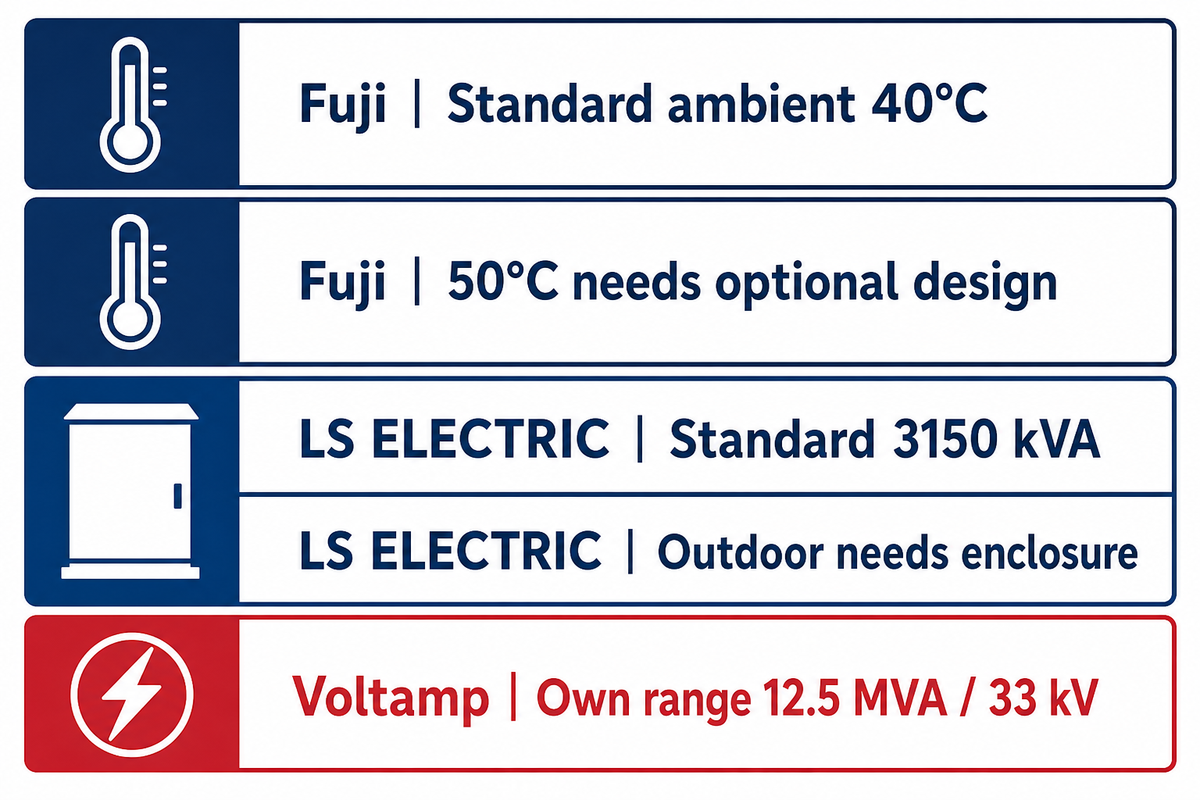
MOLTRA’s standard design reaches 4000 kVA and 36 kV, combining class-F insulation, AN/AF cooling, aluminium windings and copper terminals. Production bases in Chiba, Japan, and Thailand support a product offering that includes optional rectifier and low-noise designs, while all units receive partial-discharge testing with a stated level below 10 pC. Clear standard construction and test information make Fuji a practical candidate for a building or infrastructure team preparing a repeatable equipment specification. The standard maximum ambient is 40°C; a 50°C site or class-H insulation requirement needs an optional design.
10. Hyosung Heavy Industries: Best for special industrial configurations and demanding plant loads
Headquarters: Seoul, South Korea · Founded: 2018, current entity formed by spin-off · Type: Transformer manufacturer
Official website: www.hyosungheavyindustries.com
Main products: Cast-resin distribution, seismic, zigzag, OLTC and excitation transformers
Standards / notable work: Hyosung reports specialized C2, E2 and F1 testing on its cast-resin product page.
Vacuum-moulded epoxy windings underpin Hyosung’s offering, with customizable cast-resin designs reaching a maximum 36 kV and 30 MVA. The availability of zigzag, excitation and on-load tap changer (OLTC) configurations gives industrial engineers distinct routes for duties that a basic distribution unit may not address. A plant project with unusual winding connections or voltage-control requirements therefore has specific product options to discuss with the manufacturer. The 30 MVA/36 kV envelope is a customized offering, so OLTC, excitation and insulation selections belong in the project design rather than a stock-item assumption.
11. LS ELECTRIC: Best for industrial distribution with rapidly changing equipment loads
Headquarters: Anyang, South Korea · Founded: 1974; current name adopted in 2020 · Type: Power-equipment and transformer manufacturer
Official website: www.ls-electric.com
Main products: Beyond X cast-resin distribution transformers
Standards / notable work: The product page references KS C4311, IEC 60076-11 and IEEE C57.12.01.
Beyond X standard units reach 3150 kVA, with 33/22/10/6 kV HV selections, 400 V LV and a Dyn11 connection. LS ELECTRIC lists F/H insulation choices and a separate order-specific envelope of approximately 36 kV/25 MVA, keeping larger engineered units distinct from the standard series. LS describes overload tolerance and explicitly identifies power supply to equipment with rapidly changing loads as an application. For industrial distribution systems serving changing equipment loads, that separation helps buyers start with a defined standard configuration before adding special requirements. Standard installation is indoors; outdoor projects require an enclosure, so a bare transformer can’t simply be transferred to an exposed location.
12. Kirloskar Electric: Best for converter, rectifier and static-excitation duties
Headquarters: Bengaluru, India · Founded: 1946 · Type: Electrical-equipment and transformer manufacturer
Official website: kirloskar-electric.com
Main products: Cast-resin distribution, converter, rectifier and static-excitation transformers
Standards / notable work: Its product page lists IS11171, IEC60726, ANSI, NEMA and Australian Standard design/test references.
Kirloskar Electric publishes a cast-resin range from 160 kVA/11 kV through 10000 kVA/33 kV class, alongside special-duty design, manufacture and testing. The company identifies technical know-how from May & Christie and Ocrev, and specifically includes converter, rectifier and static-excitation applications in its offer. Those named duties make it a candidate for industrial power conversion and power generation projects where winding arrangement and load behavior need engineering attention. The published cast-resin envelope ends at 10 MVA and 33 kV class, which limits its fit for a larger requirement under this particular product range.
13. Voltamp: Best for Indian industrial projects specifying copper HV and LV windings
Headquarters: Vadodara, Gujarat, India · Founded: 1967 incorporation; predecessor partnership began in 1963 · Type: Transformer manufacturer
Official website: www.voltamptransformers.com
Main products: Cast-resin transformers and a separate resin-impregnated dry-type family
Construction / monitoring: The product page describes copper HV/LV conductors, vacuum-cast windings and thermistor or RTD options.
Copper conductors in both HV and LV windings distinguish Voltamp’s published cast-resin offer, which reaches 12.5 MVA/33 kV class. The company describes its own automatic vacuum-casting plant and offers thermistor or RTD temperature monitoring, giving industrial purchasers concrete manufacturing and instrumentation details to include in a bid comparison. A specification that already calls for copper on both winding sides can therefore be discussed against a directly described product construction. Voltamp’s own rating envelope stops at 12.5 MVA/33 kV; higher HTT figures elsewhere on its website describe its technology partner’s range.
Infrastructure, Data-Center and Specialist Manufacturers
14. Legrand: Best for data-center distribution focused on Tier2 efficiency
Headquarters: Limoges, France · Founded: 1904 · Type: Electrical-equipment group and cast-resin transformer producer
Official website: www.legrand.com
Main products: Zucchini Green T.HE high-efficiency MV/LV cast-resin transformers
Standards / notable work: The current product page states EN50708-1:2020, EU548 Tier2 and E3-C2-F1 under IEC 60076-11.
Green T.HE’s published portfolio spans 50 kVA to 20 MVA, with insulation class up to 36 kV and partial discharge below 5 pC. Legrand places this family within its data-center offering, making its high efficiency and documented class information useful starting points for a facility’s distribution specification. A buyer seeking low loss equipment can compare the offered unit’s guaranteed losses with alternatives under matching rated conditions rather than treating an efficiency label as the final answer. E4 for heavy pollution is an on-request option; the listed standard classification remains E3-C2-F1.
15. IMEFY: Best for distribution projects within the published 6–30 kV range
Headquarters: Los Yébenes, Toledo, Spain · Founded: 1973 · Type: Transformer manufacturer
Official website: imefy.com
Main products: Cast-resin distribution, energy step-up, traction and maritime transformers
Standards / notable work: IMEFY reports E3/C3/F1 testing on a 1600 kVA transformer.
IMEFY publishes a 50 kVA to 20 MVA range at 6–30 kV, using resin-encapsulated medium-voltage windings and controlled thermal/vacuum processing. Its described applications include distribution, traction, maritime and offshore work, while the numerical range gives distribution engineers a straightforward basis for shortlisting. The 1600 kVA test example is useful evidence of a specific tested design, separate from the company’s stated application list. That example covers a narrower scope than the full 20 MVA offering, so it can’t serve as a whole-range class certificate or as proof of maritime suitability.
16. SEA Trasformatori: Best for cold or heavily polluted infrastructure environments
Headquarters: Arzignano, Italy · Founded: 1959 · Type: Transformer manufacturer
Official website: www.seatrasformatori.it
Main products: TTR cast-resin distribution, industrial and power transformers
Standards / notable work: SEA reports IEC 60076-11 E4/C5/F1; its C5 figures are −50°C operation and −60°C storage/transport.
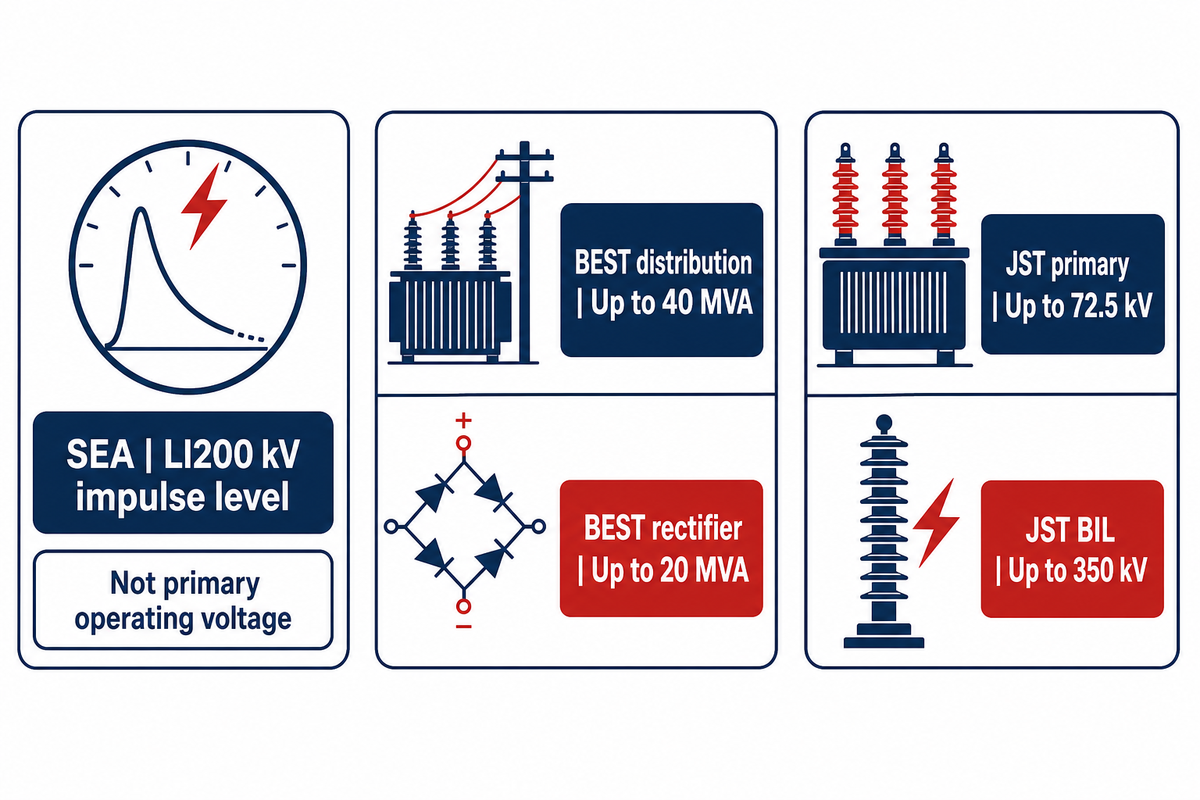
TTR reaches 30 MVA and an LI200 kV impulse insulation level, which must not be read as a 200 kV primary operating voltage. OLTC, multiple-secondary winding configurations and AN/AF/AFWF cooling choices broaden the application range beyond a standard indoor distribution unit. Published cold-climate and environmental classes make SEA a relevant candidate when infrastructure exposure drives the equipment specification. The enclosure-free TTR IP00 outdoor solution is specified for lower ratings; other outdoor projects use a selected protective enclosure, so that arrangement doesn’t extend automatically across the whole range.
17. Eltaş: Best for industrial winding, enclosure and monitoring options
Headquarters: İzmir, Türkiye · Founded: 1981 · Type: Transformer manufacturer
Official website: www.eltas.com.tr
Main products: Cast-resin distribution and special transformers, including OLTC designs
Standards / notable work: Manufacturing references include IEC 60076-11, NEMA ST20, CSA C9-02 and IEEE C57.12.01.
Eltaş publishes a cast-resin range to 25 MVA/36 kV, with F/H temperature classes, copper or aluminium windings and partial discharge below 5 pC. Quartz and fibreglass casting technologies, plus optional vacuum-cast LV windings, give the purchaser identifiable construction choices rather than one generic epoxy resin transformer description. Standard temperature control uses PT100 or PTC sensors in the LV winding; communication interfaces are available on request. Those choices suit industrial applications in which the winding specification and accessory package are decided together with the electrical duty. Standard delivery is IP00 without an enclosure; protection against water, dust and contact must therefore be included as a separate mechanical requirement.
18. Tesar: Best for European and Gulf infrastructure or renewable-energy projects
Headquarters: Subbiano, Arezzo, Italy · Founded: 1979 · Type: Cast-resin and instrument-transformer manufacturer within R&S Group
Official website: the-rsgroup.com/tesar
Main products: Cast-resin dry-type transformers and medium-voltage current/voltage instrument transformers
Standards / notable work: The group page lists ISO9001, ISO14001 and ISO45001 management systems and test laboratories.
Tesar’s cast-resin development dates to 1979, with design and manufacturing operations in Italy, Poland and the UAE. Its listed applications cover infrastructure, data centers, rail, wind, solar and BESS, making the regional production structure relevant to renewable energy and infrastructure procurement across Europe and the Gulf. Management-system references describe organizational controls, while transformer test classes remain properties of the specified product. An order must identify Tesar Italia, Tesar Polska or Tesar Gulf as the selected production entity and define its configuration, because the regional operations are separate supply routes.
19. BEST: Best for large cast-resin distribution and multipulse rectifier projects
Headquarters: Balıkesir, Türkiye · Founded: 1966 · Type: Transformer manufacturer
Official website: besttransformer.com
Main products: Cast-resin distribution, earthing and 6/12/24-pulse rectifier transformers
Construction / notable work: The product page lists F155°C/H180°C insulation systems, multipulse rectifier designs and an IP55 enclosure option.
BEST’s distribution family reaches 40 MVA/72.5 kV, while its rectifier family reaches 20 MVA/72.5 kV. Published construction choices include F155°C/H180°C insulation systems and an IP55 enclosure option, alongside 6-, 12- and 24-pulse rectifier variants. Large industrial buyers can therefore distinguish a conventional power distribution transformer request from a multipulse rectifier duty before asking for a technical offer. The rectifier capacity ceiling is 20 MVA, below the distribution-family maximum; a 40 MVA distribution entry can’t be used to size or qualify a rectifier transformer purchase.
20. JST Power Equipment: Best for large MV data-center and industrial projects
Headquarters / office: Lake Mary, Florida, USA office · Founded: 1993 business roots in Haikou, China · Type: Cast-resin and dry-type transformer manufacturer
Official website: jstpower.com
Main products: Medium-voltage cast-resin transformers and a separate VPI family
Standards / notable work: The cast-resin section states 10 pC or lower partial discharge; NEMA250/CSA/UL50 references concern enclosures.
JST’s cast-resin table covers 300 kVA to 45 MVA, primary voltage up to 72.5 kV, secondary up to 15 kV and BIL up to 350 kV. NEMA4/4X and marine enclosure options accompany the large-rating offer, making it a candidate for substantial data-center or industrial distribution projects. Those electrical figures retain distinct meanings: BIL is an impulse-withstand measure, separate from primary and secondary voltage. The product page listed a 30-week cast-resin lead time when checked, with separate quotation and drawing stages, so procurement must allow a project-specific delivery schedule.
Which manufacturers actually make cast resin transformers in China, Europe and North America?
The companies’ own manufacturing descriptions identify Toplit’s Hai’an facility in China, Eaton Transformer (Jiangsu) in the cited Eaton brochure, and SGB-SMIT cast-resin production in China, Europe and the USA. European examples include TMC in Italy and Tesar’s Italian and Polish operations; HPS provides a Canadian-headquartered North American offering. Headquarters and sales offices aren’t factory locations: JST’s Lake Mary address is a US office, and Tesar’s UAE operation is a distinct regional production route. For cross-border procurement, name the offered manufacturing site as well as the brand.
How to Choose a Cast Resin Transformer Manufacturer
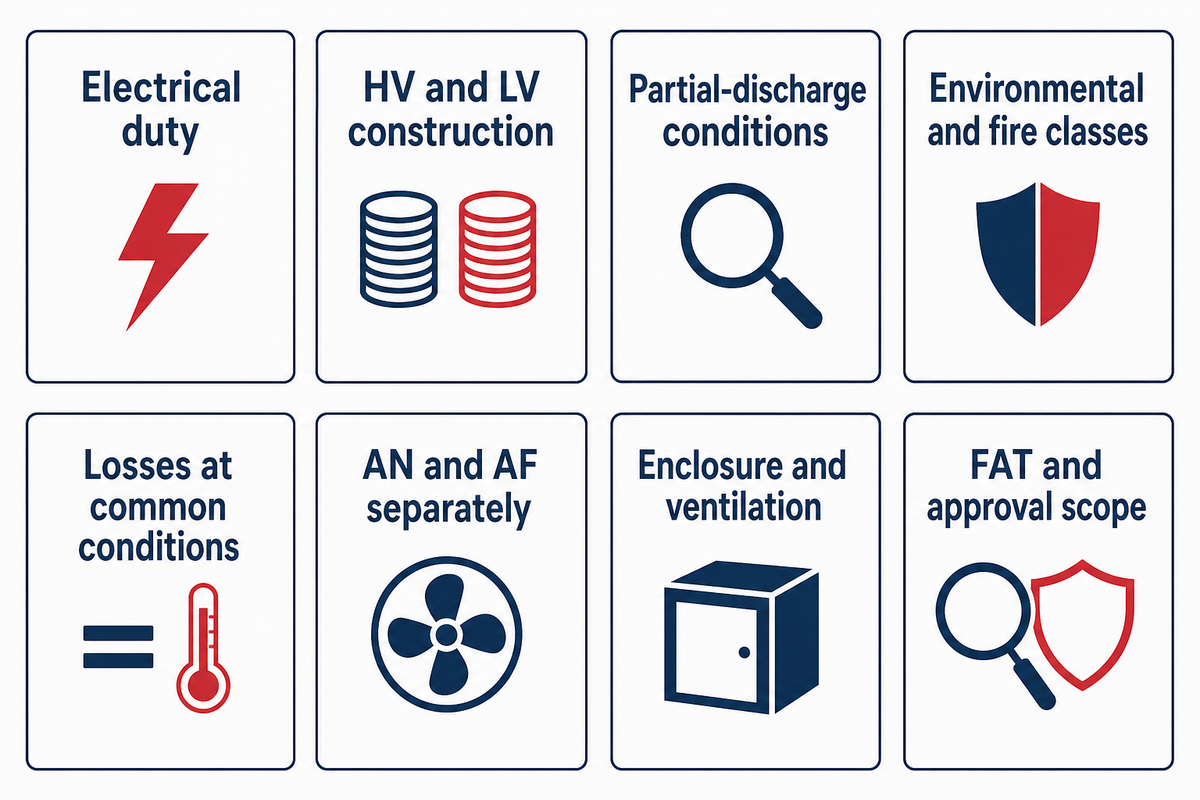
Comparison starts with review of design requirements and electrical limits and ends with agreement on a factory acceptance test (FAT). Eight decisions by the customer lead to comparable bids. IEC 60076-11 provides the framework for dry-type transformers. Product data sheets referenced herein justify the need to keep construction, ratings and test limits attached to the offered design.
Define the electrical duty before requesting a price
Give each supplier the rated kVA, primary and secondary voltage, frequency, phase, vector group, tap range, impedance, neutral requirement and load profile. A request for a “1000 kVA cast resin transformer” leaves too many variables open for meaningful pricing. Separate nominal operating voltage from highest voltage for equipment Um, insulation class and BIL or lightning-impulse withstand. The Siemens Energy, SEA and JST profiles illustrate why those values can’t share one “maximum voltage” comparison column.
For equipment containing, or affected by, non-linear loads, review the harmonic spectrum, non-linear load percentage and neutral-current requirements. What are the design considerations for temperature rise, derating, winding arrangement, and shielding where required? The presence of a K-factor label alone doesn’t establish adequacy of the design for the actual harmonic load. The engineer evaluating the design of the transformer substation should coordinate these load inputs with the design of the connected switchgear and protective devices.
Specify the HV and LV winding construction separately
Ask whether each winding is cast, vacuum-impregnated or otherwise insulated, and record the epoxy encapsulation method and vacuum casting process where applicable. A supplier describing a “cast resin dry type transformer” may still offer an impregnated secondary, as the Trihal, TMC and HPS examples demonstrate. Cast coil transformer manufacturers and resin encapsulated transformer suppliers should provide the same construction clarity.
Consider guaranteed loss data for both aluminum and copper conductors, temperature rise, short-circuit withstand, dimensions, weight and connection design. In consultations with the engineer, evaluate and compare winding configurations, current density, and thermal and electrical stresses. The manufacturer’s proposal should cover these considerations. For the purchaser, guaranteed results should be compared.
Compare partial discharge under the same test conditions
Identify the partial discharge limit, test voltage, measurement method, test category and acceptance criteria. The supplier should indicate where in the FAT report the requirement is assessed. Review catalog data to distinguish routine acceptance from customer-ordered special partial discharge tests.
It isn’t permissible to state, from below 5 pC and below 10 pC figures alone, that transformers are less reliable than other transformers. A difference in the stated figures wouldn’t be acceptable as evidence of a reliability ranking. The documented test method should remain linked to the actual unit’s report. The unit under test should be evaluated in accordance with the described test procedure. This should be included in the purchase order evaluation.
Match environmental, climatic and fire classes to the site
Use the project’s required classes under IEC 60076-11, then compare the offered product’s evidence. E, C and F classes address different conditions; thermal class F is not fire class F1. IMEFY’s 1600 kVA example and Legrand’s optional E4 classification show why a test example or option should not silently become a whole-range claim.
Cast resin units don’t contain transformer oil, and an F1 rating doesn’t preclude a fire hazard. The protection of a building from fire is dependent upon the design and installation of the unit and local requirements. State the ambient conditions (i.e. temperature, altitude, dust, humidity, etc.). Corrosion, for example, may occur in tunnel and mine installations as well as in chemical plant and marine installations. Indoor installations don’t preclude the above conditions.
Compare losses at a common rating and temperature
Use the same kVA, voltage, frequency, reference temperature, temperature-rise class and load-loss basis when comparing no-load and load losses. Toplit’s model page gives load-loss values at three temperatures; selecting whichever value looks lowest would distort a bid comparison. Include the expected operating load profile when evaluating how guaranteed losses affect the project.
A high-efficiency label shouldn’t be interpreted as a guarantee. Other factors, including the material of the conductor and enclosure should be evaluated. For installations where the transformer is located adjacent to occupied space (i.e. data center), the design should take into account the declared noise level and measurement conditions as well as the attenuation and isolation required at the site.
Keep AN and AF ratings separate
AN means air natural; AF means air forced. Specify the required continuous natural-air rating separately from fan-assisted capacity or overload duty. HPS’s distinct ANN and AFN ratings illustrate the purchasing consequence: a fan-assisted figure must not be entered as the basic natural-air rating in the equipment schedule.
Be specific when stating requirements for temperature sensors, alarm contacts, fan control, monitoring interfaces and any required fan redundancy. For a data center, evaluate UPS duty, harmonic loading, sound, enclosure and the facility’s redundancy requirements. A data center may have a design for redundant power and room ventilation; fan availability belongs in that design, and a universal assumed capacity boost doesn’t replace the manufacturer’s rating.
Select the enclosure together with ventilation and access
Specify the actual protection level and configuration: IP00, IP20, IP21, IP23, IP31, IP33, IP4X or the manufacturer’s offered alternative. Bare units and enclosed units are different mechanical packages. Eltaş supplies IP00 as standard, whereas TMC describes IP21/IP23 choices; those offers shouldn’t be compared as though the enclosure were included in both.
Consider dimensions, cable entry, heat dissipation, airflow, clearances and access with the qualified installation designer. In some cases, a higher IP rating may be chosen, but the cooling arrangement still needs evaluation. For the review of the layout, consider the interfaces to medium-voltage switchgear and to low-voltage distribution equipment. If the layout is approved, don’t substitute a catalog equipment footprint for the approved arrangement.
Agree the FAT and approval scope before purchase
Indicate routine tests, type tests, and special tests, separately. Depending on the specified standard and design, the schedule may include tests for resistance of the winding, voltage ratio and vector group, impedance, no-load and load loss, dielectric tests, partial discharge, temperature rise, lightning impulse, or sound tests. Agree on acceptance criteria, testing and inspection requirements, the format of testing and approval reports, and rules for retesting before equipment is ordered.
Keep design standards, ISO management systems, product certificates, FAT reports and utility approvals distinct. “Designed to IEC 60076-11” is not an IEC-certified company claim. For a claimed UL Listing or Recognition, match the exact product, file number, voltage and manufacturing-site scope through the applicable record; UL Product iQ certification information supports that search. A mention of UL1562 or UL5085 alone does not establish Listing.
What are the disadvantages of a cast resin transformer?
There are a number of considerations that are specific to the design of a given product. For a given application, consider if an air-cooled product is suitable, and if so, if there’s adequate room ventilation. Are fans permitted? Is the manufacturer able to replace or repair the coils? If an oil immersed transformer product is considered, it should be compared at matching electrical duty before drawing conclusions about cost, size or sound. Published cast-resin ranges above 35 kV also make a universal “35 kV maximum” misleading. A given product should be priced based on its design, and comparison should be made for products of equivalent design. For replacement products, the practical constraints of a given application and the design of the enclosure should be considered.
Frequently Asked Questions
Which is the best cast resin transformer manufacturer?
The best cast resin transformer manufacturer depends on voltage, kVA rating, installation environment, loss requirements, fire classification, testing scope and local approvals. Legrand is worth considering for data-center efficiency requirements, Siemens Energy for converter duty and SEA for cold-climate infrastructure. Toplit’s published 1000 kVA model provides a defined medium-voltage comparison point. Select the offered product against the project specification rather than choosing an overall global winner.
Which cast resin transformer manufacturer is best for data centers?
The best supplier for a data center is one whose documented cast-resin family matches the facility’s electrical and thermal duty. Legrand’s Green T.HE and JST’s large-rating cast-resin offer provide different starting points in this list. Compare guaranteed losses, harmonic loading, temperature rise, sound, monitoring, enclosure, fire behavior and service. The proposed unit must also fit the UPS duty, ventilation and redundancy design; construction type alone doesn’t establish suitability.
What is the difference between a cast resin transformer and a dry-type transformer?
A cast resin transformer is a type of dry-type transformer. Not all dry-type transformers are of cast resin design. Other construction techniques may be utilized for dry-type windings. A product may be of a design that uses a cast primary winding and an impregnated secondary winding. A broad product offering may include both cast and impregnated windings, so a resin coating alone doesn’t establish an all-cast design.
Are cast resin transformers safer than oil-filled transformers?
Cast resin transformers avoid transformer oil leaks and oil-related fires, but other dangers remain. Designs are tested for fire behavior. The electrical system, enclosures and local codes also impact safety. Classification as F1 describes tested fire behavior; it doesn’t guarantee that a transformer cannot burn. Consider the entire design.
Are Chinese cast resin transformer manufacturers reliable?
Factory and model, routine testing, PD readings, guaranteed losses, impedance, references, and after sale services are some of the considerations to evaluate the quality of the product.
How much does a cast resin transformer cost?
The price of a cast resin transformer depends on the kVA rating, losses, voltage, enclosure, winding material, accessories, tests, and the user’s requirements. The costs of transport, installation, and other services must be considered when preparing the total procurement budget.
Build a Project-Specific Shortlist
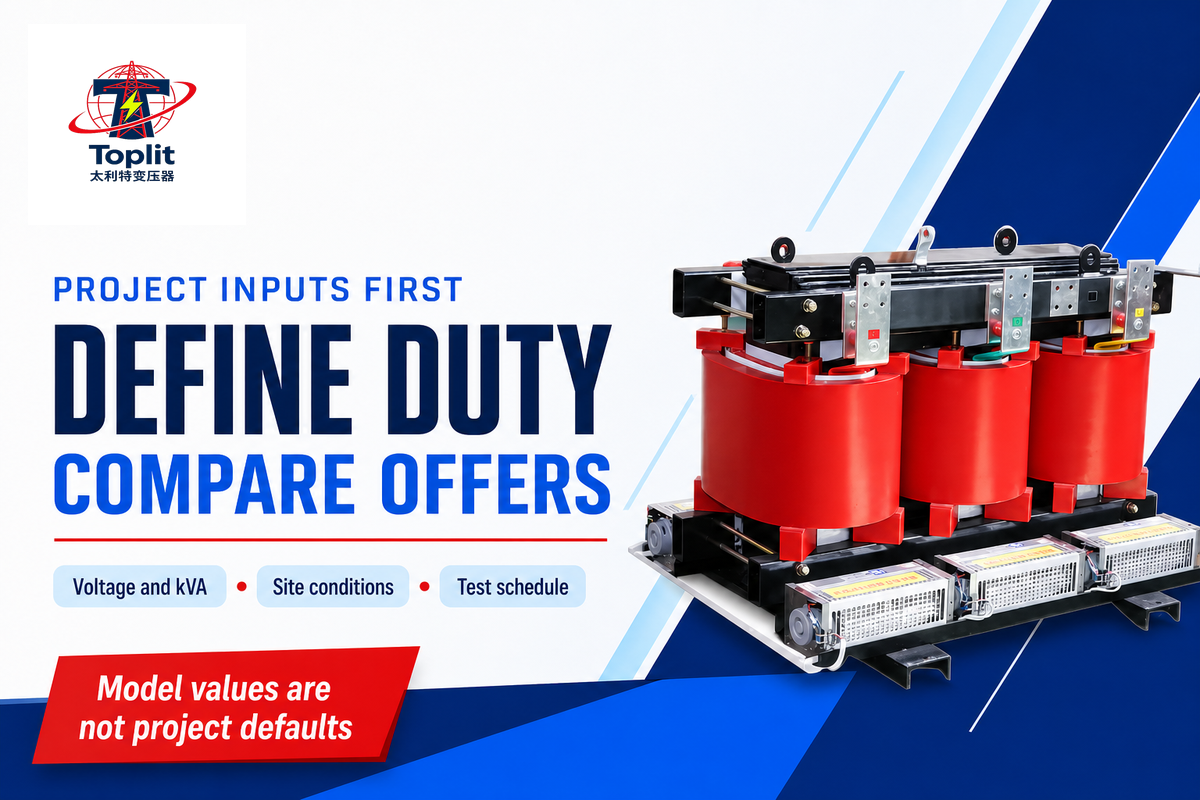
Project circumstances guide the type of winding construction, as well as the fire and environmental classes and testing of the equipment; review electrical duty, losses, enclosure and approvals too. Review the equipment families to determine if they meet the requirements.
Key takeaway
Choose the manufacturer around a defined electrical duty and an offered cast-resin design. Keep winding construction, cooling ratings, loss conditions, tested classes and factory scope attached to that design throughout bid comparison.
What electrical and site data should I send when requesting a 1000 kVA 11 kV cast resin transformer quote?
Send a single-line diagram and specify rated capacity, primary and secondary voltage, frequency, three phase configuration, vector group, taps, impedance and load profile. Add AN/AF duty, harmonics, site altitude and ambient conditions, enclosure, environmental/climatic/fire classes, FAT scope and delivery needs. For comparison, Toplit’s published SC(B)13-1000/11 model lists 1000 kVA, 11 kV, 0.4 kV secondary and 6.0% impedance. Those are model values, not defaults to impose on a different project.
Send your specification to Toplit for a technical quotation, including the required site conditions and test schedule so the proposed design can be reviewed against the same requirements as the other shortlisted offers.
References & Sources
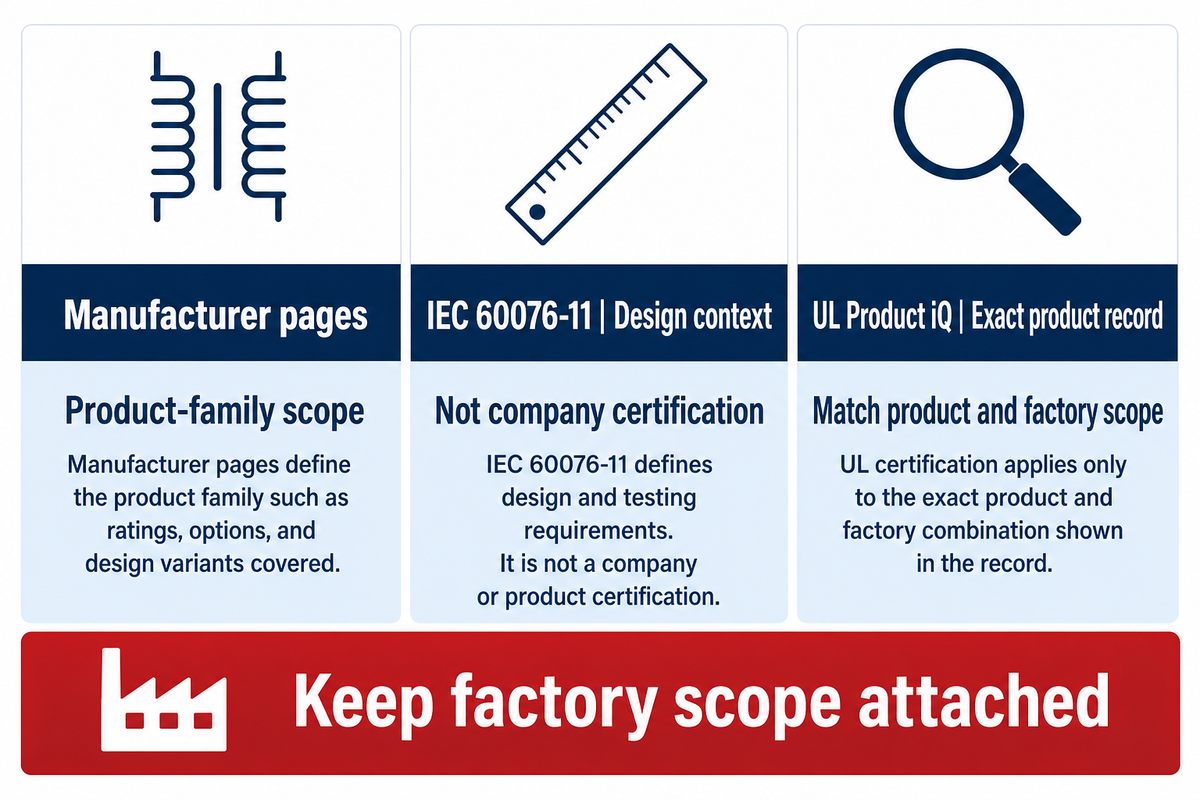
Company profiles and comparison rows use the manufacturers’ official company pages, cast-resin product pages and catalogues checked in September 2026. Product-family sources include RESIBLOC, GEAFOL, Trihal, MOLTRA, Beyond X, Green T.HE and TTR documentation. The addresses in each company profile identify the source organization; standards and certification references are linked in the purchasing guidance.