Get in touch with Talite Transformer Co., Ltd Company

Updated August 2026
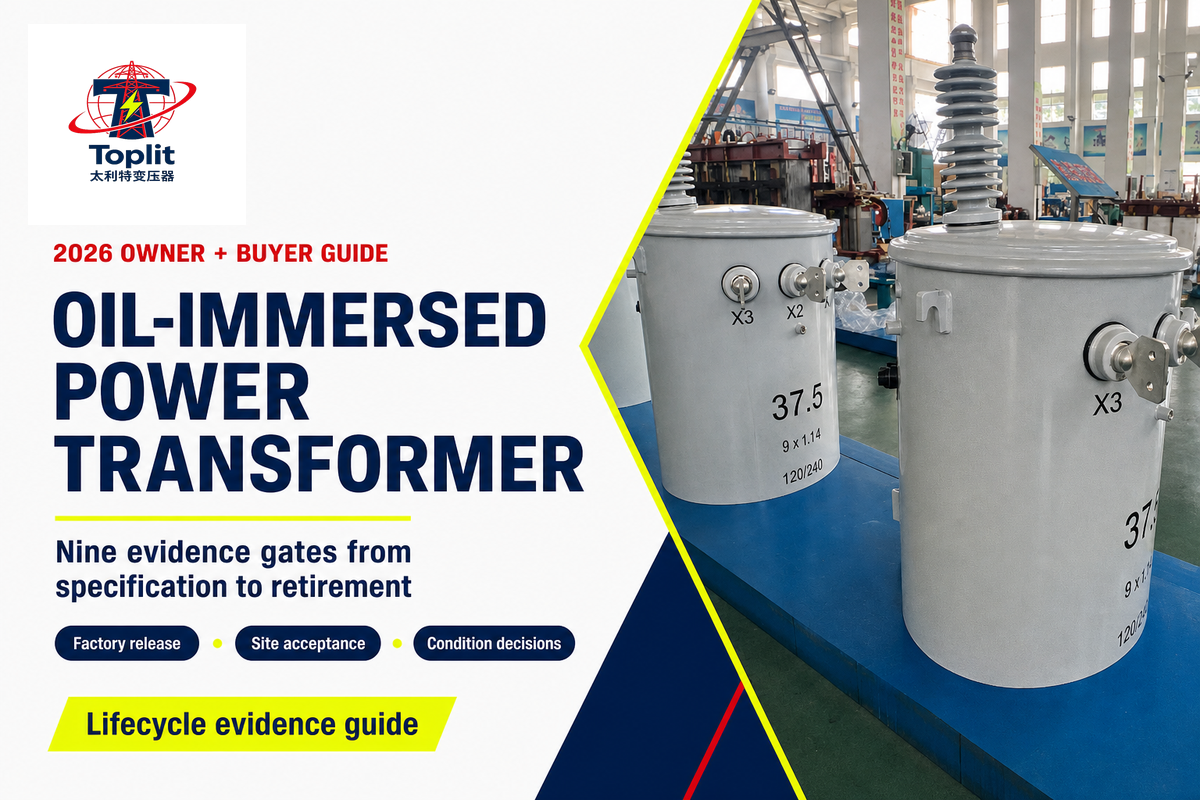
An oil-immersed power transformer is a power transformer whose core-and-winding assembly operates in insulating liquid that supports dielectric insulation and heat transfer. A project involving one succeeds when each choice leaves an accepted record for the next owner; the product name alone doesn’t settle system duty, loading, fluid, transport, site interfaces, factory evidence, permission to energize, maintenance choices, or the moment at which repair becomes replacement.
Quick answer
A buyer needs nine connected evidence gates, from specification and factory release through site acceptance, operation, condition review, and the repair-or-retire decision. Each gate identifies the decision owner, accepted record, acceptance rule, and open exception.
This guide owns that lifecycle evidence route. It doesn’t reproduce Toplit’s catalog choices, configuration tools, quotation logic, or product claims. When the evidence questions are clear and you need a technical proposal, go to the oil-immersed power transformer solutions page.
Scope signals, not a model specification
601 V+IEEE C57.12.00 covered-scope boundary
60 HzU.S. distribution-rule frequency
55 galU.S. SPCC container-counting example
9 stopsEvidence clock used in this guide
Those first three numbers belong to specific standards or United States regulations. None is a universal line for choosing a transformer. Our nine-stop clock is an editorial decision aid, not a substitute for the project specification.
What Does an Oil-Immersed Power Transformer Guide Need to Cover?
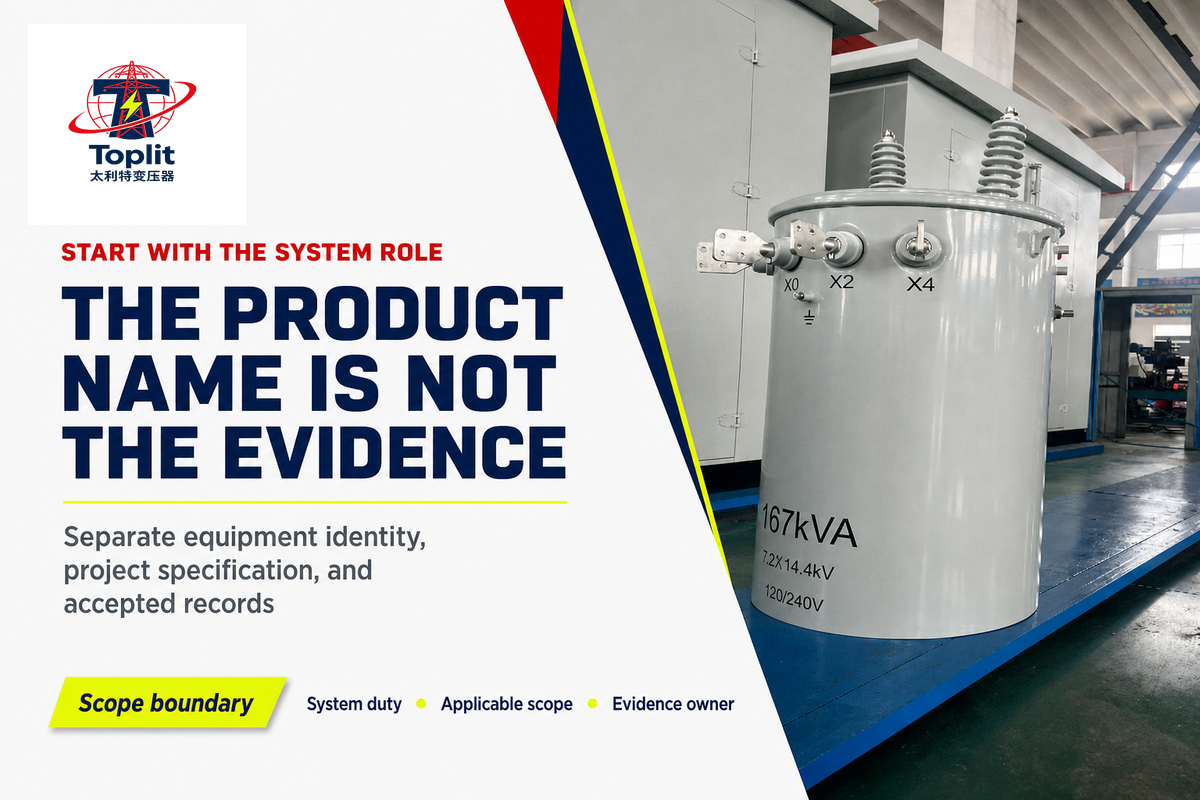
Useful guidance sets apart three questions: what the equipment is, what the project must specify, and what evidence enables responsibility to move to the next party. It must not convert one regulatory definition, catalog family, voltage class, or factory result into a universal engineering rule.
IEEE’s public page for C57.12.00-2021 addresses electrical and mechanical requirements for specified liquid-immersed distribution, power, regulating, and related transformers with a highest-voltage winding of 601 V or higher. It also lists excluded equipment classes. That scope helps a purchaser ask which standard applies; it doesn’t make every covered transformer interchangeable.
On the other hand, the current 10 CFR § 431.192 definition serves a United States energy-conservation function. It describes covered 60 Hz distribution transformers with input at or below 34.5 kV, output at or below 600 V, listed capacity bands, and explicit exclusions. That regulatory scope isn’t a global technical marker for distribution and power transformers.
What is an oil-immersed power transformer?
An oil-immersed power transformer is a transformer whose core-and-winding assembly functions in insulating liquid that supports insulation and heat transfer. Those words provide no intrinsic indication of the needed rating, voltage ratio, impedance, cooling configuration, mineral or ester fluid, loading policy, monitoring set, site controls, or proof of acceptance.
Scope comes first.
| Page or evidence owner | Question it should answer | What stays out |
|---|---|---|
| This lifecycle guide | Which record closes each project and operating handoff? | Catalog models, public prices, supplier claims |
| Commercial product page | Which product family and configuration should enter a proposal? | Independent proof of performance |
| Voltage-specific guide | What changes for a stated voltage class and network duty? | A cross-voltage universal template |
| Project specification | What electrical, mechanical, environmental, test, document, and interface duties are agreed? | Unapproved assumptions |
| Applicable authority | Which regulation, utility requirement, approval, or work practice controls the site? | Rules copied from another jurisdiction |
Physical vocabulary and its evidence consequence
The working principle of oil-immersed transformer equipment begins with electromagnetic induction: a magnetic core, usually fashioned from insulated silicon steel laminations, couples the transformer winding on one voltage side to the winding on the other. This iron core and winding configuration alters voltage; it doesn’t generate power. A transformer used in a substation, power station, or industrial power supply continues to require a system duty that states load power, frequency, voltage, fault conditions, and grounding.
Inside an oil-immersed transformer, the windings and core may be fully submerged in insulating oil so the liquid can support cooling and insulation. In many designs, oil cools internal components by carrying heat toward a tank or radiator, while an oil conservator may accommodate oil expansion as oil temperature changes. As oil expands, the approved preservation system has to maintain its intended boundary. Other transformer design choices include sealed preservation, forced oil circulation, different cooling-medium paths, and accessories. Terms such as efficient cooling, cooling oil, or stability under heavy load remain claims until the rated capacity of the transformer, temperature of the transformer, cooling arrangement, test evidence, and operating limits are defined.
The types of oil-immersed transformer used across power generation, transmission networks, power distribution, and distribution networks don’t share one evidence pack. This type of power transformer may sit at power plants, transmission substations, industrial sites, or another power grid interface. Wherever a transformer is used, the system role controls the evidence. High voltage transformers, distribution transformers, and special transformer type categories can fall under different standard and project scopes. Power transmission and distribution systems also assign different consequences to the same transformer performance signal. Evidence must follow the actual network role rather than a broad label such as high power or large-scale power.
A dry-type transformer uses a different insulation and heat-transfer arrangement, so dry-type and oil immersed equipment shouldn’t share an unrestricted diagnostic table. An oil filled transformer vs dry type comparison must remain tied to site, fire, environment, access, duty, and adopted rules. Choosing which oil is used in a transformer for cooling also requires a fluid-specific basis; mineral oil, ester liquids, contaminated oil, oil quality, cooling and insulating properties, and oil-temperature evidence need the correct method and interpretation. A transformer manufacturer can propose transformer solutions, but the owner must still accept the evidence basis for transformer operation, reliability, and service-life decisions.
Readers who need voltage-specific construction, cooling, tap-changing, and standards context can use the 110 kV power transformer guide. Keeping that detail on its existing page prevents this guide from competing for the same question.
The 9-Stop Transformer Evidence Clock: A Responsibility Map
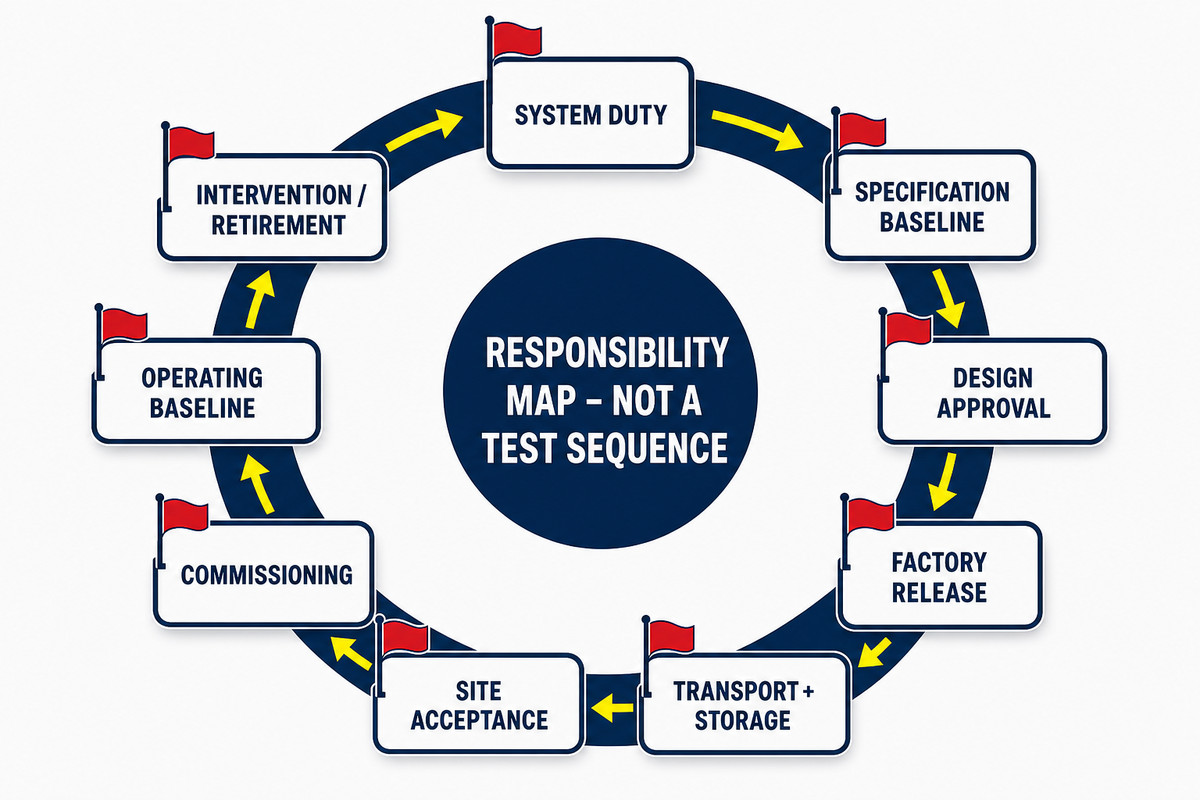
The 9-Stop Transformer Evidence Clock maps a decision owner, required record, acceptance rule, and open exception to each lifecycle stage. It isn’t a standard test sequence. Its purpose is to stop one valid record, such as an approved drawing or factory report, from being misused as proof that a later handoff is complete.
IEC’s public 60076-1:2011 summary names functional specification, transport, safety and environmental requirements, liquid preservation, tank tests, and facilities for condition monitoring among its topics. IEC 60076-7:2018 treats mineral-oil transformer loading through ambient temperature, load conditions, operating temperature, and thermal ageing. Together, those public scopes show why a nameplate rating cannot close the lifecycle.
An oil immersed power transformer diagram can locate equipment and record interfaces, but the drawing becomes useful evidence only when its revision, approval status, represented configuration, and open deviations are known.
| Stop | Decision owner | Required record | Acceptance question | Limitation / not suitable for |
|---|---|---|---|---|
| 1. System duty | Owner / network planner | Load, voltage, frequency, fault, grounding, contingency, growth basis | Does the duty describe the actual power system? | Not closed by a catalog kVA alone |
| 2. Specification baseline | Owner / engineer | Approved data sheet, standard hierarchy, environmental and document schedule | Are conflicts and exclusions resolved? | Not a copied competitor specification |
| 3. Design approval | Manufacturer + owner reviewer | Approved drawings, calculations, deviations, interfaces | Is the proposed design reviewable against duty? | Approval does not prove manufactured condition |
| 4. Factory release | Manufacturer + witness/reviewer | Test results, inspection, deviations, release note | Did the agreed factory scope pass or receive disposition? | Not proof of site readiness |
| 5. Transport and storage | Logistics + receiving owner | Shipping condition, impact/event logs, preservation, storage inspection | Did delivery preserve the released condition? | Factory evidence cannot erase a shipment event |
| 6. Site acceptance | Installer + owner | Foundation, grounding, oil, accessories, cables, clearances, receiving checks | Do installed interfaces match approved documents? | Not authorization to energize |
| 7. Commissioning | Qualified commissioning team | Settings, site tests, functional checks, punch closure | Does the installed system behave as approved? | No live-work instruction in this guide |
| 8. Operating baseline | Asset owner | As-builts, accepted test baselines, oil identity, settings, maintenance plan | Can future changes be compared with a known state? | A missing baseline weakens every later trend |
| 9. Intervention / retirement | Owner + technical/economic decision makers | Condition, consequence, spares, transport, system need, cost, evidence confidence | Repair, investigate, replace, retire, or hold? | No single sample or age threshold decides alone |
Consider a factory report that passes while a drawing deviation remains open. Stop 4 cannot close until the deviation has an accepted disposition. If the unit then experiences an abnormal transport event, Stop 5 opens a new question; the factory result remains valid for what it tested, but it does not describe the delivered condition.
How Should Factory Acceptance Evidence Be Structured?
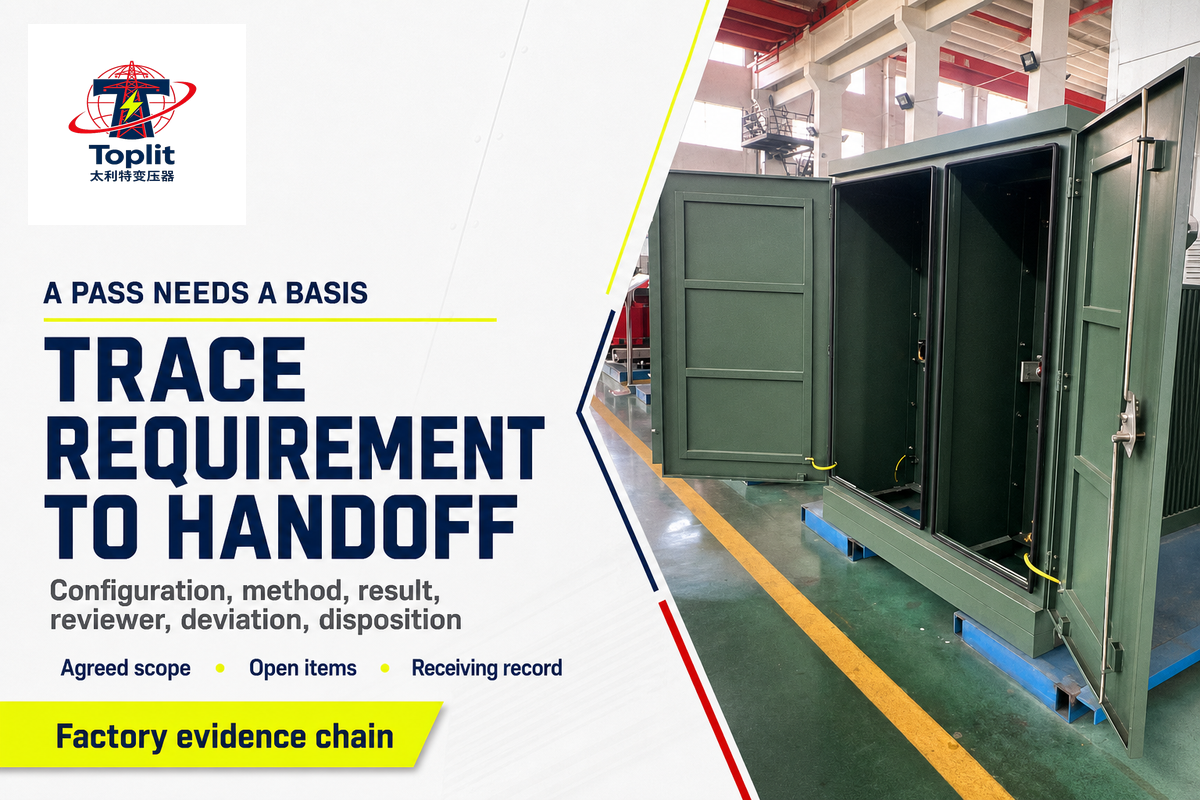
Factory acceptance evidence is useful when every result can be traced to an agreed requirement, method, acceptance basis, reviewer, and disposition. Generic test lists are weaker than a smaller, contract-bound evidence pack. Each record must also say what wasn’t tested and which site or system questions remain open.
IEC 60076-1 and IEEE C57.12.00 are general anchors, but the actual factory scope comes from the applicable standards, customer specification, approved drawings, transformer class, design novelty, witness plan, and contract. This guide therefore does not publish a universal routine/type/special test checklist or imply that one test pack suits all high-voltage transformers.
The evidence pack is a chain, not a folder
The following nine editorial fields can make a factory acceptance record easier to review and hand off. The agreed project scope may require fewer, additional, or different fields.
| Evidence field | Question to answer | Reject or clarify when |
|---|---|---|
| 1. Requirement ID | Which specification, drawing, standard, or deviation created the obligation? | The test has no traceable requirement |
| 2. Approved configuration | Which serial number, drawing revision, tap, accessory, and fluid state was tested? | The tested configuration differs from release |
| 3. Method and instrument | How was the result produced and which controlled equipment was used? | Method or calibration control is unclear |
| 4. Acceptance basis | What agreed limit, tolerance, or qualitative condition applies? | A “pass” has no stated basis |
| 5. Result and units | What was observed, calculated, or measured? | Units, phase, tap, temperature, or correction is missing |
| 6. Witness / reviewer | Who observed, reviewed, and accepted the record? | Signature does not match authority |
| 7. Deviation | What differed from the approved basis? | The exception is hidden in narrative |
| 8. Disposition | Was the exception corrected, accepted, retested, or carried forward? | Open items have no owner or due point |
| 9. Handoff reference | Which receiving, site, commissioning, or operating record consumes this result? | The evidence cannot be found after delivery |
Silence isn’t acceptance.
Buyers can adapt the factory acceptance document handoff checklist to the project scope. This tool organizes a handoff; it doesn’t decide which tests are required.
The Handoff Exception Register: Transport to Site Acceptance
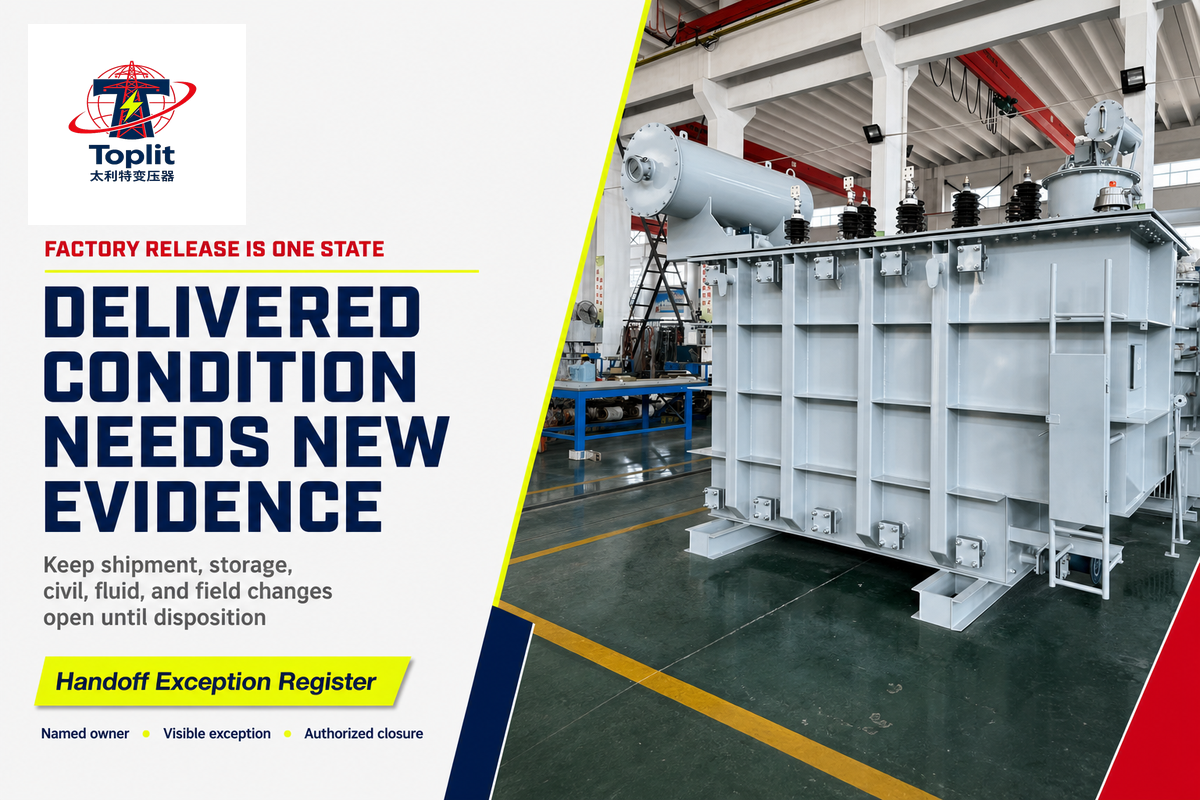
The Handoff Exception Register keeps every condition that can invalidate an earlier assumption visible between factory release and site acceptance. Its rows belong to different owners, so one party can’t close another party’s evidence. The register is most valuable when a shipment, storage period, civil interface, or field change departs from the approved basis.
Transport appears in the public IEC 60076-1 scope for a reason: an accepted factory condition has to survive lifting, shipment, storage, assembly, fluid handling, and site connection. Project instructions and approved drawings govern the actual checks. This table identifies questions, not universal tolerances.
| Exception class | Primary owner | Evidence to preserve | Close only when | Limitation / not suitable for |
|---|---|---|---|---|
| 1. Lifting / handling | Logistics | Approved method, lift record, observed event | Condition is accepted or investigated | Not closed by “no visible damage” alone |
| 2. Shipment event | Carrier + owner | Event logger, inspection, disposition | The event’s significance is reviewed | No generic event threshold in this guide |
| 3. Storage environment | Receiving owner | Dates, preservation state, inspections, alarms | Manufacturer/project instructions are met | Not a forum-derived storage interval |
| 4. Foundation / mounting | Civil contractor | Survey, approved arrangement, installation inspection | The installed geometry matches the design | Not closed by supplier outline drawing alone |
| 5. Grounding / bonding | Electrical contractor + owner | Study basis, drawings, inspection/test records | Equipment and site grid interfaces agree | No live-work steps provided |
| 6. Oil / fluid handling | Qualified service team | Fluid identity, handling, sample, fill and exception records | Approved fluid system and condition are verified | Mineral and ester systems are not merged |
| 7. Accessories | Manufacturer + installer | Serials, settings, wiring, functional checks | Delivered and approved functions match | Not closed by packing list alone |
| 8. Cable / terminal interface | Installer + system engineer | Approved interface drawing, installation and inspection | Actual cable and terminal duties agree | No generic termination instruction |
| 9. Protection / control change | Protection/control owner | Approved settings, wiring and test result | Final network basis is represented | Factory settings may not be final |
| 10. Open deviation | Named exception owner | Issue, consequence, temporary control, due date, acceptance | Authorized disposition is recorded | Silence is not acceptance |
Which Oil, Fire and Environmental Controls Need Local Proof?
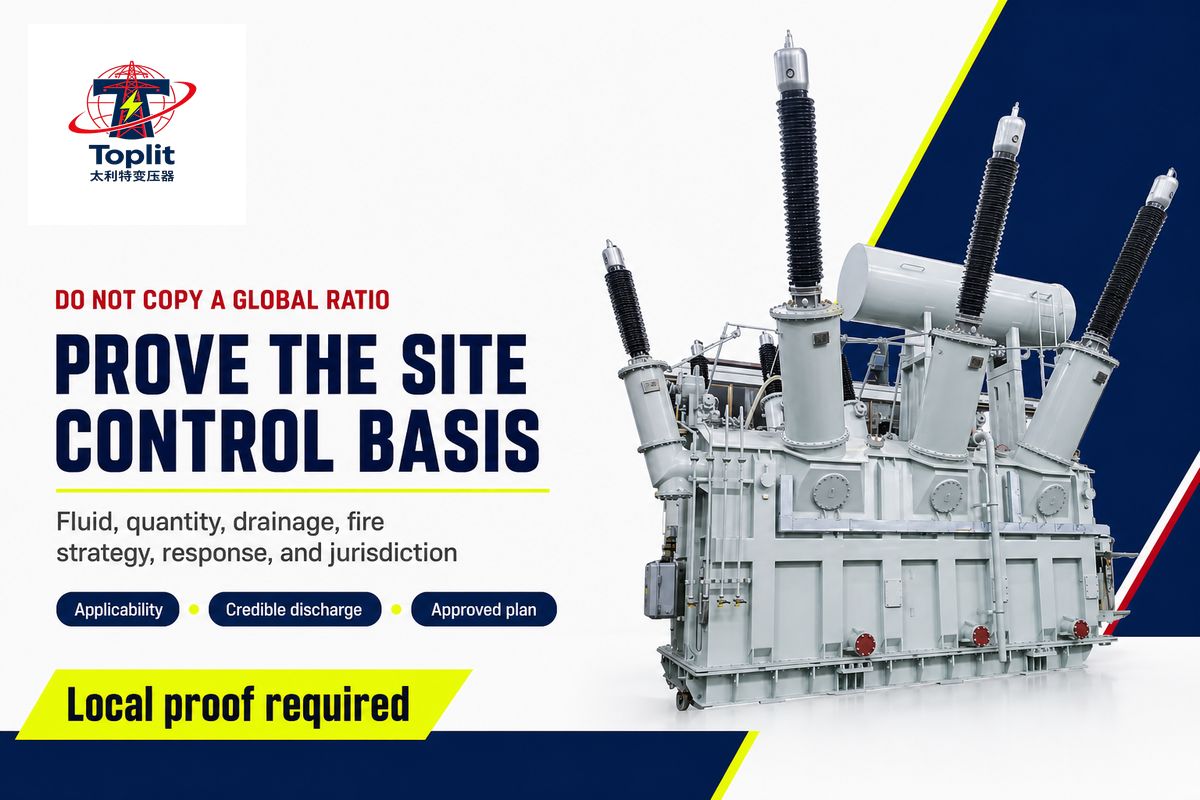
Oil, fire, and environmental controls must be proven against the actual fluid, quantity, location, drainage, occupancy, emergency plan, and jurisdiction. A worldwide containment percentage doesn’t exist. Even within the United States, facility applicability, container counting, general containment, qualified-equipment alternatives, and engineering judgment answer different questions.
For U.S. Spill Prevention, Control, and Countermeasure applicability, the Environmental Protection Agency says containers of 55 gallons or greater count toward facility oil storage capacity, including oil-filled electrical equipment such as transformers. The facility must also satisfy the rule’s location, discharge-potential, and capacity conditions. This isn’t a global transformer-design limit.
Another EPA page explains that covered facilities can use listed or equivalent containment/diversion systems and describes an optional alternative for qualified oil-filled operational equipment. Gravel, building drainage, active spill measures, and other provisions may play different roles. Its public text doesn’t prescribe a universal 110% or 112% transformer bund rule.
Do oil-filled transformers need containment?
Sometimes, but the answer starts with applicability rather than a copied ratio. Confirm the jurisdiction, facility status, individual oil containers, total counted capacity, credible discharge path, drainage, fire strategy, response resources, inspection plan, and accepting professional or authority. Outside the United States, use the applicable local environmental, fire, building, utility, and occupational rules.
| Evidence question | Owner / reviewer | Record | Do not assume |
|---|---|---|---|
| Which jurisdiction applies? | Owner / legal-environmental reviewer | Applicability determination | A U.S. rule applies worldwide |
| Which oil containers count? | Facility owner | Inventory and capacity basis | Every small container counts identically |
| Where can oil travel? | Civil/environmental engineer | Drainage and discharge-path review | A curb solves every path |
| What failure mode is credible? | Owner / professional engineer | Engineering basis | Total oil volume is always the design spill |
| What passive measure exists? | Civil/fire/environment team | Drawings and inspection | Gravel has one universal function |
| What active response exists? | Facility operator | Spill plan, equipment, training | Equipment alone proves readiness |
| Which fluid is present? | Transformer owner / supplier | Fluid specification and quantity | All insulating liquids behave alike |
| What fire strategy applies? | Fire/code authority | Approved fire basis | Containment equals fire protection |
| Who accepts the controls? | Named authority / professional | Approval, inspection, change record | Supplier literature is approval |
What Must Be Closed Before Commissioning and Energization?
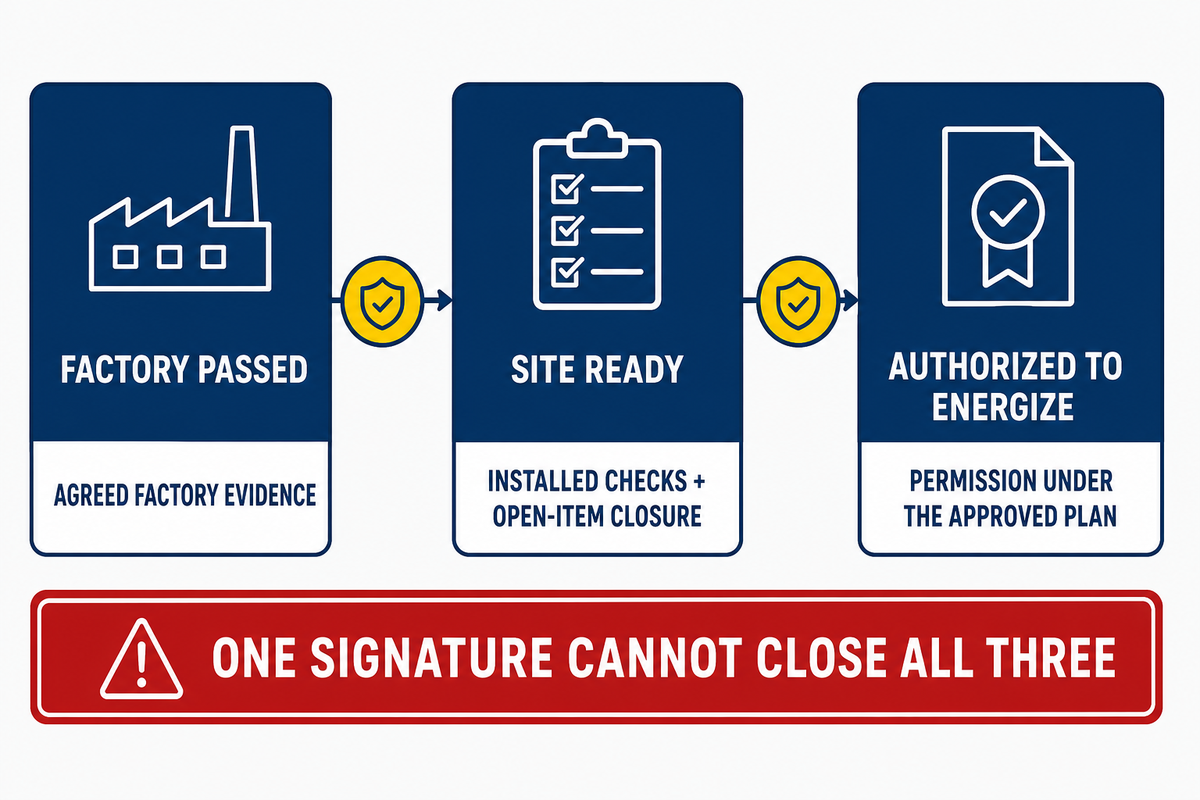
Commissioning closes the installed system’s evidence; energization requires a separate authorized decision. The manufacturer, installer, owner, protection team, utility, and safety authority may each own part of the record. No factory signature can replace site configuration, settings, grounding, inspection, work controls, and accepted open-item disposition.
For covered United States workplaces, OSHA 1910.333 requires safety-related work practices, treats de-energization as the default unless conditions justify otherwise, and limits work on non-deenergized parts to qualified persons using suitable precautions. This article therefore gives evidence questions, not energized-work instructions or approach distances.
| Closure record | Owner | What it proves | What remains open |
|---|---|---|---|
| 1. Approved design set | Owner / engineer | Accepted configuration and interfaces | Manufactured and installed condition |
| 2. Factory disposition | Manufacturer / witness | Agreed factory evidence | Transport and site evidence |
| 3. Receiving inspection | Owner / installer | Delivered condition and exceptions | Completed installation |
| 4. Mechanical completion | Installer | Physical assembly and connections | Functional performance |
| 5. Grounding / cable record | Electrical contractor | Installed interfaces match drawings | Protection behavior |
| 6. Settings baseline | Protection/control owner | Approved live configuration | Field wiring and function |
| 7. Site test result | Qualified commissioning team | Installed checks under approved method | Authority to energize |
| 8. Exception closure | Named issue owner | Open items accepted or corrected | Final authorization |
| 9. Energization authorization | Owner / utility / authority | Permission under the approved plan | Operating baseline and handover |
Handoff rule
“Factory passed,” “site ready,” and “authorized to energize” are three different states. Keep them separate in the document register and in every project meeting.
The Oil Evidence Split: Serviceability vs Equipment Condition
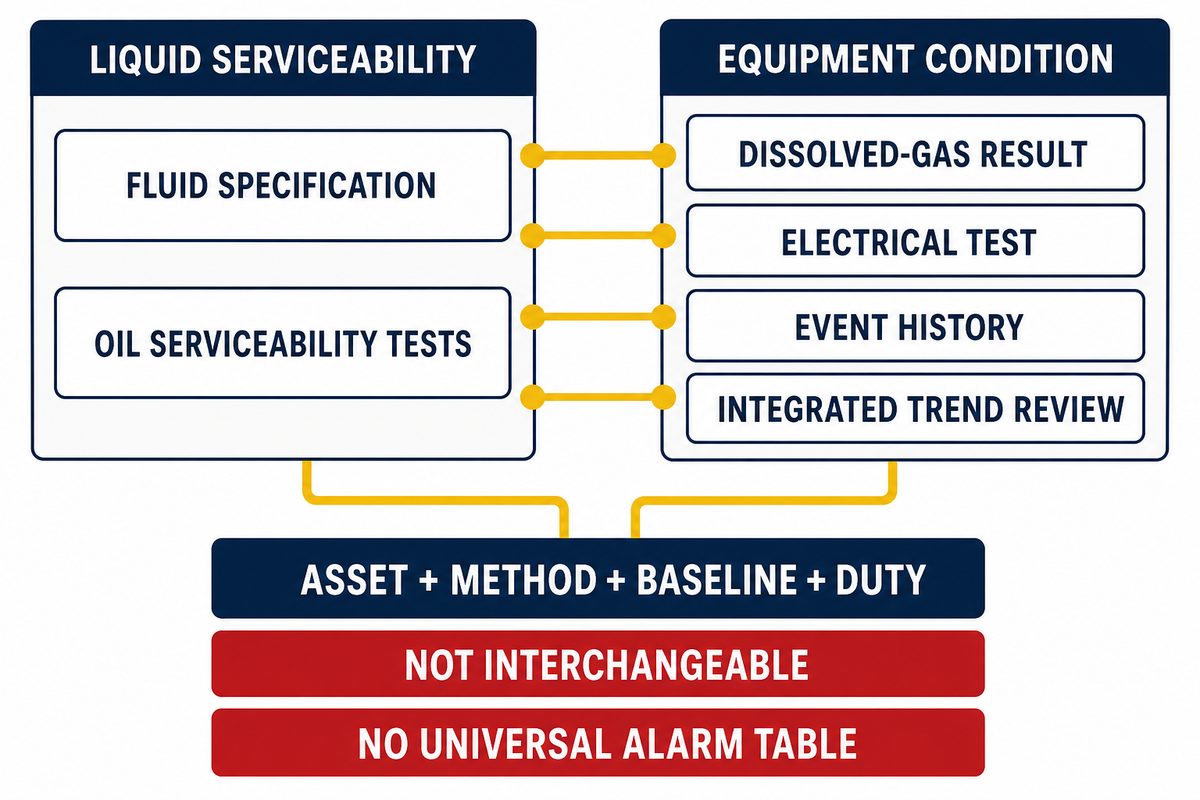
The Oil Evidence Split separates evidence about the insulating liquid’s serviceability from evidence about the transformer’s condition. The tracks overlap but are not interchangeable. Sample identity, fluid chemistry, solid-insulation system, baseline, rate of change, loading, temperature, events, and other tests determine what a result can—and cannot—support.
IEC 60422:2024 covers supervision and maintenance guidance for mineral insulating oils, yet its public scope places equipment-condition monitoring by dissolved gases and furanic compounds outside the document. IEC 60599:2022 describes interpretation of dissolved and free gases in in-service mineral-oil equipment with cellulosic insulation and states that action requires proper engineering judgment. Other liquid-solid systems need additional validation.
IEEE’s public page for C57.104-2019 also includes dissolved-gas quality, interpretation, limitations, diagnostic techniques, and serviceability information. None of these public summaries allows copying one gas concentration or ratio into a universal alarm table.
Teams may label records as transformer oil analysis, dissolved gas analysis, transformer testing, or transformer condition monitoring. Each label still needs the asset, fluid/insulation system, method, baseline, duty, and decision question. An RFQ may ask, “Which oil is used in transformer for cooling purpose?” The answer should name the approved fluid and evidence basis, not merely say mineral or ester.
| Evidence type | Question it may answer | Question it does not answer alone | Context needed | Decision owner |
|---|---|---|---|---|
| 1. Sample identity | Which asset, compartment, point, date, and state does the sample represent? | Whether sampling practice was adequate | Chain of custody and method | Owner / laboratory |
| 2. Fluid specification | Which liquid and approved basis apply? | Current asset health | Mineral, natural ester, synthetic ester, additives | Owner / supplier |
| 3. Oil serviceability tests | Is the mineral oil fit for continued service or treatment under the adopted program? | Complete mechanical/electrical condition | Limits, trend, operating condition | Owner / oil specialist |
| 4. Dissolved-gas result | What gas pattern and change require qualified interpretation? | Automatic fault, repair, or retirement | Fluid/solid system, baseline, rate, duty | Condition specialist |
| 5. Furan / ageing marker | What evidence may inform cellulosic-insulation ageing? | One universal end-of-life point | Design, oil, history, uncertainty | Asset manager / specialist |
| 6. Electrical test | What changed against a comparable accepted baseline? | Why it changed without context | Method, temperature, tap, configuration | Qualified test engineer |
| 7. Visual / physical inspection | What leak, corrosion, damage, noise, temperature, or accessory condition is visible? | Internal condition not observable | Operating state and qualified access | Maintenance owner |
| 8. Load / temperature history | Which thermal duty accompanied the evidence? | Exact loss of life without a validated model | Ambient, cooling, design, sensor quality | Operations / asset engineer |
| 9. Event history | Did fault, through-current, transport, alarm, or maintenance change the question? | Condition without follow-up evidence | Time-aligned records | Owner / investigation team |
| 10. Integrated trend review | Does the combined evidence support hold, investigate, plan, or intervene? | A deterministic answer when evidence conflicts | Criticality, confidence, consequences, alternatives | Authorized asset decision group |
One common mistake is to ask, “Did the oil pass?” when the decision is, “Can this asset proceed with its current duty?” That initial question can be correct and still be too specific. Keep every result with its scope and with the question it can’t answer.
The Baseline-or-Investigate Rule for Monitoring and Maintenance
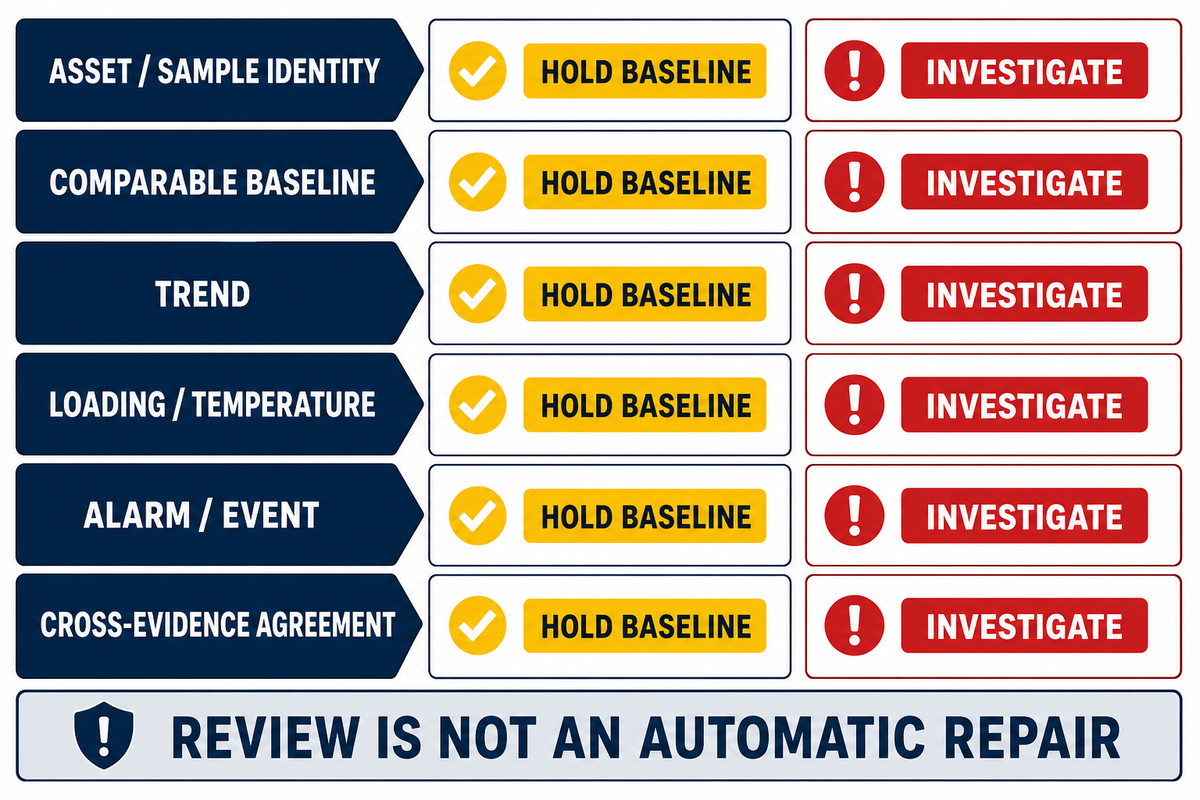
The Baseline-or-Investigate Rule says a monitoring value should trigger qualified review when identity, comparability, trend, duty, event context, or expected behavior is uncertain. It does not prescribe a repair. Maintenance timing comes from the approved program, manufacturer instructions, asset criticality, operating history, prior evidence, and competent judgment—not one global interval.
How often do oil-immersed transformers require maintenance?
No single interval applies to every situation. Determine the program from the equipment and fluid system, the manufacturer’s approved instructions, applicable standards and law, owner procedures, duty, criticality, environment, baseline, previous results, events, and evidence quality. Fixed schedules can time activities; they can’t determine what the transformer needs without condition and context.
Loading and thermal ageing relate to ambient and operating conditions in IEC 60076-7. Gas interpretation involves quality and limitation questions in IEEE C57.104. Both of these public scopes involve a condition-aware approach, but neither public page authorizes a universal maintenance schedule or a do-it-yourself diagnostic step.
| Evidence condition | Hold baseline when | Investigate when | Do not infer |
|---|---|---|---|
| 1. Asset/sample identity | Identity and state are confirmed | Asset, point, date, state, or custody is uncertain | A result belongs to the assumed unit |
| 2. Comparable baseline | Method and configuration are comparable | Tap, temperature, fluid, instrument, or method changed | Difference equals deterioration |
| 3. Trend | Stable evidence fits known duty | Rate or pattern changes | One point defines the trend |
| 4. Loading / temperature | Duty matches the approved basis | Ambient, cooling, load, or sensor behavior changes | Nameplate alone proves thermal margin |
| 5. Alarm / event | No new event changes the question | Protection, transport, leak, fault, maintenance, or alarm event occurs | A reset closes the event |
| 6. Cross-evidence agreement | Oil, electrical, inspection, and operating evidence align | Evidence conflicts or leaves a critical gap | The preferred test overrules the rest |
| 7. Asset criticality | Consequence and redundancy remain accepted | Load, redundancy, outage, or safety consequence changes | Same condition means same decision on every asset |
| 8. Evidence confidence | Data quality and limitations are understood | Method, calibration, representativeness, or analysis is weak | More decimals mean more certainty |
| 9. Decision authority | The owner accepts continued operation and review date | No named person can accept residual risk | A vendor or laboratory owns the operating decision |
Finance and operations should read the same record. Technically minor uncertainty may have a large consequence on a single-point-of-failure asset; a stronger condition signal may be manageable where redundancy and a compatible spare exist. That decision isn’t “maintenance versus no maintenance.” It asks which uncertainty must be closed, by whom, before the risk changes.
For the economic element of condition decisions, the power transformer lifecycle loss worksheet can give structure to project inputs. It can’t transform technical indications of uncertainty into a guaranteed saving.
Repair, Replace, Retire, or Hold? The Evidence Decision
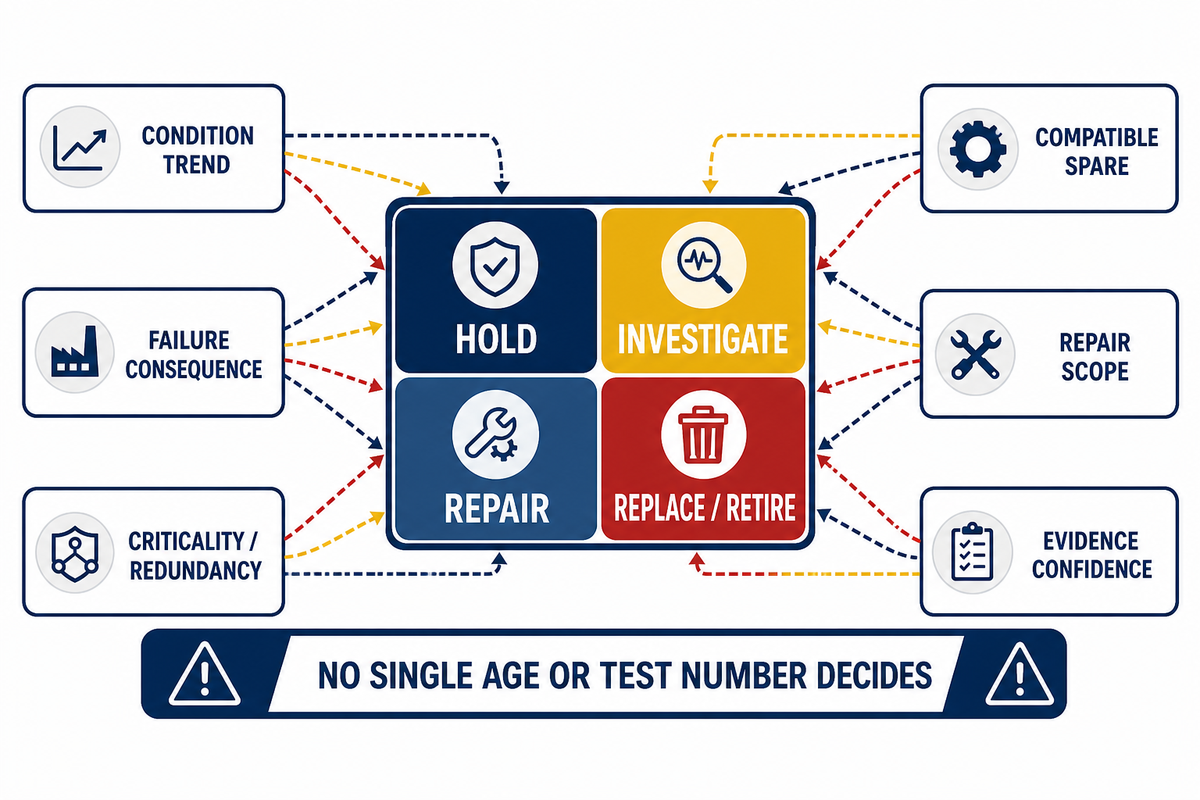
Repair, replacement, retirement, and continued service are portfolio decisions as well as equipment decisions. Condition, consequence, criticality, redundancy, compatible spares, transport feasibility, system need, intervention risk, cost, lead time, and evidence confidence belong in the same record. No age, oil result, gas value, or paper marker decides alone.
CIGRE’s ELECTRA reference paper frames end of life around condition, economic, and risk considerations and explains why no single ageing marker gives a widely accepted retirement point. That limitation is more useful than an artificial threshold because it forces the owner to show how the decision was made.
When condition evidence points in one direction but redundancy, spare compatibility, transport access, system growth, repair feasibility, outage consequence, and procurement timing point in several others, the decision record must preserve the disagreement, identify which uncertainty can still be reduced, and state who accepts the remaining exposure if the asset continues in service.
For solid transformer insulation, CIGRE does not identify one strict, clear, and widely accepted technical end-of-life threshold or lowest acceptable parameter.
System consequences also matter. One September 2024 U.S. Department of Energy Inspector General audit found gaps in a critical-spares program for assets including transformers: critical parts weren’t fully specified or identified, sparing and reorder levels weren’t established, and spares weren’t staged strategically. That page supports spare-program discipline; it doesn’t say that monitoring predicts every credible failure.
Current 2026 trade reporting describes disputed United States supply constraints and new manufacturing investment. Treat this as planning context. It should encourage earlier evidence closure and compatible-spare planning, but it must not lower technical acceptance criteria or become a Toplit price or lead-time promise.
| Decision factor | Hold / continue evidence | Investigate / repair evidence | Replace / retire evidence | Confidence question |
|---|---|---|---|---|
| 1. Condition trend | Stable within accepted context | Change requires diagnosis or correction | Degradation cannot be managed acceptably | Are results comparable? |
| 2. Failure consequence | Consequence and controls remain accepted | Controls or contingency need strengthening | Residual consequence exceeds tolerance | Who accepts the risk? |
| 3. Criticality / redundancy | System can tolerate planned action | Temporary redundancy or contingency is needed | Single-point exposure is unacceptable | Is the system model current? |
| 4. Compatible spare | Verified spare strategy exists | Compatibility or staging gap can be closed | No acceptable recovery route exists | Is compatibility proven? |
| 5. Transport / site feasibility | Access and intervention route remain viable | Temporary works or outage can enable repair | Intervention cannot meet site/system need | Has the current route been checked? |
| 6. Repair scope | No repair is justified by current evidence | Bounded repair has acceptance evidence | Repair cannot restore acceptable duty/risk | Is post-repair proof defined? |
| 7. Losses / system need | Present performance remains acceptable | Operating or loading strategy can change | New duty or economics favor replacement | Are scenarios and tariffs current? |
| 8. Schedule / supply | Decision window is protected | Early engineering/procurement reduces exposure | Replacement must start before risk window closes | Is lead-time evidence project-specific? |
| 9. Evidence confidence | Known limitations are accepted | Targeted evidence can close uncertainty | Uncertainty itself exceeds risk tolerance | What would change the decision? |
Effective decision records conclude with the next review date, the evidence that would reopen the decision, the owner of each action, and the contingency if the evidence is delayed. They don’t conceal uncertainty behind a single health index.
Move from evidence questions to a reviewable proposal
Use the lifecycle clock to identify open decisions, then submit the approved electrical duty, site conditions, standards hierarchy, test/document expectations, and handoff owners through the site’s contact form. This guide doesn’t promise that one product or test plan fits every site.
Frequently Asked Questions
What is an oil-immersed power transformer?
An oil-immersed power transformer uses insulating liquid for dielectric insulation and heat transfer. The name identifies its insulation and thermal medium, but it does not define the required rating, voltage ratio, cooling arrangement, site controls, or acceptance evidence.
Insulating liquid surrounds the core-and-winding assembly, but the name does not define rating, voltage ratio, impedance, cooling arrangement, loading policy, mineral or ester chemistry, monitoring package, site controls, or acceptance evidence. Those items come from the system duty, approved project specification, drawings, applicable standards, manufacturer instructions, site conditions, and authority review. Buyers should first identify the network role and governing scope, then treat the product name as one input rather than the decision itself.
Does a passed factory acceptance test mean the transformer is ready to energize?
No. A passed factory record closes only the agreed factory evidence. Transport, installation, protection settings, site tests, open deviations, owner acceptance, and the approved energization plan remain separate; site ready and authorized to energize require their own records.
Transport, storage, receiving inspection, installation, grounding, oil and accessories, cables, protection settings, site tests, open deviations, utility requirements, owner acceptance, and the approved energization plan remain separate. Record factory passed, site ready, and authorized to energize as different states; do not let one signature stand in for all three. A release note also needs the tested configuration, open deviations, accepted disposition, and the receiving record that consumes each result.
Do oil-filled transformers always need secondary containment?
No worldwide yes-or-no rule or universal containment ratio applies safely. Requirements depend on jurisdiction, facility applicability, oil inventory, credible discharge, site drainage, fire and environmental rules, engineering judgment, and the approved plan.
For U.S. SPCC applicability, EPA says containers of 55 gallons or greater count toward facility oil storage capacity, including transformers, while additional facility and discharge conditions apply. Required containment or alternative measures depend on applicability, site drainage, credible discharge, oil inventory, engineering judgment, and the approved plan. Other jurisdictions may use different environmental, fire, building, and utility rules.
How often should transformer oil be tested?
Testing follows the approved program, not a global web calendar. Set timing from the equipment and fluid system, duty, criticality, operating history, events, sampling quality, manufacturer instructions, applicable practice, and prior evidence.
Base timing on the equipment, fluid, duty, criticality, history, events, sampling quality, manufacturer instructions, and applicable practice. Keep oil supervision and equipment-condition diagnosis as separate tracks.
Does normal dissolved-gas analysis prove that the transformer is healthy?
No single dissolved-gas result proves whole-asset health.
Interpretation depends on the mineral-oil and solid-insulation system, sample quality, baseline, trend, rate of change, loading, temperature, events, and other condition evidence. IEC 60599 and IEEE C57.104 provide guidance and limitations rather than an automatic intervention rule. Other fluid/insulation systems require their own validated basis and qualified engineering judgment. Reconcile the gas result with oil-serviceability tests, electrical evidence, inspections, loading and temperature history, protection or transport events, and the asset’s failure consequence. When evidence conflicts, preserve the disagreement and define the next targeted question instead of averaging unlike signals into one health score.
When should an owner replace an oil-immersed power transformer?
Replace an oil-immersed power transformer when integrated evidence supports that decision—not because of one age or test number. Review condition trend, failure consequence, criticality, redundancy, repair feasibility, system need, outage constraints, cost, supply timing, and evidence confidence together.
Review condition trend, failure consequence, asset criticality, redundancy, compatible spares, transport and site feasibility, repair scope, system need, losses, outage constraints, cost, supply timing, and evidence confidence. CIGRE notes that no single widely accepted technical end-of-life threshold exists for solid transformer insulation. Document what would change the decision, which contingency applies if evidence arrives late, and who accepts the residual risk.
Scope and limitations
This guide uses public IEC and IEEE scope summaries, current U.S. government pages, a CIGRE reference paper, qualified trade context, and a current audit of Toplit’s page cluster. It does not reproduce paid standard clauses, provide energized-work instructions, diagnose equipment, prescribe maintenance intervals, certify regulatory compliance, or treat first-party company, capacity, certification, price, lead-time, and performance statements as independent evidence.
Related project resources
References & Sources
- IEEE C57.12.00-2021 public standard summary: IEEE Standards Association
- 10 CFR § 431.192: Definitions: Electronic Code of Federal Regulations
- IEC 60076-1:2011: International Electrotechnical Commission
- IEC 60076-7:2018: International Electrotechnical Commission
- Oil-filled equipment capacity less than 55 gallons: U.S. Environmental Protection Agency
- Secondary containment for oil-filled operational equipment: U.S. Environmental Protection Agency
- OSHA 1910.333: Selection and use of work practices: Occupational Safety and Health Administration
- IEC 60422:2024: International Electrotechnical Commission
- IEC 60599:2022: International Electrotechnical Commission
- IEEE C57.104-2019 public standard summary: IEEE Standards Association
- The Condition of Solid Transformer Insulation at End-of-Life: CIGRE ELECTRA
- Audit DOE-OIG-24-30: Critical Spare Parts: U.S. Department of Energy Office of Inspector General
- Transformers in 2026: Shortage, Scramble, or Self-Inflicted Crisis?: POWER Magazine
![Pad-Mounted Transformer: How It Works [2026 Guide]](https://toplit-transformer.com/wp-content/uploads/2026/08/pad-mounted-transformer-guide-featured-150x150.png)

![Single Phase Pad Mounted Transformer Guide [2026]](https://toplit-transformer.com/wp-content/uploads/2026/08/single-phase-pad-mounted-transformer-guide-featured-1-150x150.png)