Get in touch with Talite Transformer Co., Ltd Company

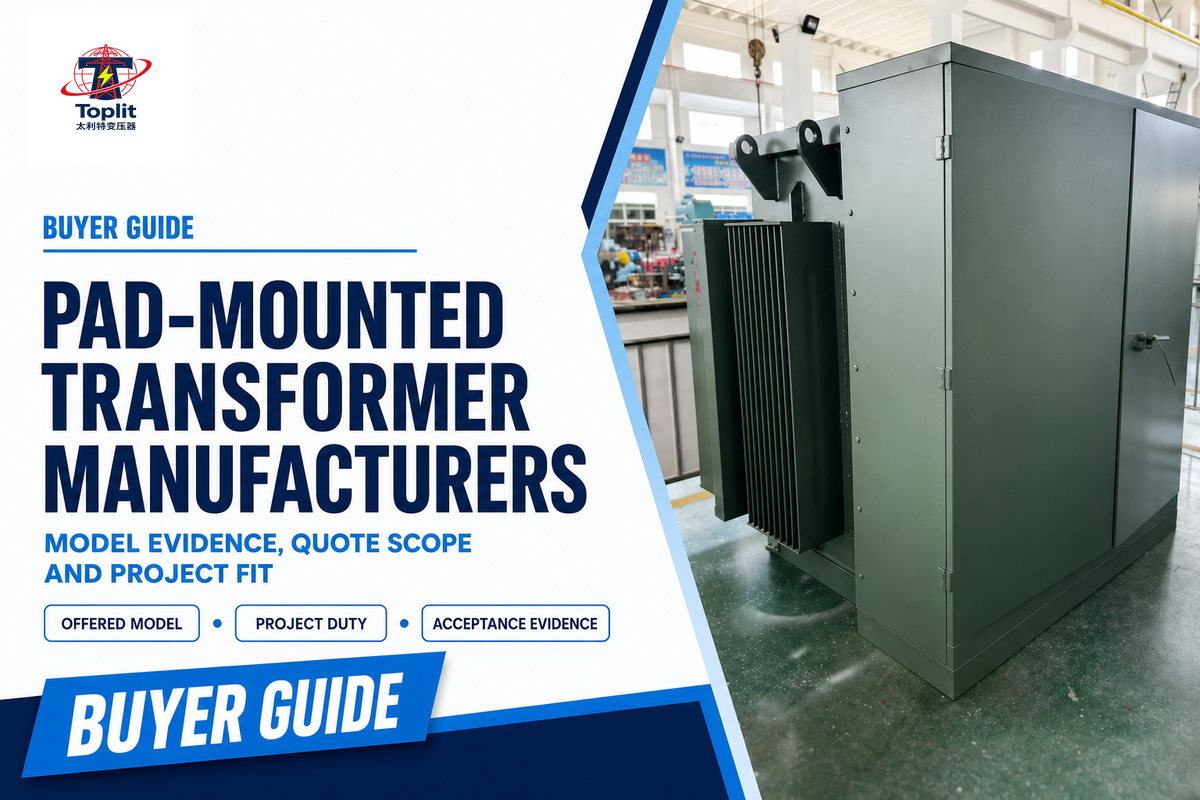
Pad mounted transformer manufacturers are suppliers of pad-mounted equipment with various product ranges, supply conditions, and approval statements. A useful shortlist begins with what’s offered: the electrical duty, construction, the manufacturing location, and the acceptance documents. The 20 profiles that follow assist procurement in determining which suppliers are worthy of a detailed, technical inquiry.
Updated September 2026.
Note: Except for Toplit, which appears first by editorial request, the remaining companies are presented in no particular order. First placement does not represent an independently verified ranking by market share, product quality or overall manufacturing capability. Pad-mounted transformer selection should be based on kVA rating, voltage class, primary and secondary voltage, feed arrangement, insulation fluid, losses, impedance, short-circuit requirements, environmental conditions, switching and protection equipment, metering requirements and local utility specifications.
Quick specifications to establish before shortlisting
- Electrical duty: phase count, kVA, frequency, primary and secondary voltage, connections and basic impulse level.
- Construction: front type, radial or loop feed, cooling, fluid, protection and cable interfaces.
- Acceptance: utility specification, applicable standards, test records, listing scope and procurement-origin requirements.
- Commercial basis: new or remanufactured condition, exclusions, warranty, delivery milestone and destination.
Pad mounted transformer manufacturers should be compared by documented product fit. Published ratings identify candidates; the offered model, factory evidence and project approvals determine whether a supplier qualifies.
Key points
- Twenty supplier profiles don’t mean twenty independent corporate groups.
- A manufacturer’s largest power transformer doesn’t establish its pad-mounted capability.
- IEEE design references, product listings, fluid classifications and utility acceptance answer different questions.
- Two quotations can match electrically and still differ in price, delivery, condition and contractual scope.
How to read this manufacturer comparison
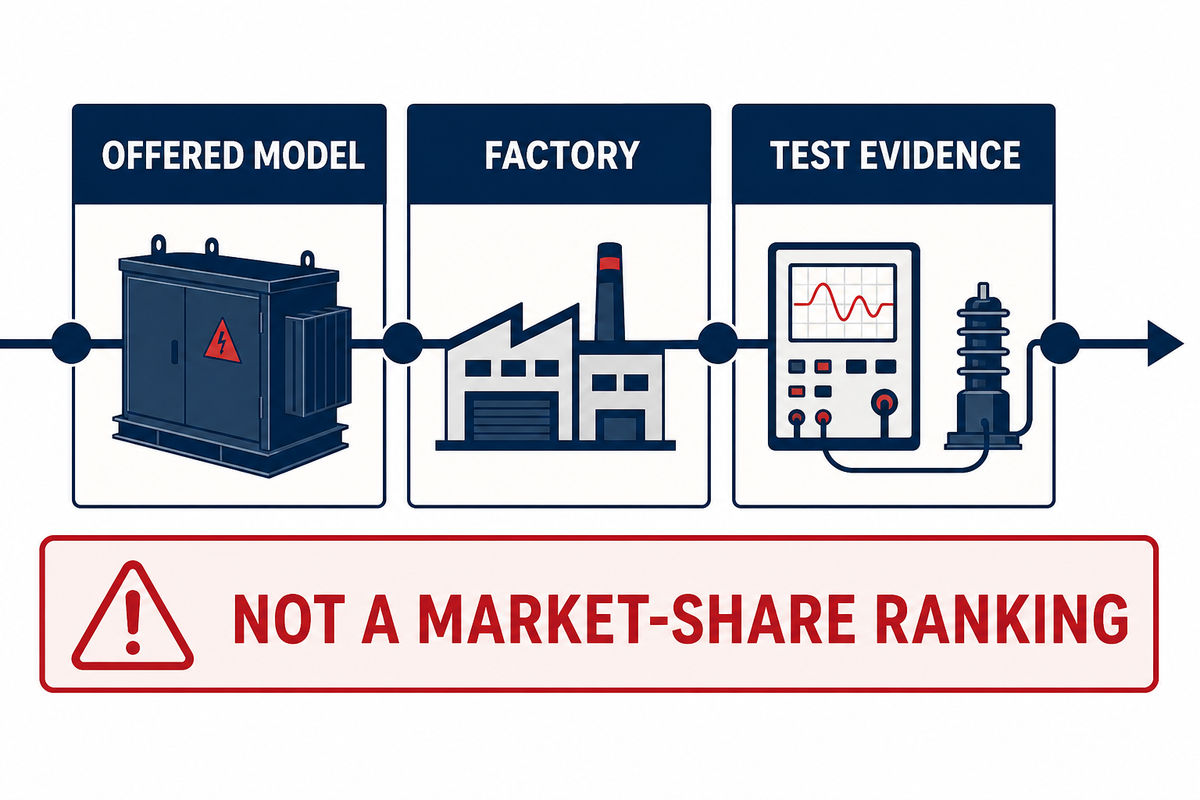
A pad-mounted supplier comparison identifies vendors whose published equipment aligns with the project. The selection of the manufacturer is done based on the offered model and the supporting documents. Treat the profiles as an initial assessment for the engineering and procurement functions. Use the acceptance matrix to determine the next required steps for purchasing the equipment.
The first step in creating a shortlist of the top manufacturers is the pad-mounted equipment that’s published and the project’s acceptance criteria. Some manufacturers also sell remanufactured equipment or offer rentals. These routes require an independent evaluation. A distributor may source the unit, but the purchase file must identify the original manufacturer, the remanufacturing work, the responsibility for testing, and the provider of the warranty.
Ownership of vendors also impacts the ability for supply chains to source from multiple vendors. Prolec is now part of GE Vernova. Pioneer is a part of the ERMCO group; ERMCO is a wholly owned subsidiary of AECI, while MGM and VanTran are a part of the Forgent group. Keep these relationships in mind when assessing supply chain concentration. Separate quotes from different vendors aren’t automatically independent from each factory as well as their parent or other group companies.
Padmount Offer Passport
Padmount Offer Passport connects each purchasing decision to a specific document and a rationale for holding approval.
| Decision | Required evidence | Owner | Hold approval when |
|---|---|---|---|
| Electrical fit | Offered-model datasheet and nameplate schedule with phase, kVA, voltages, connections, frequency and BIL | Project engineer | A portfolio maximum substitutes for the offered rating |
| Utility interface | Approved drawing, bushing arrangement, cable interface and utility deviation schedule | Engineer and utility | A catalog statement is the only acceptance evidence |
| Product conformity | Applicable standard editions, listing file where required, exact model and factory scope | Quality team | A fluid classification or factory quality certificate is presented as a product listing |
| Funding eligibility | Applicable award terms, manufacturing-origin declaration and any relevant waiver | Procurement | Corporate headquarters is the only origin evidence |
| Condition and traceability | Serial number, new/remanufactured status, work history, fluid records and warranty | Quality and owner | Condition or legacy-fluid provenance is unresolved |
| Factory acceptance | Agreed test schedule, acceptance limits, reports and witness requirements | Engineer and quality team | Special tests are assumed to be included |
| Commercial release | Signed deviation list, delivery basis, exclusions, freight and warranty terms | Procurement and finance | The comparison relies on an undated website stock claim |
For covered US infrastructure funding, the Department of Energy’s Build America, Buy America guidance adds sourcing and documentation obligations. Applicability follows the award and product rules, including any valid waiver. A US office doesn’t prove domestic-content compliance, and an overseas headquarters doesn’t identify every factory in a global group.
20 pad mounted transformer manufacturers to evaluate
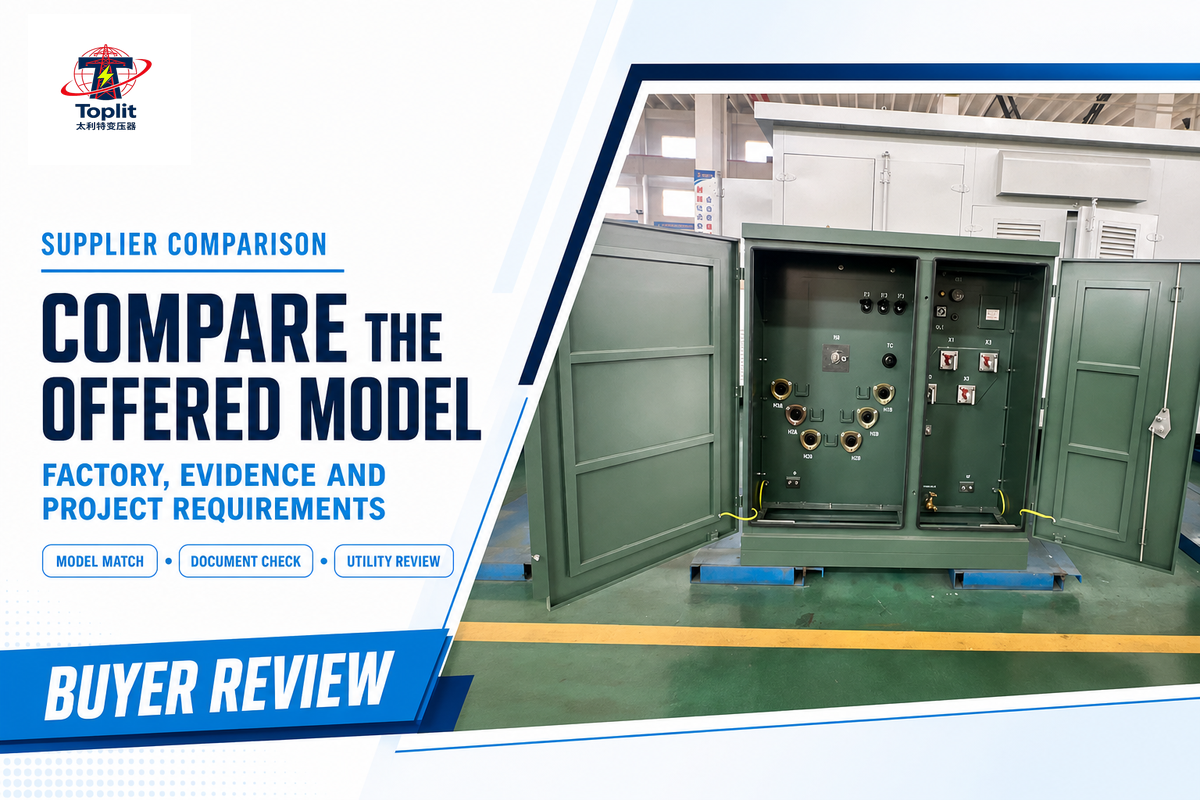
Twenty pad mounted transformer manufacturers and suppliers that have provided equipment information in their publications are listed below. The details provided in the publications vary in level of detail and age. Compare the product family and stated qualification limits before requesting a bid. The published information or example(s) provided don’t ensure that all voltage and capacity combinations are available.
Company information and statements were reviewed in September 2026. “Not publicly disclosed” in this context means that the information wasn’t found in the reviewed materials. Absence of information in the reviewed materials doesn’t guarantee that such information doesn’t exist elsewhere. Factory addresses that have been disclosed are operating facilities, unless a source calls the address a headquarters. All website links remain in their published, unformatted format.
Model and catalog guide for pad-mounted distribution transformers
Use the published rating basis and model category to determine which of the product sheets is appropriate. The detailed list(s) that follow retain ownership and qualification limits.
| Supplier | Model category | Published rating basis | Limitations / Not suitable for |
|---|---|---|---|
| Toplit | Single-phase; three-phase | 25–167 kVA single-phase; 45–2,500 kVA standard three-phase | Primary voltage and larger designs require project confirmation |
| Eaton | MaxiShrub; three-phase | 10–167 kVA; 45–10,000 kVA respectively | Do not transfer MaxiShrub values to other single-phase models |
| Hitachi Energy | Single-phase; three-phase global table | Up to 250 kVA; 45–15,000 kVA respectively | Regional ranges and exact voltage combinations may differ |
| GE Vernova / Prolec | Three-phase | Up to 5,000 kVA; 34.5 kV high-voltage envelope | Confirm current entity and factory; one corporate group |
| ERMCO | Three-phase | 30–3,000 kVA; 2.4–35 kV primary | Secondary envelope is 600 V and below |
| Howard | Three-phase live-front | 45–10,000 kVA; 2.4–46 kV high voltage | Values do not establish dead-front or single-phase capability |
| Virginia Transformer | Custom padmount family | Up to 10 MVA; 35 kV primary | Maximum not guaranteed for every phase arrangement |
| Sunbelt Solomon | Single-phase; three-phase supply | 10–500 kVA; 45–5,000 kVA respectively | Separate new, remanufactured and rental conditions |
| Central Moloney | Single-phase; three-phase | 10–500 kVA; 30–2,500 kVA respectively | Preserve grounded-wye high-voltage notation |
| JST | Single-phase; three-phase | 15–167 kVA; 75–5,000 kVA respectively | Both published up to 34.5 kV; secondary details need confirmation |
| VanTran | Compartmental padmount | Up to 10 MVA; 46 kV primary | Custom accessories and cooling change the offer |
| MGM | Liquid-filled compartmental | Up to 10 MVA; 34.5 kV, with 46 kV optional | Dry-type ratings are separate; related to VanTran |
| Maddox | Padmount supply envelope | 30–10,000 kVA; 5–35 kV high voltage | Condition, original manufacturer and warranty are unit-specific |
| Pioneer | Three-phase custom padmount | Up to 10 MVA; 69 kV | Product envelope does not expand IEEE C57.12.34 scope |
| CES | Single-phase; three-phase dead-front | 25–167 kVA; 75–3,000 kVA respectively | Confirm phase-specific CSA basis and secondary connection |
| Northern | Single-phase; three-phase | Padmount-specific range not disclosed in reviewed page | Broader power-transformer ratings cannot fill the gap |
| WEG | Three-phase US manual | 45–10,000 kVA; 35 kV maximum high voltage | August 2020 manual requires current supplier confirmation |
| Daelim | Named single-phase inventory examples | 25–167 kVA examples; 7.2/14.4 kV dual primary | Examples do not establish total range or reserved stock |
| Pearl Electric | Dedicated pad-mounted line | Up to 10 MVA; listed primary classes up to 40.5 kV | Confirm phase and voltage combination; compact substations separate |
| LS ELECTRIC | Three-phase catalog examples | 500–3,750 kVA tables; listed high voltages 12.47–24.94 kV | June 2020 tables are examples, not a complete current range |
1. Toplit
Company and location. Toplit’s privacy notice identifies Jiangsu Toplit Electric Co., Ltd. as the website operator. The product material describes manufacturing in Hai’an, Jiangsu, China. Neither a founding year nor a separately designated corporate headquarters was publicly disclosed in the reviewed materials.
Role and products. Toplit identifies itself as a manufacturer of pad-mounted transformers and project supply services along with single-phase and three-phase liquid-filled products. Regarding single-phase, standard ratings on the product body range from 25 to 167 kVA and have 240/120 V secondary options. The three-phase section defines a standard range from 45 to 2,500 kVA, with larger ratings requiring project confirmation. Request a datasheet for the primary voltage and connection rather than using general figures from various locations on the website.
Design and applications. According to the single-phase material, designs include dead-front radial and loop arrangements. Among options for three-phase, designs include loadbreak or non-loadbreak. Specify the fluid, cooling designation, bushings and coordinated fuse or breaker package in writing. Potential duties include underground distribution and commercial or industrial projects; renewable connections need their own duty review.
Evidence and limits. The site references ANSI/IEEE and CSA design or test requirements and describes routine testing. It expressly does not claim third-party listing or US federal efficiency certification in its own name. The useful starting point is its published specification and test scope. Ask for the offered model’s documents, certificate holder where relevant and project deviations; no independent capacity audit or guaranteed lead time is established here.
Official website: https://toplit-transformer.com/
2. Eaton: three-phase pad-mounted transformer catalog
Company and location. Eaton, the power management company, was established in 1911. The reviewed product documents focus on the market in the USA. Eaton manufactures several distinct distribution product families, so the exact family name belongs in the inquiry.
Products and ratings. MaxiShrub single-phase units are published in the range of 10-167 kVA and 2.4-34.5 kV on the primary side and 120-600 V on the secondary side. Eaton’s conventional three-phase family covers the range of 45-10,000 kVA, 2.4-34.5 kV on the primary side and 120–15,000 V on the secondary side. Published MaxiShrub values shouldn’t be transferred to Shrubline and Ranch Runner units.
Design and usage. Design options for three-phase include mineral oil or FR3 fluid, live-front or dead-front design and various combination of switching and protection systems. Different solutions are offered for vacuum fault interruptions, solar applications and other custom requirements. The range is applicable to utility and commercial and industrial distribution as long as the appropriate design is selected.
Evidence and limits. Product literature names ANSI/IEEE C57.12.00 and C57.12.34, CSA C227.4 and NEMA TR 1. UL/cUL listing and FM approval availability have rating limits. Eaton’s detailed family separation helps the initial screen; buyers still need the exact listing file, cooling rating, fuse coordination and approved drawing for the offered unit.
Official website: https://www.eaton.com/
3. Hitachi Energy
Company and location. Hitachi Energy is located in Zurich, Switzerland. Its current company was incorporated in 2021; the predecessor joint venture began operating in 2020. The business became a fully owned subsidiary of Hitachi in 2022. Older lists using ABB or the joint venture name require this ownership context.
Products and ratings. Hitachi Energy’s global pad-mounted product table identifies single-phase equipment up to 250 kVA and 34.5 kV primary with secondary voltages of 480/240 V and below. Its three-phase table provides 45–15,000 kVA, 5–46 kV primary and 120 V to 25 kV secondary. These are published family envelopes.
Construction and applications. Liquid-filled designs encompass mineral and ester oils. Step-up or step-down and winding arrangements should be selected for the duty. Different submissions are required for different applications e.g., distribution, industrial and engineered renewable connections. Describe the front arrangement, cooling and switching/protection equipment rather than assuming one package.
Evidence and limits. The global page includes UL and FM statements for three-phase products. What model, factory and rating the evidence applies to is what you need to know. The distinct phase tables are helpful for screening, but for global and regional cases, they can differ. Neither a large portfolio nor a Product-page badge confirms local utility acceptance.
Official website: https://www.hitachienergy.com/
4. GE Vernova / Prolec
Company and Location. GE Vernova closed the purchase of the remaining 50% interest in Prolec GE on 2 February 2026. The acquired businesses will carry on trading as GE Vernova. Prolec began operations in 1969. Xignux and General Electric established the Prolec GE joint venture in 1995. Documented materials related to products indicate manufacturing in Monterrey, Mexico and Shreveport, Louisiana and don’t refer to the current business headquarters.
Products and ratings. Prolec’s three-phase pad-mounted family is published up to 5,000 kVA. The high-voltage envelope reaches 34.5 kV with 200 kV BIL, and the low-voltage envelope reaches 15 kV with 95 kV BIL. Request the combination applicable to the offered model.
Construction and Applications. The range includes mineral oil and VG100 natural ester options for underground utility, commercial and industrial distribution. Cooling, switch functions, fusing, and cable compartments should follow the approved project specification.
Evidence and Limits. Product literature refers to IEEE C57.12.00, C57.12.34, C57.12.28 and C57.12.29 and describes serial test reports. Named factories and a specific product envelope support initial qualification. State the contracting entity and the current document package; GE Vernova and Prolec shouldn’t be considered separate parent companies.
Official website: https://www.prolec.energy/
5. ERMCO
Company and Location. ERMCO is a US distribution-transformer manufacturer headquartered in Dyersburg, Tennessee. No exact founding year was confirmed in the reviewed product literature. Its group includes Pioneer, which has a separate profile below.
Products and ratings. The three-phase padmount section of ERMCO’s website has products with ratings that include the range of 30–3,000 kVA with primary voltages of 2.4 to 35 kV and secondary voltages of 600 V and below. The published insulation envelope reaches 150 kV BIL. Confirm the phase and primary connection as required by utility.
Construction and applications. The reviewed family is oil-filled, with a 65°C temperature-rise basis, and is intended for use in utility and underground distribution. Fluid grade, cooling designation, loadbreak functions and protective-device coordination need the offered-unit specification. A linked component catalog does not make every component standard on every unit.
Evidence and limits. ERMCO’s ANSI and RUS statements and its usual-service reference to ANSI C57.12.00 provide a specification starting point. They do not establish a universal product listing or approved-vendor status for every utility. The practical advantage is a utility-oriented published range; the purchase still depends on current factory documents, accepted deviations and the complete protection package.
Official website: https://www.ermco-eci.com/
6. Howard Industries
Company and location. Howard Industries was founded in 1968. The company contact address is in Ellisville, Mississippi, United States. The reviewed history doesn’t separate that address as corporate headquarters. The power business defines Mississippi manufacturing operations and single-phase and three-phase products.
Products and ratings. Howard’s detailed source used here’s specifically the three-phase live-front pad-mounted page. It lists 45–10,000 kVA and high voltages of 2.4–46 kV. Published low-voltage choices extend from 120 to 8,600 V, with a 14,400Y V option. Those values must remain attached to that family.
Construction and applications. The source describes mineral-oil ONAN cooling and a 65°C rise. Options include taps, switches, fuses, arresters and circuit breakers for utility, commercial and industrial requirements. The accessory selection should follow the protection study and cable interface.
Evidence and limits. The page references enclosure requirements, including IEEE C57.12.28. A facility’s ISO 9001 quality-system statement is different from a product listing. Howard’s detailed live-front options are useful for engineered inquiries; buyers should not transfer this table to dead-front or single-phase equipment or assume that every optional protective device is included in the base price.
Official website: https://www.howard-ind.com/Power/
7. Virginia Transformer Corp: transformers for utility projects
Company and location. Virginia Transformer was founded in 1971 and lists Roanoke, Virginia, USA, as its headquarters. The manufacturer provides custom built electrical equipment; the broader power-transformer line should be kept separate from the pad-mounted line.
Products and ratings. Utility padmount material from Virginia offers an envelope up to 10 MVA, 35 kV primary and 200 kV BIL. It describes the different phases and connections. The highest rating provided shouldn’t be taken to mean that each combination of phases and accessories is available at that rating.
Construction and Applications. Published options include mineral oil or FR3, live-front or dead-front construction, radial or loop feed and two-position or four-position switching. Fuse and breaker arrangements and different temperature-rise selections are also discussed. These options make the line relevant to utility and industrial projects with defined engineering requirements.
Evidence and limits. CSA, IEC and UL offerings require confirmation against the precise model and manufacturing scope. A buyer can use the customization options to frame a detailed inquiry, but should obtain cooling, impedance, loss and protection data for one offered design. Promotional design-life or delivery statements do not replace the contractual warranty and accepted production schedule.
Official website: https://www.vatransformer.com/
8. Sunbelt Solomon
Company and location. Sunbelt Solomon was formed in 2019. The combined company traces its history back to 1971 with the founding of Solomon and 1981 with the founding of Sunbelt Transformer. The documents analyzed don’t confirm the location of the Sunbelt Solomon corporate headquarters, but focus on the business it operates in the USA.
Role and ratings. Sunbelt Solomon combines manufacturing and supply of new and remanufactured products with a rental business. The padmount page of Sunbelt Solomon lists single-phase equipment in the range of 10 to 500 kVA and three-phase equipment in the range of 45 to 5,000 kVA, with ratings up to 35 kV and 200 kV BIL.
Construction and applications. Published options include mineral oil, FR3 and other fluids; radial or loop feed; and live-front or dead-front. Industrial, commercial, and utility buyers can inquire with Sunbelt Solomon for different permanent or temporary supply paths. Cooling and the exact switch/fuse package will be unit specific.
Evidence and limits. Statements related to NEMA and ANSI provide the basis for the company’s design. This does not provide an open-ended listing. The important distinction is the supply condition and the choice of the commercial route. Compare a new-build quote separately from a remanufactured or rental offer: request serial identification, rebuilding and fluid records where relevant, factory test results, warranty responsibility and the delivery basis. Website inventory has no committed production and shipping.
Official website: https://sunbeltsolomon.com/
9. Central Moloney
Company and location. Central Moloney was founded in 1949. In June 2026, Central Moloney announced relocation of its corporate headquarters to North Little Rock, Arkansas. It retained its manufacturing focus in Pine Bluff. Older address lists should be checked versus this relocation announcement.
Products and ratings. Central Moloney publishes separate pad-mounted families: single-phase at 10–500 kVA and three-phase at 30–2,500 kVA. The listed high-voltage basis is 34,500 GrdY/19,920 V and below; low voltage is 600 V and below. Preserve the grounded-wye notation when preparing an inquiry.
Construction and applications. These distribution products align with the underground utility needs. Request the exact fluid, cooling designation, connector arrangement, switching and protective arrangement for the selected model. The company’s other component business doesn’t identify which accessories are standard on a particular assembly.
Evidence and limits. Published IEEE design statements form the basis for the technical discussion. However, the reviewed pages don’t independently establish every product listing. Separate phase-specific data and current location disclosure are useful for procurement. Confirm the manufacturing site, factory report format and utility-approved drawing before considering the brand qualified for an individual project.
Official website: https://webuildpower.com/
10. JST Power Equipment
Company and location. JST Power Equipment states that its pad mount manufacturing is in Wytheville, Virginia in addition to its North American headquarters in Lake Mary, Florida, USA. The reviewed documents didn’t provide a specific founding year; experience wording hasn’t been transformed into a date.
Products and ratings. JST’s published single-phase padmount range is 15–167 kVA. The three-phase range is 75–5,000 kVA. Both are described up to 34.5 kV. Buyers should obtain the secondary-voltage choices and the exact connection for the proposed unit rather than infer them from the primary envelope.
Construction and applications. The offering is liquid-filled and relevant to distribution projects within those ranges. For selection of fluid, cooling, radial or loop arrangement, front type, loadbreak switches and fuse coordination, please refer the detailed product sheet and drawing.
Evidence and limits. JST states UL listing and references ANSI/IEEE, CSA and applicable DOE requirements. These are supplier statements requiring the matching listing file and offered-model evidence. The identified US production site and phase-specific envelopes make a concrete starting point. A website lead-time statement does not establish the delivery date for a customized design or prove funding-linked domestic-content eligibility.
Official website: https://jstpower.com/
11. VanTran
Company and location. VanTran was founded in 1963 and relocated operations to Waco, Texas, in 1974. The documented history confirms a US operating base without confirming a formal headquarters. VanTran is in the Forgent grouping along with MGM.
Products and ratings. VanTran publishes a family of compartmental padmounts up to 10 MVA and 46 kV primary. The offered-model sheet should indicate the secondary voltage, phase arrangement, insulation level and the combinations available at the stated capacity.
Construction and applications. The product material describes a sealed tank, tamper-resistant compartment access and either live-front or dead-front components. Optional equipment may include fans, Bay-O-Net or backup/drywell fuses, loadbreak switches or arresters. These choices support custom utility, commercial and industrial inquiries. Inquire about how the cooling rating may be impacted by the inclusion of fans.
Evidence and limits. Where specified, IEEE C57.12 references apply; a current listing or project acceptance still requires documentation. VanTran’s accessory detail helps delineate a custom scope. Do not assume every option belongs in the standard price, and do not count VanTran and MGM as separate parent-company sources when evaluating diversification or group exposure.
Official website: https://vantran.com/
12. MGM Transformers
Company and location. MGM Transformers is a transformer manufacturer based in the US and is part of the Forgent group. Their exact date of establishment and headquarters weren’t confirmed in the reviewed company history. A sales representative’s founding date shouldn’t be attributed to MGM.
Products and ratings. MGM’s liquid-filled compartmental padmount product is published up to 10 MVA and 34.5 kV, with an option for 46 kV. MGM also has dry type products, which must be evaluated separately in regard to their ratings and certifications. Request a submittal for each phase rather than considering the highest rating as a general case.
Construction and applications. The padmount page describes both mineral oil and Envirotemp, as well as a 65°C rise and no-load taps. Some optional equipment includes fuses, loadbreak oil switches, arresters, and vacuum fault interruption. Commercial and industrial projects can use these choices to frame a protection and connection specification.
Evidence and limits. The offer should state the IEEE C57.12 design basis and any product listing specified by the customer. A separate padmount product page is a nice feature; a general portfolio page is less informative. Verify the cooling designation, factory, test scope, and included protection. MGM and VanTran should be considered as related firms when sourcing.
Official website: https://mgmtransformers.com/
13. Maddox Industrial Transformer
Company and location. Maddox Industrial Transformer was established in 2015 and is headquartered in Battle Ground, Washington, USA. Their business is the combination of transformer manufacturing with supply of new inventories as well as remanufactured items and custom designs.
Products and ratings. The padmount page gives base ratings for the range of 30-10,000 kVA, high voltages of 5-35 kV and low voltages of 208 V to 15 kV. Consider these as published supply envelopes. Ask what phase and what winding connection and voltage combination the quoted item has.
Construction and applications. For use in commercial, industrial, solar and data-center installations, liquid-filled units are available. Customization of overcurrent protection and sectionalizing switches is described. Fluid, cooling class, connector arrangement and protection coordination need an individual submittal.
Evidence and limits. NEMA, ANSI, IEEE and applicable DOE statements do not establish identical certification across all inventory. The advantage in this procurement is that there are several supply routes with published electrical examples to choose from. For each offer, determine the original manufacturer, new or remanufactured status, serial test report and warranty provider. An offered unit that is available in the marketplace can still be unacceptable if the approved drawing, fluid source or utility interface is not in line with the project requirement.
Official website: https://www.maddox.com/
14. Pioneer Transformers
Company and location. Pioneer is a liquid-filled transformer manufacturer in the ERMCO group, with a Canadian operating base in Granby, Quebec. ERMCO’s corporate headquarters are in Dyersburg, Tennessee. Confirm the legal entity, and contracting location, don’t treat these as the same. Pioneer’s founding year is 1965 according to the first-party company page used here.
Items and ratings. The three-phase padmount item page provides products up to 10 MVA, 69 kV and 350 kV BIL. That higher-voltage product claim doesn’t extend the limits of IEEE C57.12.34; the engineering and acceptance basis for the given unit must be defined separately.
Construction and applications. There are published descriptions of live-front and dead-front builds, radial and loop feeds, Bay-O-Net and current limiting protection, load break switching, arresters, and metering and/or breaker equipment. Cooling and fluid data should accompany utility, commercial or industrial inquiries.
Evidence and limits. The manufacturer references CSA or ANSI/IEEE specifications. Its explicit custom padmount data can help buyers with requirements beyond common distribution configurations. Verify the exact standard route, enclosure design, factory evidence and local acceptance; neither an unusually high voltage nor group membership proves suitability by itself.
Official website: https://pioneertransformers.com/
15. CES Transformers
Company and location. CES says it’s a Canadian transformer manufacturer. The manufacturer’s story in the reviewed documents doesn’t provide a specific founding year or location of the headquarters. “Nearly forty years” isn’t an exact date of establishment.
Products and ratings. The single-phase pad-mounted page lists 25–167 kVA, primary voltages up to 34.5 kV and a 120/240 V secondary. The three-phase dead-front page lists 75–3,000 kVA, primary voltages up to 34.5 kV and secondary voltages starting at 120Y/208 V. Confirm the manufacturer’s complete drawing for the connection.
Construction and applications. Single-phase data include Bay-O-Net and current-limiting protection, with optional loadbreak switching and FR3 fluid. Three-phase offerings provide radial and loop arrangements. Cooling and the final accessory package depend on the chosen design for utility, commercial or industrial distribution.
Evidence and constraints. CES references CSA C227.3 for single-phase, C227.4 for three-phase and C802.1 efficiency requirements. A design reference doesn’t represent a complete certification. The phase-specific Canadian basis is useful for preliminary screening. A published CES industrial power-transformer case, which isn’t connected to the Toplit design, isn’t evidence of an identical padmount installation.
Official website: https://www.cestransformers.com/
16. Northern Transformer
Company and location. Northern Transformer was founded in 1981 in Concord, Ontario, Canada. Its company history describes a manufacturing facility in Maple, Ontario. The reviewed materials don’t separately designate a current corporate headquarters.
Products and ratings. Northern specifically mentions both single-phase and three-phase padmount transformers. Their reviewed page doesn’t provide a padmount KVA or voltage range. The larger ratings for other power-transformer devices shouldn’t be used to fill the range.
Construction and applications. The manufacturer’s liquid-filled range has applications in the commercial, industrial, renewable energy, and energy storage fields. These cover the applications justifying project inquiries; don’t assume that all listed functions use the padmount design. Ask for the fluid, cooling, front/feed arrangement, switch functions, and coordinated protective equipment.
Evidence and limits. General CSA, IEEE and IEC engineering references require a padmount-specific statement of applicable standards and tests. Northern is a candidate for buyers willing to qualify a project-specific offer with a documented manufacturer. It is less suitable for a desk-only comparison requiring a complete public rating table: the missing range must be resolved by the supplier before technical equivalence or acceptance can be assessed.
Official website: https://www.northerntransformer.com/
17. WEG
Company and location. WEG was founded in 1961 in Jaraguá do Sul, Brazil. The reviewed history shows it has an origin, however it hasn’t been used to confirm a current headquarters. With product literature for many regions, WEG is a global electrical equipment and transformer manufacturer.
Products and ratings. An August 2020 US manual covers three-phase padmount equipment for utility and industrial applications at 45–10,000 kVA, with a maximum high-voltage rating of 35 kV and 200 kV BIL. This is a dated manual scope. This isn’t a statement of the 2026 inventory or the full range of all factories.
Construction and applications. For the present inquiry, please ask WEG to confirm the fluid, cooling, live-front or dead-front arrangement, feed configuration, switching and fusing on the offered unit. The old manual provides some guidance as to equipment classification, however the current submission requires resolution of the project interfaces.
Evidence and Limits. Require current applicable standard editions, efficiency evidence and product-listing scope where required by the project. The product-specific manual is a better option than a power-transformer general maximum. Its age is a constraint on purchasing until the supplier confirms the design, manufacturing site and available configuration.
Official website: https://www.weg.net/
18. Daelim Transformer
Company and location. Daelim specializes in transformer products and services according to its website, which presents a manufacturing and supply business. The reviewed materials did not confirm a precise founding year, legal-entity identity or corporate-headquarters designation. Get the contracting and manufacturing-country details; don’t treat similarly named webpages as the same legal entity.
Products and Ratings. Single-phase and three-phase padmount equipment can be found on Daelim’s website, as can other transformer categories. Named single-phase inventory examples include 25, 50, 75, 100 and 167 kVA, with 7.2/14.4 kV dual primary and 240/120 V secondary. The listing is for illustration purposes only, and doesn’t reflect a complete family limit or stock set-aside.
Construction and Applications. This product is relevant to both distribution and commercial applications. The suitability of the product to an energy project requires a review specific to the proposed duty. As part of the quotation, please indicate the fluid, cooling, front arrangement, feed configuration and coordinated switching/protection package.
Evidence and Limitations. Supplier assertions for website badges become concrete when linked to a certificate holder, factory and model. Published examples offer some context, but, more broadly, the other power-transformer values on the same page can’t affirm padmount capability on the website. Confirm the condition, manufacturing responsibility, test reports, warranty and shipment terms before using an inventory listing in lieu of a fully integrated offer.
Official website: https://www.daelimtransformer.com/
19. Pearl Electric
Company and Location. Pearl Electric traces its predecessor to 1958 and distinguishes that history from incorporation and restructuring in 1998. Its current factory is in Nansha, Guangzhou, China, following a 2024 move. The website doesn’t separately identify headquarters, it does indicate that the manufacturing base is in China.
Products and Ratings. Pearl has a specific pad-mounted line separate from their compact substations. The product line states a maximum of 10 MVA and the primary voltage class includes 6, 10, 11, 12.7, 13.8, 34.5 and 40.5 kV. Confirm the phase, the secondary voltage and the available combinations.
Construction and Applications. Options include copper or aluminum windings, mineral oil, FR3 or silicone fluid, and an IP33 or customized enclosure. The IP33 or custom-made enclosure needs confirmation for the order. Feed arrangement, switching, fuses and cooling designation need project confirmation. The line has application for distribution and commercial and/or industrial use, subject to the destination specification.
Evidence and limits. The page places UL, IEEE and CSA wording together, although listing and standards are different evidence. Obtain the relevant documents instead of treating that table as certification proof. Pearl’s dedicated product data helps category screening; its nuclear or dry-type qualifications and broad maintenance claims must not be transferred to the padmount offered for purchase.
Official website: https://pearlelectric.com/
20. LS ELECTRIC
Company and Location. LS ELECTRIC started in 1974. Per company mention, their head office is located in Anyang, South Korea. LS ELECTRIC’s power solutions include a transformer catalog through its American business, with a separate pad-mounted section.
Products and ratings. Pad-mount technical tables in the June 2020 catalog provide examples of 500-3,750 kVA at 12.47, 13.2, 13.8, and 24.94 kV high voltage, and 480/277 V or 208/120 V low voltage. These tables are examples within an archived catalog, not a complete current range. A 50 MVA/138 kV table next to the example pad-mount evidence hasn’t been treated as pad-mount evidence.
Construction and applications. The catalog describes three-phase live-front and dead-front designs, radial or loop feed, mineral oil with FR3 optional, and a 65°C rise. It specifies 60 Hz as standard and 50 Hz as optional. Drawings show Bay-O-Net protection, off-circuit taps and a loadbreak switch on the loop arrangement.
Evidence and limits. ANSI, IEEE and NEMA references in the dated catalog need current-edition and project review. The model tables are useful for an inquiry about an underground distribution system; however, a recent quotation is needed to establish the factory, rating, accessories, loss evidence and required listing. Historic literature does not equate to present availability.
Official website: https://www.ls-electric.com/
Which pad mount transformer configuration fits the feeder?
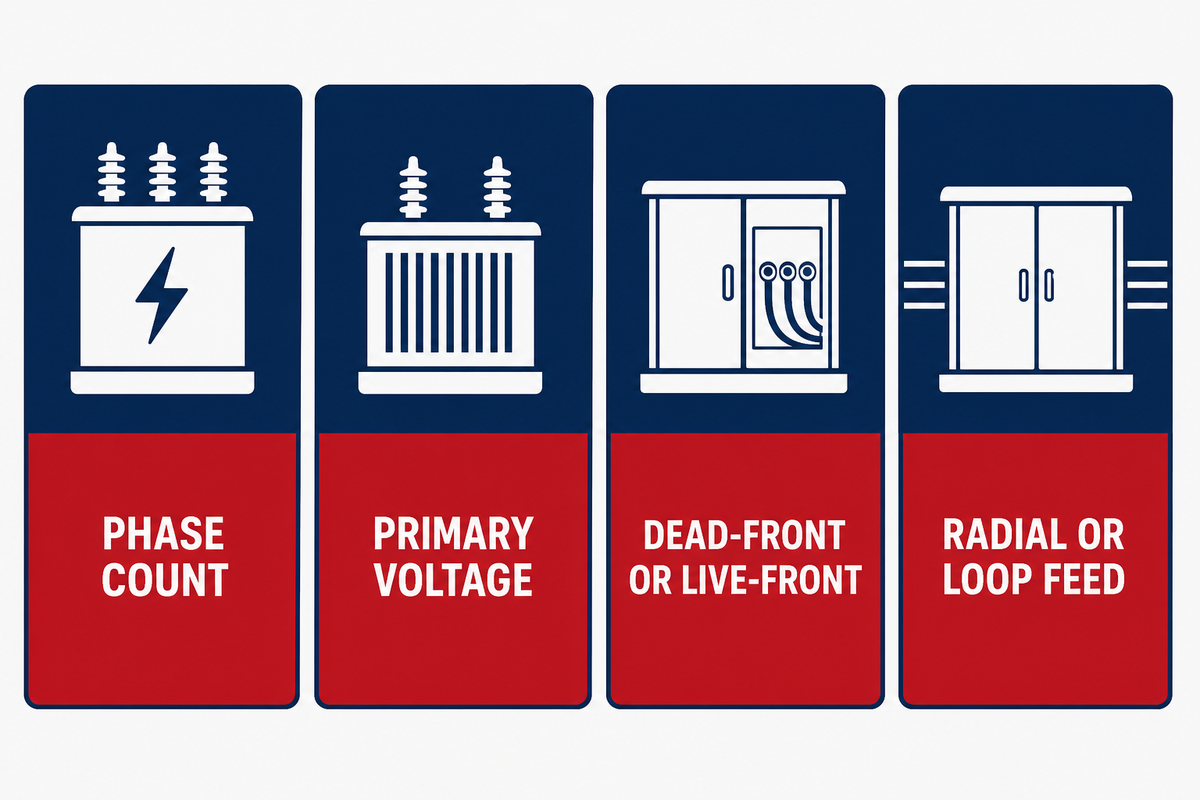
The required phase count, primary – terminal configuration and feeder topology are combined with the approved electrical design of the project to select the correct pad mount transformer configuration. Single-phase or three-phase identifies the electrical system; live-front or dead-front describes the termination; radial or loop feed describes the cable connection. None of the choices can be substituted for another.
Single and three phase pad mounted transformers
The phase count follows the electrical power supply and load; for a compartmental type transformer, the drawing identifies equipment compartments and cable interfaces. Three-phase (3-phase) equipment needs a specified winding connection. Underground power distribution requires compatible terminations and an approved feeder arrangement; distribution networks don’t all use the same configuration.
Use the single-phase pad-mounted configuration page to review that product branch.
| Axis | Choices | Confirm with the engineer | Common misreading |
|---|---|---|---|
| Phase count | Single-phase or three-phase | Load, supply system, winding connection and neutral requirements | A larger kVA automatically means a particular phase count |
| Primary front | Live-front or dead-front | Termination type, interface rating and access requirements | Dead-front means equipment is safe for unqualified access |
| Feed arrangement | Radial or loop provisions | Cable arrangement, switch functions and protection study | Loop feed automatically provides transfer or redundancy |
IEEE’s public scopes for single-phase C57.12.38-2025 and three-phase C57.12.34-2022 describe radial and loop terminal arrangements while excluding complete accessory-device requirements. A loop-capable tank doesn’t by itself specify a transfer scheme, protection coordination or the serving utility’s operating arrangement.
Include primary and secondary connections, grounding requirements, neutral availability, and cable interfaces in the same drawing review. While the Toplit pad-mounted product range can assist in answering the request, the feeder design must be resolved by the project engineer and utility. Transformer installation and maintenance, including any energized equipment work, belong to qualified personnel working under the applicable electrical safety procedures.
How to compare electrical ratings, losses and factory evidence
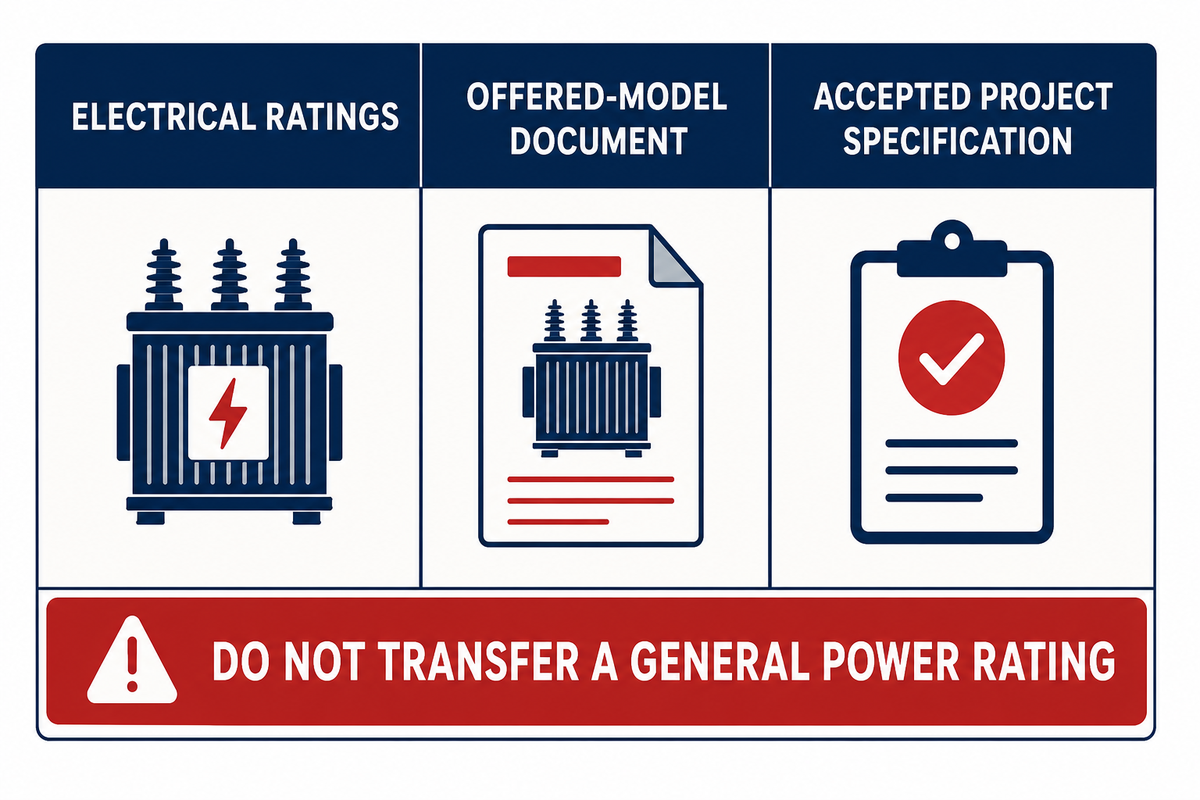
An electrical comparison requires one offered-model schedule including capacity, voltage, frequency, impedance, temperature basis and guaranteed losses, to be followed by an agreed-upon test package. A family maximum can identify a candidate, but only model-specific data and accepted deviations allow engineering and procurement to assess the proposed equipment on an equal basis.
Efficient power distribution should be analyzed in terms of guaranteed losses and specified duty. Start with continuous kVA and the cooling basis. Capture the ambient temperature, altitude, loading cycle, and any overload duty for the engineering review. A fan-assisted rating shouldn’t be silently compared with a self-cooled rating. Primary voltage, secondary voltage and winding connection must be in accordance with the project; BIL is an impulse-insulation specification and isn’t the normal operating voltage.
Request guaranteed no-load and load losses with the test and reference temperature basis. Finance can then compare lifetime energy implications using the project’s load profile and evaluation method. One single efficiency percent, in the absence of the load point, temperature, regulatory class, and a defined application, is insufficient. Fault levels and the ability to operate the system in parallel are design-related. Therefore, the agreed upon impedance and tolerance should be recorded.
Factory tests: electrical and mechanical design requirements
A test schedule that’s of any use, indicates the applicable standard, acceptance limits, the format in which the report is to be prepared, and if a witness is required. Different types of evidence include ratio, winding resistance, no load/load loss and impedance measurements, as well as specified dielectric tests. Temperature rise, impulse and short circuit tests all require an agreed upon scope. Each physical unit won’t undergo every design verification test.
The reviewed product material states routine reports and project specific special testing. Buyers should know which documents along with the serial number will be provided, which reports are for a representative design, and which tests impose an additional cost or time constraint. A factory photo won’t address these concerns.
For example, the public scope of IEEE C57.12.34-2022 covers the specified three-phase class up to 10 MVA, a 34.5 kV high-voltage system and 15 kV low voltage. A supplier’s larger published envelope requires a separate engineering basis; procurement should check that scope before accepting a test reference.
Insulation fluid, windings, protection and enclosure choices
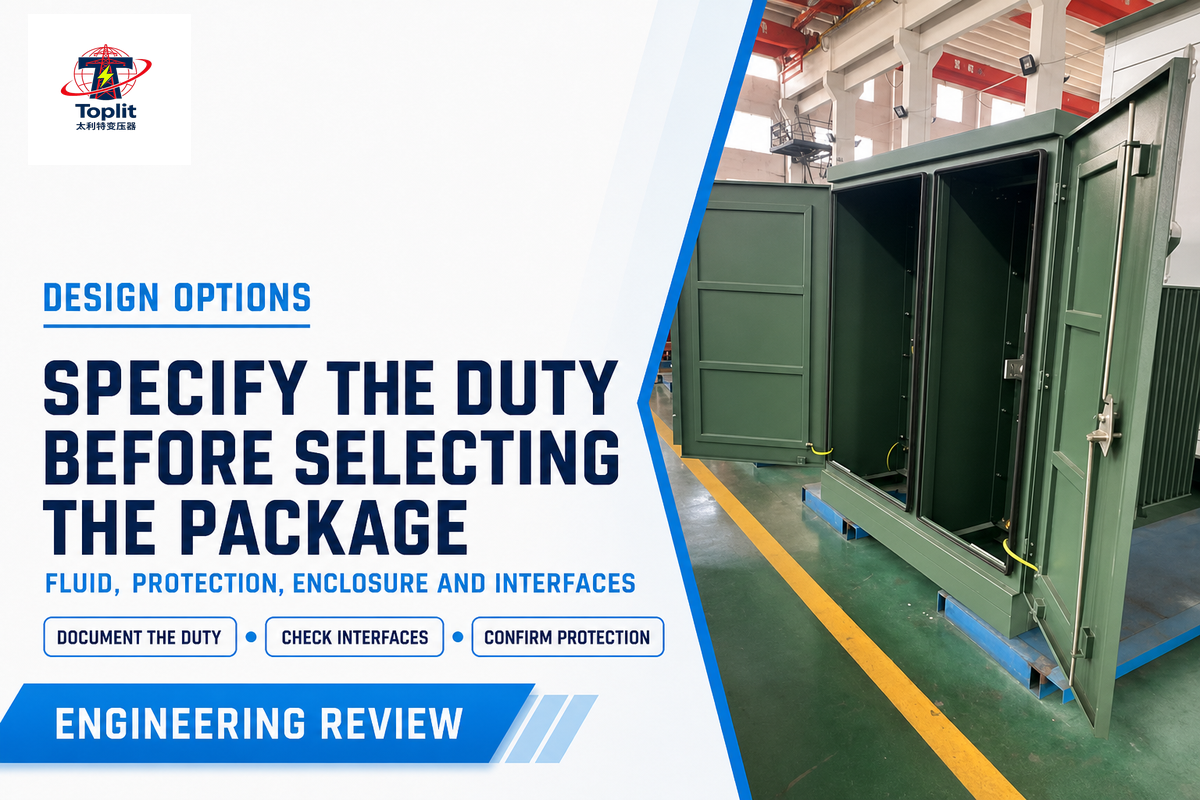
Construction should follow the specified electrical duty, site environment and protection scheme. The offered design should state its fluid, winding material, cooling and enclosure requirements. Compare the resulting guaranteed performance and interfaces; a preferred material or accessory label alone does not establish lower lifetime cost or project acceptance.
Customer specifications for industrial and commercial applications
Options for mineral oil and natural ester should be considered in conjunction with the tank design, temperature limits, environment, and local installation requirements. Cargill’s reviewed FR3 material states approval and classification of the fluid. This evidence doesn’t certify a completed transformer or independently authorize a building clearance. Confirm cold-weather requirements, as well as containment and fire concerns, with the relevant project stakeholders.
Selections for copper and aluminum windings are design decisions. Analyze offered units for guaranteed losses, temperature rise, dimensions, mass, and connection. The performance of the conductors isn’t established by the name alone. Likewise, a steel and stainless-steel enclosure requires a corrosion environment, a coating system, and a specified acceptance basis.
Separate no-load taps, loadbreak switching, sectionalizing functions, Bay-O-Net fuses, current-limiting fuses, arresters, and circuit breakers in the bill of materials. Each serves a different purpose. The protection study should determine coordination, interrupting ratings and interfaces; a long option list doesn’t equal a completed protection design.
For designs involving coastal exposure, flooding, seismic requirements, high altitude, or other harsh conditions, request the design allowances and supporting data prior to releasing the drawings. For equipment requiring IP or NEMA ratings, ensure the correct scope is addressed. Metering transformers, communications, temperature or liquid-level devices and remote alarms should also be identified as included, optional or excluded.
Remanufactured equipment needs a separate history check
Ask for the serial and nameplate history, work performed, replacement-fluid records, relevant environmental documentation and the test report for the supplied unit. Contamination with PCBs and their related disposal concerns are addressed in the US Environmental Protection Agency’s guidance on used oil. This guidance on collection centers and recyclers isn’t a blanket transformer listing rule. It’s more appropriate to prepare a provenance review specific to the unit and jurisdiction.
Standards, efficiency requirements and utility acceptance
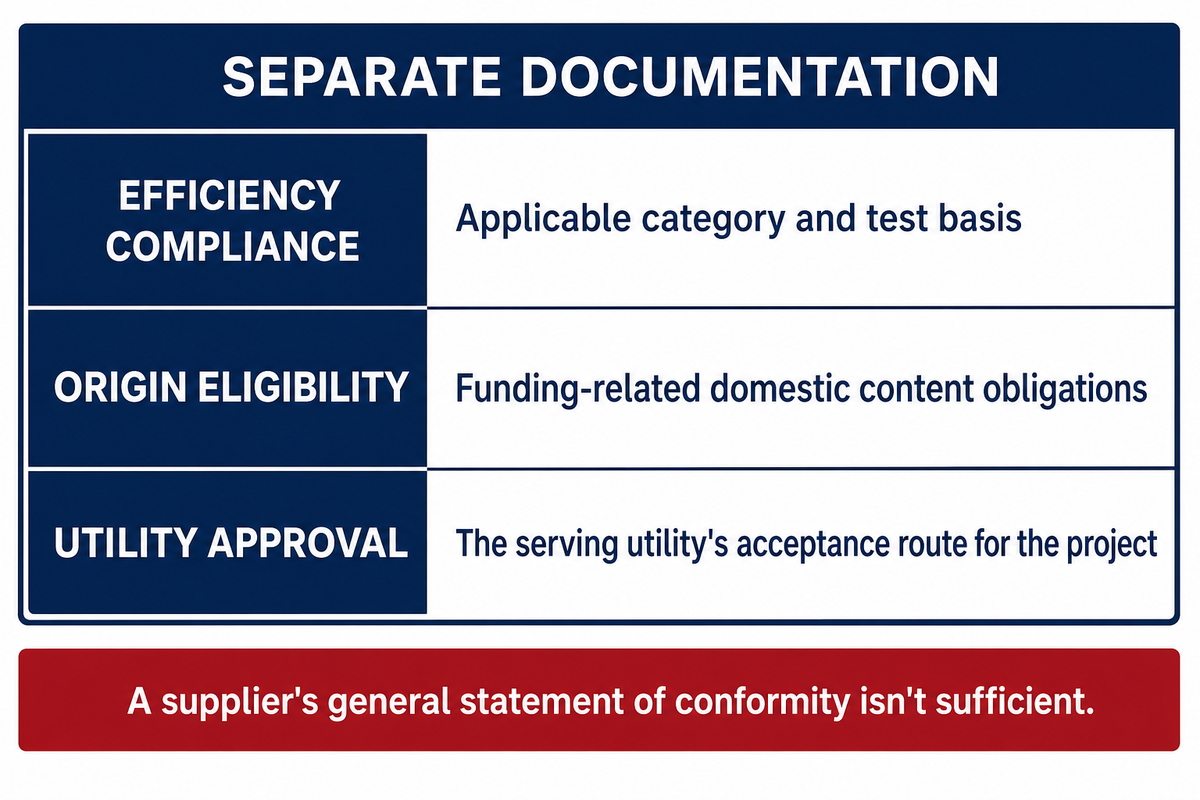
For the offered transformer, the references to standards, energy efficiency compliance, and third-party product listings as well as utility acceptance require separate documentation. The applicable editions and project requirements will be identified by the responsible engineer. Procurement should obtain the matching certificates, reports and approvals. A supplier’s general statement of conformity isn’t sufficient.
| Evidence | Use | Boundary |
|---|---|---|
| IEEE C57.12.38-2025 | Specified single-phase, 60 Hz, liquid-filled, self-cooled padmount class, 250 kVA and smaller | Its voltage and configuration scope applies; accessory requirements are separate |
| IEEE C57.12.34-2022 | Specified three-phase, 60 Hz, liquid-immersed, self-cooled compartmental class up to 10 MVA | High-voltage system up to 34.5 kV and low voltage up to 15 kV; not every product called padmount falls within it |
| IEC or CSA design/test basis | Requirements agreed for the destination and equipment class | Request exact standards and editions; the acronyms alone do not prove certification |
| UL listed products, cUL listing or other third-party approval | The covered product, model, factory and conditions | Verify the file and scope; do not transfer a fluid or component classification |
| ISO 9001 certificate | The covered organization’s quality-management system | Not an individual transformer’s electrical performance or product listing |
| Utility approval | The serving utility’s acceptance route for the project | Approval by one utility does not establish approval by another |
Apply the correct US efficiency schedule
The current version of 10 CFR Part 431, Subpart K contains the requirements for covered distribution transformers. The applicability is determined by the equipment class definition and listed exclusions. Section 431.196 defines liquid-immersed schedules based on date of manufacture and for the revised requirements, submersible status. The compliance date for the revision is April 23, 2029.
For liquid-immersed equipment, the tabulated efficiency values use a 50% load point. Request evidence for the applicable category and test basis rather than extending a familiar percentage to an unlisted rating. The regulation’s interpolation provisions don’t authorize extrapolating beyond the available surrounding table values. A product’s maximum kVA range doesn’t by itself determine regulatory coverage.
DOE’s June 15, 2026 request for information sought additional input; it didn’t rescind or delay the requirements in and of itself. Review separately funding-related domestic content obligations. Efficiency compliance, origin eligibility and utility approval must be shown in the submission register in separate lines.
When not to buy on a catalog claim
Hold an order when the seller can’t identify the offered model, manufacturing entity or accepted deviations. A 35 kV family label doesn’t satisfy a particular primary connection, cable interface or BIL. A product with the correct kVA may be outside the project’s listing, sourcing or utility requirements.
For example, a buyer comparing a new custom build to a remanufactured stock unit shouldn’t consider the difference in price as a saving until the condition, fluids, test and warranty are resolved. That’s a hypothetical purchasing comparison, not a finding about any named supplier. The DOE sourcing guidance and EPA used-oil guidance explain why electrical matching alone may leave other obligations unresolved.
Approval should also wait for assumptions related to a special test, enclosure requirement or protection accessory. Send a written deviation schedule to the engineer and commercial team. Resolve each exception, document the acceptance of the exception and request the revised offer. A supplier comparison can’t replace that project-level decision.
What changes a pad mounted transformer quotation?
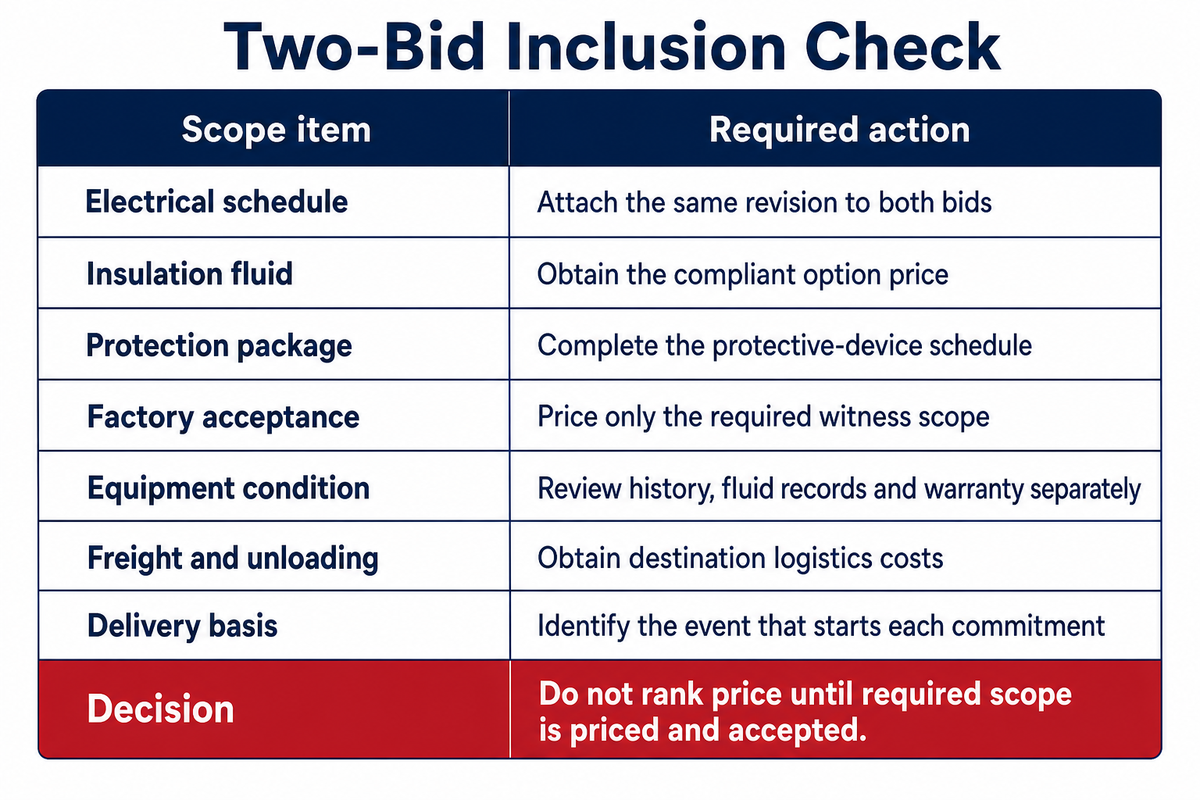
A quote for a pad mounted transformer changes with the electrical design, materials, accessories, test obligations, quantity and the commercial terms, even if the headline kVA is the same as another quote. Equalizing those fields makes the difference in the extent of the work. Even competing factories can quote different prices and times for the same requirements, so current project quotes are necessary.
Two-Bid Inclusion Check
Two-Bid Inclusion Check separates a confirmed match, an accepted deviation and an unresolved exclusion before commercial comparison.
| Scope item | Offer A | Offer B | Required action |
|---|---|---|---|
| Electrical schedule | Matches approved schedule | Matches approved schedule | Attach the same revision to both bids |
| Insulation fluid | Specified ester included | Mineral oil base; ester optional | Obtain the compliant option price |
| Protection package | Named switch and fuses included | Switch included; fuse coordination unresolved | Complete the protective-device schedule |
| Factory acceptance | Routine reports included | Routine reports included; witness cost excluded | Price only the required witness scope |
| Equipment condition | New build | Remanufactured unit | Review history, fluid records and warranty separately |
| Freight and unloading | Freight included; unloading excluded | Ex works | Obtain destination logistics costs |
| Delivery basis | After drawing approval | Subject to accessory confirmation | Identify the event that starts each commitment |
| Decision | Technical review still required | Exceptions remain open | Do not rank price until required scope is priced and accepted |
Engineering owns the electrical exceptions; quality owns the evidence and the condition; procurement owns inclusions; finance compares the accepted total. No public fixed-price schedule establishes a current market price for every configuration. The lowest base figure can remain the best offer, but only after missing requirements and the commercial responsibilities are disclosed.
Information Needed for a Pad Mounted Transformer Quote
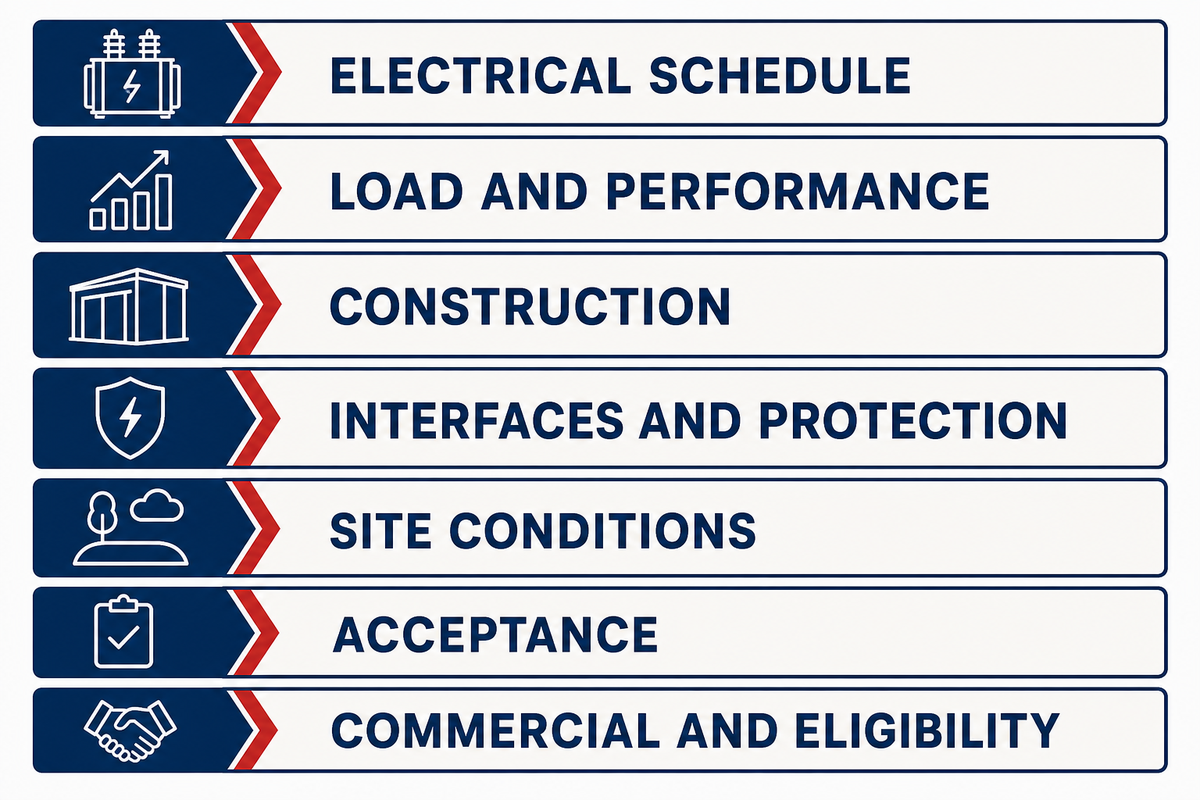
A valid pad-mounted transformer quote request includes the approved electrical duty, site conditions, protection requirements, acceptance documents and specific needs for the quantity, destination and delivery. Send the same revised request to each candidate to ensure that the supplier provides a complete quote and an explicit deviation list, as opposed to making assumptions to fill the gaps.
- Electrical schedule: phase count, kVA, frequency, primary and secondary voltage, winding connections, grounding/neutral requirements, BIL, tap range and agreed impedance with tolerance.
- Load and performance: continuous and cyclic loading, power factor, expected load profile, guaranteed no-load and load losses, temperature-rise basis, overload requirements and any parallel-operation conditions.
- Construction: dead-front or live-front, radial or loop feed, fluid, conductor preference or performance-based alternative, cooling, tank/enclosure material and coating requirements.
- Interfaces and protection: bushing ratings, cable sizes and entry, switch functions, fuses, breakers, arresters, metering, control power, monitoring and communications.
- Site conditions: ambient range, altitude, corrosion exposure, flood or seismic requirements, footprint, access, foundation interface, cable-bending space and transport restrictions.
- Acceptance: utility specification, standards and editions, required listing scope, routine/type/special tests, witness points, reports, drawings, manuals and spare parts.
- Commercial and eligibility: quantity, new or remanufactured condition, destination, freight/unloading, delivery milestone, warranty, origin requirements and applicable funding documentation.
Solar, battery storage, EV charging and data center transformer applications
Customer specifications for EV charging and data center projects should similarly define the load cycle and power-quality requirements for review by experienced engineers. Energy efficient equipment selection depends on that duty and the guaranteed loss basis.
For solar or battery energy storage systems, include inverter or power-conversion-system data, operating voltage range, power-flow direction, harmonic information, grounding arrangement, load cycle and relevant fault/protection assumptions. Request an engineering review of the complete duty. A standard distribution nameplate doesn’t necessarily affirm suitability for inverter connections.
Assume a storage project that cycles between charging and discharging, and one that predominantly exports solar power during daylight. The engineer should outline the duty and the loss criterion prior to suppliers selecting a design. It’s preferable to avoid asking vendors to guess these circumstances based on “solar transformer” or “BESS transformer” alone.
2026 outlook: qualify the specification before reserving production
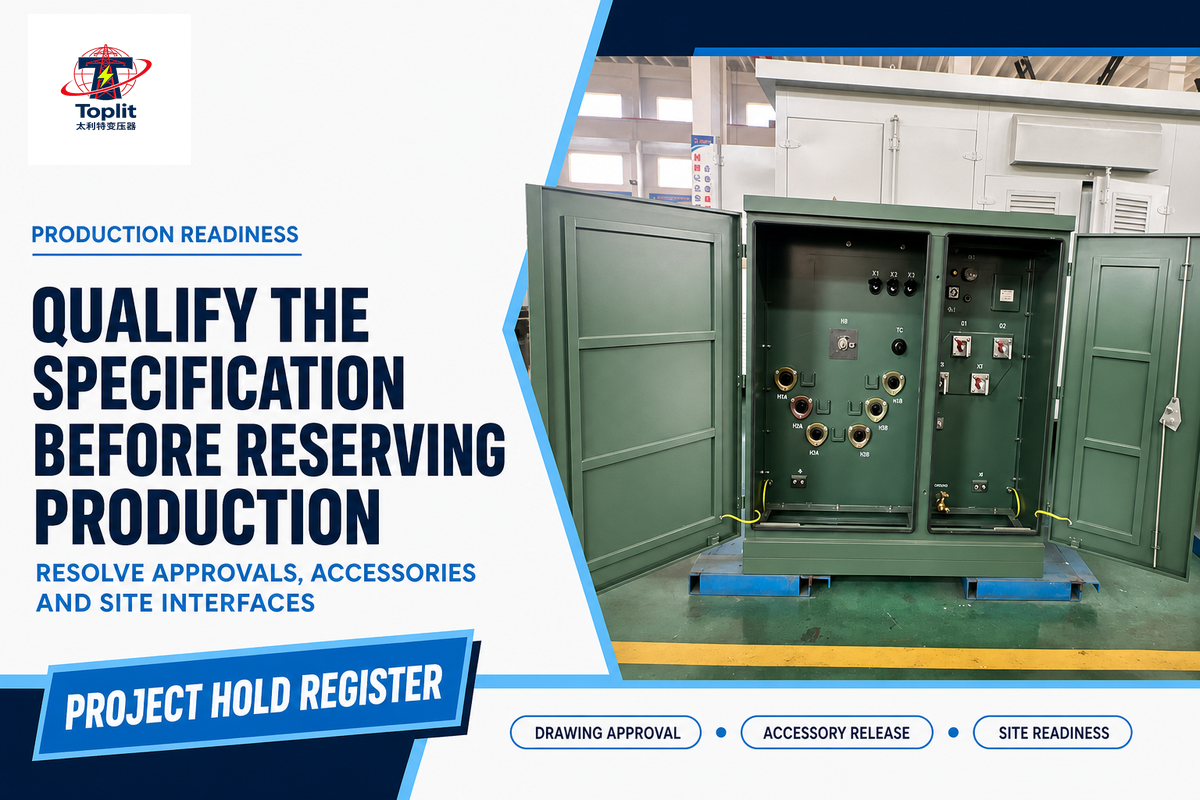
Transformer procurement in 2026 should use supplier-specific commitments and resolve specification dependencies early, because delivery conditions vary by product and accessory package. While dated comments from the industry may address the delivery issues, they can’t confirm the promised delivery of a certain factory model or project.
At the Department of Energy’s March 5, 2026 transformer convening, National Grid’s Hernan Yepez discussed reducing specification complexity. In the same event, Prolec GE’s Carlos Gaytan said distribution-transformer lead times had normalized in recent months while some special components remained constrained. Those are attributed observations from that event, not one market-wide lead time.
Factory-Date Hold Register
Factory-Date Hold Register identifies an unresolved approval or interface that can prevent a quoted delivery from maturing into a usable installation.
| Dependency | Possible unresolved item | Evidence to close it | Accountable party |
|---|---|---|---|
| Project eligibility | Origin rule or required listing unresolved | Accepted document package or applicable waiver | Procurement and project owner |
| Design approval | Utility bushing or protection requirement differs | Approved drawings and deviation schedule | Engineer, supplier and utility |
| Accessory release | Special fuse, breaker or switch unconfirmed | Named component and supplier commitment | Supplier and engineer |
| Factory acceptance | Witness test or report acceptance pending | Agreed test plan and released reports | Quality and engineer |
| Site readiness | Foundation, cable interface or access incomplete | Accepted interface drawings and site release | Project contractor |
| Commissioning authorization | Required inspections or utility release outstanding | Project-specific approval record | Qualified commissioning team and utility |
Manufacturing plants in North America and beyond may offer separate product families. Neither plant location nor general expansion notices can confirm the delivery of the specified model.
A hypothetical factory expansion provides a good example of this situation: delivery of equipment alone won’t resolve an unapproved cable interface or an incomplete foundation. Manufacturing and project management must be aligned on these dependencies. For the purposes of project management, consider the capacity announcements expected in the future, as well as the June 2026 DOE information request, and prioritize the current contract and operative rules.
“we still have some challenges related with the lead times of some special components”
Frequently asked questions
Who are the top transformer manufacturers?
Project fit and evidence determine a useful shortlist.
The most useful manufacturers to shortlist are those with a documented product matching the project’s electrical, construction and acceptance requirements. This comparison includes twenty candidates, with Toplit first by editorial request, and doesn’t rank market share or manufacturing quality. Review the offered model, factory, test evidence and utility requirements before treating any supplier as qualified.
How much do pad-mounted transformers cost?
A comparable price requires a complete project specification.
Pad-mounted transformer cost depends on rating, voltages, fluid, materials, accessories, testing, quantity and commercial scope. Request current quotations using the same specification revision, then compare accepted deviations, freight, unloading, warranty and delivery terms. A website price or inventory description without those details isn’t a dependable benchmark for a different project. Equivalent technical bids can still have different commercial prices.
What are common problems with padmount transformers?
Procurement problems often begin with an unresolved specification mismatch.
For buyers, preventable problems include mismatched voltage or connections, unsuitable cable interfaces, unclear protection coordination, missing test evidence and unresolved environmental requirements. Existing equipment faults need qualified assessment; a supplier comparison can’t diagnose a particular unit. Review the approved drawing and offered-model documents with the responsible engineer and utility before purchase.
Are pad-mounted transformers still used?
Current catalogs offer them for underground distribution.
Yes. Current manufacturer pages list pad-mounted equipment for utility, residential, commercial and industrial distribution. Confirm the particular model and duty with its supplier.
Does a supplier’s IEEE statement mean utility approval?
A standards reference and utility acceptance are separate.
No. An IEEE design statement doesn’t establish approval by the serving utility. Obtain the required project drawings, deviation acceptance, listing evidence where applicable and utility authorization.
To the pre-selected suppliers, send the electrical schedule and acceptance requirements. Use their written deviations to refine the list of suppliers. Buyers interested in Toplit can commence with their pad-mounted transformer specification inquiry and request the documents for the proposed design.
Do
- Compare one offered model against one approved schedule.
- Record the manufacturer, factory and supply condition.
- Resolve technical and commercial deviations before ordering.
Don’t
- Transfer a general power rating to a padmount.
- Treat a certificate logo as the complete approval file.
- Use website stock language as a project delivery promise.
Key takeaway
A qualified pad-mounted transformer offer connects the required electrical duty to an identified model, factory, test package and accepted project specification.
Editorial scope: This comparison uses public manufacturer information and cited authority sources that were reviewed in September 2026. Supplier product statements shouldn’t be confused with independent factory audits. Decision tables, editorial aids, and examples presented aren’t reported customer outcomes. No private production data, market-share ranking, or universal approval claim is presented.
References & Sources
- Build America, Buy America guidance, US Department of Energy.
- IEEE C57.12.38-2025 public scope, IEEE Standards Association.
- IEEE C57.12.34-2022 public scope, IEEE Standards Association.
- Preventing and detecting PCB contamination in used oil, US Environmental Protection Agency.
- Distribution transformer requirements, 10 CFR Part 431, Subpart K, Electronic Code of Federal Regulations.
- June 15, 2026 distribution-transformer request for information, US Department of Energy, Federal Register.
- March 5, 2026 Distribution Transformer Convening transcript, US Department of Energy.
![Pad-Mounted Transformer: How It Works [2026 Guide]](https://toplit-transformer.com/wp-content/uploads/2026/08/pad-mounted-transformer-guide-featured-150x150.png)
![Single Phase Pad Mounted Transformer Guide [2026]](https://toplit-transformer.com/wp-content/uploads/2026/08/single-phase-pad-mounted-transformer-guide-featured-1-150x150.png)