Get in touch with Talite Transformer Co., Ltd Company

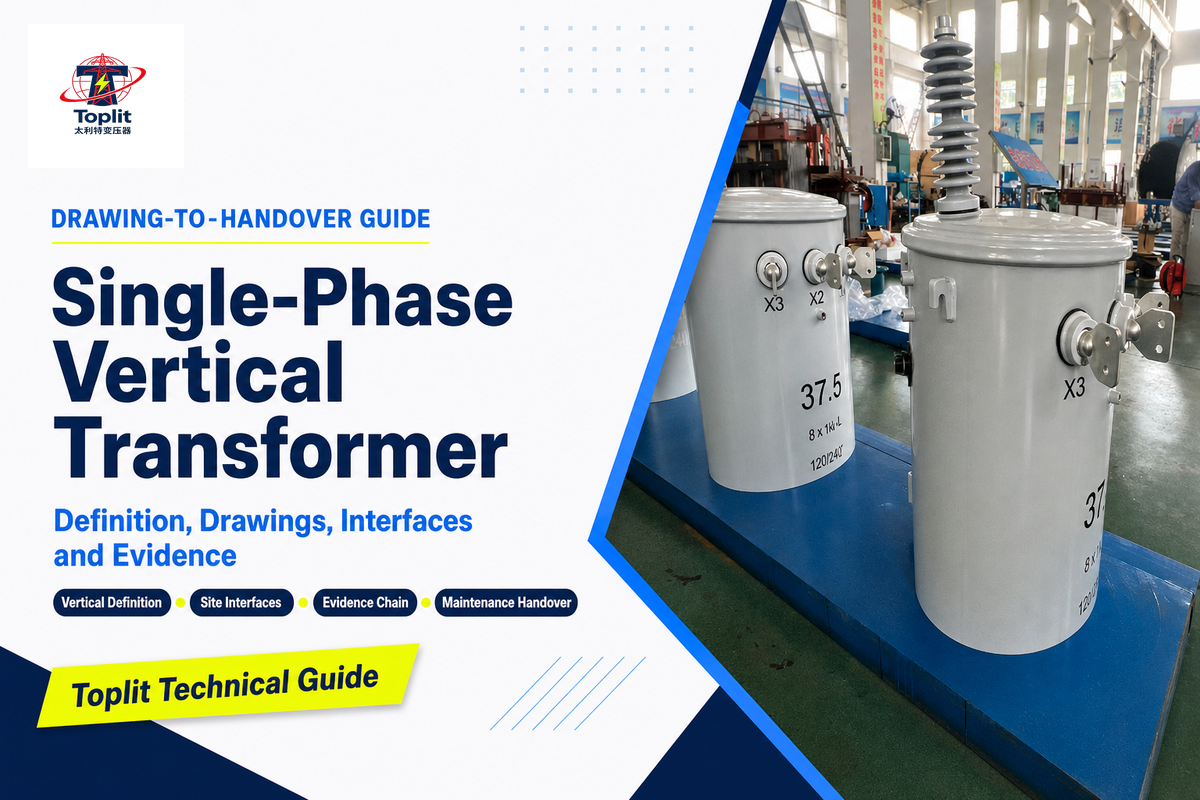
Drawing Review · Site Interfaces · Handover Evidence
A single phase vertical oil immersed transformer is a liquid-filled, single-phase unit whose requested vertical orientation still needs a project definition. “single-phase” and “oil-immersed” are descriptions of electrical phase arrangement and insulation and cooling medium, respectively. “Vertical” still needs a project definition. Before making your label an installation instruction, find the equipment class and operating attitude, and determine the support points, terminal faces, access requirements, and drawing revision level.
Updated September 9, 2026 · For owners, consultants, EPC teams, installers, inspectors, and technical buyers
Bottom line: Treat “vertical” as a project-specific geometry descriptor, not a universal mounting class. First classify the transformer. Resolve the applicable standard, approved outline drawing, connection documents, site interfaces, evidence of receiving, and the authorizing path.
If you’re looking for a model configuration, ratings, a quote, or lead time, look on the single-phase vertical oil-immersed transformer solution page. This guide is for interpretation, review, and evidence.
Quick Specs: what the phrase proves and what it leaves open
| Input | What it can establish | What still needs evidence |
|---|---|---|
| Single-phase | Phase arrangement | Voltage, frequency, connection, terminals, duty |
| Oil-immersed | Liquid insulation/cooling construction | Fluid type, preservation, containment, fire strategy |
| Vertical | A requested geometry/orientation clue | Reference surface, support, footprint, access faces, terminal direction |
| Product page | Commercial solution context | Project-specific approved data and exceptions |
| Approved package | The evidence basis for review | Which revision is contractual, final, and accepted |
The phrase doesn’t specify the additional duties of power distribution, the silicon steel core design, or the no-load loss guarantee. Those duties would be provided in the approved performance data, not in a finding based on a search term.
1. Vertical Definition Record: What Does “Vertical” Actually Mean?
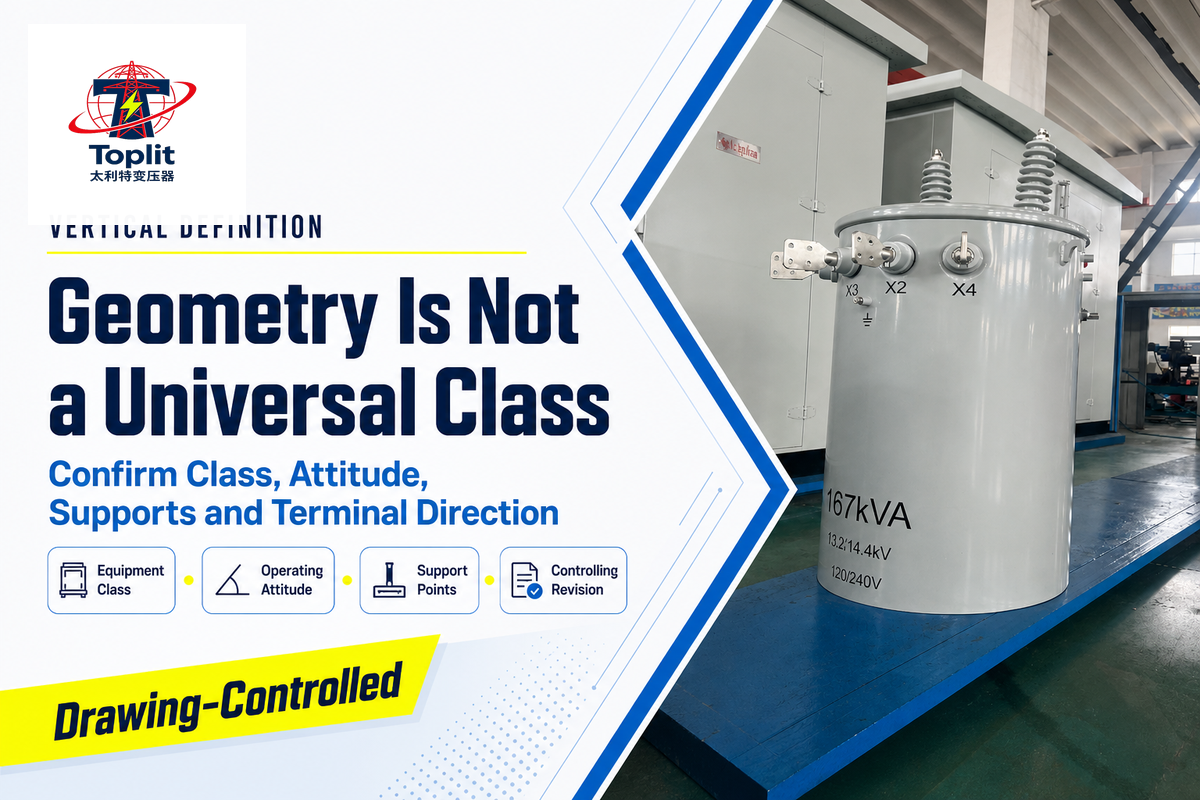
Vertical means only what the controlled project records indicate; until those records define the mounting orientation, “vertical oil-filled transformer” remains a search label. In one request, the buyer may mean a tall tank. In another, the word may mean limited attitude, small footprint, a surface for mounting, or terminal orientation. None of those interpretations can be inferred from this keyword alone.
The standardized installation classes described by these sources are distinct. The public version of IEEE C57.12.20-2023 covers a defined overhead-type liquid-immersed distribution-transformer class, whereas IEEE C57.12.23-2018 covers a defined submersible single-phase class. These examples show that classification can have dimensional and mechanical meaning. They don’t show that a supplier’s use of the word “vertical” could mean either class.
60 Hzfrequency in both cited IEEE class scopes
500 kVAupper size in the cited overhead-type scope
250 kVAupper size in the cited submersible scope
Those numbers aren’t selection criteria. They show why the project must identify class and scope before a rule can be imported. An overhead-type standard scoped to 60 Hz cannot govern equipment with a different frequency, environment, rating, or installation method.
| Field | Question to close | Acceptable evidence |
|---|---|---|
| Equipment class | Overhead, pad-mounted, submersible, substation, or another defined class? | Specification and applicable standard scope |
| Operating attitude | Which face is up in normal service? | Approved outline drawing and instructions |
| Reference surface | From where are dimensions taken? | Dimensioned datum on the drawing |
| Support points | Where does load transfer into the structure? | Base/support detail and structural review |
| Access faces | Which sides need operation, inspection, or removal access? | GA drawing, manuals, owner requirements |
| Terminal direction | Where do bushings and cable interfaces face? | Terminal arrangement and connection diagram |
| Handling attitude | Do transport and lifting orientations differ from service? | Manufacturer handling instructions |
| Environment | Indoor, outdoor, below grade, coastal, or other? | Site basis and project specification |
| Controlling revision | Which issue is approved for the current decision? | Document register and approval record |
For a visual comparison of two commonly adopted standardized designs, Toplit’s presentation on the pad-mounted versus pole-mounted transformers is a better source to find the category. Don’t use either the pad-mounted or pole-mounted category as “vertical.”
2. Approved Drawing Package: Which Record Controls Each Interface?
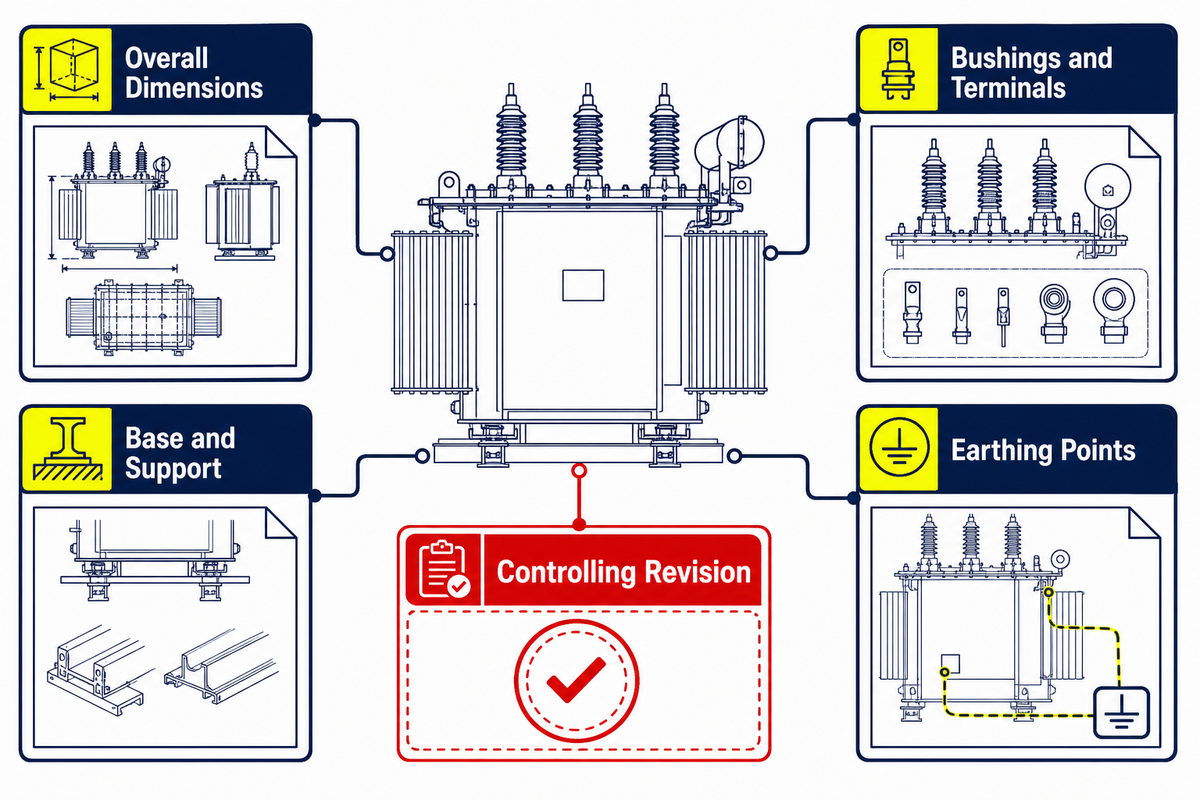
The name of the product starts the conversation. That conversation carries the equipment class and vertical definition from the first record into a controlled drawing package. Approved documents control the project review. A drawing can be coordination, approved for fabrication, modified from comments, or can be an official record. Calling all four “the drawing” creates confusion and impacts everyone working on the drawing differently.
“applies to three-phase and single-phase power transformers”
The IEC 60076-1:2011 public page confirms a broad transformer scope. However, it does not inform the project which terminal face, base detail, or arrangement of accessories was selected. These are submittal questions.
| Review field | Controlling evidence | Named reviewer | If unresolved |
|---|---|---|---|
| Overall dimensions | Dimensioned outline/GA | Designer and site coordinator | Hold physical-fit acceptance |
| Mass and center of gravity | Approved handling data | Lifting/structural team | Request confirmed values |
| Base and support | Base/foundation detail | Structural engineer | Open an interface action |
| Bushings and terminals | Terminal arrangement | Electrical designer | Do not authorize connection |
| Connection identity | Nameplate and connection diagram | Electrical/test team | Reconcile discrepancy |
| Earthing points | GA and earthing design | Electrical designer/installer | Keep interface open |
| Accessories | Accessory schedule and manuals | Package engineer | Confirm supplied scope |
| Applicable standard edition | Contract and standards register | Engineer/owner | Resolve edition conflict |
| Document status | Revision, date, approval stamp/status | Document controller | Stop release against an obsolete issue |
A Town of Apex transformer specification requests outline information for overall dimensions, weight, bushings, and terminal information. The IEEMA transformer drawing manual addresses dimensions, foundation/fixing information, terminal information, revisions, and dates. The force of these clauses varies from project to project, though the document logic is useful: records and revisions for this information are required to assign review and ownership.
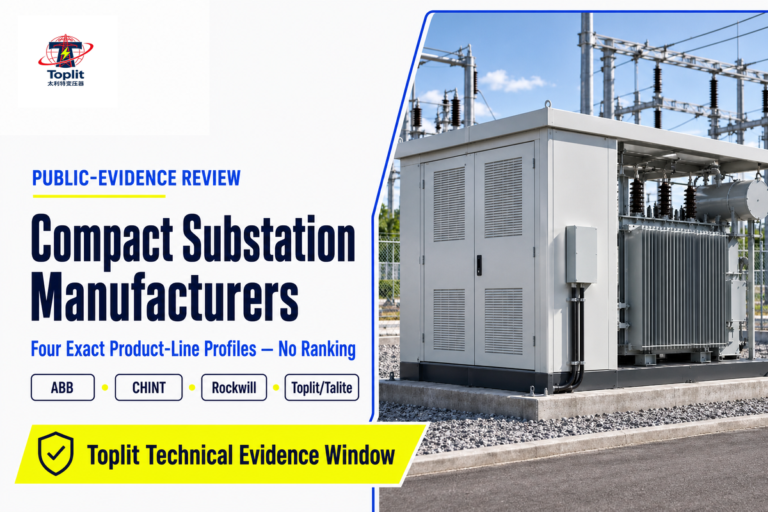
When the interface package is completed and the task becomes a product fit, revisit Toplit’s project-specific solutions page. This is the space for commercial configuration, not a second, almost identical blog.
3. Envelope, Clearance, Access Matrix: Why “It Fits” Is Not Enough
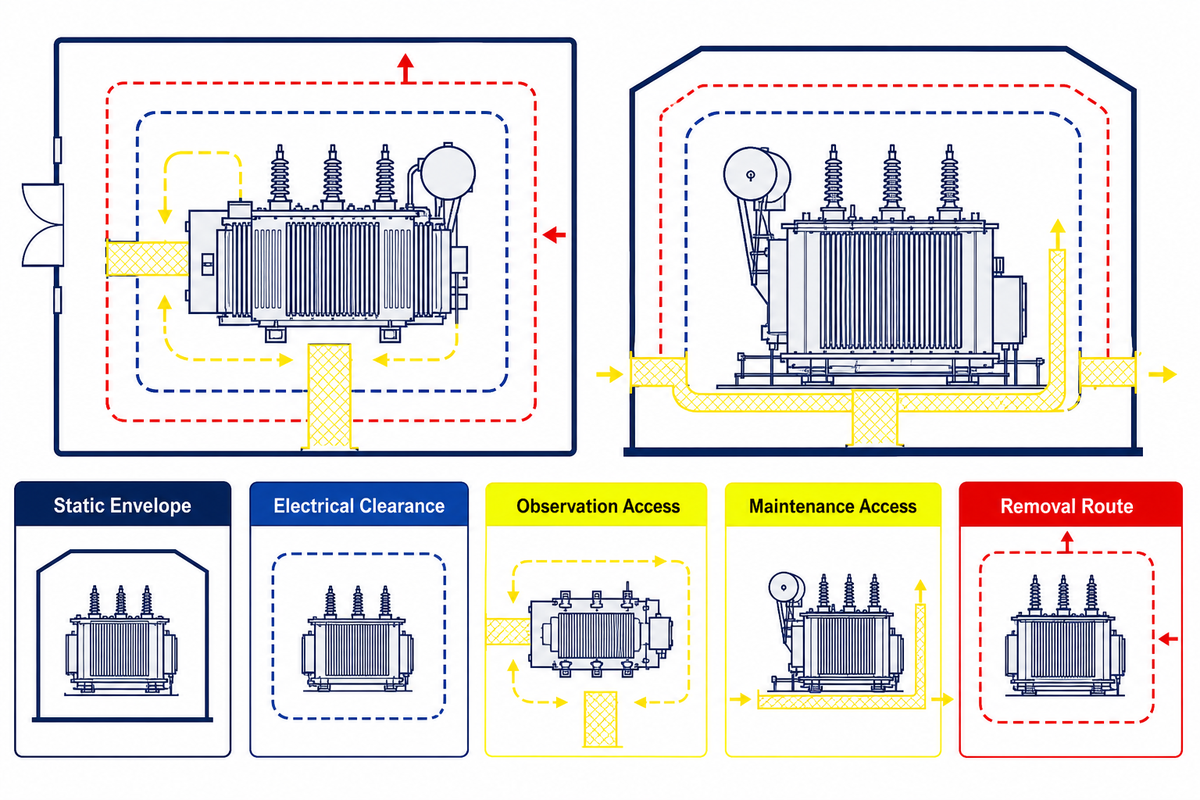
The equipment envelope is the maximum physical space occupied by an installed unit and its protrusions. Once the controlling drawing is known, the next task is to separate physical envelope, electrical clearance, and service access instead of treating them as one fit check. Electrical clearance is the space set by the approved design and the rules. Service access is the space and route needed to observe, operate, inspect, remove, or replace something. One dimension can’t be used to represent the other two dimensions.
| Constraint | Ask | Evidence source | Typical hidden conflict |
|---|---|---|---|
| Static envelope | What are the true maxima? | Approved GA/outline | Gauge, valve, radiator, or terminal projects outside tank outline |
| Operating movement | What opens, swings, expands, or is removed? | Manual and accessory drawing | Cover or door cannot open |
| Electrical clearance | Which value applies to which energized/grounded parts? | Approved design and applicable rule | Generic distance applied to the wrong voltage or environment |
| Observation access | Can indicators be read safely? | Layout and operating procedure | Indicator faces a wall |
| Maintenance access | Can the specified task be performed? | Manufacturer and owner plan | Part removal path is blocked |
| Cable approach | Does the route match terminal direction and support? | Electrical layout and cable design | Required bend/support space is absent |
| Removal route | How would the unit or major part leave? | Site logistics plan | Installed services close the route |
| Containment/drainage | Does a facility or rule require containment/diversion? | Environmental/fire design and applicable regulation | Foundation fit is mistaken for environmental acceptance |
| Emergency boundary | What route, isolation, and response space must remain? | Owner safety and emergency plan | Normal-access layout blocks abnormal response |
A universal value for clearance isn’t provided here because the correct value is some combination of the class, voltage, terminal configuration, environment, ownership, and the jurisdiction. A matrix that doesn’t guess the value is useful; it leaves a space for the value, its source, the revision, and the approver.
4. Support, Foundation, and Environmental Interface: What Must Be Proven?
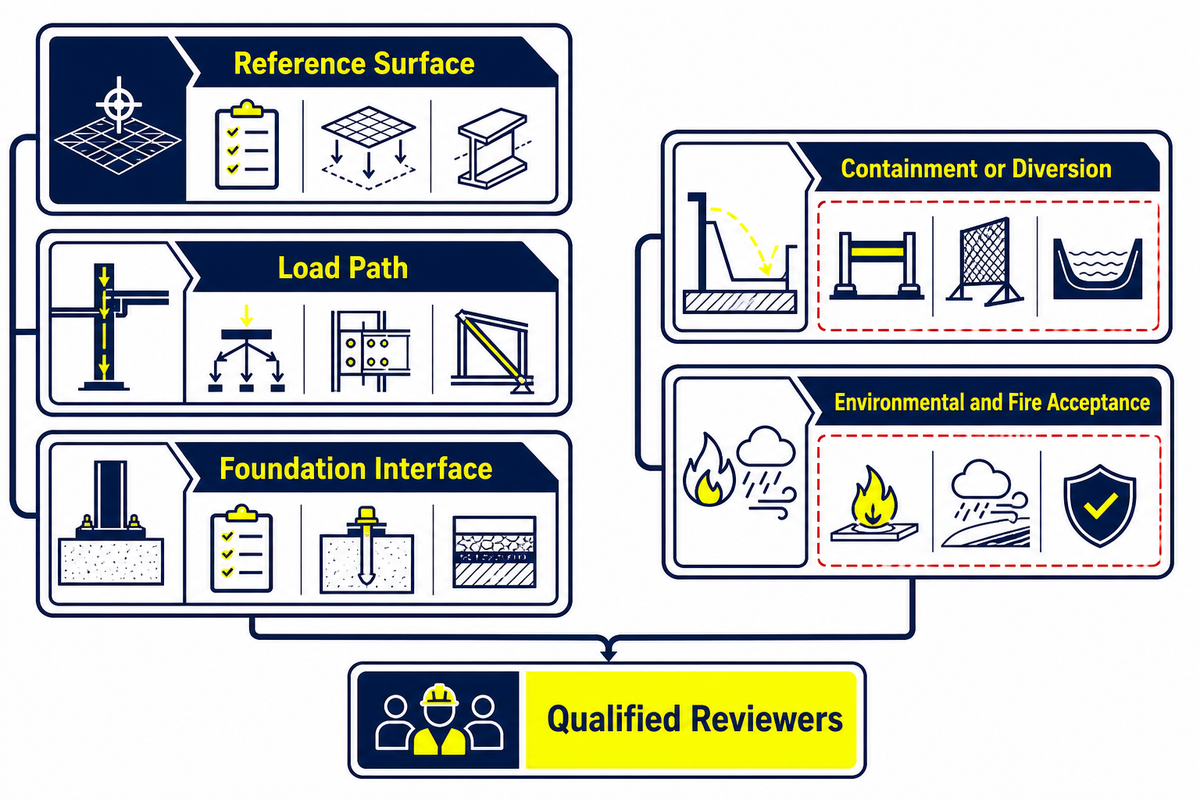
The reference surface and load path are the starting inputs. Those inputs extend the preceding envelope review into the foundation, supports, and site environment. These are the supports and fixing pattern for the equipment’s operating position and mass. The project may specify loading cases that differ from the support positions. If equipment loads transfer through those supports, a mismatch is a structural-interface issue, not a matter for field improvisation.
Keep structural acceptance separate from environmental and fire acceptance. In the United States, the EPA’s SPCC guidance for qualified oil-filled operational equipment creates a conditional containment or diversion question. It doesn’t make every transformer subject to one detail, and it doesn’t turn a gravel bed into an automatic solution. Facility scope, oil capacity, plan applicability, fire strategy, drainage, local requirements, and the authority having jurisdiction still matter.
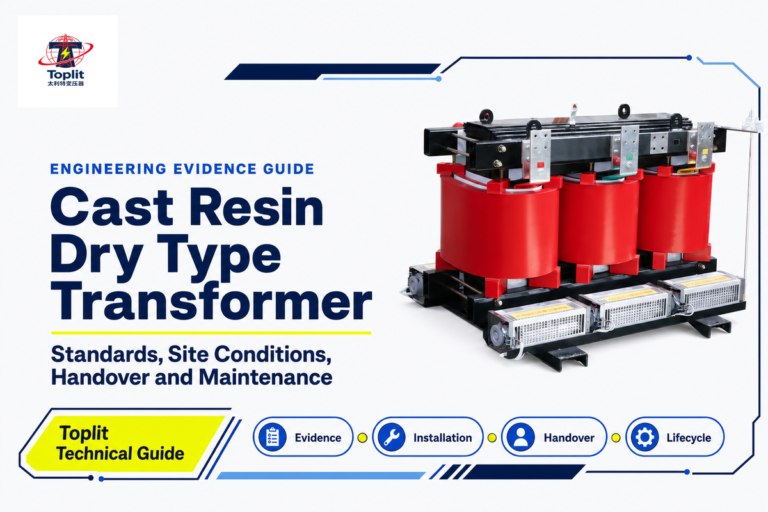
For typical applications of electrical distribution, refer to Toplit’s distribution transformer specification guide. Use the guide to aid in developing questions and not to completely revise the project’s approved structural or environmental design.
5. Terminal, Cable, and Earthing Interface Register: Which Items Need Closure?
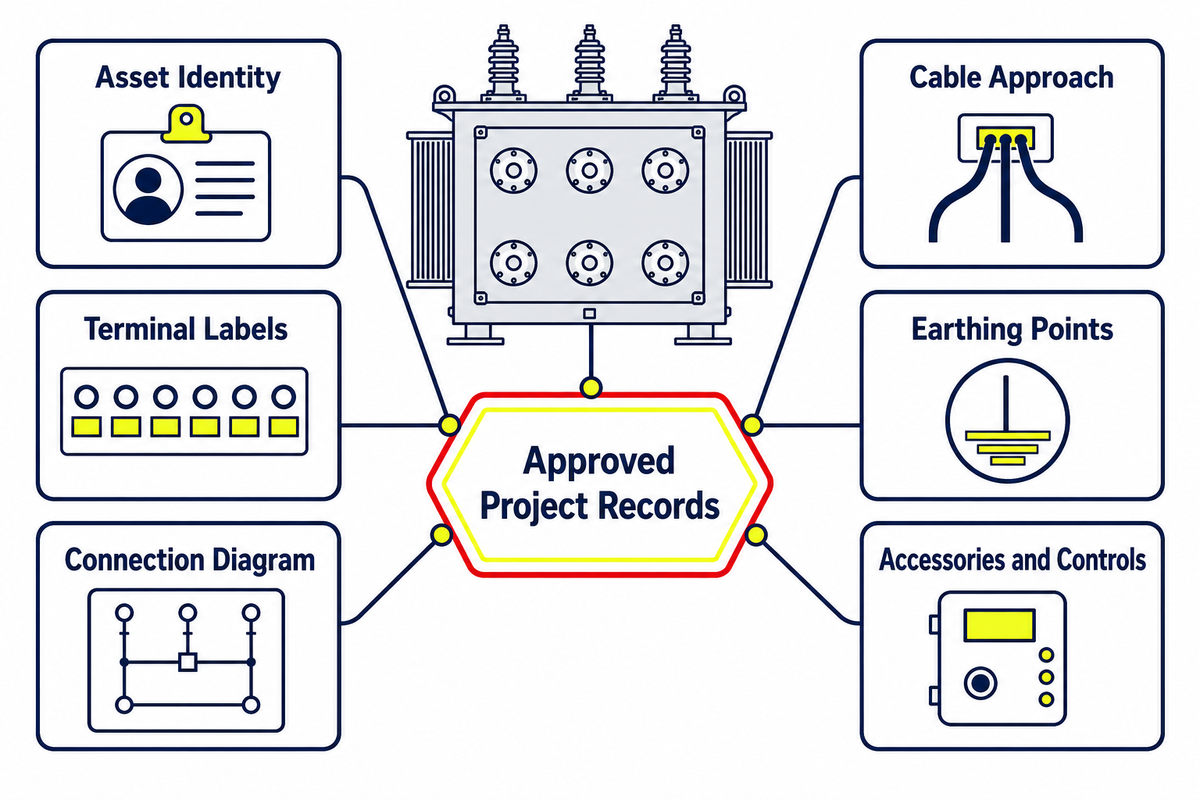
Although a generic wiring diagram may be useful during the planning phases of the project, it can’t authorize field connections. This electrical review follows the mechanical and environmental interface review; it doesn’t replace either one. The project requires unit identity, nameplate data, the approved connection diagram, terminal or bushing labels, phase/polarity information, where applicable, approach of the cable, conductor support, earthing interfaces, accessories, and the applicable work procedure.
| Interface | Evidence question | Owner |
|---|---|---|
| Asset identity | Does delivered identity match the approved schedule? | Owner/inspector |
| Terminal labels | Do physical markings match the drawing and nameplate? | Electrical/test team |
| Connection diagram | Is the approved revision tied to this unit? | Designer/manufacturer |
| Cable approach | Does direction, support, and termination space close? | Designer/installer |
| Earthing points | Are locations and project connections defined? | Electrical designer |
| Accessories/controls | Are terminals, signals, power supplies, and ownership documented? | Package/control teams |
The rules of electrical safety are dependent on the type of work and the type of installation. The approved bushing arrangement and cable clearance belong in the same interface register, but they don’t authorize energized work. The OSHA electric-power eTool scope mentions that 1910.269 outlines the operations and maintenance activities associated with the defined generation, transmission, and distribution of electric power and excludes construction work. Other requirements may apply in the case of non-US projects, construction work, or the premises wiring. The governing branch is to be determined by the employer and authority having jurisdiction.
Do
- Match identity across nameplate, drawing, and schedule
- Record the governing connection-document revision
- Assign cable, support, earthing, and control owners
- Escalate discrepancies before authorization
Don’t
- Connect from a generic online diagram
- Assume terminal direction from a product photo
- Publish universal torque or test values
- Treat this guide as an energized-work procedure
6. Receiving Evidence Chain: What Should Travel With the Delivery?
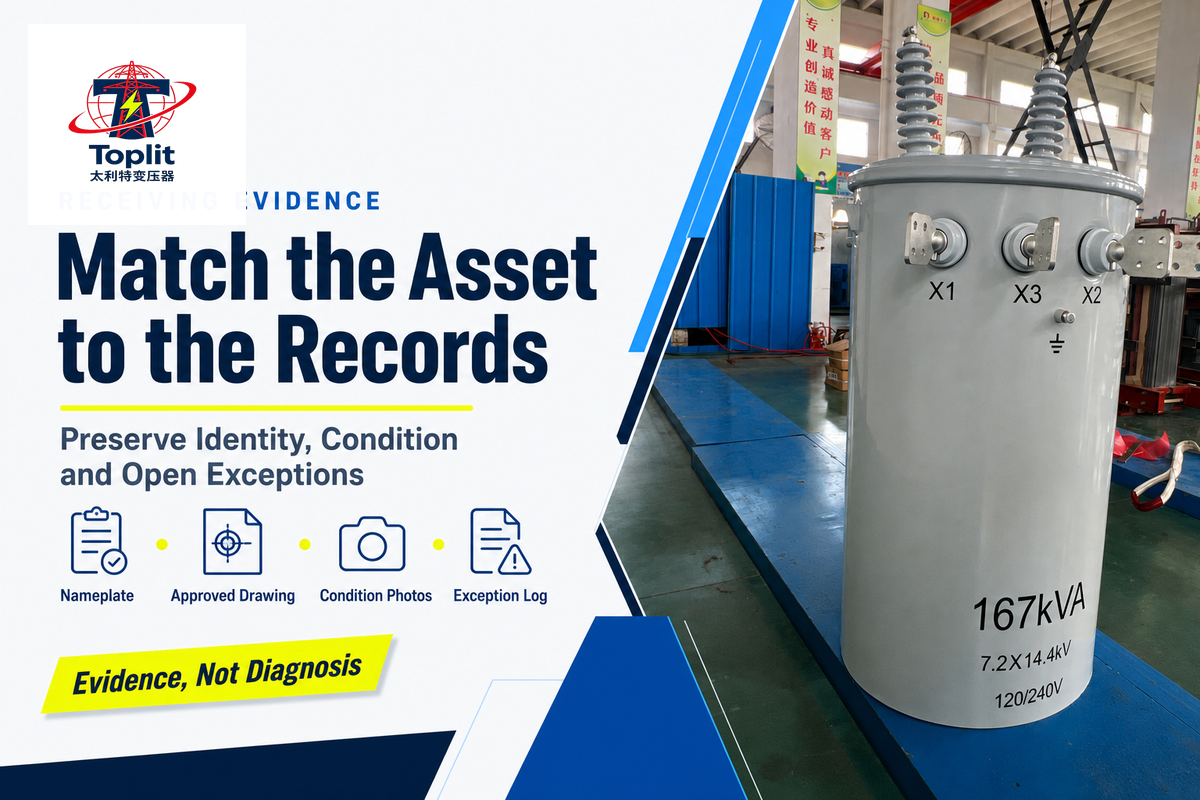
At receiving, the contractual identity is matched to the physical unit. The terminal and earthing records from the prior review now become part of that identity check. The objective isn’t to analyze the transformer at the gate. The objective is to retain a traceable record of what arrived, which documents describe it, what was observed, and which exceptions remain open.
A defensible record associates the purchase or asset identifier, nameplate, approved drawing revision, packing list, accessory list, visible package and equipment conditions, noted transport indicators, photographs, date, location, and reviewer. That receiving inspection record should preserve identity and condition without claiming a field diagnosis. A photograph without asset identity or date may show damage, but can still fail to prove which unit, event, or stage it’s associated with.
NETA World Journal’s discussion of factory acceptance and field commissioning tests states that factory records should be certified and comparable field records should be available after transport. Since test results may be produced under different conditions and configurations, it’s important to capture the test setup with the result.
This public guide doesn’t address lifting and rigging. Use the manufacturer’s handling instructions for the actual unit together with a qualified lifting plan that addresses the route, lifting points, unit mass, center of gravity, and installed accessories. Lifting methods can’t be assumed from the words “vertical” or “tank-shaped.”
For background on company manufacturing and contact information, see the company profile of Jiangsu Toplit Electric. This is company background; it isn’t evidence that the specific transformer unit passed a project-specific test or acceptance step.
7. Drawing-to-Energization Evidence Ladder: What Belongs in the Pack?
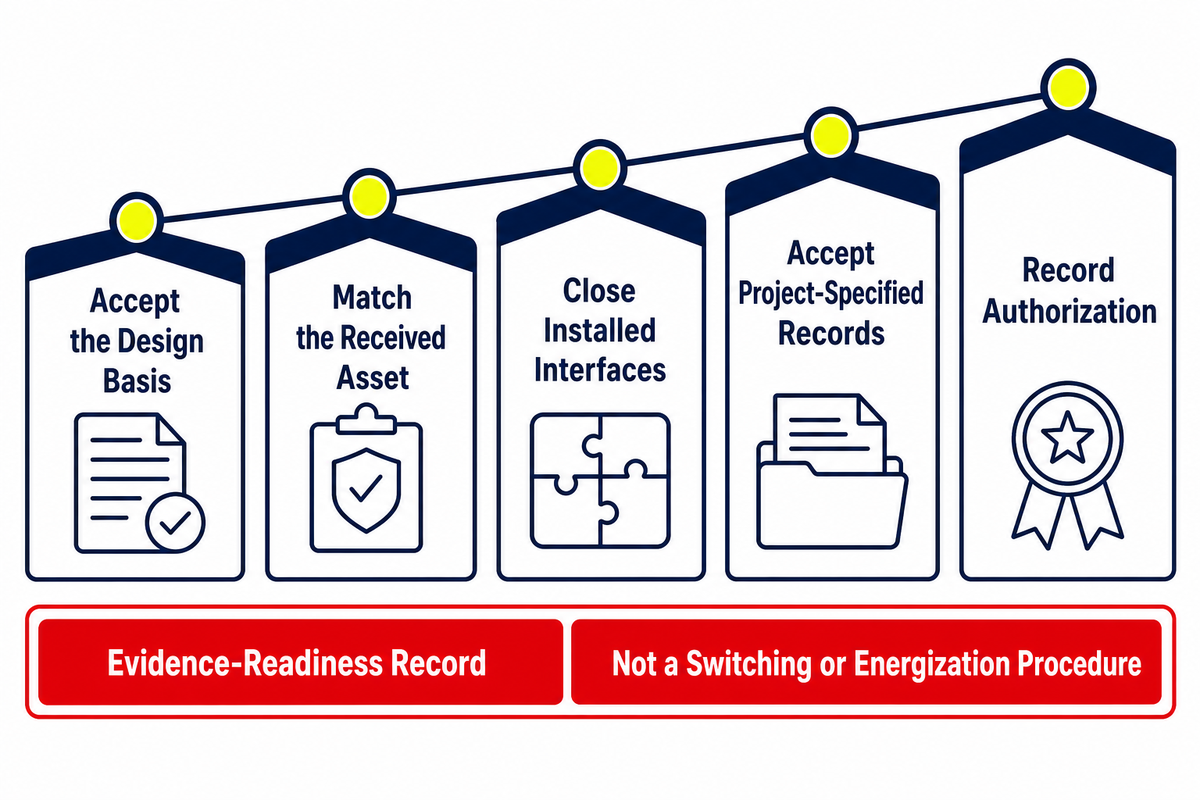
A pre-energization pack is an evidence-readiness record. Pre-energization checks connect the approved design, received identity, installed interfaces, exceptions, and named authorization path without replacing the project procedure. It isn’t a public switching, isolation, connection, testing, oil-treatment, or energization procedure. The qualified team determines the actual steps, methods, limits, acceptance criteria, and authorization.
- Accept the design basis – identify the equipment class, applicable standards/editions, approved drawings, specifications, and resolved comments.
- Match the received asset – reconcile identity, nameplate, accessories, shipment condition, and exceptions with the approved package.
- Close installed interfaces – record acceptance of support, access, environmental/fire, terminal, cable, earthing, and control interfaces by their named owners.
- Accept project-specified records – attach the qualified team’s inspections, tests, configurations, results, deviations, and reviewer sign-offs under the project procedure.
- Record authorization – close or formally disposition exceptions and capture the owner-authorized decision path before energization.
The word “accepted” must nominate an authority. The manufacturer can confirm if supplied design information is correct. The designer can accept the design interface. The installer can document the completion of installation. A test organization can produce a report. The owner can issue the final approval. One party’s signature doesn’t imply that they’ve accepted the responsibilities on behalf of the other parties.
The safety boundary is strict. OSHA’s de-energizing guidance states that equipment should be treated as being de-energized if and only if all the requirements are satisfied; otherwise, the energized-work requirements apply. This source is general, but the editor’s emphasis is universal: a document titled “checklist” can’t create a safe state.
8. Observe, Record, Escalate Matrix: How Should Operating Changes Be Handled?
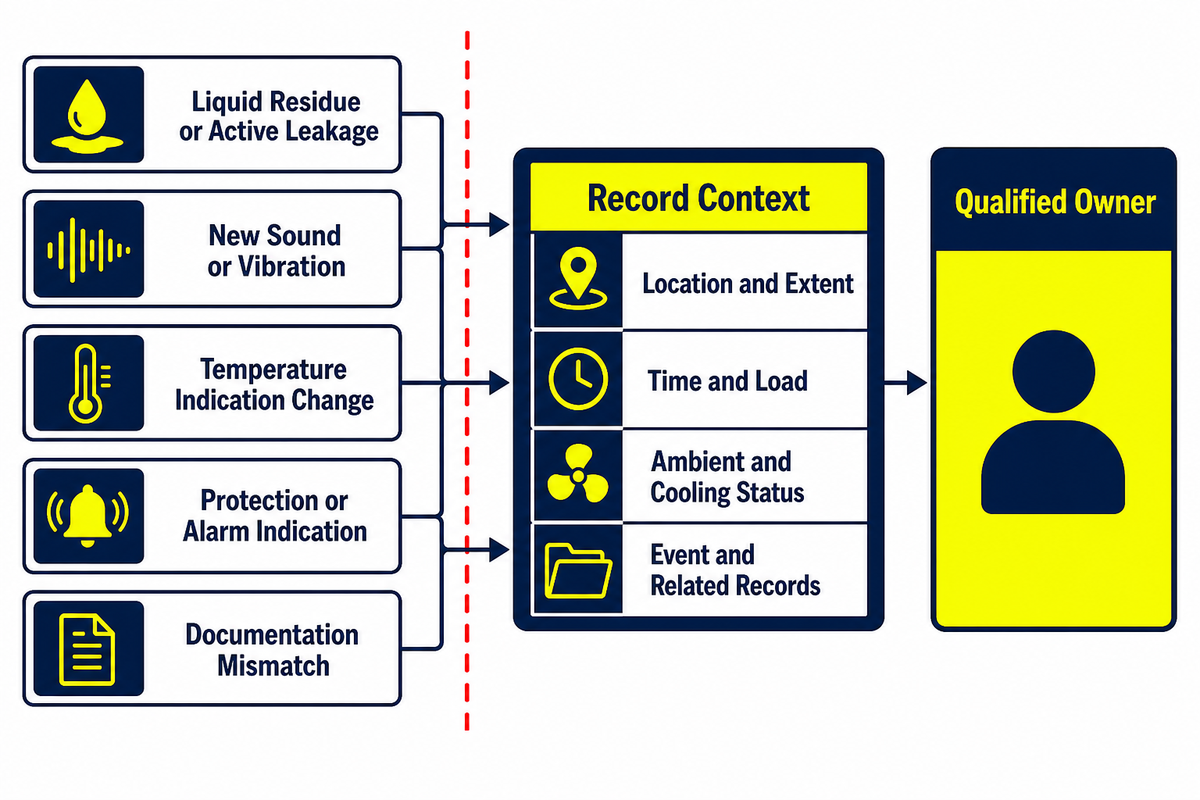
Observing a situation isn’t the same as making a diagnosis. When a leak, a sound, a change in temperature, an alarm, or a physical mark is observed, that observation must be placed in context by noting time, place, equipment identity, load and ambient conditions, associated indications, recent work and events, relevant photographs, the prevailing situation, and the source or criterion against which the situation is accepted. Then, follow the owner’s escalation procedure.
| Observation | Preserve | Do not assume | Route |
|---|---|---|---|
| Liquid residue or active leakage | Location, extent, timing, photos, level/temperature context | Residue proves the current leak source | Owner’s qualified asset team |
| New sound or vibration | Time, load/context, location, recording if permitted | One sound identifies one internal fault | Operations and transformer specialist |
| Temperature indication change | Trend, ambient, load, cooling status, instrument identity | One reading proves overheating | Operations/asset engineer |
| Protection or alarm indication | Exact indication, event time, related records | The indication is false or identifies the cause | Owner’s authorized response path |
| Physical damage | Location, extent, date, shipment/work history | Cosmetic appearance proves acceptability | Inspector/manufacturer/owner |
| Contamination or moisture concern | Exposure history and affected interface | Appearance proves internal condition | Qualified inspection/test team |
| Odor or discoloration | Time, place, associated indications, safe observations | Odor identifies a material or fault | Safety/asset response path |
| Loose or missing accessory | Part identity, drawing/list reference, condition | It is optional or safe to substitute | Package engineer/manufacturer |
| Documentation mismatch | Both revisions, asset identity, conflict description | The newest-looking file is controlling | Document controller and engineer |
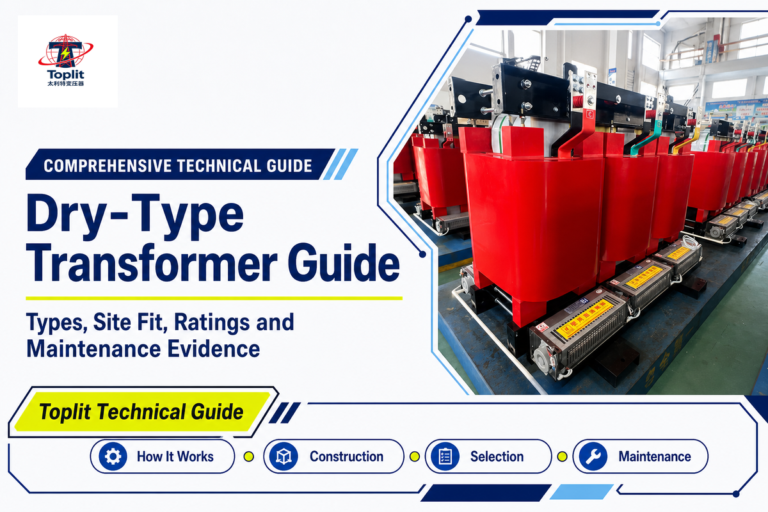
This matrix doesn’t give a universal control algorithm or field remediation. If safety, environmental, or equipment concerns arise, follow the site-specific emergency procedures and the qualified-person response process. For general oil, cooling, construction, and condition-state signals, refer to Toplit’s oil-immersed transformer fundamentals guide.
9. Maintenance Handover File: Which Records Retain Value?
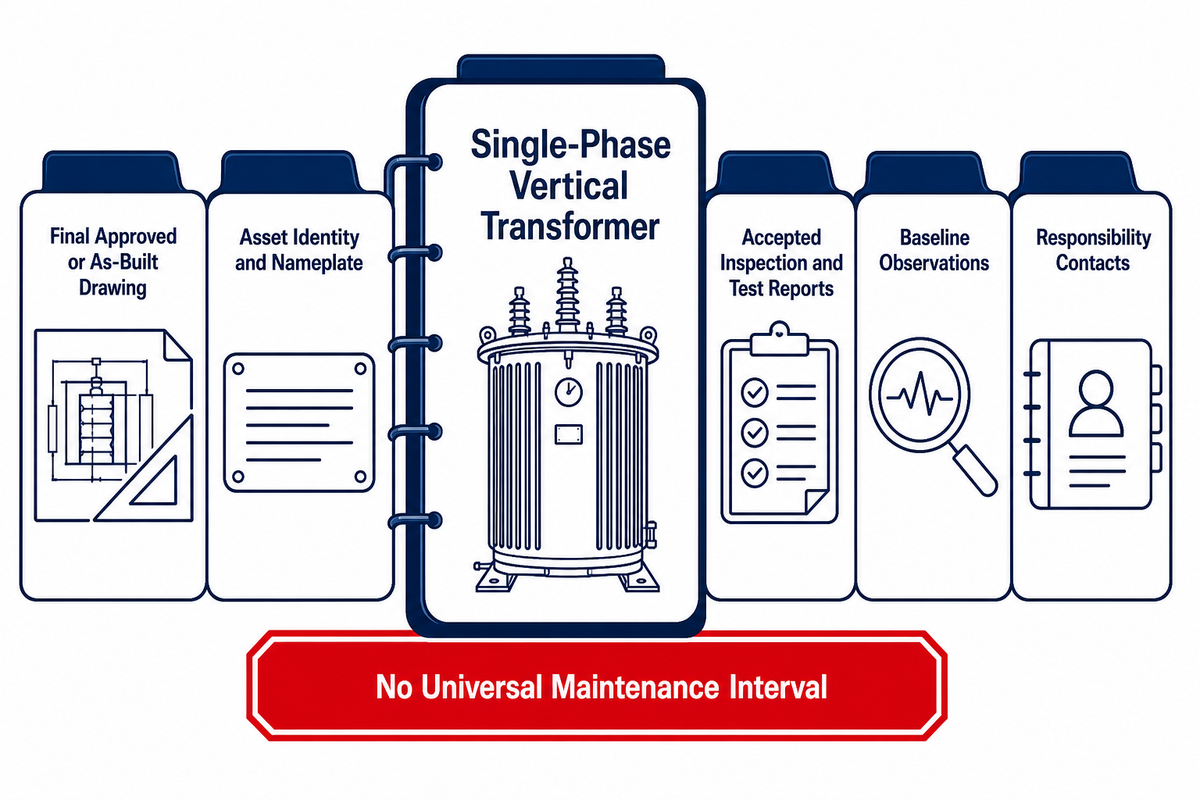
A handover file should enable the subsequent owner to answer what was finally installed, what established the accepted baseline, and who’s responsible for the next decision. It carries the preceding observation record forward as a baseline, not as an isolated maintenance note. The handover file should contain the final approved or as-built drawing revision, asset identity and nameplate records, manufacturer’s instructions, accessory records, accepted inspection and test reports, exceptions or waivers, photographs, baseline observations, and responsibility contacts.
Results must be kept with configuration. A reading—whether a measurement, observation, or test—has value only if the sample-point location, fluid condition, temperature, and test parameters are known. The same principle should apply to photographs and inspection forms.
Don’t set a universal maintenance interval. Each maintenance decision should point to the approved source, current condition evidence, and responsible owner. Applicable manufacturer instructions, owner program information, service conditions, tests performed, fluid system, accessories, applicable standard, and jurisdiction can all affect the maintenance window. Handover should document the approved source for each interval and acceptance limit, rather than just copying a maintenance schedule from the internet.
10. 5-Decision Drawing-to-Handover Record: Can the Project Pass?
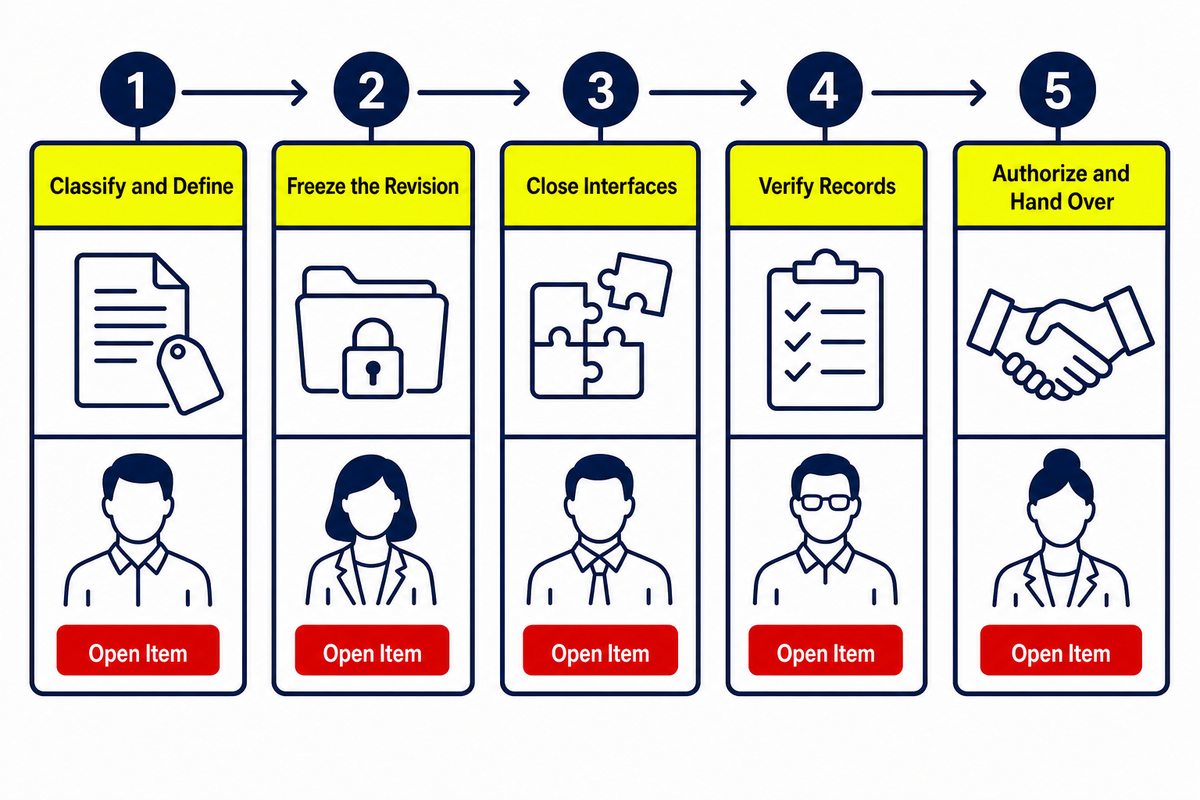
The following record is an editorial framework rather than a standard, certification or commissioning form, or maintenance plan. It organizes five decisions: classification, revision control, interface closure, record verification, and handover authorization. Its purpose is to keep assumptions from moving between teams.
| Decision | Evidence input | Named owner | Pass condition | If open |
|---|---|---|---|---|
| 1. Classify and define | Class, scope, ratings, environment, Vertical Definition Record | Designer/owner | No ambiguous geometry or scope | Request clarification |
| 2. Freeze the revision | Approved drawing/document register | Document controller | One identified issue controls | Stop dependent release |
| 3. Close interfaces | Mechanical, electrical, access, environmental/fire registers | Discipline owners | Every field has evidence and acceptance | Open assigned action |
| 4. Verify records | Receiving, installation, inspection/test, exception evidence | Inspector/test/owner teams | Identity and configuration are traceable | Reconcile or disposition |
| 5. Authorize and hand over | Closed evidence pack and responsibility map | Owner’s authorized party | Authorization and retained baseline recorded | Do not imply approval |
There’s a useful US scope example that demonstrates the first decision’s importance. The Department of Energy’s distribution-transformer page combines a number of conditions: input voltage at or below 34.5 kV, output at or below 600 V, 60 Hz, and a liquid immersed unit in the range of 10 kVA to 2,500 kVA. The revised efficiency standard comes into force on April 23, 2029. These conditions pertain to US classification and timing and aren’t a definitive description of the product phrase in this article.
Key takeaway
Classify the transformer first, define “vertical” on the controlled drawing, close each site interface with its named owner, and preserve the evidence that links delivery, acceptance, authorization, and maintenance.
Frequently Asked Questions
What does vertical mean for a single-phase oil-immersed transformer?
Answer
Vertical is a project-specific geometry or operating-orientation descriptor. It can indicate tank form, reference surface, support arrangement, access direction, or terminal orientation, but the word alone doesn’t select an overhead, pad-mounted, submersible, wall, or platform class. Confirm the equipment classification, applicable standard scope, manufacturer’s approved drawing, normal operating attitude, support points, access faces, and controlling revision before using it for design or installation.
Is there such a thing as a single-phase transformer?
Answer
Yes. Single-phase transformers are established equipment, and standards can cover single-phase units within defined classes and rating limits. “Single-phase” still doesn’t specify voltage, capacity, frequency, connection, installation class, cooling arrangement, terminal layout, or project fit. Those inputs must be established by the specification, applicable standard, nameplate, approved drawings, and manufacturer’s project records.
What is an oil-immersed transformer?
Answer
It’s a transformer whose active insulation and thermal design uses an insulating liquid around the core-and-winding assembly. The construction can support dielectric insulation and heat transfer, but the name doesn’t state the fluid family, preservation system, rating, installation class, containment requirement, maintenance program, or market compliance. Use the nameplate, approved documentation, and applicable scope to answer those questions.
Is a vertical transformer automatically pole-mounted?
Answer
No. Vertical describes geometry or orientation; it doesn’t establish a pole-mounted class. Confirm the approved class, drawing, support design, utility rules, and terminal arrangement.
Which drawing details should be approved before release?
Answer
At minimum, identify the governing revision and review overall dimensions, mass, handling references, base/support geometry, terminals or bushings, connection identity, earthing interfaces, accessories, access faces, and applicable notes. The exact package and approval status are contractual, so use the project document register rather than assuming that one generic drawing controls everything.
What should be checked after delivery but before energization?
Answer
Preserve the delivery identity, packaging condition, impact or exception records, photographs, nameplate details, and accessory list. Reconcile them with the approved drawing and document register. Confirm that support, terminals, earthing interfaces, access faces, fluid-related observations, protection interfaces, and required inspection or test records each have a named owner, recorded result, and disposition. Any transport damage, drawing mismatch, missing accessory, leak indication, unexplained reading, or open safety item should remain visible in the exception log until the authorized party closes it. This is evidence guidance only: qualified personnel must use the manufacturer, employer, owner, and jurisdictional procedures for installation, testing, isolation, and energization.
Summary: Ready to Turn the Guide Into a Project Drawing Review?
Bring the transformer class, voltage and frequency, capacity, service environment, proposed mounting/support, terminal direction, access constraints, destination requirements, and the latest approved drawing package. Toplit will discuss the configuration and documentation scope without treating a general guide as project approval.
We separated informational intent from Toplit’s commercial solution page and existing oil-fundamentals guide, reviewed current public scopes from IEC, IEEE, OSHA, EPA, and DOE, used municipal and industry-association drawing documents, and challenged every universal mounting, clearance, wiring, testing, and maintenance assumption.
References & Sources
- IEC 60076-1:2011, Power transformers, general scope and edition status
- IEEE C57.12.20-2023, overhead-type liquid-immersed distribution transformer scope
- IEEE C57.12.23-2018, submersible single-phase transformer scope
- IEEE C57.12.00-2021, general requirements scope
- Town of Apex, transformer specification and submittal requirements
- IEEMA Transformer Manual, chapter on transformer drawings
- OSHA Electric Power eTool, scope and work-category exclusions
- OSHA eTool, de-energizing lines and equipment
- US EPA, conditional secondary containment for oil-filled operational equipment
- US Department of Energy, distribution-transformer definition, test procedure, and compliance timing
- NETA World Journal, factory acceptance and field commissioning records
![Pad-Mounted Transformer: How It Works [2026 Guide]](https://toplit-transformer.com/wp-content/uploads/2026/08/pad-mounted-transformer-guide-featured-150x150.png)

![Single Phase Pad Mounted Transformer Guide [2026]](https://toplit-transformer.com/wp-content/uploads/2026/08/single-phase-pad-mounted-transformer-guide-featured-1-150x150.png)