Get in touch with Talite Transformer Co., Ltd Company

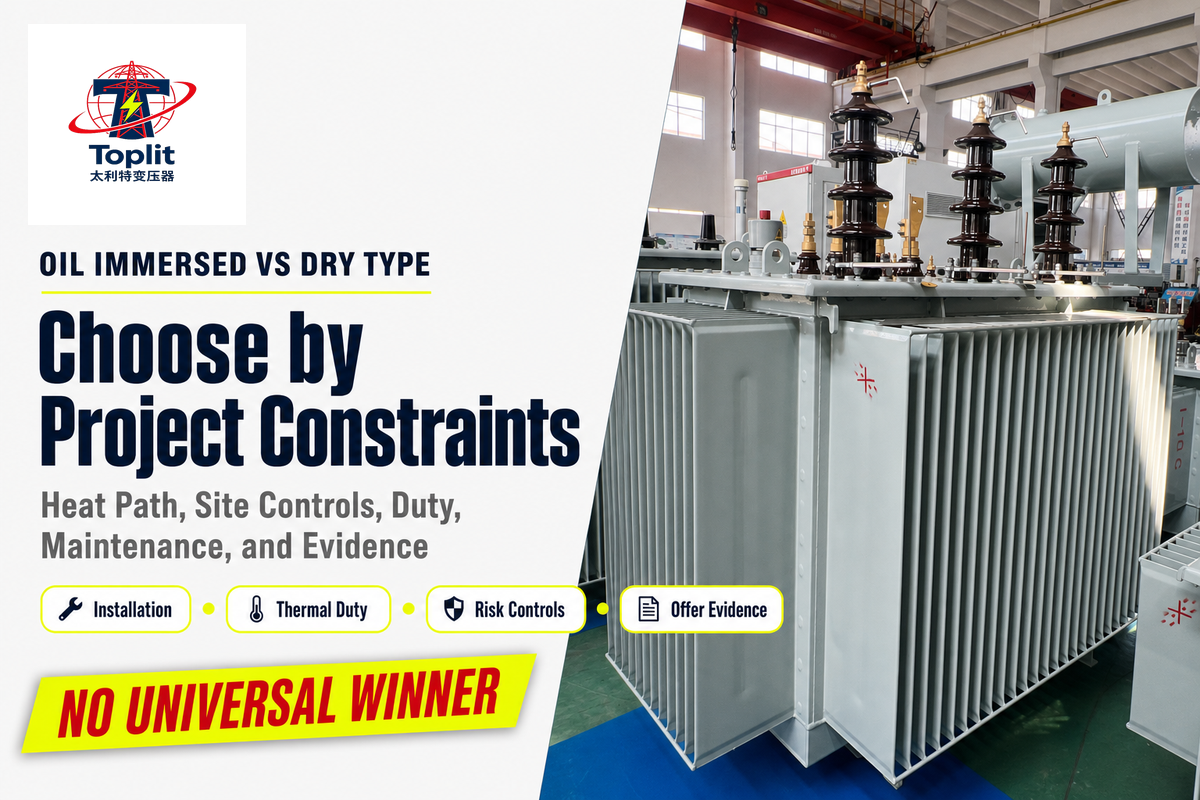
An oil immersed vs dry type distribution transformer comparison is a comparison of how liquid-filled and dry-type designs use insulation and transfer heat. A type of dielectric liquid is used for insulation and heat path in liquid-filled units, while the solid insulation and air path are used in dry-type units. The best choice isn’t determined by the label, but by installation conditions, load duty, fire and fluid controls, the accessibility of the unit for cleaning and maintenance, and verifiable specifications.
The five-gate routeSite → duty → risk → lifecycle → evidence
A dry-type label doesn’t automatically approve outdoor use, and an oil-insulated label can trigger specific installation controls. In the United States, for example, the workplace rule in 29 CFR 1910.305(j)(5) requires indoor oil-insulated transformers to be installed in a vault; other jurisdictions and transformer classes can apply different conditions.
Decision boundary
Use this guide to prepare and compare offers. The responsible engineer, authority having jurisdiction, utility, and selected manufacturer must confirm the final installation.
Use this guide to prepare and compare offers. The responsible engineer, authority having jurisdiction, utility, and selected manufacturer must confirm the final installation.
What the Two Designs Actually Change
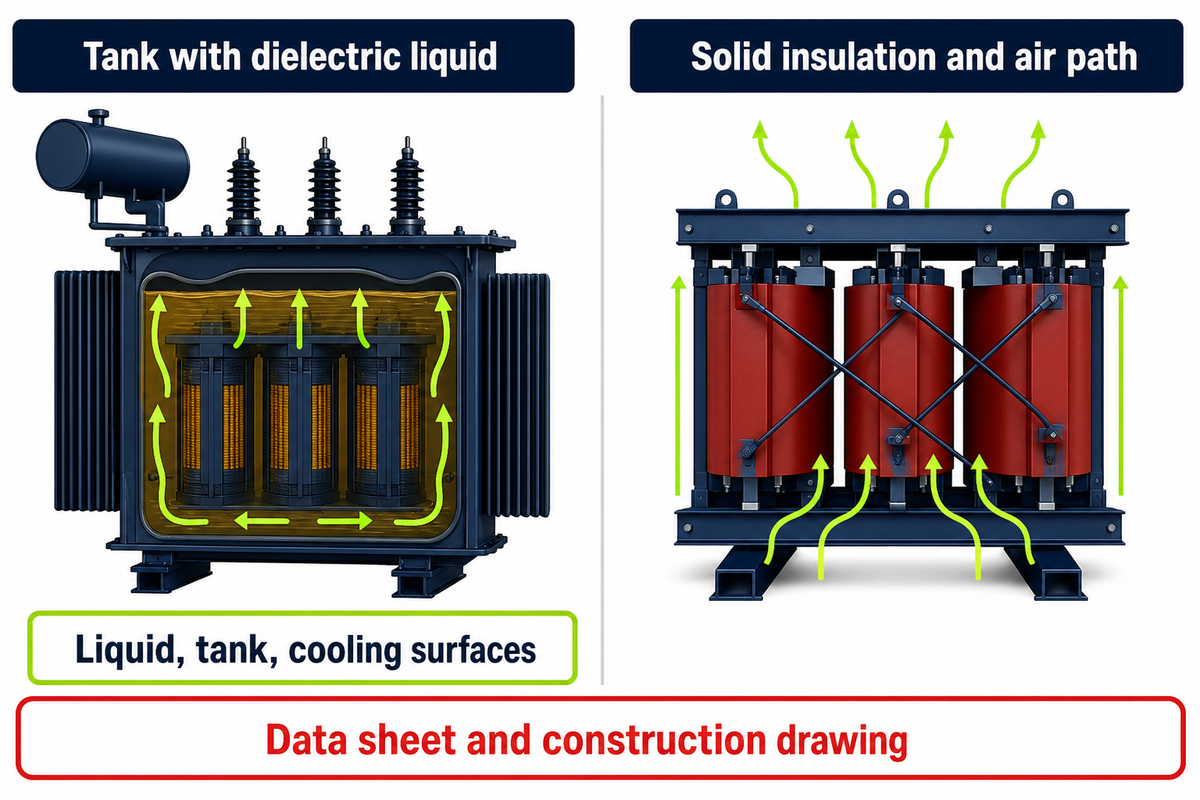
In oil immersed equipment, the active part is located in a tank with dielectric liquid; therefore, the liquid, tank, cooling surfaces, bushings, seals, and accessories form an integral operating system. In dry type equipment, the active component is located out of the liquid, and may be of a ventilated winding, cast resin, or any other solid insulation construction, depending on the manufacturer.
| Design item | Confirm | Evidence to request |
|---|---|---|
| Insulation medium | Actual liquid or solid system | Data sheet and construction drawing |
| Heat path | Cooling class and limits | Thermal/test documentation |
| Enclosure | Environmental rating and openings | Outline and installation drawing |
| Service interface | Fluid, airflow, sensors, access | OEM maintenance manual |
Don’t treat “oil-filled,” “liquid-filled,” and “oil-immersed” as indicators of one single fluid system. Likewise, “dry-type” doesn’t reveal whether the winding is ventilated, encapsulated, or cast resin unless the product record says so. For U.S. scope, see the DOE coverage resource.
Regulatory scope matters
The U.S. Department of Energy defines a covered distribution transformer using voltage, frequency, capacity, and configuration limits and lists exclusions. A commercial product name alone does not prove that a particular efficiency table applies.
The U.S. Department of Energy defines a covered distribution transformer using voltage, frequency, capacity, and configuration limits and lists exclusions. A commercial product name alone does not prove that a particular efficiency table applies.
Media-and-Heat Proofchain
| Evidence type | Vocabulary to clarify | Record to request |
|---|---|---|
| Family | dry-type transformer or oil-filled transformer | Transformer data sheet |
| Declared design | oil-immersed transformer or dry transformer | Transformer construction drawing |
| Heat path | cooling medium or air-cooled transformer arrangement | Transformer cooling class |
| Commercial basis | initial cost and operational cost | Transformer scope and exclusions |
| Fire review | risk of fire and fire safety controls | Transformer fire strategy |
| Electrical basis | voltage rating for the electrical transformer | Transformer guaranteed schedule |
| Fluid event | oil spill and oil leaks | Transformer containment design |
| Fluid service | insulating oil, a tank filled with oil, and oil filtration | Transformer fluid manual |
| Terminology | liquid transformer or liquid-filled transformers | Transformer manufacturer declaration |
Search-language translation
A “dry-type vs oil-type transformer” search often asks for the key differences between dry-type and liquid designs. Choosing a transformer means identifying the right transformer for the site’s power distribution duty; the phrase “dry-type and oil-filled transformer” is not a complete technical specification.
A “dry-type vs oil-type transformer” search often asks for the key differences between dry-type and liquid designs. Choosing a transformer means identifying the right transformer for the site’s power distribution duty; the phrase “dry-type and oil-filled transformer” is not a complete technical specification.
Installation Location Comes Before the Nameplate
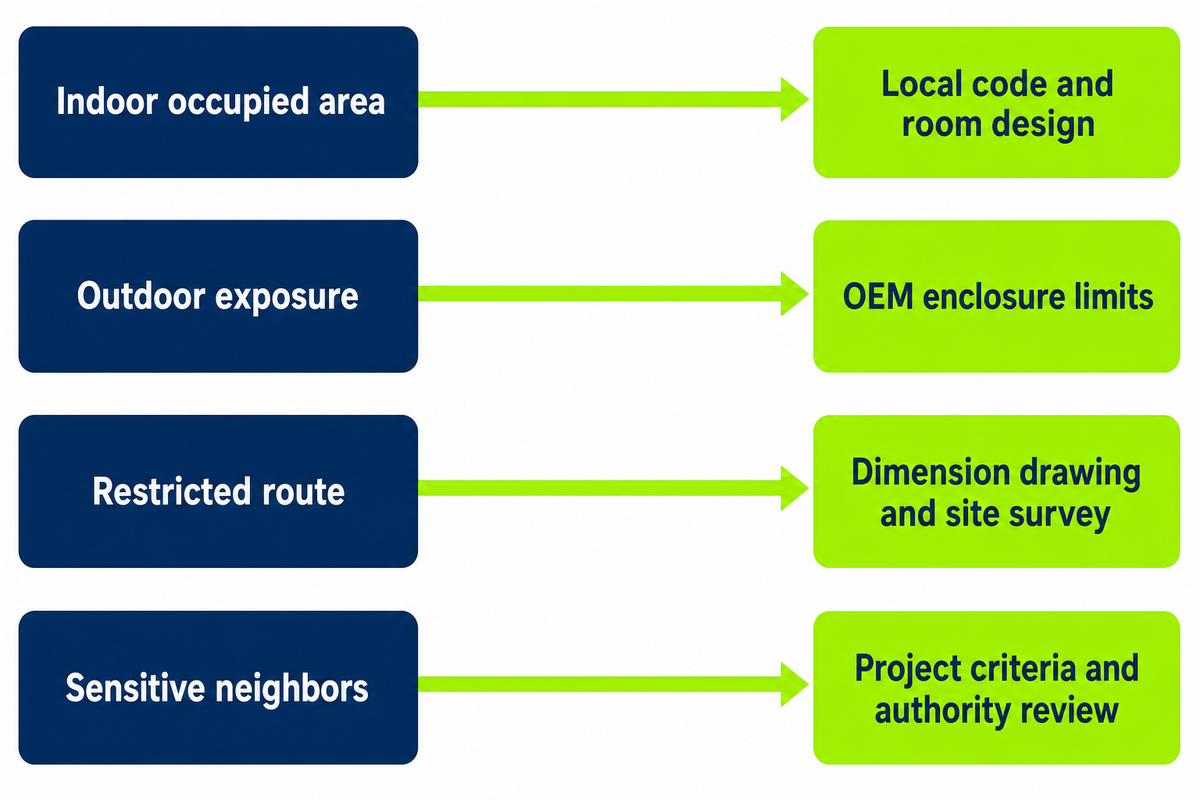
Compare room, pad, access route, enclosure, ventilation, moisture, loading, emergency response, structural integrity, lifting requirements, and the requirements of the applicable rules and regulations before evaluating the product family. An outdoor or indoor position may require different controls for ventilation, clearance, and response.
| Site fact | Design response | Source required |
|---|---|---|
| Indoor occupied area | Fire separation, ventilation, access | Local code and room design |
| Outdoor exposure | Weather, moisture, contamination controls | OEM enclosure limits |
| Restricted route | Transport, lifting, replacement plan | Dimension drawing and site survey |
| Sensitive neighbors | Sound, fire, spill, and clearance review | Project criteria and authority review |
Can a dry type transformer be placed outside? A dry type transformer can only be placed outside if certain conditions are met. This includes the enclosure, ventilation, environmental limits, and local requirements. The manufacturer should supply written limits and an installation drawing. The responsible engineer should also confirm the site design.
U.S. workplace example
29 CFR 1910.305(j)(5)(iv) says indoor oil-insulated transformers must be installed in a vault. Subsection (iii) states a separate vault condition for dry-type, high-fire-point liquid-insulated, and askarel-insulated transformers installed indoors and rated over 35 kV. Apply the exact rule only within its scope. See the 29 CFR 1910.305 transformer provisions for this U.S. example.
Compare Losses and Thermal Duty on One Declared Basis
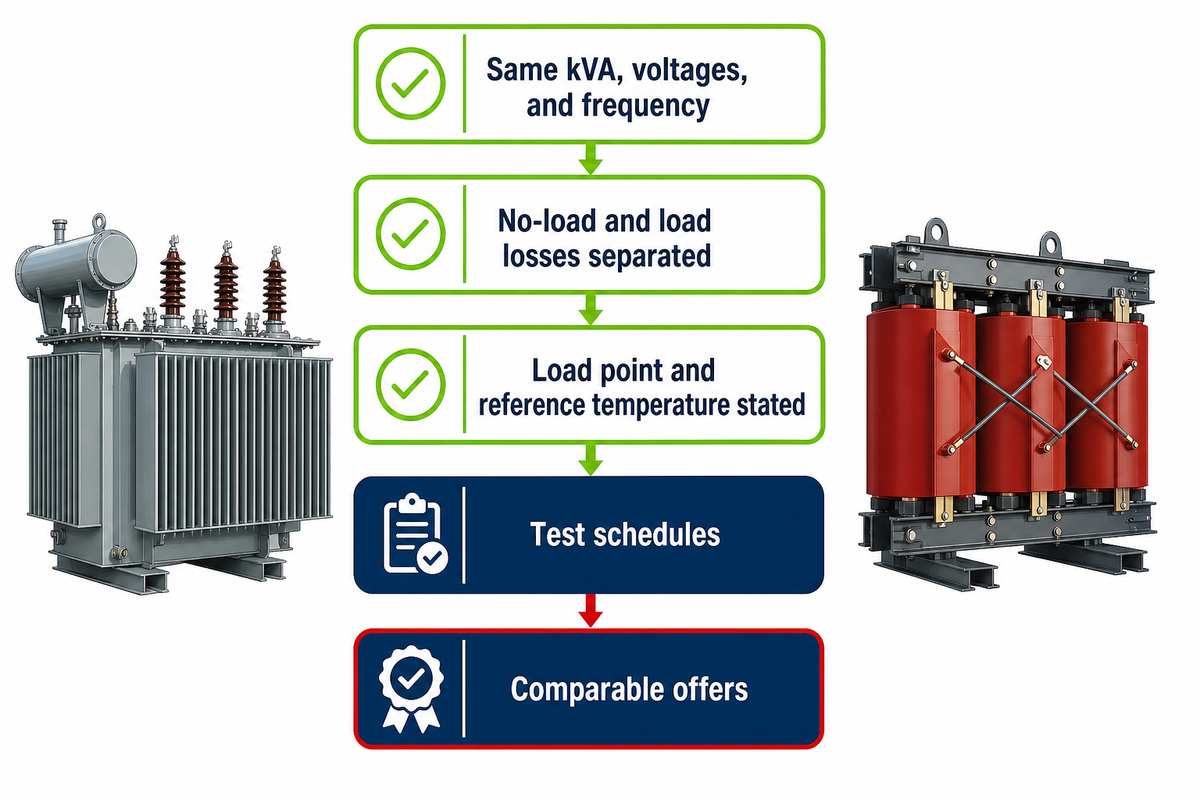
There will always be no-load loss in a transformer that’s energized and maintaining its magnetic field. Load loss is a function of the current and the operating temperature. A fair comparison needs the same transformer category, kVA, voltages, frequency, load profile, evaluation point, temperature reference, impedance, enclosure, and test method.
P₀
No-load loss at the stated reference condition
No-load loss at the stated reference condition
PL
Load loss at the stated current and temperature basis
Load loss at the stated current and temperature basis
Load fraction
The declared operating or evaluation point
The declared operating or evaluation point
Temperature
The reference used for the reported loss
The reference used for the reported loss
Because U.S. test procedures use category-specific evaluation conditions, it’s possible that two headline efficiency values may not have the same operating basis. The federal basis is 10 CFR Part 431 Appendix A. Therefore, the project load profile must be a separate RFQ input and can’t be incorporated in the nameplate rating.
The Loss-at-Load Check
- Same covered category and test method?
- Same kVA, voltages, and frequency?
- No-load and load losses separated?
- Load point and reference temperature stated?
- Expected site load profile and harmonics disclosed?
Liquid cooling doesn’t prove that every oil-immersed model has lower total loss at every duty. Many factors can have an effect on the loss incurred, including conductor selection, winding design, temperature, airflow, accessories, and the load profile. Therefore, the test schedules must be compared rather than ranking in general terms.
Nonlinear loads
If the project includes converters, drives, data loads, or other harmonic-producing equipment, disclose the load characteristics and request the manufacturer’s thermal application guidance. Do not assign a universal derating or K-factor from a generic article.
If the project includes converters, drives, data loads, or other harmonic-producing equipment, disclose the load characteristics and request the manufacturer’s thermal application guidance. Do not assign a universal derating or K-factor from a generic article.
U.S. Coverage and Test-Basis Example
| Reference type | Published value | How to use it |
|---|---|---|
| DOE covered input ceiling | 34,500 V | Coverage screen, not a project rating |
| DOE covered output ceiling | 600 V | Coverage screen, not a product limit |
| DOE covered frequency | 60 Hz | U.S. program scope only |
| Low-voltage dry-type evaluation point | 35% | Certification basis under the cited test method |
| Liquid-immersed evaluation point | 50% | Certification basis under the cited test method |
| Medium-voltage dry-type evaluation point | 50% | Certification basis under the cited test method |
| No-load loss reference | 20°C | Report basis to confirm |
| Liquid-immersed load-loss reference | 55°C | Report basis to confirm |
| Dry-type load-loss reference | 75°C | Report basis to confirm |
These federal values, 34,500 V, 600 V, 60 Hz, 35%, 50%, 20°C, 55°C, and 75°C, illustrate why scope and test basis must travel with an efficiency figure. They aren’t universal transformer ratings, local-code limits, or a recommendation for a specific project. The 34,500 V DOE input ceiling, 600 V DOE output ceiling, and 60 Hz DOE covered frequency belong to the cited DOE screen, while the separate OSHA vault condition applies to the listed indoor transformer classes rated over 35 kV; none should be treated as an interchangeable product rating.
Single-source boundary
The exact values above come from the cited federal definition and test method. Confirm the current text and applicability rather than copying them into a global specification.
The exact values above come from the cited federal definition and test method. Confirm the current text and applicability rather than copying them into a global specification.
Do not convert scope into a rating
The 34,500 V input ceiling, 600 V output ceiling, and 60 Hz frequency describe the cited U.S. covered-equipment definition. They do not select a transformer or set an international project limit.
The 34,500 V input ceiling, 600 V output ceiling, and 60 Hz frequency describe the cited U.S. covered-equipment definition. They do not select a transformer or set an international project limit.
Fire, Fluid, and Environmental Controls Are a System
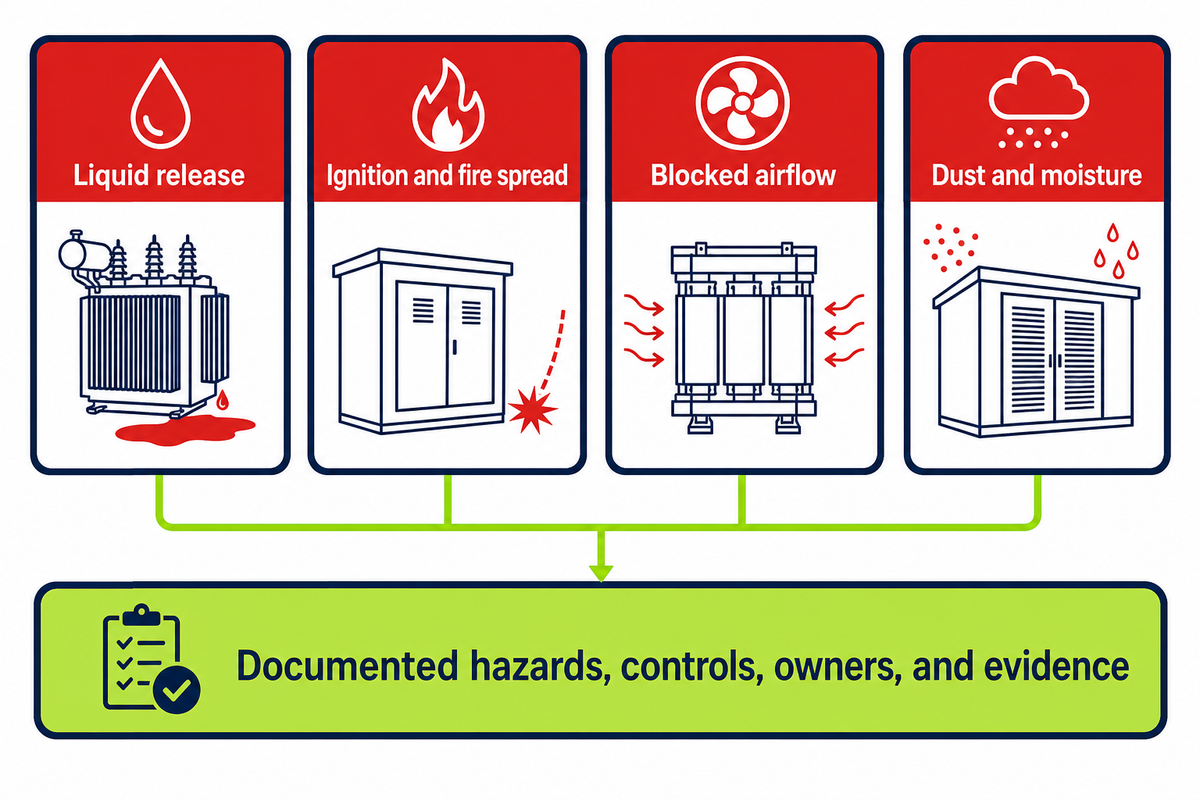
The use of oil-immersed equipment introduces a liquid system that can require leak detection, spill control, separation, drainage, fire protection, and emergency planning. The U.S. workplace transformer provisions are one jurisdiction-specific example; the rules governing the actual project still control. The potential for exposure to liquid can be reduced by removing the liquid insulation medium. Dry type equipment still requires a suitable enclosure, airflow, contamination control, temperature monitoring, and protection against overheating.
| Hazard | Control question | Evidence |
|---|---|---|
| Liquid release | Where can the fluid migrate? | Containment and drainage design |
| Ignition/fire spread | What separation and protection apply? | Code review and fire strategy |
| Blocked airflow | How is heat rejected in normal and abnormal duty? | OEM thermal and ventilation limits |
| Dust/moisture | Can the environment reach the active part? | Enclosure/environment specification |
“Oil” covers several fluid classes that require the supplier to disclose the specific fluid. Mineral oil, high-fire-point liquid, and other declared dielectric fluids can require different containment, handling, and maintenance methods, which can affect the installation design.
Language check
Neither “fireproof” nor “zero risk” belongs in the comparison. Use documented hazards, controls, owners, and evidence instead.
Neither “fireproof” nor “zero risk” belongs in the comparison. Use documented hazards, controls, owners, and evidence instead.
Maintenance Is Different, Not Automatically Easier
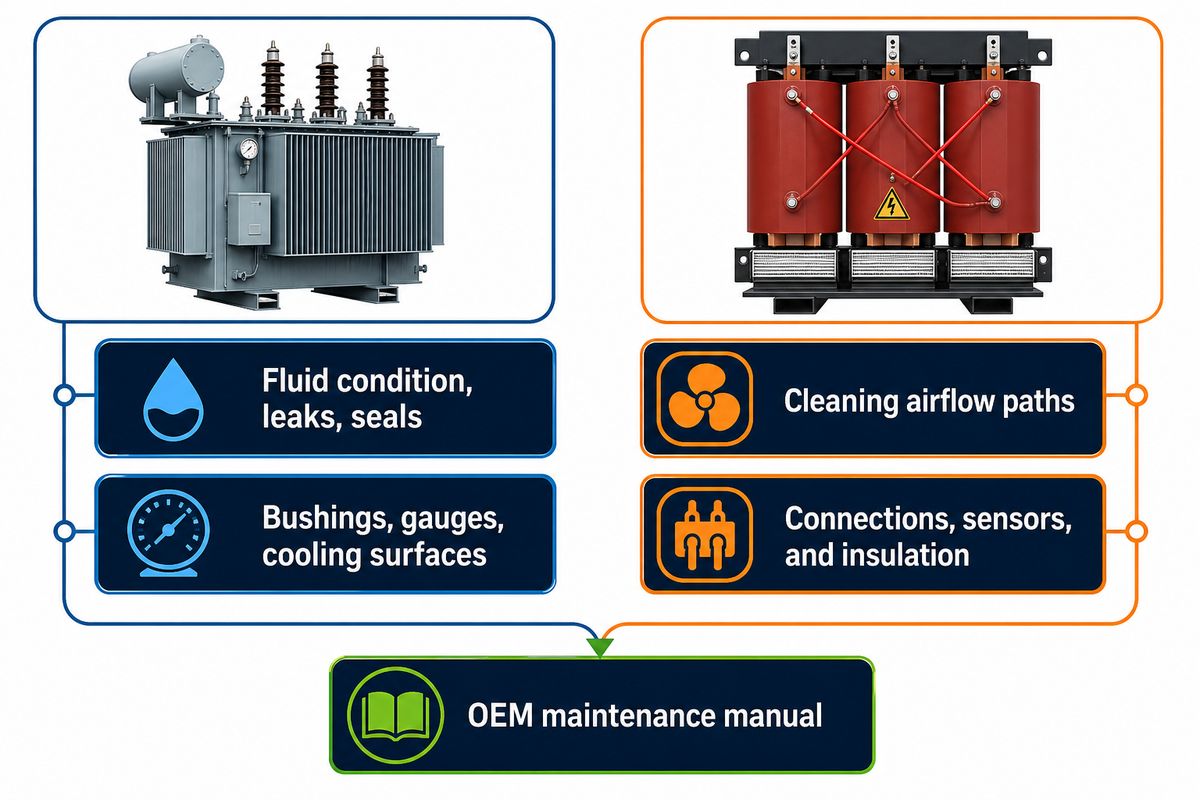
The oil-immersed model’s service instructions may cover fluid condition, leaks, seals, bushings, gauges, cooling surfaces, and accessories. For a dry-type model, maintenance may involve cleaning airflow paths, inspecting connections, sensors, and insulation surfaces, assessing resin condition, and checking the enclosure. For broader U.S. system context, see the Department of Energy distribution-transformer webinar transcript; the selected manufacturer’s manual remains the task-level authority.
| Task family | Oil-immersed focus | Dry-type focus | Frequency |
|---|---|---|---|
| Condition | Fluid, seals, bushings | Insulation surface, resin, enclosure | OEM/site plan |
| Cooling | Radiators/fans if fitted | Air paths/fans if fitted | OEM/site plan |
| Connections | Terminals and accessories | Terminals and connections | OEM/site plan |
There’s no basis for inventing a monthly or annual maintenance interval. The service environment, service duty, service history, critical nature of the service, and the manufacturer’s manual together determine the maintenance interval.
The Maintenance-Access Test
Can a qualified technician safely isolate, reach, inspect, clean or sample, test, and document every required item? If the answer is unknown, the layout is not ready for a lifecycle comparison.
Can a qualified technician safely isolate, reach, inspect, clean or sample, test, and document every required item? If the answer is unknown, the layout is not ready for a lifecycle comparison.
Voltage, kVA, Footprint, and Expansion Must Be Specified Together
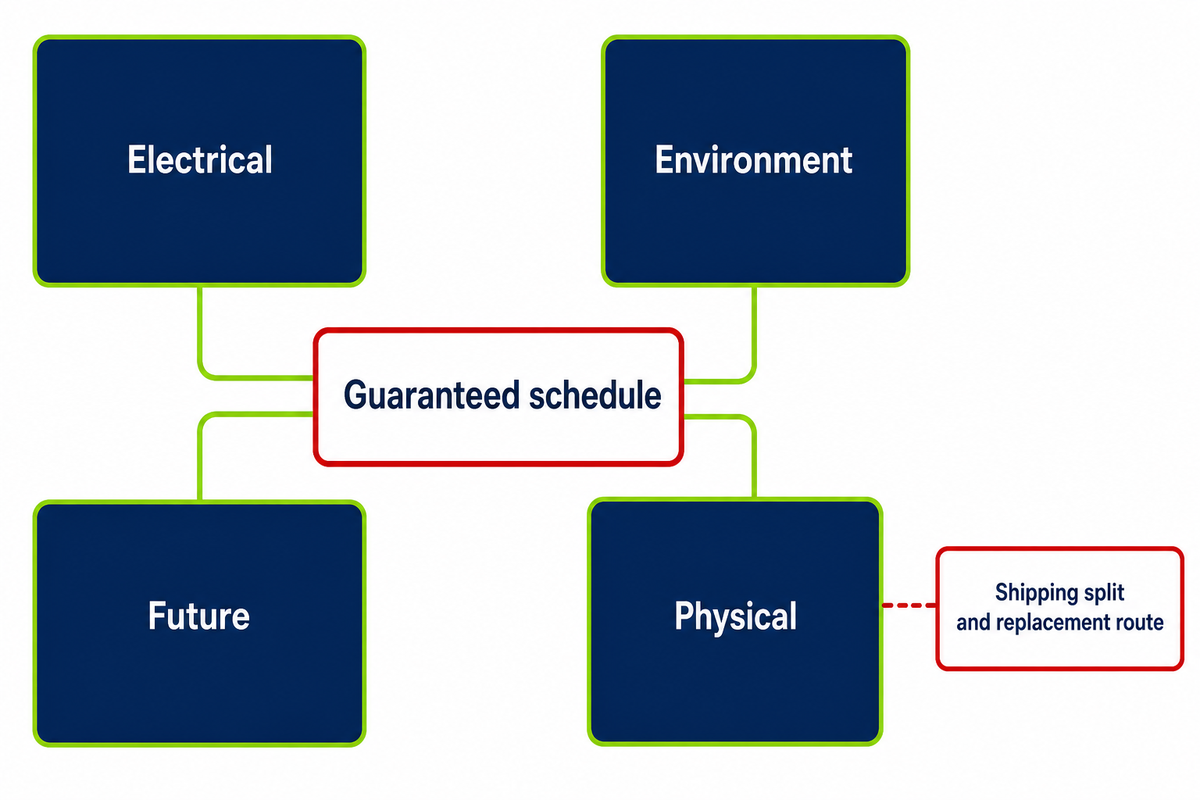
The comparison of primary and secondary voltages, phase, frequency, kVA, impedance, taps, ambient conditions, enclosure, cooling mode, sound criteria, and potential future duty affects the electrical design as well as the physical route for delivery, installation, inspection, and replacement of the equipment. The DOE covered-class definition is one example of why voltage, frequency, capacity, and configuration must travel together.
Electrical
Voltages, phase, frequency, kVA, impedance, taps
Voltages, phase, frequency, kVA, impedance, taps
Environment
Ambient, altitude, dust, moisture, seismic/site duty
Ambient, altitude, dust, moisture, seismic/site duty
Physical
Outline, weight, sound, access, lifting, clearances
Outline, weight, sound, access, lifting, clearances
Future
Growth, standby duty, parallel operation, replacement route
Growth, standby duty, parallel operation, replacement route
There’s no general upper limit for voltage or kVA for either family if a standard isn’t stated and an entire product series isn’t specified. The range stated by a supplier doesn’t justify the use of that product for the service.
Footprint objection resolved
Record not only the installed outline but also shipping split, door and corridor limits, lifting points, service clearances, and the route for eventual replacement.
Record not only the installed outline but also shipping split, door and corridor limits, lifting points, service clearances, and the route for eventual replacement.
Constraint Funnel for Project-Level Decision
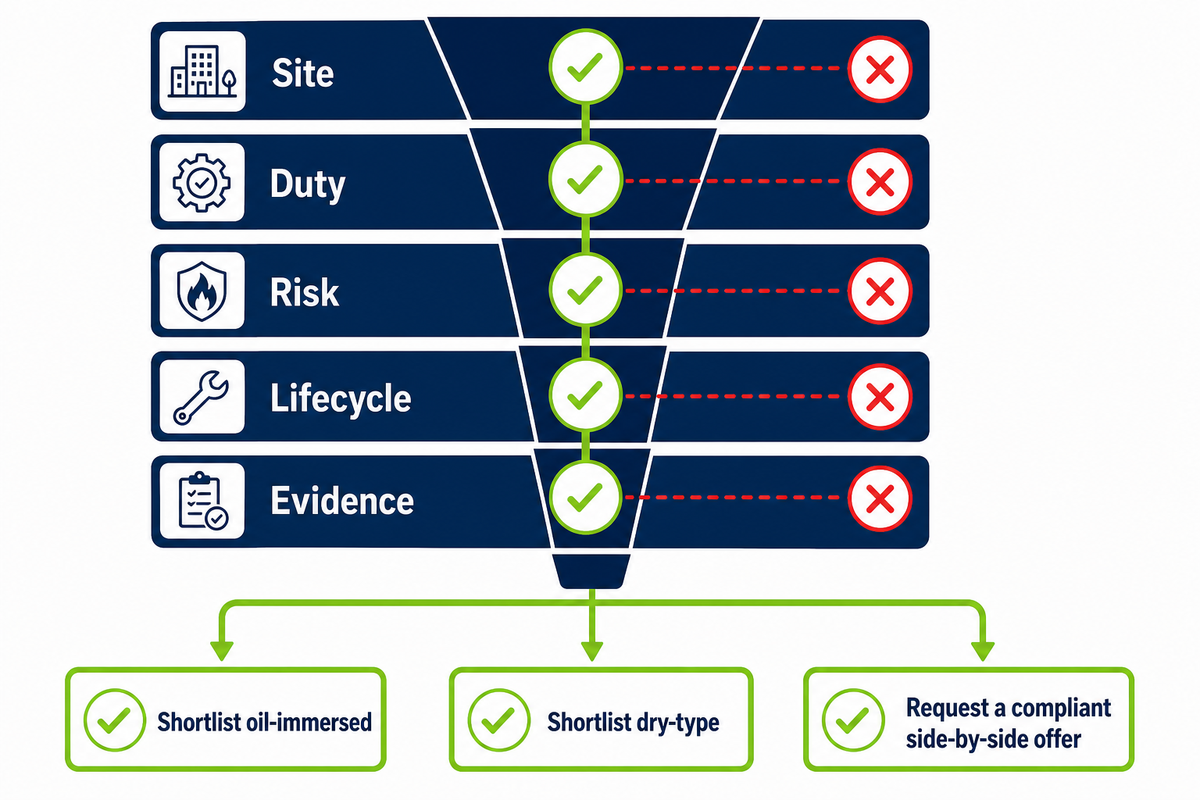
The five gates cover the site and access, duty and load profile, controls for fire, liquid, and the environment, the maintenance and outage plan, and the evidence package. SLAC’s public procurement notice illustrates project-specific evidence; it isn’t a reusable specification. The result should be “shortlist oil-immersed,” “shortlist dry-type,” or “request a compliant side-by-side offer”—never “one type is always better.”
| Gate | Question | Hold if missing |
|---|---|---|
| 1. Site | Where and how will it be installed? | Room/pad, access, environment |
| 2. Duty | What load profile and abnormal duty apply? | Load schedule and studies |
| 3. Risk | Which fire, fluid, and airflow controls govern? | Code and protection review |
| 4. Lifecycle | Can it be maintained and replaced? | Access and outage plan |
| 5. Evidence | Can every offered value be verified? | Data, drawings, tests, deviations |
One specific type can solve one problem, but cause another. An example is the case of liquid. Simplifying one spill-control problem by removing liquid may create an airflow or enclosure problem. A unit filled with liquid may satisfy one thermal duty, but may still necessitate the design of a vault or containment, which the site may not be able to fulfill.
Shortlist rule
Advance the option that satisfies all documented constraints with an auditable offer. Keep any unknown gate open.
Advance the option that satisfies all documented constraints with an auditable offer. Keep any unknown gate open.
What to Put in the RFQ Before You Ask for Price
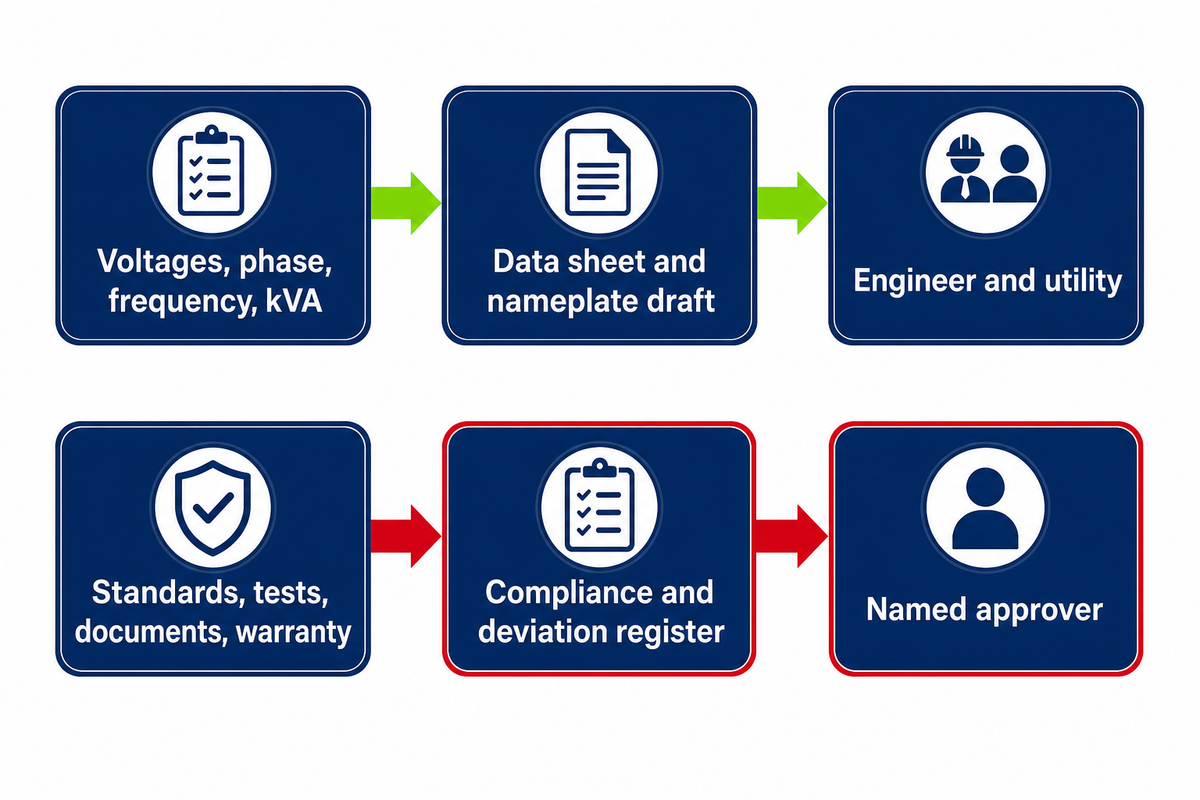
A quote can’t be compared fairly with another until the technical basis of comparison is established and documented. When requesting a quote, submit an oil-or-dry transformer brief and keep the utility- or site-specific fields separate from the baseline equipment request.
| Requirement | Supplier response | Proof file | Reviewer |
|---|---|---|---|
| Voltages, phase, frequency, kVA | Offered values and deviations | Data sheet/nameplate draft | Engineer/utility |
| Impedance, taps, loss/test basis | Guaranteed schedule | Test schedule | Engineer |
| Fluid or insulation system, cooling | Exact construction | Drawing/data sheet | Owner/engineer |
| Enclosure and environment | Environmental limits | Installation drawing | Site team |
| Fire, containment, sound, accessories | Included scope | Scope list/drawings | Project team |
| Standards, tests, documents, warranty | Applicable edition and package | Compliance/deviation register | Named approver |
An actual procurement specification will probably provide numerous site-specific ratings and withstand values; these should never be copied to another RFQ. Identify the baseline, name each site-specific requirement, and make the supplier state any deviations rather than assuming equivalence.
Commercial boundary
The linked supplier page helps with evaluation context. It does not prove that any particular Talite model meets an unstated rating, standard, test, certification, price, lead time, or warranty.
The linked supplier page helps with evaluation context. It does not prove that any particular Talite model meets an unstated rating, standard, test, certification, price, lead time, or warranty.
Talite Transformer Co., Ltd. in the Supply Conversation
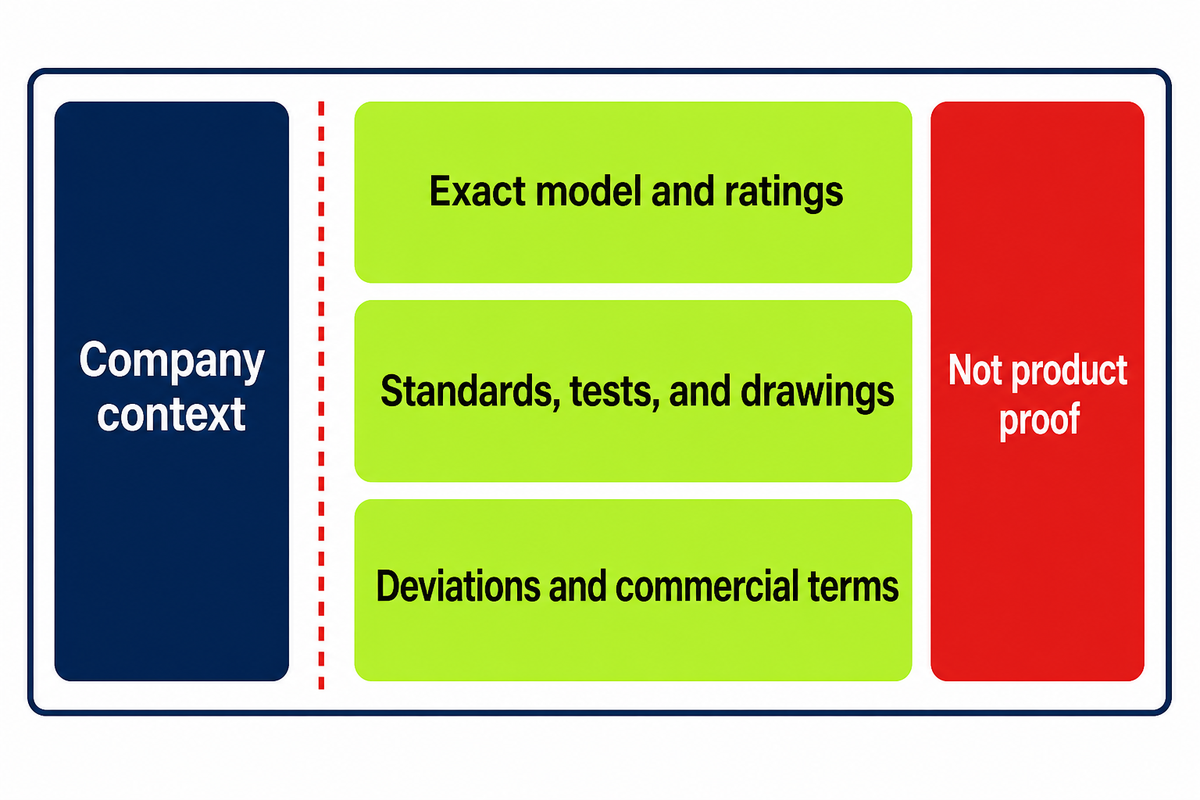
As per the company background provided for this article, Talite Transformer Co., Ltd. has been active in the power-equipment sector for more than 3 decades. The supplied company profile identifies Jiangsu Fangteng Industrial Co., Ltd. as a former name and places Talite in the Hai’an Economic and Technological Development Zone of Nantong, Jiangsu Province.
Company context, not product proof
The supplied profile describes a high-tech enterprise integrating research and development, production, and sales, with clients in international markets. A project offer must still identify the exact model, ratings, standards, tests, drawings, deviations, and commercial terms.
Talite can evaluate the site’s technical inputs and generate a documented proposal within the indicated scope. This doesn’t substitute for the utility, authority having jurisdiction, or responsible engineer. For adjacent product context, review Talite’s oil-immersed transformer range, oil-immersed distribution transformer page, dry-type transformer range, and medium-voltage dry-type transformer page before finalizing a side-by-side RFQ.
Bring a reviewable transformer brief
Share the site conditions, load profile, applicable rules, and Project-Scope Offer-Basis Proofboard so the comparison can be tied to actual requirements.
Final Selection Checklist
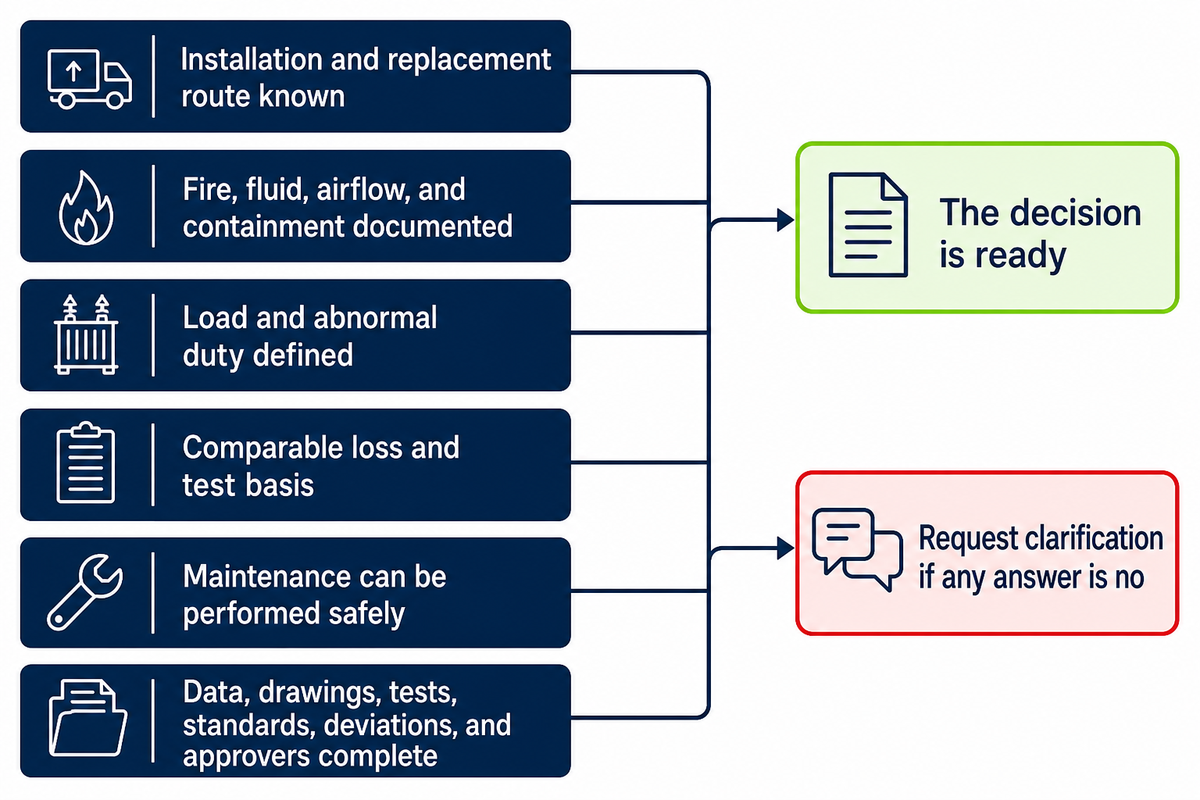
The decision is ready only when the site, duty, controls, lifecycle plan, and evidence package agree. DOE building-level guidance is context; project and manufacturer documents control. Use six yes-or-no checks prior to releasing the shortlist.
- Are installation location, environment, access, and replacement route known?
- Are fire, fluid, airflow, and containment controls documented?
- Are kVA, voltages, frequency, load profile, and abnormal duty defined?
- Do both offers use a comparable loss and test basis?
- Can the planned maintenance be performed safely?
- Are data, drawings, tests, standards, deviations, and approvers complete?
Choose the option that satisfies the documented constraints with a verifiable offer. If one answer remains “no,” request clarification rather than choosing by transformer type alone.
Key takeaway
The better transformer is the one whose installation, duty, controls, maintenance plan, and evidence all fit the project—not the one with the more familiar label.
Frequently Asked Questions
Which is better, an oil type or dry type transformer?
Neither type is universally better.
An oil-immersed unit may fit a project that prioritizes a liquid-cooled design, outdoor placement, or a particular utility arrangement, while a dry-type unit may fit an occupied building or a site where liquid containment is difficult. The choice still depends on voltage, kVA, load profile, ambient conditions, fire controls, maintenance access, applicable code, and the exact manufacturer’s evidence package.
What are the disadvantages of dry-type transformers?
The relevant disadvantage depends on the project and model.
Dry-type equipment can require careful space and airflow planning, and its thermal performance can be sensitive to enclosure, ambient temperature, dust, and ventilation. Purchase cost is not a universal constant, and maintenance is not zero: cleaning, connections, sensors, and insulation or enclosure condition still need an OEM-based plan. Compare the same kVA, duty, loss basis, and site constraints before calling any disadvantage decisive.
Can you put a dry type transformer outside?
Sometimes, when the selected model and installation permit it.
The enclosure, environmental rating, mounting, ventilation, moisture protection, working clearances, and governing electrical and building rules must all allow outdoor service. A dry-type label alone is not approval. Ask for an installation drawing and written environmental limits, then have the responsible engineer confirm protection, access, and inspection requirements before procurement.
What is an oil immersed transformer?
An oil immersed transformer uses an insulating liquid around its active part to provide electrical insulation and transfer heat toward the tank and cooling surfaces.
The liquid, tank, cooling surfaces, bushings, seals, and accessories form one system. The actual fluid, ratings, enclosure, cooling class, and maintenance requirements depend on the product series and governing standard, so the family name should not be used as a complete specification.
What is the lifespan of a dry type transformer?
A dry-type transformer has no single defensible lifespan because design, loading, temperature, contamination, maintenance, and operating history all affect the service outcome for each installation.
Service life depends on the insulation system and thermal class, but also on temperature history, loading, harmonics, ventilation, dust, moisture, altitude, vibration, switching events, and how promptly abnormal conditions are corrected. A transformer in a clean, temperature-controlled electrical room can age differently from a similarly rated transformer exposed to heat, contamination, blocked airflow, or repeated overload. Ask the manufacturer for thermal limits, loading guidance, insulation and sensor details, inspection intervals, repair criteria, spare-part strategy, and warranty terms. Confirm whether any published expectation assumes continuous duty, a particular ambient, a defined load profile, or a maintenance regime. Treat a generic online lifespan number as a verification question for the selected transformer and duty, not as a guaranteed result, a condition assessment, or a replacement date.
References & Sources
- 29 CFR § 1910.305, Transformer Installation Requirements Legal Information Institute, Cornell Law School
- Distribution Transformers: Coverage and Standards U.S. Department of Energy
- 10 CFR Part 431 Appendix A, Test Method Legal Information Institute, Cornell Law School
- Distribution and Building-Level Transformers U.S. Department of Energy / Pacific Northwest National Laboratory
- HV Transformer Procurement Presolicitation SLAC National Accelerator Laboratory
- Distribution Transformer Webinar Transcript U.S. Department of Energy
- Dry-Type Transformer Energy Savings Report Bonneville Power Administration
Sources accessed September 11, 2026. Verify current editions, local amendments, and project applicability before procurement.
Editorial and safety note
The named decision tools in this article are editorial frameworks, not methods issued by the cited organizations. The sources do not endorse Talite or prove any specific Talite product claim.
The named decision tools in this article are editorial frameworks, not methods issued by the cited organizations. The sources do not endorse Talite or prove any specific Talite product claim.
![Pad-Mounted Transformer: How It Works [2026 Guide]](https://toplit-transformer.com/wp-content/uploads/2026/08/pad-mounted-transformer-guide-featured-150x150.png)
![Single Phase Pad Mounted Transformer Guide [2026]](https://toplit-transformer.com/wp-content/uploads/2026/08/single-phase-pad-mounted-transformer-guide-featured-1-150x150.png)