Get in touch with Talite Transformer Co., Ltd Company

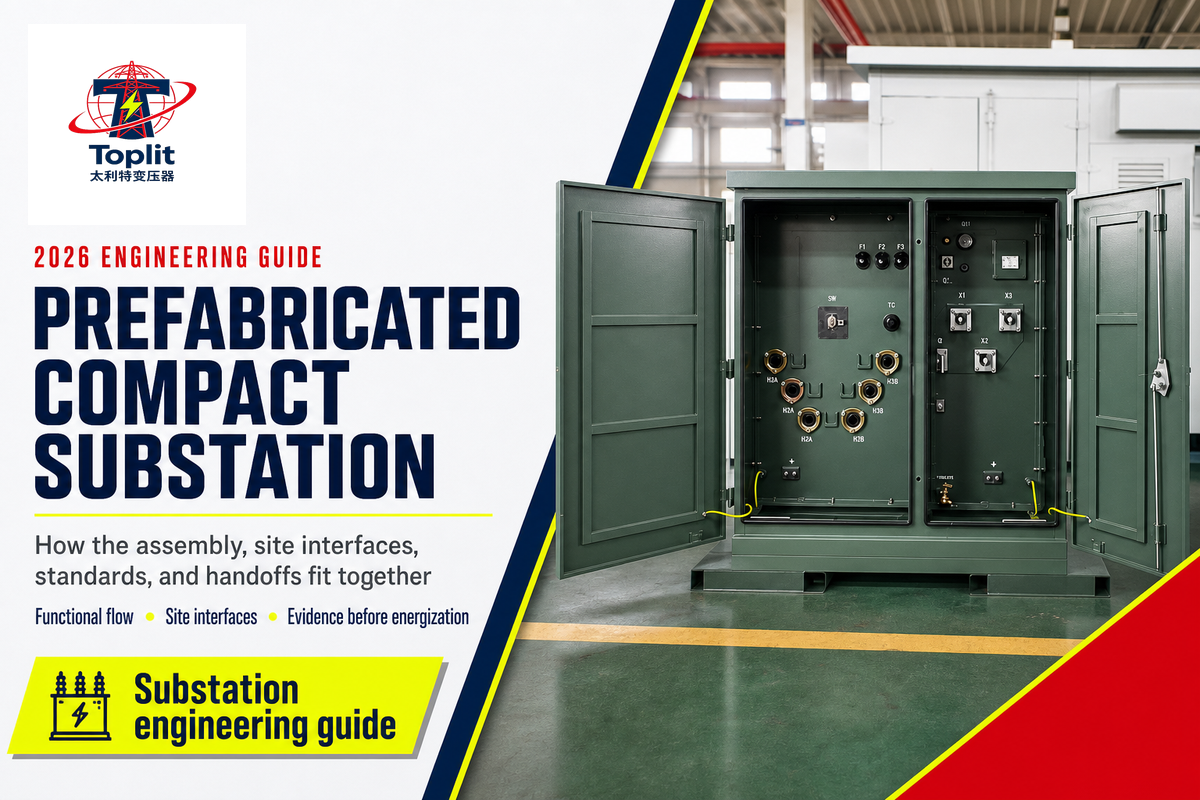
Updated August 2026
Prefabricated compact substation is a market phrase for a factory-assembled power-distribution package, but the phrase is not a complete specification. Buyers still have to define the electrical functions, physical arrangement, access model, governing equipment standards, site interfaces, test evidence, and the party responsible for each handoff.
Quick answer
A prefabricated compact substation can bring medium-voltage (MV) switching, a transformer, low-voltage (LV) distribution, controls, and an enclosure into one coordinated assembly. Its value depends on correct interfaces and evidence; factory assembly does not remove foundation, cable, grounding, commissioning, utility, or operating responsibilities.
This guide explains the category boundary and the evidence chain. It does not repeat Toplit’s model, pricing, quotation, or enclosure-selection pages. When you are ready to move from education to a project configuration, use the outdoor prefabricated compact substation solutions page.
What Is a Prefabricated Compact Substation, and What Is It Not?
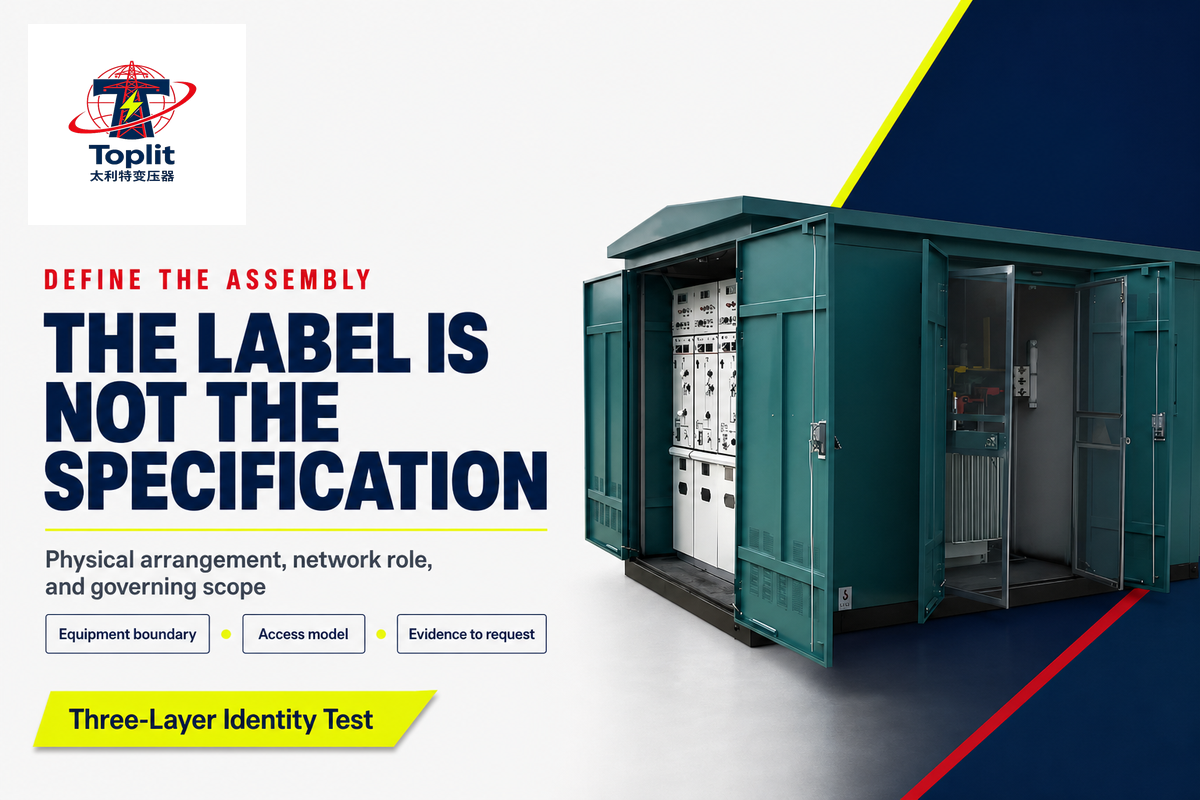
In this guide, a prefabricated substation is an enclosed, factory-assembled power-distribution system. Here, compact usually describes footprint or integration, not one universal IEC product type. Depending on the agreed scope, the category can include interconnected switching, transformation, distribution, auxiliary, control, and enclosure functions, but the agreed project scope decides what is actually supplied.
The public scope for IEC 62271-202:2022 covers enclosed AC prefabricated substations for rated voltages above 1 kV (1,000 V) through 52 kV (52,000 V). It describes cable-connected equipment for power frequencies up to 60 Hz, with walk-in or non-walk-in operation in outdoor locations accessible to the public where personnel protection is provided. Those scope facts do not state which transformer, feeder count, protection scheme, or local approval your project needs.
Quick scope signals, not product specifications
>1,000 VPart 202 lower boundary
≤52,000 VPart 202/212 upper boundary
50/60 HzCEADS service frequencies
601–52,000 VIEEE unit-substation primary range
Those scope numbers are classification limits, not recommended project ratings.
Three-Layer Identity Test
The Three-Layer Identity Test separates the physical assembly, its network role, and the governing equipment scope before a label becomes a specification.
| Type or label encountered | What it may describe | Evidence to request | Do not assume |
|---|---|---|---|
| Prefabricated substation | An enclosed assembly produced before site delivery | Applicable standard, rated characteristics, drawings, test plan | That every site activity is included |
| Compact substation | A space-conscious integrated arrangement | Compartment plan, access, removal route, heat path | That compact is an IEC classification |
| Package substation | A commercial package of coordinated equipment | Inclusions, exclusions, battery limits, supplied documents | That two suppliers package the same scope |
| Modular substation | One or more transportable modules assembled into a system | Module interfaces, transport splits, field connections | That modular means ready to energize |
| Containerized substation | Equipment packaged in a container-like enclosure | Structural, thermal, lifting, cable-entry, fire basis | That a shipping-container form defines electrical scope |
| CEADS | Compact Equipment Assembly for Distribution Substation | IEC 62271-212 applicability, restricted-access basis | That CEADS and every compact substation are synonyms |
| Unit substation | A coordinated incoming, transformer, outgoing, and transition arrangement | IEEE scope, exclusions, section standards | That it includes pad-mounted or mobile equipment |
| Pad-mounted transformer | A ground-level enclosed distribution transformer | Transformer standard, utility drawings, service arrangement | That it is a walk-in integrated substation |
| Conventional substation | A site-engineered arrangement assembled from separate equipment | Civil/electrical design basis, interfaces, test and handover plan | That site-built is automatically less suitable |
What is a compact substation?
A compact substation brings several power-distribution functions into a smaller coordinated footprint. The useful definition is not merely “small.” It is an assembly whose electrical sections, enclosure, access, ventilation, earthing, control wiring, test evidence, and site interfaces have been designed together. The term remains descriptive until the quotation identifies the actual equipment and governing scope.
How Does Power Move Through the Functional Sections?
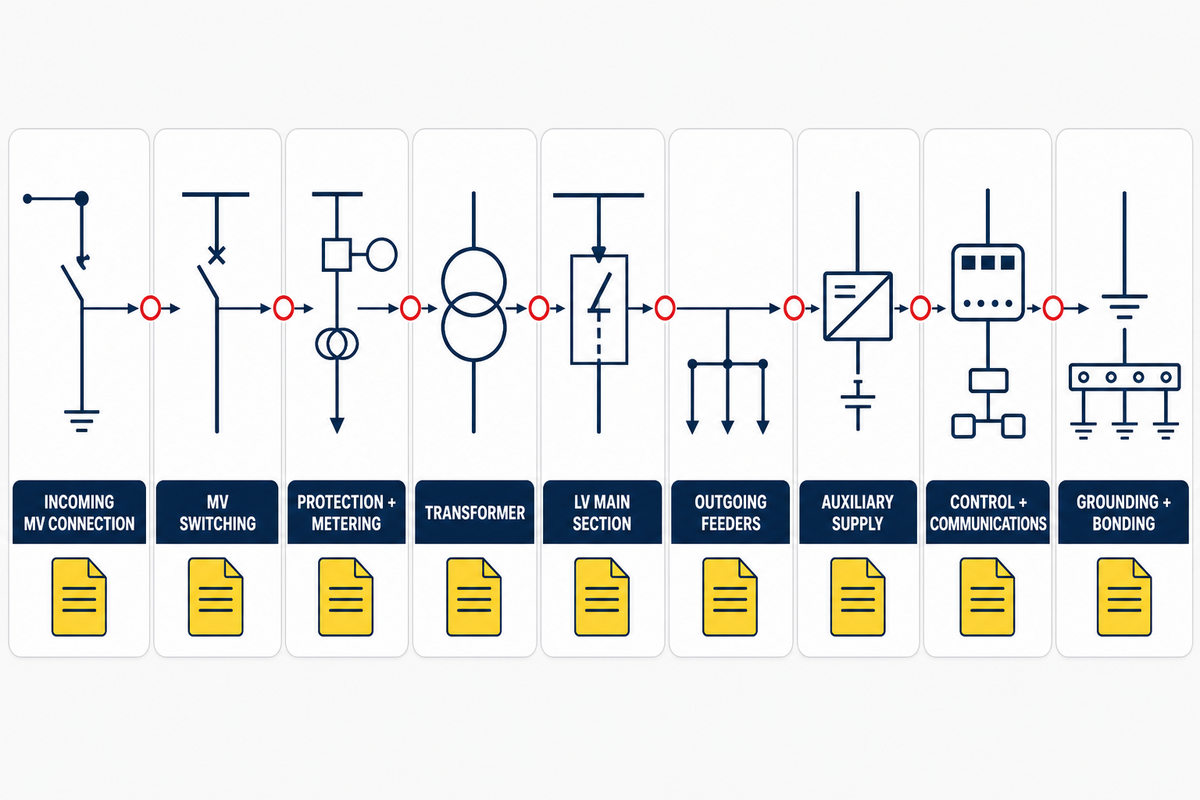
Functionally, the teaching path has three functions: high-voltage switchgear controls the incoming circuit, the transformer changes the voltage, and low-voltage equipment distributes outgoing power. That sequence is useful for reviewing evidence, but it is not a universal compartment count. Designs can add incoming, outgoing, transition, control, metering, or auxiliary sections.
The public scope of IEC 62271-202:2022 covers prefabricated substations that may contain transformers, medium-voltage and low-voltage switchgear, interconnections, and auxiliary equipment. It does not prescribe this guide’s three-function teaching sequence as a universal physical layout.
Searchers often call these substation components, yet the buyer’s task is to connect each function to the network decision and evidence it carries.
MV → Transformer → LV Evidence Chain
The MV → Transformer → LV Evidence Chain connects each functional step to a document or test record instead of treating a single-line diagram as proof of completed integration.
| Functional step | Decision it carries | Evidence to review | What the evidence does not prove |
|---|---|---|---|
| Incoming MV connection | System voltage, frequency, fault basis, cable interface | Approved single-line diagram and interface schedule | That the utility has accepted the connection |
| MV switching | Isolation, interruption, interlocking, earthing | Switchgear data, protection study, interlock matrix, test records | That one device suits every network |
| Protection and metering | Fault detection, clearing, measurement, coordination | Settings, coordination report, wiring drawings, functional tests | That factory settings match the final network |
| Transformer | Voltage ratio, capacity, impedance, losses, thermal duty | Approved datasheet, nameplate schedule, factory test report | That the complete substation is approved |
| LV main section | Rated current, fault duty, incomer arrangement, bus system | LV drawings, device schedules, protection settings | That outgoing loads are correctly designed |
| Outgoing feeders | Load grouping, cable duty, selectivity, future capacity | Feeder schedule, cable study, load list, as-built labels | That future expansion is physically possible |
| Auxiliary supply | Controls, heating, ventilation, lighting, battery/UPS needs | Auxiliary load list and functional test | That site power is available at delivery |
| Control and communications | Signals, protocols, time synchronization, remote control | I/O list, logic narrative, settings files, integration test | That the owner system is configured |
| Grounding and bonding | Equipment bonds and connection to the site grid | Grounding drawings, study inputs, inspection/test records | That the site grid is complete |
How does a compact substation work?
Incoming MV circuits reach switching and protection equipment, then feed a transformer that produces the required secondary voltage. LV switchgear distributes power to outgoing circuits, while auxiliary and control systems support protection, metering, ventilation, alarms, and communications. Actual arrangements depend on the project; the evidence chain should follow the actual single-line diagram and the wider power system.
Package, Compact, Modular, Containerized, Unit, or Pad-Mounted?
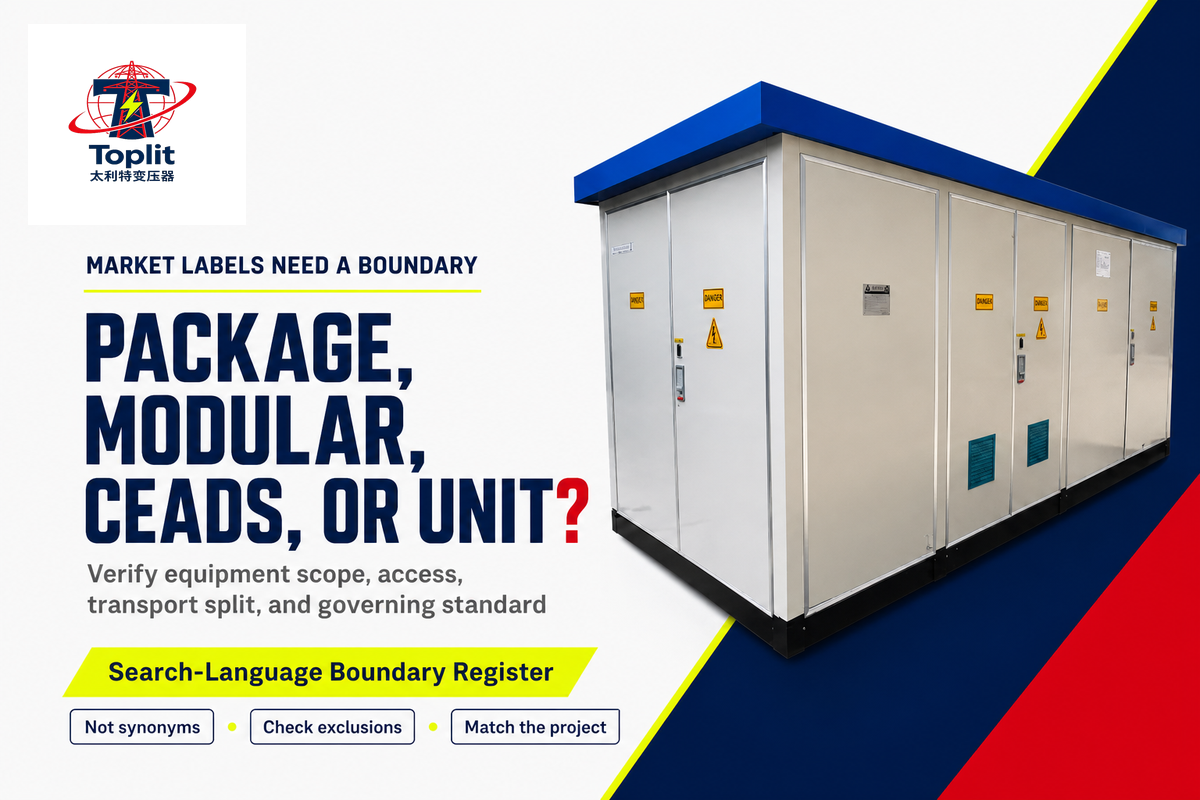
Market labels live at different classification levels. Some describe how equipment is packaged, some describe access or mobility, and some belong to a regional equipment standard. Treating them as interchangeable can put the wrong standard, test plan, enclosure, or utility rule into an enquiry.
A downloaded prefabricated compact substation diagram or prefabricated compact substation PDF may show one arrangement. An 11kV compact substation reference still doesn’t define the access model, fault duty, standards scope, or supplied interfaces for another project.
The public page for IEC 62271-212:2022 defines CEADS for AC voltages up to 52 kV on the HV side, at 50 Hz or 60 Hz, for restricted-access indoor or outdoor applications. Part 202 says CEADS may be a component of an MV/LV prefabricated substation. The two scopes overlap; they are not two mutually exclusive product families.
North American unit-substation language adds another boundary. The public IEEE C37.121-2020 page covers three-phase step-down unit substations from 112.5 kVA upward at primary voltages from 601 V through 52 kV. It allows varied incoming, transformer, outgoing, and transition sections, while excluding pad-mounted transformer sections, mobile unit substations, and several other installations. A pad-mounted transformer is therefore not simply another name for a prefabricated walk-in substation.
For a transformer-only equipment boundary, use Toplit’s pad-mounted transformer guide. For commercial format and project-input context, compare the prefabricated substation formats and project inputs page with the compact substation engineering options page. Each link serves a different role; none replaces the project specification.
What is a modular substation?
A modular substation is assembled from transportable modules or skids whose electrical and physical interfaces are completed at the site. Modular describes the delivery architecture, not a promise that field engineering has disappeared. Ask how modules are split for transport, what is connected in the field, which tests are repeated after assembly, and who closes each open interface.
Search-Language Boundary Register
The Search-Language Boundary Register turns common query phrases into document checks. Terms in the first column are not endorsements or standardized product names.
| Search term type | What the buyer should verify | Do not infer |
|---|---|---|
| prefab substation; prefab | Factory scope, transport split, field connections | Ready-to-energize status |
| types of prefabricated substations; functions of prefabricated; applications of prefabricated | Classification source, network role, access model | One universal type list |
| traditional substation; conventional substation installations | Site assembly, separation, access, expansion basis | Automatic disadvantage |
| compact transformer; compact design; advantages of compact | Transformer-only versus integrated boundary, removal route, heat path | Smaller means suitable |
| power supply; backup power; reliable power | Network source, redundancy, protection, outage philosophy | Reliability from enclosure alone |
| fuse; breaker; relay | Fault study, clearing duty, settings, coordination, test evidence | Interchangeable protection devices |
| low voltage switchgear; distribution equipment; power distribution equipment | Rated current, fault duty, feeder schedule, metering, section standard | Same outgoing scope in every package |
| substation or compact substation; power substation; electric unit | Equipment list, physical sections, utility boundary, adopted standard | A complete specification from a noun phrase |
| commercial buildings; residential areas; commercial and residential | Occupancy context, public access, noise, fire, security, local authority | One enclosure is suitable for every occupancy |
| industrial facilities; power plants | Load behavior, criticality, environment, process interface, owner rules | An industrial label defines duty |
| power infrastructure; power equipment; power solution | Network function, supplied equipment, evidence and ownership boundary | Marketing scope equals contract scope |
| modular design; relocation; ease of installation | Module split, lifting, route, reconnection, repeat tests, approvals | Mobility or a fixed schedule |
| dry type; transformer tank; sealed and insulated | Transformer construction, fluid/fire basis, cooling, enclosure, maintenance | One phrase defines the transformer design |
| prefabricated electrical | Which electrical and non-electrical work is factory completed | All interfaces are electrical |
| power transformation; voltage transformation | Transformer ratio, capacity, impedance, losses, thermal and network duty | The transformer proves the assembly scope |
| installation and commissioning; key components | Installed interfaces, FAT/SAT boundary, tests, owners, energization sequence | Installation and commissioning are one event |
| reliability and efficiency | Loss basis, protection, maintainability, evidence history, operating context | A general benefit claim without a method |
Engineering note
Treat numbered search labels as fields that need sourced boundaries: 50 Hz or 60 Hz frequency, a 601 V lower boundary in the IEEE scope, an above-1,000 V lower boundary in IEC Part 202, a 52,000 V public scope ceiling, and the OSHA 2.4 m guarding context. None of these values specifies a complete substation.
What Must Be Defined at the Electrical and Site Interfaces?
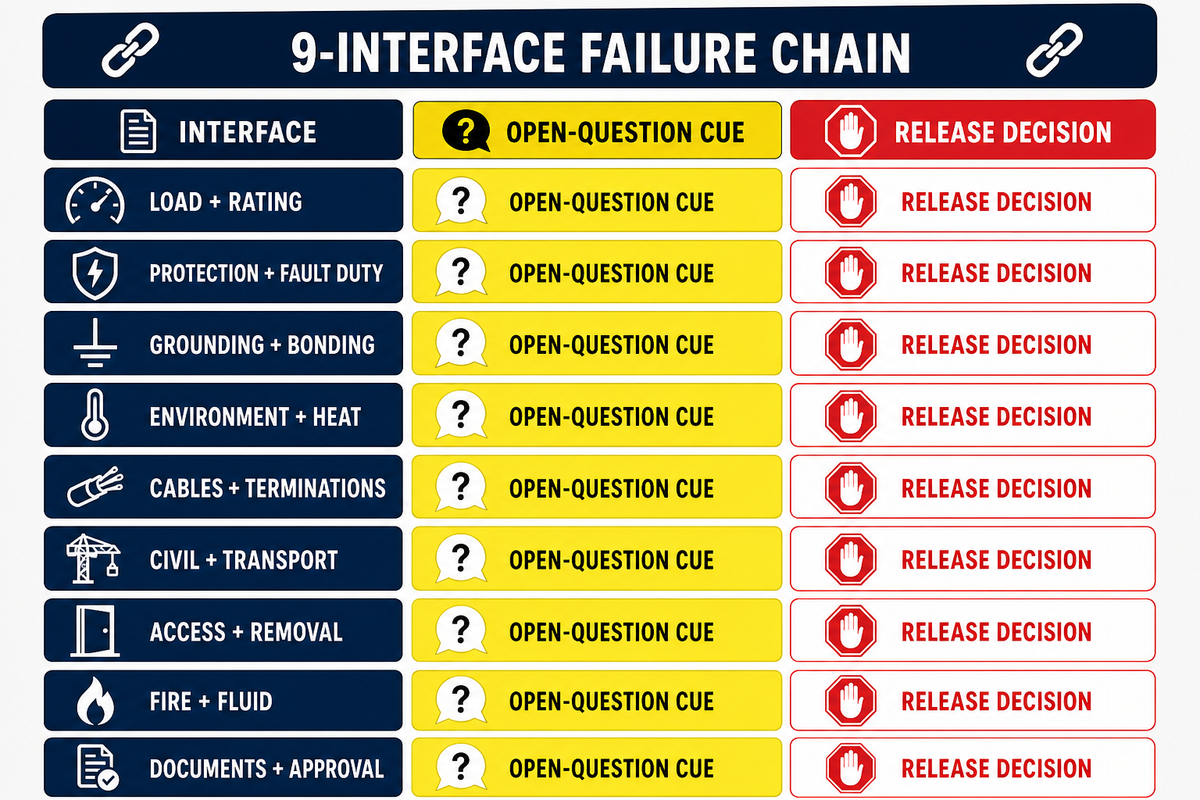
Capacity and primary voltage are only two inputs. Beyond capacity, a workable compact-substation basis also identifies frequency, fault duty, grounding, protection, feeder plan, ambient conditions, access, transport, foundation, cable entry, fire/fluid strategy, documents, and acceptance responsibilities. Missing interfaces reappear later as design changes or exclusions.
Start with the on-site load and network basis in an electrical distribution system design, then connect it to the equipment and site. Do not copy a nominal rating from a brochure and assume the remaining decisions follow automatically.
9-Interface Failure Chain
The 9-Interface Failure Chain groups hidden dependencies, letting buyers stop release when an owner, input, or closing record is missing.
| Interface | Hidden question | Evidence before release | If unresolved |
|---|---|---|---|
| 1. Load and rating | Which operating cases and future loads govern? | Approved load list and design basis | Clarify before transformer release |
| 2. Protection and fault duty | Do devices, settings, and clearing assumptions match the network? | Fault/coordination study and settings schedule | Stop the final protection schedule |
| 3. Grounding and bonding | Where does equipment grounding meet the site grid? | Grounding drawings, study inputs, bond schedule | Do not convert missing site data into a factory assumption |
| 4. Environment and heat | How do temperature, altitude, solar load, pollution, corrosion, flood, and ventilation affect the enclosure? | Site conditions and thermal/enclosure basis | Hold enclosure design |
| 5. Cables and terminations | Who defines cable type, bending space, entry, termination, and sealing? | Cable schedule and interface drawing | Hold gland plates and internal routes |
| 6. Civil and transport | Can the route, crane, base, foundation, drainage, and anchoring accept the delivered split? | Transport study and approved foundation/interface plan | Stop shipping-release assumptions |
| 7. Access and removal | Can people operate safely and replace major equipment later? | Working-space and removal-route review | Apply the No-Fit Screen |
| 8. Fire and fluid | Which equipment, fluid, separation, drainage, alarm, and local rules apply? | Project fire/fluid basis and authority review | No generic fire claim |
| 9. Documents and approval | Who reviews, accepts, revises, and hands over each record? | Document register, review status, deviation/open-item log | Do not equate document submission with approval |
For United States construction work, OSHA 1926.966 requires sufficient access and working space for safe operation and maintenance, requires conductive substation fences to be grounded, and controls access and guarding around energized equipment. It is a U.S. worker-safety rule, not a global compact-substation design standard. Other jurisdictions and utilities can impose different requirements.
Which Standards Apply, and What Does Compliance Not Prove?
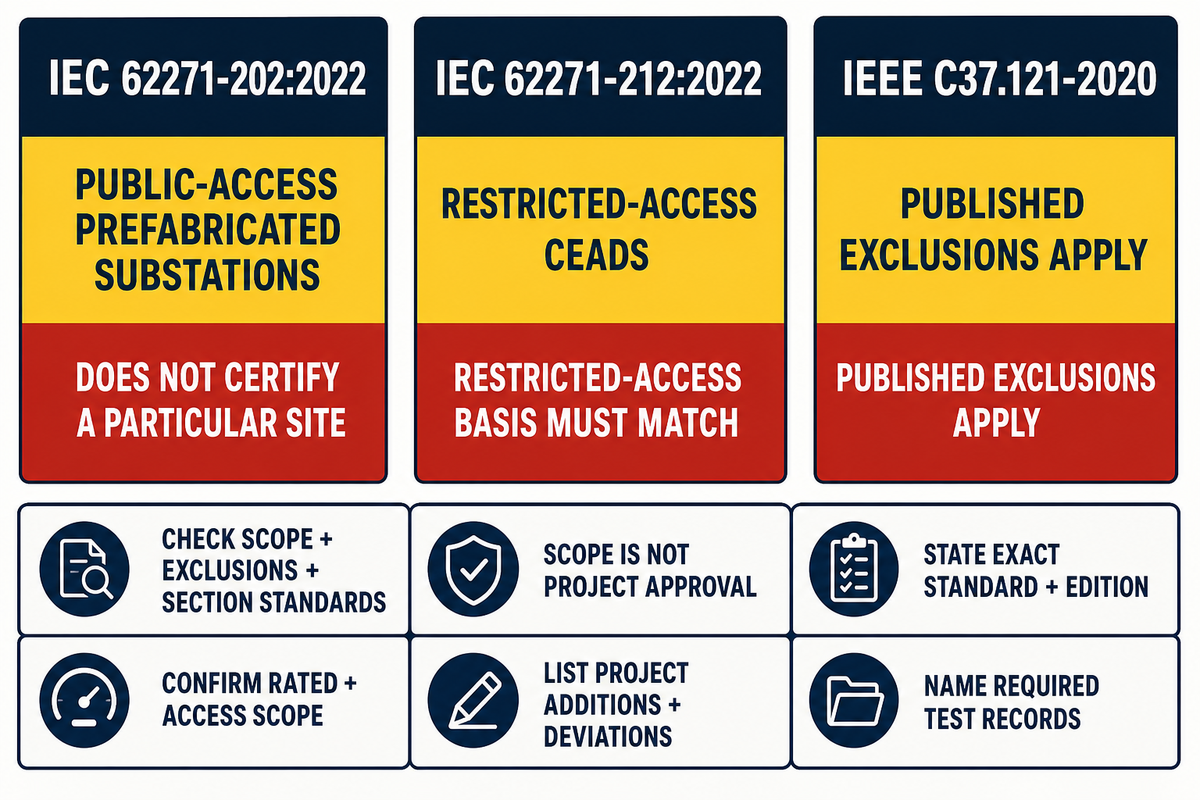
Each standard number answers only the scope assigned to that document. It does not prove that the selected equipment matches the network, that local authorities accept the design, that site interfaces are complete, or that commissioning has passed. Record the edition, adopted jurisdiction, project additions, deviations, and required evidence.
IEC’s public pages list the current 2022 editions. Part 202 is the third edition and replaced the 2014 edition; Part 212 is the second edition and replaced the 2016 edition. A 2023 Corrigendum exists for Part 202. Detailed clauses, dimensional rules, test voltages, and acceptance criteria are still paid standard content and are not reproduced here.
Both a 50 Hz project and a 60 Hz project can sit within the same public standard scope while requiring different equipment. Likewise, a 52,000 V upper scope boundary isn’t a recommended project rating.
Do not turn worker-access thresholds into equipment dimensions
OSHA 1910.269(u) uses separate conditions for exposed live parts at 50–150 V, 151–600 V, and above 600 V, including a 2.4 m height reference in its guarding logic. These are U.S. employer-access conditions, not universal compact-substation clearances.
| Public scope source | Voltage/frequency signal | Access or section boundary |
|---|---|---|
| IEC 62271-202:2022 | >1,000 V to 52,000 V; up to 60 Hz | Outdoor public-access context, walk-in or non-walk-in |
| IEC 62271-212:2022 | Up to 52,000 V; 50 Hz or 60 Hz | Restricted-access CEADS |
| IEEE C37.121-2020 | 601 V to 52,000 V; 112.5 kVA and above | Varied unit-substation sections; published exclusions apply |
Do
- State the exact standard and edition.
- Confirm the rated and access scope.
- List project additions and deviations.
- Name every required test record.
Don’t
- Use “IEC compliant” as a complete specification.
- Treat market labels as standard categories.
- Assume factory tests prove site acceptance.
- Apply U.S. worker rules as global design law.
Frequency remains a project input: a 50 Hz value cannot be inferred from a regional style label.
For a project that crosses regional rule sets, Toplit’s IEC-to-ANSI clause check can help organize questions. It is a comparison aid, not a certification or legal determination.
Why Factory Integration Does Not Remove Site Risk
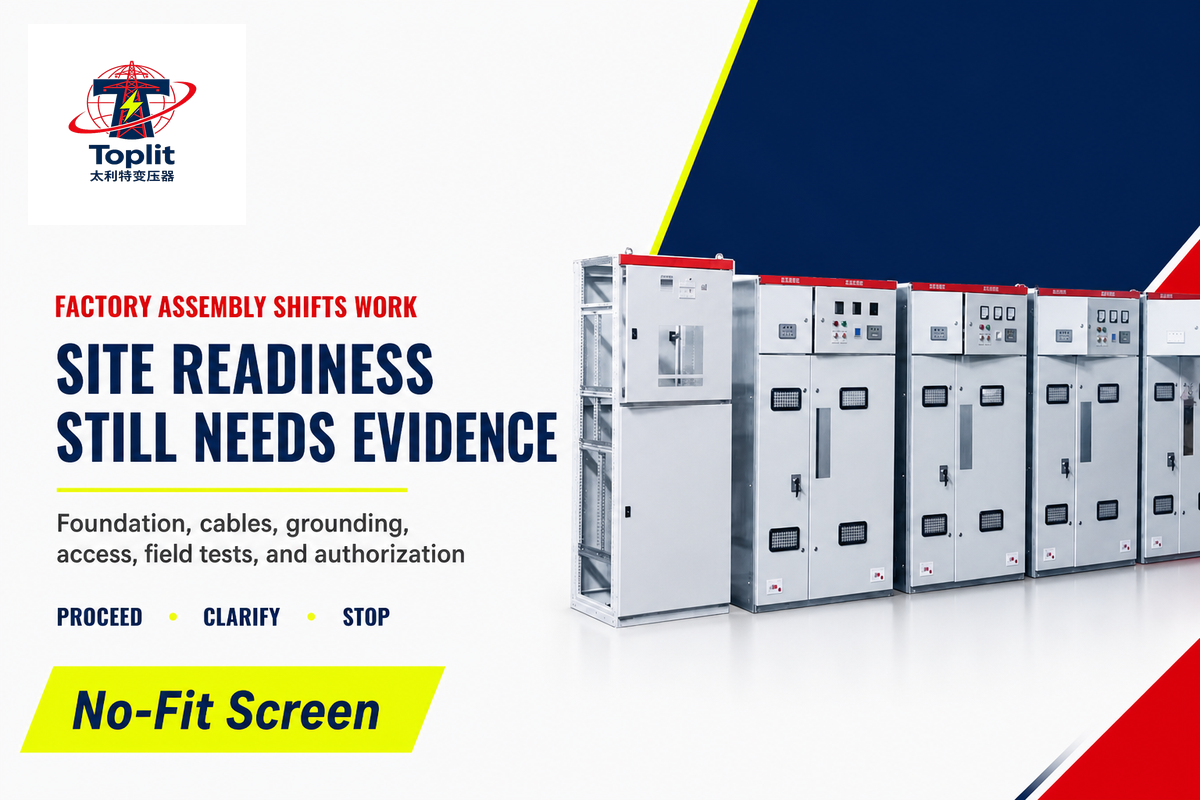
Factory assembly can shift work away from the site, but it does not close the site basis. Foundations, incoming/outgoing cables, grounding, drainage, lifting, access, communications, fire strategy, utility review, field tests, and authorization to energize still require named owners and evidence.
For United States construction work, OSHA 1926.966 separately addresses substation guarding, access, grounding, attendants, and entry safeguards. Those site duties remain distinct from factory assembly evidence.
Pair the equipment schedule with a site-interface responsibility register. That tool reflects Toplit’s process; it is not an industry-mandated allocation. The contract and project documents determine the actual owners.
No-Fit Screen
The No-Fit Screen prevents a compact arrangement from becoming the default before the site, network, access, expansion, transport, and ownership limitations are understood.
| Decision | Use it when | Buyer action |
|---|---|---|
| Proceed | Electrical basis, site data, transport split, access, owners, and evidence plan are defined | Freeze the coordinated interface schedule |
| Clarify | One or more interfaces are open but can be closed before design release | Assign owner, due date, input, and acceptance record |
| Stop | Expansion, fault duty, access, route, jurisdiction, or ownership conflicts make the arrangement unsafe or unreviewable | Compare a conventional, mobile, containerized, or separately engineered alternative |
The 4-Owner Handoff Ledger: Factory Test to Energization
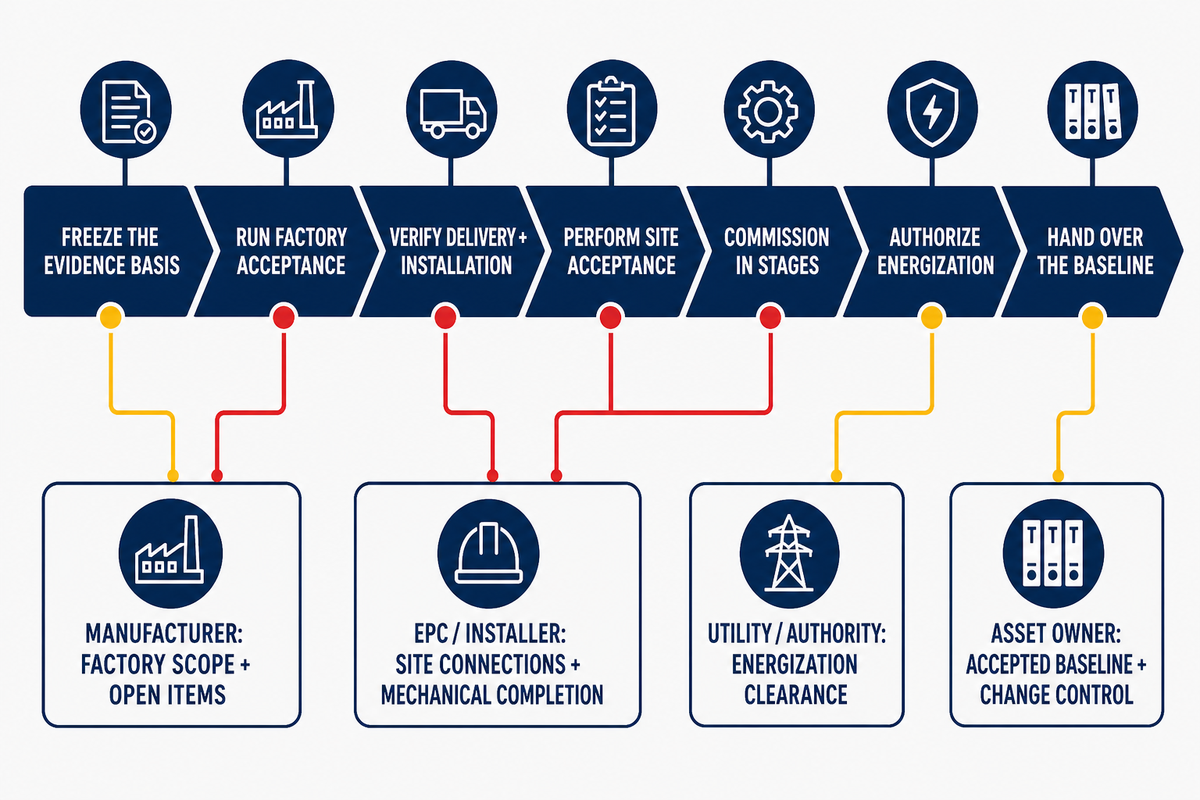
A useful handoff ledger separates the manufacturer, engineering-procurement-construction (EPC) contractor or installer, utility or authority, and asset owner. Each stage closes different evidence. Factory acceptance records can show controlled-facility conformance, but they cannot prove the installed system, adjacent interfaces, live settings, operating procedures, or permission to energize.
A March 2026 EE Power commissioning article distinguishes factory acceptance testing (FAT) at the vendor facility, site acceptance testing (SAT) after installation, and staged commissioning through mechanical completion, pre-commissioning tests, functional and integration tests, energization, monitoring, documentation, and sign-off. That sequence is sourced industry practice, not a universal IEC vocabulary.
“There are no standard FAT or SAT work instruction documents.”
That statement is a warning against copy-and-paste test plans. Required tests, witnesses, hold points, punch-list closure, retests, site checks, and final approvals must come from the project specification and applicable equipment standards.
- Freeze the evidence basis — align approved drawings, data sheets, standards, deviations, owners, and witness points.
- Run factory acceptance — test the supplied assembly in the controlled factory scope and record open items.
- Verify delivery and installation — inspect transport condition, mechanical completion, site connections, labels, grounding, cables, and adjacent interfaces.
- Perform site acceptance — verify operation in the installed environment and close interface-specific punch items.
- Commission in stages — complete pre-energization and live functional/integration checks under the approved plan.
- Authorize energization — obtain the required utility, authority, owner, and safety clearances; do not infer permission from FAT.
- Hand over the baseline — issue accepted as-built drawings, settings, test reports, manuals, open-item status, and change-control ownership.
Key takeaway
Factory acceptance proves only the agreed factory scope. Service readiness depends on separate site evidence, commissioning, authorization, and handover decisions.
What Inspection and Maintenance Records Preserve the Configuration?
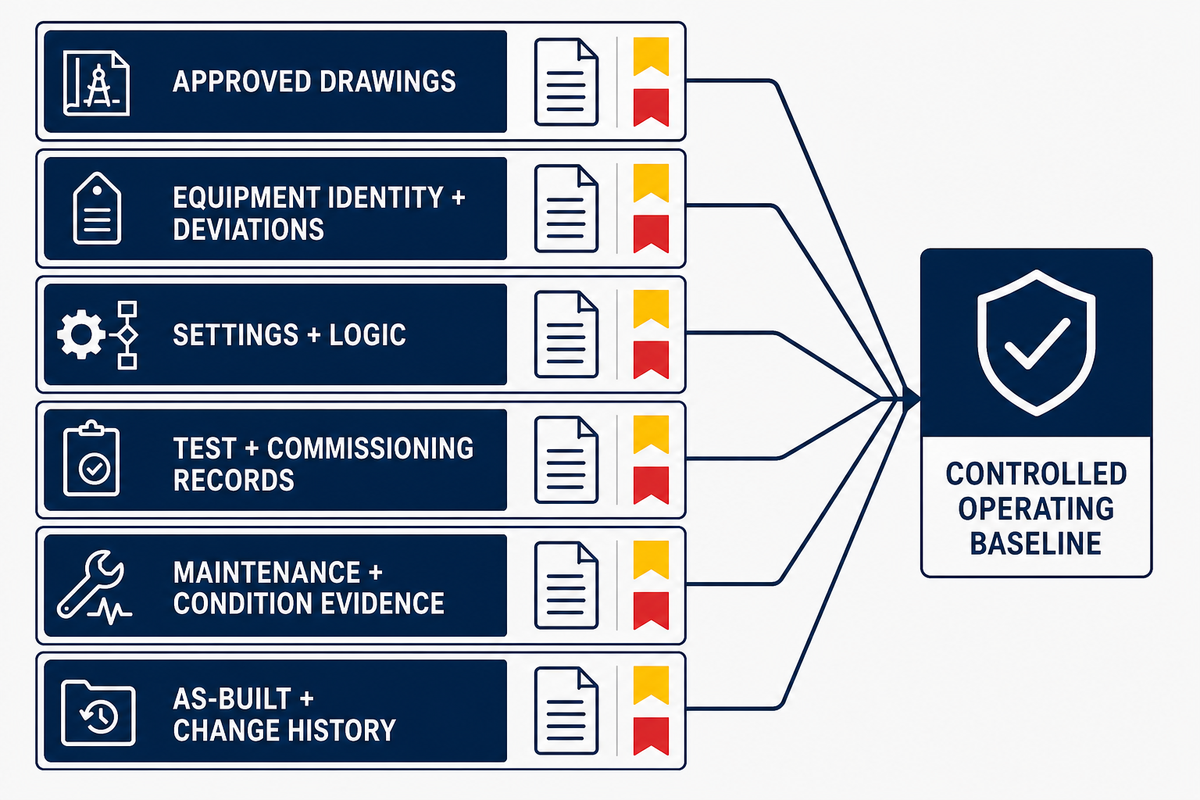
The operating baseline is a controlled set of accepted drawings, nameplates, settings, logic, test results, inspection findings, maintenance records, and approved changes that preserve reliability. Generic maintenance checklists cannot replace manufacturer instructions, condition evidence, owner procedures, and qualified electrical work.
For United States transmission and distribution operations, OSHA 1910.269(u) separately addresses substation working space, fence grounding, guarding, restricted access, and qualified-person entry. Construction and operation/maintenance rules are not interchangeable, and neither set applies automatically outside the United States.
Digital records matter alongside physical equipment. The public change summary for IEC 62271-212:2022 mentions control equipment, communication, smart-grid devices, and integration of components. Where those functions are present, preserve settings files, I/O and communications records, logic versions, time-synchronization settings, cybersecurity responsibilities, test baselines, and change logs with the electrical as-built package.
Lifecycle record set
- Approved single-line, general arrangement, wiring, cable, grounding, and interface drawings
- Equipment data sheets, nameplates, serial numbers, and accepted deviations
- Protection, control, metering, communications, and alarm settings
- FAT, SAT, commissioning, energization, and punch-list closure records
- Inspection findings, maintenance work, replaced parts, and condition evidence
- As-built revisions, firmware/configuration versions, approvals, and change history
What Is Changing in Grid Projects, and What Still Needs Proof?
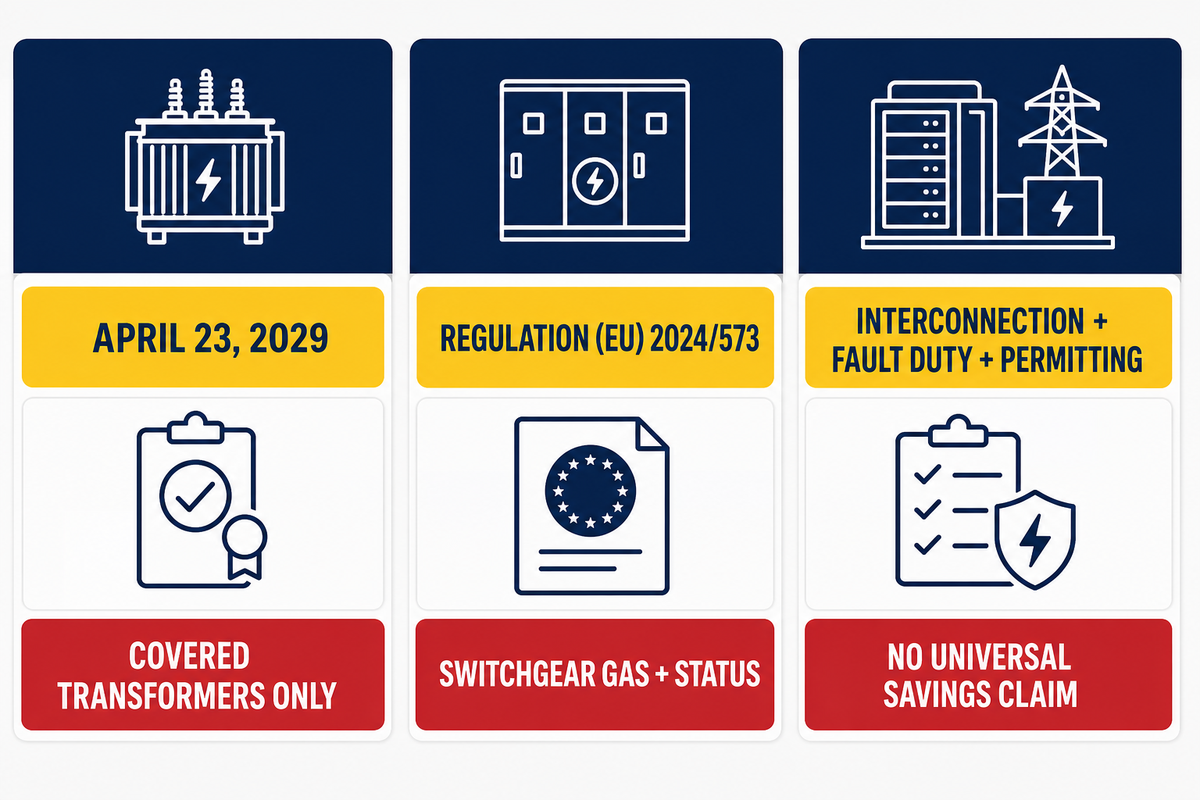
Useful trend analysis is not a generic market-growth number. Buyers face tighter interconnection schedules, changing transformer-efficiency rules, switchgear environmental restrictions, renewable energy connections, and more digital integration. Modular delivery may help a project sequence, but it cannot cure a missing network study, utility decision, site basis, or commissioning plan.
The U.S. Department of Energy states that compliance with its amended efficiency standards for covered distribution transformers is required on and after April 23, 2029. That date matters only when the transformer inside the assembly falls within the covered product definition; it does not classify or approve the complete substation.
In the European Union, Regulation (EU) 2024/573 creates staged restrictions and service rules for fluorinated gases in electrical switchgear. Exact dates and exceptions depend on voltage/current class, gas, procurement evidence, and equipment status. Make the switchgear technology and destination-market rule an RFQ input; do not publish one blanket date for every compact substation.
In 2026, POWER Magazine described interconnection capacity, fault-duty constraints, and permitting as data-center schedule bottlenecks. It presented modular substations as one response. Treat that as a specific project context, not proof of universal savings or shorter schedules.
Conclusion: Turn the Guide Into a Reviewable Project Basis
Use this guide to identify open boundaries, then move the configuration and quotation work to Toplit’s outdoor prefabricated compact substation solutions. If the input set is not ready, start with the outdoor substation RFQ input check and build a defined evidence plan.
Discuss the Project Boundary →
Frequently Asked Questions
What is a compact substation?
Compact substations coordinate several distribution functions in a smaller integrated footprint, while equipment scope, access, standards, site interfaces, and approval remain project-specific for each site.
It may include MV switching, a transformer, LV distribution, controls, auxiliaries, and an enclosure. Compact is usually descriptive rather than one universal IEC product class. Each project must still define physical sections, access model, ratings, protection, site interfaces, standards, tests, documents, responsible parties, and the local authority or utility review. No short label can close those project decisions.
What is the difference between a compact substation and a conventional substation?
Compared with a conventional site-built arrangement, a compact substation integrates more equipment before delivery; a conventional substation is assembled more extensively at site under a different project boundary.
Neither arrangement is automatically better. Compare network duty, fault level, access, expansion, maintenance, environmental conditions, transport, civil work, schedule, evidence, and ownership. Field assembly can decrease with a compact assembly, while a conventional arrangement may offer different access, separation, or expansion options. Site-built equipment can also simplify future separation or replacement in some projects. Let project data and authority review decide.
What is a modular substation?
Modular substations use transportable modules whose interfaces are completed and verified as a system after delivery under an approved site-test, commissioning, and owner-acceptance plan and sequence.
Modules may contain electrical equipment, control systems, auxiliaries, or enclosure sections. Modular describes a delivery architecture, not permission to connect or energize. Projects still need transport-split drawings, field-connection scope, grounding and cable interfaces, integration tests, site acceptance, commissioning, and final approvals. Prewiring and pretesting can occur while the system-level interfaces remain open at delivery.
How long does a compact substation take to install?
There is no defensible universal installation time.
Installation time depends on design maturity, approvals, factory scope, transport, foundation, cables, grounding, field connections, punch items, utility attendance, commissioning, and authorization to energize. Ask suppliers to state assumptions and milestones, not one unqualified duration.
What maintenance does a compact substation require?
Maintenance follows installed equipment, condition, duty, manufacturer instructions, owner programs, and applicable law, so no universal interval or task is safe for every project case.
Preserve approved settings and as-built records, inspect the condition of accessible equipment and interfaces, record findings and changes, and use qualified people under the applicable procedures. Review protection, control, communication, thermal, grounding, enclosure, cable, labeling, and document changes together because one change can alter another interface. This guide does not provide a task interval or live-work instruction because transformer, switchgear, controls, enclosure, environment, duty, manufacturer instructions, and jurisdiction differ.
Are compact substations safe near occupied areas?
Safety cannot be decided from the word compact or distance alone; equipment scope, access, grounding, fault duty, fire strategy, and local rules all matter together.
Project teams must address equipment scope, enclosure and access, fault duty, grounding, internal-arc considerations, fire/fluid strategy, ventilation, noise, working space, security, local codes, utility rules, and emergency arrangements. IEC 62271-202 includes public-access outdoor applications in its scope, but that does not certify a particular site. Project-specific engineering, authority review, owner procedures, access controls, and emergency planning still control the installation. Distance alone cannot answer the safety question.
Does factory testing mean the substation is ready to energize?
No. Factory testing closes only the agreed factory evidence.
Readiness still requires delivery inspection, mechanical completion, site connections, field tests, settings and integration checks, punch-list closure, commissioning, utility or authority decisions, owner acceptance, and an approved energization sequence.
Scope and limitations
This guide uses public IEC scope statements, IEEE’s public unit-substation summary, U.S. OSHA rules, official U.S./EU regulatory pages, industry engineering articles, and current Toplit page boundaries. It does not reproduce paid standard clauses, replace engineering or utility review, provide live-work instructions, or certify compliance.
Vendor claims, including Toplit’s, describe offerings and processes rather than independent validation. Project requirements vary with the jurisdiction, utility, network, site, equipment, adopted standards, and contract.
References & Sources
- IEC 62271-202:2022 International Electrotechnical Commission
- IEC 62271-212:2022 International Electrotechnical Commission
- IEEE C37.121-2020 public standard summary IEEE Standards Association
- OSHA 1926.966: Substations Occupational Safety and Health Administration
- OSHA 1910.269(u): Substations Occupational Safety and Health Administration
- Substation Commissioning and Testing: Scope and Workflow EE Power
- Checks for Successful Substation Factory Acceptance Testing Electrical Engineering Portal
- Distribution Transformers energy conservation standards U.S. Department of Energy
- Regulation (EU) 2024/573 Official Journal of the European Union
- Energizing AI: How Modular Substations Alleviate Data Center Power Bottlenecks POWER Magazine
![Pad-Mounted Transformer: How It Works [2026 Guide]](https://toplit-transformer.com/wp-content/uploads/2026/08/pad-mounted-transformer-guide-featured-150x150.png)
![Single Phase Pad Mounted Transformer Guide [2026]](https://toplit-transformer.com/wp-content/uploads/2026/08/single-phase-pad-mounted-transformer-guide-featured-1-150x150.png)