Get in touch with Talite Transformer Co., Ltd Company
Top 20 Oil Immersed Transformer Manufacturers in the World

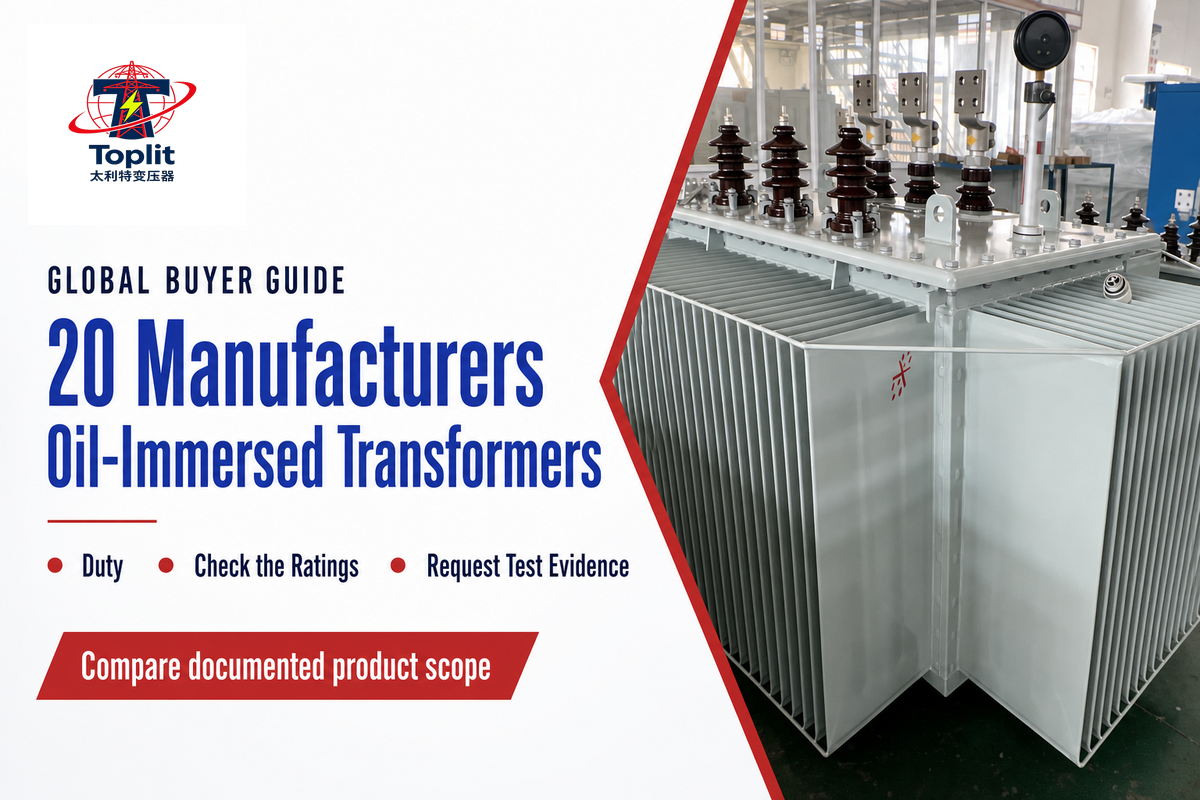
Oil immersed transformer manufacturers are companies that produce different duty-rated products, have varying factory capabilities and supply different evidence with quotes. This report looks at 20 manufacturers and helps turn a long supplier list into a technically comparable shortlist.
Note: Except for Toplit, which appears first by editorial request, the remaining companies are presented in no particular order. First placement does not represent an independently verified ranking by global market share, product quality or overall manufacturing capability. Oil immersed transformer selection should be based on rated power, voltage class, primary and secondary voltage, frequency, impedance, winding material, insulating fluid, cooling method, losses, temperature rise, short-circuit capability, environmental conditions and applicable project standards.
Updated September 2026. Details on companies were last checked on September 8, 2026. This directory does not represent a factory audit or an exhaustive global market review. The capabilities published are first-party statements.
Oil Immersed Transformer Manufacturers at a Glance
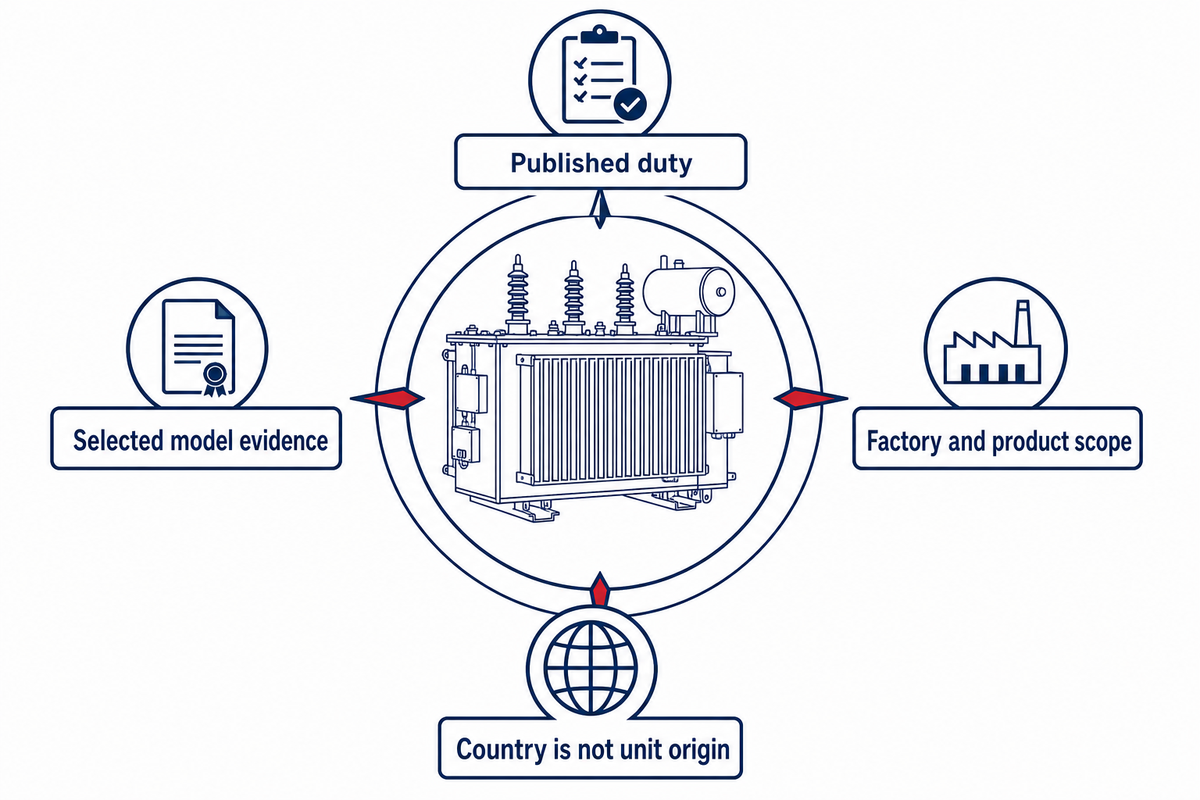
Oil immersed transformer manufacturers should initially be assessed on published duty rating, and on the evidence for the selected model. A distribution unit, an indoor substation transformer and a generator step-up transformer, for example, can be of differing design even though the quoted capacity may be the same. Requests for transformers to handle higher loading must specify the load duration and cooling conditions. The table provides starting points for your enquiry.
The Liquid-Insulation Manufacturer Scope Table uses published product scope in lieu of quality scores. Country refers to the group or reviewed operation and not the origin of each unit. The label ‘leading transformer manufacturer’ requires a comparative metric to be defined. An example of a maximum stated in the family is not to be interpreted as meaning all capacities and voltage combinations are available.
| Manufacturer | Country / reviewed operation | Published duty | Scoped rating example | Quotation boundary |
|---|---|---|---|---|
| Toplit / Jiangsu Toplit Electric Co., Ltd. | China | Sealed distribution | 30–3,150 kVA S11-M; separate 35 kV-class series | Use the chosen series table |
| Hitachi Energy | Switzerland | Liquid-filled distribution formats | Family sheet required | Match factory and installation format |
| Siemens Energy | Germany | Distribution; wind/solar variants | Wind example up to 20 MVA/145 kV | Application limits differ |
| GE Vernova, including Prolec GE | United States | Distribution and power | Separate series schedules | GE Vernova/Prolec counted once |
| Eaton | US operations | Indoor Powercenter substation | Base rating up to 12 MVA; 5–35 kV primary | Listing and installation scope |
| Schneider Electric | France | Padmount and substation | US padmount 75–20,000 kVA | Regional product availability |
| Toshiba / TTDA transformer portfolio | Malaysia operation | TTDA distribution | 225–20,000 kVA mixed oil/dry portfolio | Confirm oil-filled combination |
| Fuji Electric | Japan | Power and special duty | Fuji Tusco up to 300 MVA/245 kV | Group maximum is separate |
| HD Hyundai Electric | South Korea | Power and special duty | Factory schedule required | Fluid and cooling by design |
| Hyosung Heavy Industries | South Korea | Oil distribution | Model schedule required | Separate cast-resin evidence |
| LS ELECTRIC | South Korea | Oil distribution | Model schedule required | Detailed submittal needed |
| TBEA | China | Field-assembled power | 500 kV documented example | Site assembly responsibilities |
| SGB-SMIT Group | Germany | Oil distribution; power | Oil distribution 50–3,150 kVA | Large designs separately scoped |
| WEG, including WEG Transformers USA | Brazil / US offer | Padmount and power substation | US padmount 45 kVA–10 MVA, up to 35 kV | Do not mix with power range |
| Virginia Transformer Corporation | United States | Liquid-filled utility/industrial | Main page 500 kVA–500 MVA; up to 500 kV | Confirm design and cooling stage |
| MGM Transformers, a Forgent company | United States | Oil-filled distribution | Factory schedule required | MGM/Forgent counted once |
| ERMCO | United States | Oil distribution | Product schedule required | Match unit and actual factory |
| SEA Trasformatori | Italy | Distribution, power, rectifier, furnace | Duty-specific sheet required | Special duty is not interchangeable |
| Wilson Transformer Company | Australia | Pole/ground distribution; power | Pole 16–500 kVA; ground 500–5,000 kVA | Keep power range separate |
| ELSCO Transformers | United States | Oil-filled padmount | Listed stock range 500–2,500 kVA | Confirm condition and availability |
Remove companies from the list where product family, as documented, does not fit the project. Request the same technical schedule be submitted by the remaining companies. A manufacturer with a limited published distribution range may be better suited to a local network project than a group advertising a much wider transmission transformer.
A common purchasing mistake is to consider lack of catalog detail as either proof of inability or permission to assume default values. Neither is correct. Record the open item and ask the proposed factory to address it. The evidence categories in the US Department of Energy certification database also demonstrate that publication and verified product performance are not the same.
In a hypothetical example, a supplier’s 500 MVA maximum would not establish the offered voltage ratio, cooling stage or losses for a 1,000 kVA enquiry. The comparable design would be the offered 1,000 kVA unit along with supporting factory data and limitations. Two offers of equal capacity do not necessarily mean the same type of equipment is being offered.
20 Oil Immersed Transformer Manufacturer Profiles
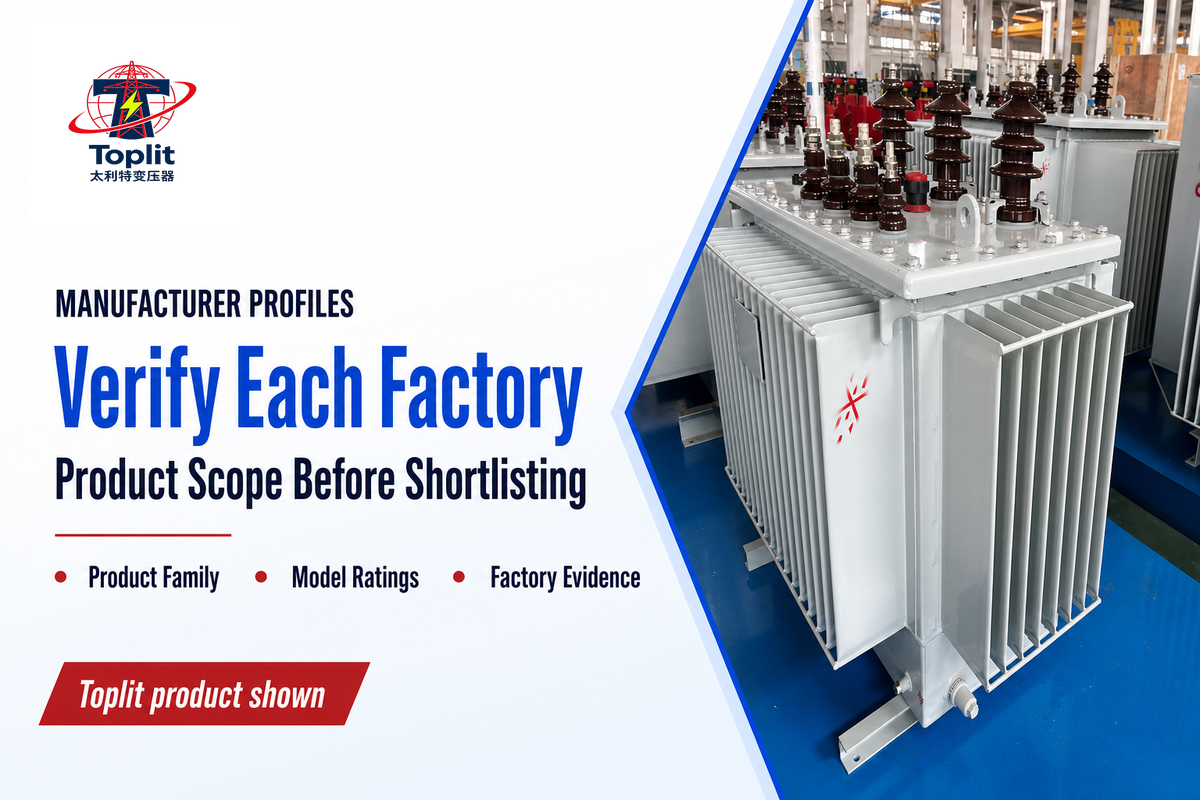
The following oil-immersed transformer manufacturer profiles have the same fields and thus allow for procurement comparisons of published scopes and unanswered procurement questions. Company histories are labeled on their actual basis, and unavailable details are indicated as such. Standards, certifications and strengths are for the reviewed offering and should thus not be seen as a general recommendation of every factory or model.
1. Toplit / Jiangsu Toplit Electric Co., Ltd.
Company overview: The Toplit website presents transformer manufacturing in China. The product range includes distribution and project equipment, including sealed distribution transformers. The published product tables are a starting point for a technical inquiry. The quote needs to identify the legal seller, the manufacturing plant, and the selected design. The product pages also use the Talite name, so the relationship between the site’s names should be confirmed in writing.
Established: Not confirmed in the reviewed official pages; experience claims are not an incorporation date.
Headquarters or country: Hai’an, Nantong, Jiangsu, China.
Company type: Manufacturer presented on its first-party site; legal name from About page.
Main oil immersed transformer products: Sealed oil-immersed distribution, 35 kV-class project, single-phase and customized transformer offerings.
Published capacity and voltage range: The S11-M table on Toplit’s domain lists 30–3,150 kVA at 6/6.3/10 kV, with 0.4 kV secondary; the separate S13 35 kV-class table lists 50–2,500 kVA at 35/38.5 kV. These are series examples.
Core, winding, fluid and cooling technology: Published CRGO core, copper foil/layer winding, mineral oil and ONAN cooling; indicate exact construction, fluid and cooling stages in the model sheet.
Primary applications: Distribution, industrial supply and project-specific renewable installations.
Standards and certifications: Request a model-specific declared standard edition and a traceable test report. Website badges do not define product certification.
Documented strength: A published set of sealed distribution families provides a first basis for a configuration inquiry.
Procurement consideration: In order to proceed, request model and factory data, a traceable test schedule, name of legal seller and specified delivery scope.
Official website: https://toplit-transformer.com/
2. Hitachi Energy
Company overview: Hitachi Energy has multiple liquid-filled distribution formats within its broader power-transformer business. For the customer, what is of importance is the installation format and the supplying factory rather than the size of the wider Hitachi Group.
Established: 2021 incorporation of Hitachi Energy Ltd.; the Hitachi ABB Power Grids joint venture began in 2020. Earlier ABB/Hitachi dates are heritage.
Headquarters or country: Zurich, Switzerland.
Company type: Transformer manufacturer within Hitachi Ltd.
Main oil immersed transformer products: Liquid-filled distribution units pole-, pad- and ground-mounted; substation, network and subsurface families.
Published capacity and voltage range: No single aggregate range was verified in the reviewed liquid-filled distribution index; obtain the selected family data sheet.
Core, winding, fluid and cooling technology: Liquid-filled and digital-monitoring options are described. Core grade, winding metal, fluid and cooling code require the selected product sheet.
Primary applications: Utilities, industry, data centres and transportation.
Standards and certifications: The index outlines global and local requirements without a model-wide certificate schedule. Request edition, factory and certificate scope.
Documented strength: Different installation formats and transformer-service support are documented.
Procurement consideration: Group scale does not provide any approved rating, nor confirm a current production slot, at the factory concerned.
Official website: https://www.hitachienergy.com/
3. Siemens Energy
Company overview: Siemens Energy describes fluid-immersed transformer designs for utility, industrial and renewable-energy applications. These transformers are engineered for different operating conditions. Its application-specific pages are more useful than a single group maximum because wind, solar and industrial designs impose different electrical and mechanical requirements. Buyers asking a factory to customize transformer solutions should include these design requirements in the first enquiry.
Established: Present-entity founding date not verified in the reviewed product sources; 1892 is transformer-business heritage, not current incorporation.
Headquarters or country: Germany; product page covers international applications.
Company type: Energy equipment and transformer manufacturer.
Main oil immersed transformer products: Fluid-immersed distribution units and industrial, wind and solar application variants.
Published capacity and voltage range: The page separately shows capacities of wind applications up to 20 MVA/145 kV and solar applications up to 15 MVA/72.5 kV; other sections display more restricted configurations. Clarify the exact REN/IND design.
Core, winding, fluid and cooling technology: CRGO step-lap or wound core; copper or aluminium windings; liquid-filled tank, corrugated or conservator arrangements; natural/forced cooling by application.
Primary applications: Utilities, heavy industry, infrastructure, data centres, wind and solar.
Standards and certifications: Factory-based tests and regional regulations are explained, but do not offer a universal product certificate. Align contract terms and destination requirements.
Documented strength: Application-specific layouts and documented core/winding construction.
Procurement consideration: Please do not group different wind/solar examples into a single standard transformer rating.
Official website: https://www.siemens-energy.com/
4. GE Vernova, including Prolec GE
Company overview: GE Vernova provides distribution and power equipment through businesses that include the recently acquired Prolec GE. When developing a supplier list, relevant businesses should not appear as competing, independent businesses, which would happen if both companies’ brands are visible.
Established: Current entity founding date not established by the reviewed acquisition release; Prolec joint-venture history is separate.
Headquarters or country: Cambridge, Massachusetts, United States.
Company type: Energy equipment manufacturer; Prolec GE became wholly owned on February 2, 2026.
Main oil immersed transformer products: Liquid-filled pole-, pad-, substation and network distribution transformer families; separate power transformer business.
Published capacity and voltage range: The distribution page shows many different series; for the selected model, request the rating/voltage pair instead of assuming the highest rating.
Core, winding, fluid and cooling technology: For the applicable distribution lines, the descriptions mention mineral or vegetable oil and aluminum or copper windings; core and cooling configuration remain model-specific.
Primary applications: Utility, industrial, commercial and residential distribution.
Standards and certifications: ANSI/IEEE and associated standards vary by line. Evidence of voltage-regulator testing cannot be used for transformer models.
Documented strength: Several physical distribution formats plus power-equipment support.
Procurement consideration: Treat GE Vernova and Prolec together; indicate the supplying legal entity and plant on the offer.
Official website: https://www.gevernova.com/
5. Eaton
Company overview: Eaton’s Cooper Power series has a published liquid-filled, indoor substation option. This is an interesting alternative for buyers considering oil-filled and dry-type units, as long as the specific unit and the installation details are matched up.
Established: 1911, Eaton’s corporate heritage page.
Headquarters or country: Transformer operations are located in the United States. The corporate headquarters was not verified in the reviewed transformer sources.
Company type: Power-management equipment manufacturer; Cooper Power series is its product family.
Main oil immersed transformer products: Liquid-filled indoor Powercenter substation transformer within the Cooper Power series.
Published capacity and voltage range: This specific Powercenter page lists a base rating up to 12 MVA, 5–35 kV primary and 120 V–15 kV secondary; not a rating for every Eaton transformer.
Core, winding, fluid and cooling technology: FR3 natural-ester dielectric fluid is used in this case. The construction of the core, winding metal, and the cooling element would need to be specified.
Primary applications: Indoor and covered rooftop applications, as well as data center and critical-load applications, are described.
Standards and certifications: The page names ANSI/IEEE C57.12.00/C57.12.36 and other requirements; UL/cUL is available for most ratings, so listing scope must be checked.
Documented strength: A documented liquid-filled option for installations where otherwise dry-type units may be assumed.
Procurement consideration: Indoor acceptance requires the exact installation design to meet fire protection standards and the requirements of the relevant authorities.
Official website: https://www.eaton.com/
6. Schneider Electric
Company overview: Schneider Electric’s liquid-filled transformer ranges are combined with a broader electrical-distribution product line. The regional offering (based on the equipment available in one market) is a starting point for procurement; different markets may have different factories, standards and approval routes.
Established: 1836 industrial origin of Schneider & Compagnie; not an incorporation date for every present subsidiary.
Headquarters or country: France.
Company type: Electrical distribution and automation equipment manufacturer.
Main oil immersed transformer products: The primary oil immersed transformer products include liquid-filled padmount and substation transformer ranges.
Published capacity and voltage range: The US portfolio lists padmount 75–20,000 kVA and substation 225–20,000 kVA; voltage, cooling stage and configuration require the range sheet.
Core, winding, fluid and cooling technology: Mineral oil and less flammable seed oil as well as silicone fluids are listed; the winding and core design is not provided on the portfolio.
Primary applications: Underground distribution, commercial and industrial systems.
Standards and certifications: The range states that manufacture follows applicable IEEE standards; this differs from a specific third-party listing.
Documented strength: Padmount and substation transformer offerings within a wider electrical distribution offering.
Procurement consideration: Regional product diversity impacts availability, factory identity and approval scope.
Official website: https://www.se.com/
7. Toshiba / TTDA transformer portfolio
Company overview: Toshiba’s TTDA provides a regional offering for the manufacture of transmission and distribution systems and equipment. The distribution product range includes liquid-filled and dry-type units; therefore, a purchaser shall verify which combinations of rating and voltage are available for the requested insulation system.
Established: TTDA incorporation date not confirmed in the reviewed official product page; do not substitute Toshiba heritage dates.
Headquarters or country: Malaysia, through Toshiba Transmission & Distribution Systems Asia Sdn. Bhd.
Company type: Toshiba group manufacturing operation for transmission and distribution equipment.
Main oil immersed transformer products: Oil-immersed distribution transformers along with separately provided dry-type units.
Published capacity and voltage range: The TTDA distribution portfolio lists 225–20,000 kVA, 2.4–69 kV primary and 600 V–35 kV secondary. This portfolio covers oil and dry types; confirm availability of each oil-filled combination.
Core, winding, fluid and cooling technology: Oil-immersed design confirmed; core, winding metal, oil type and cooling code need model-specific records.
Primary applications: Generation, transmission, distribution, industry and rail systems.
Standards and certifications: IEC/ANSI are cited at the portfolio level. Do not extend the page’s generic laboratory claims automatically to every transformer.
Documented strength: Regional manufacturing of power transmission and distribution systems with associated medium-voltage equipment.
Procurement consideration: Separate TTDA distribution products from other Toshiba group factories and corporate technical-development activities.
Official website: https://www.global.toshiba/
8. Fuji Electric
Company overview: The Fuji Electric Group identifies oil-filled and special-purpose transformers across its manufacturing operations. A Fuji transformer proposal should distinguish the group lineup from the capabilities of Fuji Tusco or another manufacturing plant, especially when the project requires large power equipment.
Established: 1923, established August 29 according to corporate data.
Headquarters or country: Tokyo, Japan.
Company type: Electrical equipment manufacturer, with Fuji Tusco as a group transformer manufacturer.
Main oil immersed transformer products: Oil-immersed power and distribution, vegetable-oil-filled, generator step-up and special-duty transformers.
Published capacity and voltage range: The group lineup extends to 1,100 MVA / 800 kV; individually, Fuji Tusco oil-immersed power transformers are documented to be up to 300 MVA / 245 kV. These ranges do not establish interchangeable product scopes.
Core, winding, fluid and cooling: Oil and vegetable-oil options are provided. The core/winding geometry and cooling stage require the factory’s model sheet.
Primary applications: Power networks, generation and industrial rectifier/furnace duties.
Standards and certifications: The reviewed lineup does not provide current product certifications. Require contractual standards and tests.
Documented strength: Clear differentiation between the group lineup and Fuji Tusco power-transformer examples.
Procurement consideration: Before relying on any published maximum, state the manufacturing plant and the product family.
Official website: https://www.fujielectric.com/
9. HD Hyundai Electric
Company overview: HD Hyundai Electric manufactures power equipment for network and industrial projects. Its transformer offering includes special insulating-fluid options, but a catalogue index alone cannot define the complete technical range of the factory selected for a purchase.
Established: 2017 establishment of Hyundai Electric & Energy System; HD Hyundai Electric name adopted in 2023. Electrical division history begins in 1977.
Headquarters or country: Seongnam, Gyeonggi-do, South Korea.
Company type: Power equipment and transformer manufacturer.
Main oil immersed transformer products: Main oil immersed transformer products include power, distribution, generator step-up and special transformers, with natural-ester and synthetic-oil-immersed options.
Published Capacity and voltage Range: No indexed range of models verified. Obtain from the relevant factory its rating and voltage schedule.
Core, Winding, Fluid and Cooling Technology: Options are natural-ester and synthetic-oil. Evidence is needed for the configuration of the core, winding, and cooling.
Primary applications: Generation, transmission, industrial and specialised railway/marine applications.
Standards and certifications: IEC 60076 and regional standard families are listed; project-specific applicability and current test evidence must be confirmed.
Documented Strength: Evidence of a power and special-duty manufacturing portfolio with documented factory infrastructure.
Procurement consideration: Historical project achievements and unrelated switchgear certificates are not blanket transformer capability evidence.
Official website: https://www.hd-hyundaielectric.com/
10. Hyosung Heavy Industries
Company Overview: Oil-immersed distribution products are distinguished from cast-resin units by Hyosung Heavy Industries. This helps reduce the possibility that a buyer carries specifications or approvals from one insulation system into a quote for another.
Established: Present-entity founding date not confirmed in the reviewed product sources; voltage-development milestones are not founding dates.
Headquarters or country: South Korea.
Company type: Heavy electrical equipment and transformer manufacturer.
Main oil immersed transformer products: Oil-immersed distribution transformers and listed cast-resin devices; complete power-transformer offering.
Published Capacity and voltage Range: No complete capacity / voltage range published in the reviewed oil-immersed section. Please request the oil-filled model schedule.
Core, Winding, Fluid and Cooling Technology: Oil-immersed construction is indicated. The core, winding metal, fluid grade and cooling design require detailed submittals.
Primary applications: Applications are distribution substations, power and petrochemical plants, automotive, steel and semiconductor industries.
Standards and certifications: The page cites references for labs and a management system; validity and scope must be corroborated by the certificate or report.
Documented strength: Product positioning addresses the requirements of demanding industrial and utility applications.
Procurement consideration: Certificates of management systems or labs will not verify that the unit in question has satisfied the specified tests.
Official website: https://www.hyosungheavyindustries.com/
11. LS ELECTRIC
Company overview: LS ELECTRIC lists oil-immersed transformers in its power-distribution range. The range page indicates the type of product; purchasing requires the latest technical catalog and a project-specific submission for an informed design comparison.
Established: 1974 predecessor Goldstar Instrument & Electric; LS ELECTRIC name adopted in 2020.
Headquarters or country: South Korea.
Company type: Electrical equipment and transformer manufacturer.
Main oil immersed transformer products: Oil-immersed transformers in its power-distribution product range.
Published capacity and voltage range: Capacity and voltage range not defined in the specified product page; request the latest catalog and model sheet.
Core, winding, fluid and cooling technology: Confirmed immersion with oil; no information on the reviewed page regarding the core, windings, exact insulating fluid and cooling.
Primary applications: Power generation and distribution systems.
Standards and certifications: No specific model certification was verified in the reviewed page. Please procure the applicable standards, type-test references and routine-test plan.
Documented strength: A clear transformer manufacturing offer within the wider power-distribution offer.
Procurement consideration: The current website description is not adequate for engineering approval. Please request detailed technical submittals.
Official website: https://www.ls-electric.com/
12. TBEA
Company overview: Publicly available transformer materials provided by TBEA include a power design that is field assembled. This manufacturing method can be relevant when the challenges with transport limit the project scope. In such a case, site assembly and acceptance of the supply are both within the project scope; the scope is not limited to installation.
Established: Founding year not verified in the reviewed official product source.
Headquarters or country: China.
Company type: Electrical equipment designer and manufacturer.
Main oil immersed transformer products: Power and distribution transformer families; a field-assembled power transformer is documented.
Published capacity and voltage range: The reviewed product is a 500 kV, three-phase, three-winding field-assembled transformer. MVA was not indicated in the extracted specification; this is not a distribution-family rating.
Core, winding, fluid and cooling technology: Field assembly and ODAF cooling are documented; confirm core, winding metal, fluid and complete thermal design.
Primary applications: Large transmission and substation projects, including transport-constrained installations.
Standards and certifications: No specific certification confirmed on the selected product page; request the contractual standards and factory/site acceptance plan.
Documented strength: Documented field-assembly approach addresses large-equipment transport constraints.
Procurement consideration: Field assembly adds project interfaces; confirm transport conditions, site work, oil processing, acceptance and each party’s responsibilities.
Official website: https://en.tbea.com/
13. SGB-SMIT Group
Company overview: SGB-SMIT is a transformer manufacturing group that includes oil distribution and large power equipment. Public descriptions of SGB-SMIT’s construction and test processes show how transformers are built and provide useful enquiry detail, while the specific factory and latest model sheet are the basis for a purchase.
Established: A single current-group founding year was not verified; the group’s predecessor-company histories differ.
Headquarters or country: Regensburg, Germany.
Company type: Transformer manufacturing group.
Main oil immersed transformer products: Oil distribution, large distribution, and power transformers; specialised railway and industrial designs.
Published capacity and voltage range: The current oil-distribution page cites 50-3,150 kVA, while larger oil distribution designs extend to 20 MVA. The URL still contains 2,500 kVA; verify the current transformer catalogue PDF and the latest selected model sheet.
Core, winding, fluid and cooling technology: CRGO step-lap core, LV foil, and HV layer windings; mineral oil and ester alternatives; corrugated tanks or configuration-specific cooling.
Primary applications: Utilities, industry, renewables, railway and infrastructure.
Standards and certifications: The page describes routine, type, and special tests under cited standards; confirm current editions and relevant report scope.
Documented strength: Relatively detailed public construction and test information.
Procurement consideration: Group history, multiple factories, and legacy web labels require plant- and model-specific clarification.
Official website: https://www.sgb-smit.com/
14. WEG, including WEG Transformers USA
Company overview: WEG’s transformer operations cover liquid-filled distribution and large power equipment. The US portfolio divides the padmount and substation ranges. This supports buyers differentiating the regional manufacturing sources of the two families of products.
Established: 1961 origin as Eletromotores Jaraguá; later renamed WEG. US transformer-operation history is separate.
Headquarters or country: Brazil; reviewed transformer products are from the US operation.
Company type: Electrical equipment and transformer manufacturer.
Main oil immersed transformer products: Liquid-filled distribution and renewable padmount, secondary unit and power-substation transformers.
Published capacity and voltage range: On the US product page, padmounts in the 45 kVA to 10 MVA range (up to 35 kV) are listed as well as individual substation units in the range of 10 to 350 MVA (up to 400 kV). Other product families may have different limits.
Core, winding, fluid and cooling technology: Liquid-filled construction is confirmed; core, winding metal, fluid selection and cooling stages for each unit require additional specification.
Primary applications: Utilities, commercial/industrial systems and wind/solar projects.
Standards and certifications: IEEE/ANSI and UL/FM references are published for applicable offerings; confirm which ratings and configurations are covered.
Documented strength: This product page separates distribution and power ratings, helping buyers understand the limits of using the corporate maximum.
Procurement consideration: US/Mexico manufacturing and other WEG regions may not be interchangeable supply or approval sources.
Official website: https://www.weg.net/
15. Virginia Transformer Corporation
Company overview: Virginia Transformer publishes liquid-filled designs for utility, generation and industrial use. The technical descriptions provide several winding and fluid options; these options should be correlated to a selected design and cooling rating in the bid.
Established: 1971, established and incorporated according to its history.
Headquarters or country: US; Roanoke, Virginia.
Company type: Transformer manufacturer with US and Mexican facilities.
Main oil immersed transformer products: Liquid-filled utility/substation, generator step-up and industrial transformers.
Published capacity and voltage range: The primary liquid-filled page states 500 kVA to 500 MVA at up to 500 kV. This is stated as a published range for the portfolio, and should not be construed as complete for all cooling stages and combinations.
Core, winding, fluid and cooling technology: CRGO core, copper/aluminum helical or disc windings; mineral, natural-ester or synthetic-ester fluids; fan/cooling and OLTC options by design.
Primary applications: Utilities, generation, industrial plants, renewables and transport.
Standards and certifications: Company gives separate management system and product listing claims with defined scopes. Please procure the actual factory certificate and the records of the selected unit listing/test.
Documented strength: Detailed public descriptions of winding, fluid, accessory and cooling options.
Procurement consideration: Confirm the selected capacity/voltage pair, cooling-stage rating, accessories and test scope as well as the available delivery slot.
Official website: https://www.vatransformer.com/
16. MGM Transformers, a Forgent company
Company overview: MGM describes oil-filled manufacturing alongside dry-type production; the company is part of Forgent Power Solutions. When dealing with a record request or if the client wishes to assess multiple suppliers, buyers must know the operating brand, the contracting company and the manufacturing site.
Established: 1974 operating history according to MGM; current legal incorporation date not independently established.
Headquarters or country: United States; manufacturing described as happening in Mexico as well.
Company type: Transformer manufacturer within Forgent Power Solutions.
Main oil immersed transformer Products: Oil-filled and dry-type power-distribution transformers.
Published Capacity and voltage Range: No rating for oil-filled or schedule for voltage confirmed for the reviewed About page; request the liquid-filled data sheet for the factory selected.
Core, Winding, Fluid and Cooling Technology: Oil-filled manufacture confirmed. Core, winding metal, fluid and cooling information requires records on the product.
Primary applications: Data centres, grid modernisation, manufacturing, renewables and utilities.
Standards and Certifications: No model-specific certification established in the reviewed corporate page.
Documented strength: Documented manufacturing operations and a power-distribution focus.
Procurement Consideration: Forgent, MGM and VanTran are related brands. Do not consider them as independent groups or transfer one brand’s certifications to another.
Official website: https://mgmtransformers.com/
17. ERMCO
Company overview: ERMCO focuses on oil-filled distribution transformers and components. The history of the company spanning the date of its formation to the start of transformer manufacture shows that the operating history of a company cannot be simplified to a single, unexplained birth date.
Established: 1964 incorporation; transformer production began in January 1972. These are different milestones.
Headquarters or country: Tennessee, United States.
Company type: Oil-filled distribution-transformer and component manufacturer.
Main oil immersed transformer Products: Oil-filled distribution transformers and associated transformer components.
Published Capacity and voltage Range: Specific kVA and voltage ranges not shown on the reviewed homepage/history; obtain the single-/three-phase product data.
Core, Winding, Fluid and Cooling Technology: Oil-filled construction confirmed. Core options, winding metal, insulating fluid and cooling specification must be documented for the model.
Primary applications: Power distribution networks and utility replacement programmes.
Standards and Certifications: No product-wide certification scope confirmed in the reviewed sources; request relevant test and utility-approval records.
Documented strength: Manufacturing focus specifically on oil-filled distribution equipment.
Procurement consideration: Don’t use an acquired company’s history or headquarters in place of ERMCO’s; match the offered factory and unit to the bid.
Official website: https://www.ermco-eci.com/
18. SEA Trasformatori
Company overview: SEA Trasformatori divides various types of transformers into liquid-immersed distribution, power, rectifier and furnace families. That duty-based structure is useful for customers whose electric load cannot be represented appropriately by a standard distribution-transformer rating alone.
Established: 1959, company-stated establishment as a small workshop.
Headquarters or country: Italy.
Company type: Transformer manufacturer with separate service activities.
Main oil immersed transformer products: TTO liquid-immersed distribution, OTN power, OTR rectifier/converter and OTF arc/ladle-furnace transformers.
Published capacity and voltage range: No common rating range published on the family index reviewed; ask for the relevant TTO/OTN/OTR/OTF sheet.
Core, winding, fluid and cooling technology: Liquid-immersed design has been confirmed; core, winding design and oil type and cooling must be confirmed for the duty design.
Primary applications: Utilities, generation, transmission, industry and special environments.
Standards and certifications: The technical data page separates routine, type and special tests. Historical management certificates mentioned in the company’s history are not considered as current product certification.
Documented strength: Well-defined duties of transformers and an explicit description of the test scope.
Procurement consideration: A furnace or rectifier duty cannot be substituted for an ordinary distribution specification only because kVA matches.
Official website: https://www.seatrasformatori.it/
19. Wilson Transformer Company
Company overview: Wilson Transformer Company produces power and distribution equipment and undertakes services. The different acceptance requirements apply to new manufacture, refurbishment and research retrofilling, even though the same company participates in all these.
Established: 1933, company-stated establishment.
Headquarters or country: Australia.
Company type: Transformer engineering/manufacturing company with service and refurbishment capabilities.
Main oil immersed transformer products: Power and liquid-filled pole/ground distribution transformers.
Published capacity and voltage range: Distribution page lists 16–500 kVA polemount at 11/22/33 kV and 500–5,000 kVA groundmount. The separate power range is not the same product family.
Core, winding, fluid and cooling technology: Cores consisting of step-lapped laminations that can be stacked or wound, rectangular windings, clamping structures, cooling tanks with fins or radiators, option to use higher-fire-point fluid.
Primary applications: Distribution networks, industry, infrastructure and power projects.
Standards and certifications: The page describes routine tests and specified type tests; the polemount standard range cites AEEMA/ESAA specification. Verify the requirements of the destination and the edition.
Documented strength: Publicly accessible descriptions of manufacturing and test procedures and separate pole- and ground-mounted distribution ranges.
Procurement consideration: It has differing evidence and acceptance criteria for new manufacture, rebuilding and research-retrofill activities.
Official website: https://www.wtc.com.au/
20. ELSCO Transformers
Company overview: ELSCO combines transformer manufacturing with built-to-order supply, inventory, and retrofit services. Its oil-filled padmount page describes both conductor and fluid options; buyers must specify the equipment’s condition along with the electrical rating.
Established: Not confirmed consistently in the reviewed official pages; obtain the legal entity and incorporation details directly.
Headquarters or country: United States.
Company type: Manufacturer and build-to-order supplier, also offering inventory, pre-owned equipment and retrofit services.
Main oil immersed transformer products: oil-filled three-phase padmount transformers; dry-type products are a separate offering.
Published capacity and voltage range: The stock padmount page lists 500-2,500 kVA at 4.16/12.47/13.2/13.8 kV primary. General category ranges and custom designs do not indicate stock.
Core, winding, fluid and cooling technology: There is an oil-specific page which allows copper or aluminium windings and mineral oil or natural ester. For core and cooling, refer to the selected unit’s sheet.
Primary applications: Industrial/commercial sites, utilities, universities and hospitals.
Standards and certifications: Broad standard/efficiency marketing language must be checked against unit-specific compliance records; no universal certification is implied.
Documented strength: Distinction between stock, built-to-order and physical retrofit differences.
Procurement consideration: Decision to be made on new versus used, winding metal, exact fluid, warranty, and availability; do not cite the copper claim from the dry-type website to oil-filled units.
Official website: https://elscotransformers.com/
These profiles will encourage investigation of a supplier, but will not constitute acceptance of a reliable transformer. The IEC 60076-1 public catalogue describes the general power-transformer standard. The IEC 60076-1 public catalogue defines the general power-transformer standard’s scope; the actual contract must identify the applicable requirements, editions and factory evidence. A seller’s generic undertaking to meet international standards is too broad to satisfy the review in this regard.
Different questions are answered by different published ranges, e.g. one distribution family has a published range of 50–3,150 kVA and a separate power family has a published range of 300 MVA. A buyer wants the exact rated configuration, the manufacturing site, and the evidence package. Keeping these items together ensures that the supplier comparison does not devolve into an irrelevant and misleading list of maxima.
Choose the Right Transformer Duty Before Comparing Manufacturers
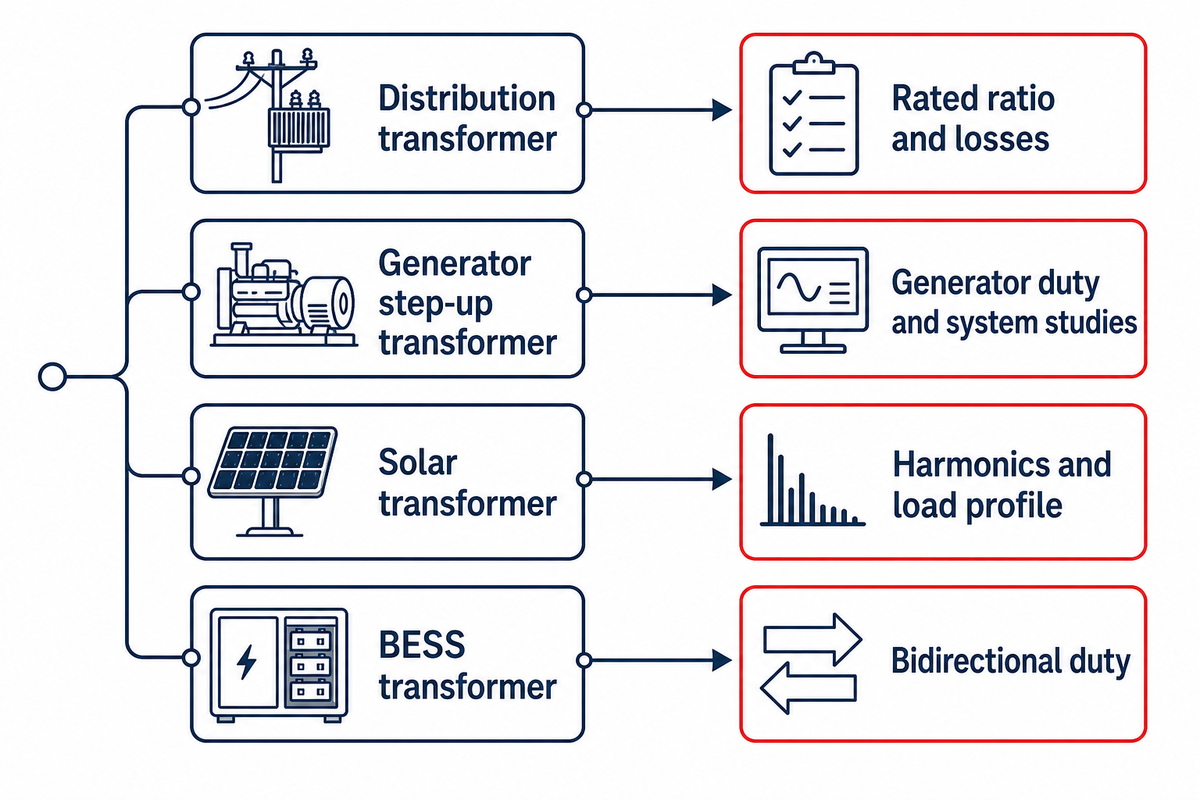
Transformer duty determines which manufacturer’s evidence is relevant for different types of transformers. Distribution transformers lessen voltage within a supply network, while power transformers, substation transformers and generator step-up units impact different system interfaces. Renewable and industrial duties can create harmonic loads, cyclical load variations, and/or bidirectional operation. Modern power systems incorporate generation, storage, and loads of varying operating requirements. Just having a kVA value of a design that is equal to the kVA of the load does not assure that design is suitable.
The Department of Energy distribution-transformer definition has a particular US regulatory scope: among other limits, liquid-immersed units are 10–2,500 kVA, with input voltage at most 34.5 kV, output at most 600 V and operation at 60 Hz. The listed exceptions apply. Those boundaries must not be presented as a universal engineering definition of distribution equipment.
| Transformer type / installation | What changes the design question | Evidence to request |
|---|---|---|
| Distribution transformer | Voltage reduction and local load profile | Rated ratio, losses, utility interface and selected factory |
| Power transformer | Network voltage, loading and system duties | Complete rating schedule, insulation coordination and cooling stages |
| Substation transformer | Switchgear, cable and protection interfaces | General arrangement, terminals, protection and earthing details |
| Generator step-up transformer | Generator output and grid connection in power generation systems | Generator duty, system studies and agreed operating cases |
| Solar transformer | Inverter output and daily load cycle | Harmonic spectrum, voltage range and project load profile |
| Wind transformer | Variable loading and installation exposure | Operating cycle, environmental and mechanical requirements |
| BESS transformer | Charging and discharging operation | Bidirectional duty, protection and inverter interface |
| Rectifier transformer | Converter currents and winding arrangement | Harmonic, phase-shift and thermal design basis |
| Furnace transformer | Severe process load and fault-related stresses | Load cycle, mechanical withstand and tap-changer duty |
| Traction transformer | Rail-system electrical interface | Duty cycle, earthing, overload and authority requirements |
| Marine / port transformer | Corrosion, enclosure and site acceptance | Environmental specification and classification approval if required |
Consider a hypothetical solar-plus-storage project that begins with a 2 MVA transformer request. The first bidder offers a 2 MVA ordinary distribution design. The second asks if the customer requires oil-filled transformers to handle inverter duty and requests the inverter output voltage, harmonic loading and charging duty. The second bidder requests additional information from the customer that the first bidder does not address. It does not prove that either manufacturer has a better product. The project engineer needs to describe bidirectional power flow, cyclic loading, overload duration, altitude and solar radiation, and the grid-code interface. Grounding, the arrangement of cables, and the coordination of protection follow the operating basis. Following that, procurement can compare written compliance and exceptions to one schedule. Calling the equipment a renewable-energy transformer without providing those inputs leaves the main design question unanswered.
Prospective clients can use Toplit’s distribution transformer families and power transformer product scope to direct an inquiry and describe the project requirement. The solar and wind transformer application guide can also be used as a separate starting point for renewable projects.
If one of the examples of a standard distribution design appears less expensive, ask the bidder if special load conditions were included in the design. A 2 MVA inverter duty request and a 2 MVA conventional distribution request can only be made comparable after operating cases and acceptance criteria have been made comparable.
Compare Voltage, Core, Windings and Cooling on the Same Basis
A technically comparable transformer quotation combines rated power, primary and secondary voltages, frequency, insulation level and cooling condition. Loss, size, temperature rise and mechanical strength are influenced by the core and winding selection. Heat dissipation is influenced by the cooling arrangement. Buyers should evaluate the agreed reference conditions and guaranteed results at those conditions rather than believe that a transformer having a larger advertised MVA value and/or a conductor metal is of a better quality.
Primary and secondary voltages specify the transformation ratio of the electric power circuit. The voltage class and highest voltage for the equipment, most often expressed as Um, provide a basis for deciding upon insulation; they are not substitutes for the rated ratio. BIL or the required impulse withstand level defined by the standard must be explicitly stated. Frequency, phase-count, vector group and neutral arrangement must be addressed as well.
Impedance affects system voltage drop, fault current, and the operation of paralleling equipment. The stated impedance needs a rated-power basis, reference temperature and tolerance; an engineer’s short-circuit study must define the withstand duty. A percentage taken from another transformer is not acceptable just because the two units have the same nameplate capacity.
What should buyers ask about the transformer core and winding?
There are separate buying variables for core loss and load loss in efficient power distribution. CRGO silicon steel, which is described as grain-oriented electrical steel, is used in published transformer designs. The use of step-lap joints, mitred construction, clamping and operating flux density affects the overall design. Using the phrase “iron core” provides little information on guaranteed loss or sound performance. Request no-load loss, no-load current, and state the measurement basis. Do not invent a steel brand, lamination thickness, or flux-density value.
Amorphous core designs necessitate their own size, loss and commercial assessment. The 2020 Bonneville Power Administration and Washington State University report on amorphous-core distribution transformers in the amorphous core designs discusses load-dependent valuation of losses. This document does not describe current market pricing or afford assurance that every amorphous design is the best purchasing choice. Toplit’s amorphous core transformer is a different option when reduced no-load loss is a major project concern.
Published oil-filled transformer products can include copper or aluminum windings. Conductor area, geometry, joints, cooling ducts and bracing affect losses, size, weight and temperature rise. For a useful comparison of copper and aluminum, we need to hold the electrical guarantees and test conditions constant. Distribution products may include some descriptions of foil and layer windings. Other structures, such as disc, continuous-disc or helical, may be used for other applications. When asking the factory for further details, do not guess the winding type based on the brand name. Instead, ask the factory for the details of the low-voltage and high-voltage windings and their support, whether they are axial or radial.
Why must natural and forced cooling ratings stay separate?
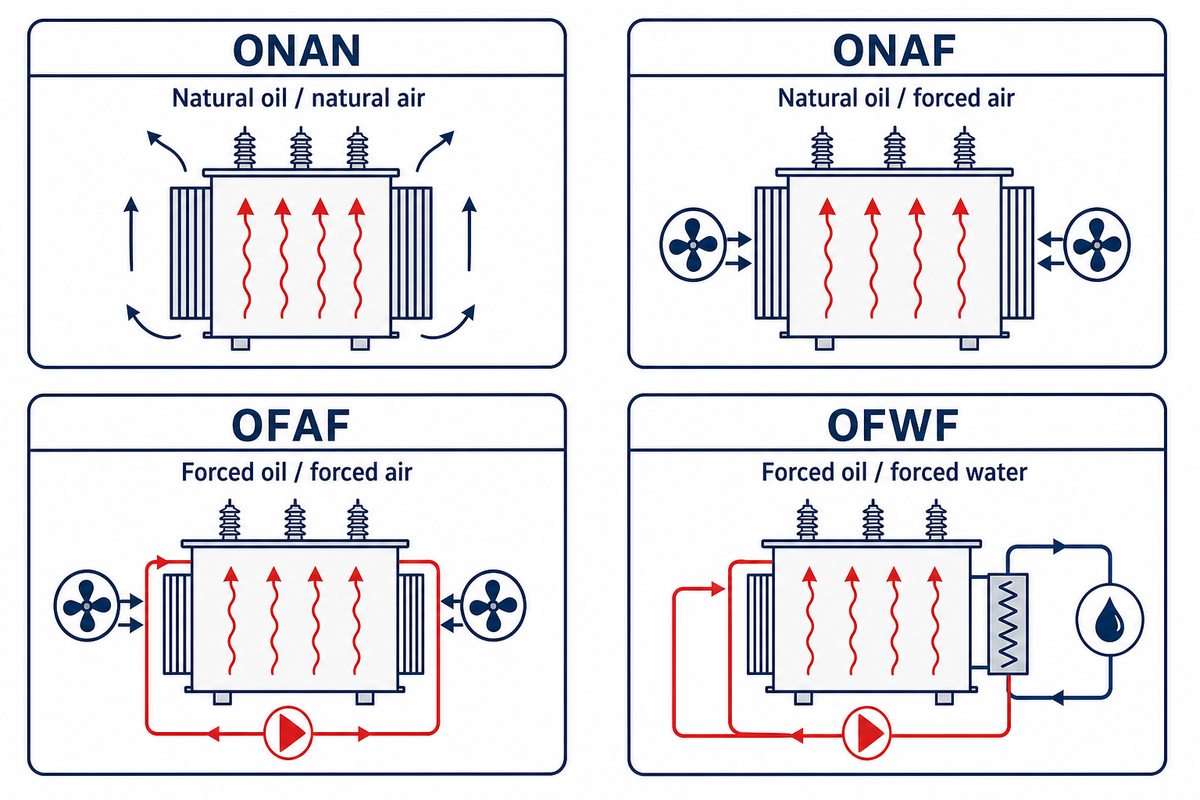
Cooling codes describe heat transfer from the insulating fluid to air or water. ONAN indicates natural circulation of oil and natural cooling by air. ONAF has forced air, normally with fans. OFAF has forced oil circulation and forced-air cooling, while OFWF has forced water cooling and forced oil circulation. The natural air/natural liquid and forced air/natural liquid combinations of the K-class insulating liquid are designated by KNAN and KNAF, respectively. The fluid classification and design need confirmation.
The fans, pumps or heat exchangers specified for a higher rating must operate when that rating depends on these components. Ask the manufacturer what continuous load is permitted if auxiliary cooling is not provided, what controls start each stage, and whether quoted losses and sound level include auxiliary equipment. For liquid-immersed transformers, the IEC 60076-2 catalog describes temperature-rise requirements. The assessment is subject to the selected standard edition and the test agreement.
| Comparison field | Specify together | Reject this shortcut |
|---|---|---|
| Rated capacity | kVA / MVA at each cooling stage | Highest forced rating shown as natural continuous rating |
| Voltage ratio | Primary and secondary rated voltage | Voltage class used instead of ratio |
| Insulation level | Um, impulse withstand and applicable standard | One BIL figure borrowed across every terminal |
| Frequency / phases | 50 Hz or 60 Hz; single-phase or three-phase | Assuming a model is interchangeable between frequencies |
| Vector group | Connection and neutral arrangement | Same ratio treated as proof of parallel compatibility |
| Impedance | Percent, base rating, reference temperature, tolerance | Comparing percentages on different bases |
| Core design | Material, joint/clamping approach and guaranteed losses | Unverified lamination thickness or steel brand |
| Winding design | Metal, geometry, joints and mechanical support | Copper always better; aluminum always equivalent |
| Tap changer | Range, steps, operating duty and control | Off-circuit adjustment described as on-load regulation |
| Thermal design | Temperature-rise limit, ambient and altitude | Forced cooling or cooler ambient silently assumed |
| Cooling auxiliaries | Fan/pump stages, control and supply requirements | Higher capacity quoted without auxiliary scope |
| Loss and sound guarantees | Rating, test basis, reference conditions and tolerances | Single-model figures applied to the whole brand |
According to its approved operating procedure, an off-circuit or de-energized tap changer requires a transformer to be de-energized. In contrast, an on-load tap changer, or OLTC, can be adjusted while energized within its specified duty. Both options have pros and cons regarding cost, controls and maintenance, and therefore should not be considered equivalent in procurement.
A bid for historical rewind and reconditioning of a City of Siloam Springs identifies a transformer with separate 12/16/20 MVA cooling-stage nameplate ratings. This was a 2020 repair procurement and not a catalog for new equipment. Its useful lesson is narrow: three capacities on the nameplate indicate different operating conditions and should not be considered three equivalent continuous ratings.
For a hypothetical 1,000 kVA continuous-load requirement, an offer rated 800 kVA naturally cooled and 1,000 kVA with fans has an unresolved dependency if the site requires full capacity after fan failure. The buyer can request a compliant rating for natural cooling or formally accept a reduced-load contingency. A lower offer will not address that operating difference.
Mineral Oil, Ester Fluids and Dry-Type Alternatives
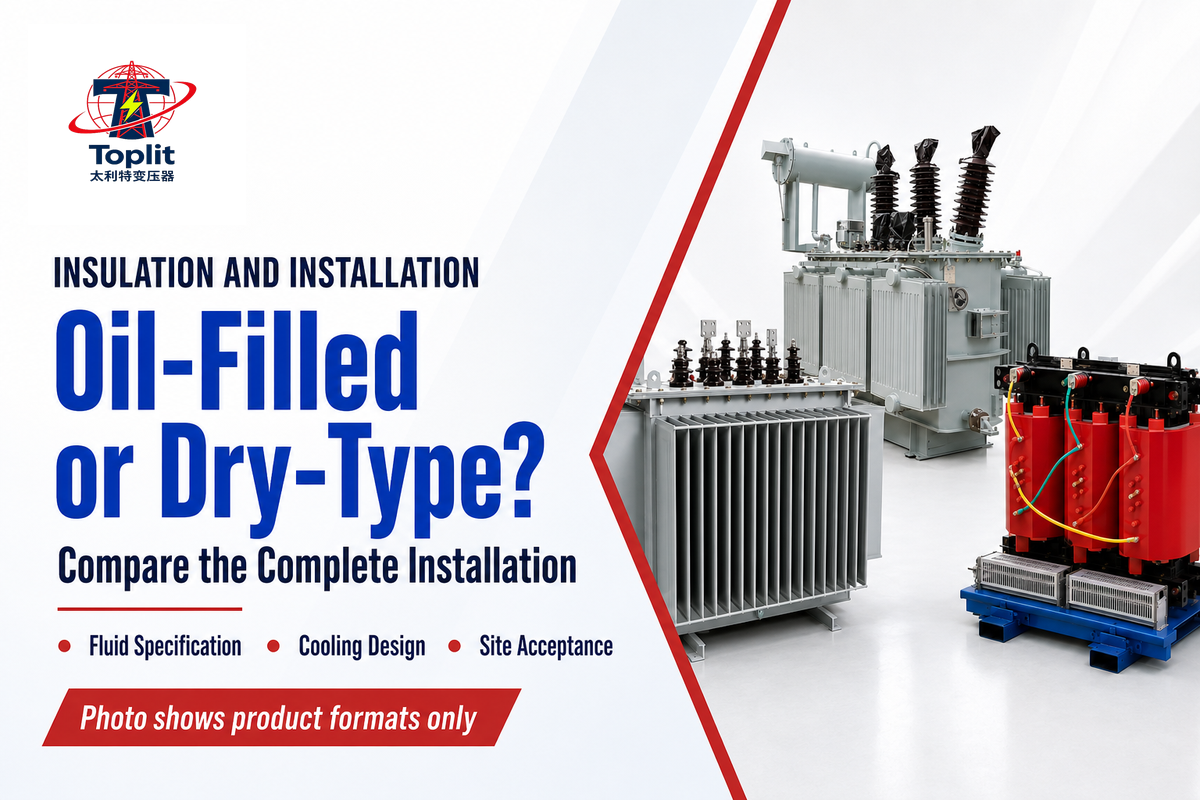
The choice of insulating fluid affects electrical insulation, heat transfer, fire safety and maintenance. There are natural ester, synthetic ester, mineral oil and silicone oil, and each has different approval requirements and properties. Dry type transformers remove liquid insulation but introduce a different cooling system and need a different installation design. The complete transformer and the requirements of the site should be considered in order to achieve a stable power supply. No design or insulation system will be the best choice for every project.
What is an oil-immersed transformer?
An oil immersed transformer is a transformer that uses insulating oil for cooling and electrical insulation. Oil absorbs heat from the windings and the core, and oil circulation transfers heat to a tank, radiators or heat exchanger. For the oil insulation system, the fluid’s electrical properties and solid insulation need to work cooperatively, which accounts for the significance of the condition and control of moisture in the fluid.
Require the actual insulating-liquid specification, dielectric strength criteria, flash point and fire point, biodegradability evidence where pertinent, oxidation stability, moisture behavior and operating-temperature limits. A higher fire point does not mean non-combustibility or approval for an indoor room. Product literature using natural ester oil or FR3-type terminology should name the exact fluid and not imply that all esters behave similarly.
What is the difference between oil-filled and dry-type transformers?
Oil-filled transformer
- Uses a liquid system for heat transfer and insulation.
- Offers several natural and forced cooling arrangements.
- Requires fluid, leakage and applicable containment planning.
- Needs installation-specific fire and maintenance provisions.
Dry-type transformer
- Uses solid and gaseous insulation without a liquid oil inventory.
- Requires an appropriate air-cooling and ventilation design.
- Avoids transformer-oil leakage but retains environmental constraints.
- Needs installation-specific fire and maintenance provisions.
A cast resin transformer is one dry-type construction, not a synonym for every dry-type product. Buyers considering indoor equipment can compare the dry-type transformer range against a properly specified liquid-filled alternative. Eaton’s published indoor Powercenter offering demonstrates that liquid-filled indoor equipment exists; its listing scope, room design and authority acceptance still have to match the project.
The 2018 TechCon paper by Kerry Williams and Brian Sparling describes a University of Queensland research transformer rated 486 kVA, 22/4.5/0.415 kV and 50 Hz. In 2016, Wilson, the original equipment manufacturer, replaced the mineral oil with natural ester. During factory testing, it was found that the thermal changes were dependent on the winding and cooling conditions. As such, these results do not justify an automatic uprating when mineral oil is swapped out. For an existing asset, the buyer is required to obtain an engineering analysis, an approved conversion procedure and an agreed thermal assessment. The reported work is attributed to the researchers and participating organisations; it is not a Toplit project. The paper lists Williams with K-BIK Power and Sparling with Dynamic Ratings, and describes the university centre as supported by industry funding. Wilson identifies Dynamic Ratings as its wholly owned subsidiary, so the paper includes an author affiliated with the original manufacturer’s group.
The paper from TechCon presents valuable insights into monitoring and asset records. The paper’s earlier statements regarding available monitoring devices should not inform a contemporary assessment of the product market. An ester-filled design and an existing transformer converted to ester are two disparate engineering applications.
According to the Environmental Protection Agency guidance on secondary containment, for covered US spill-prevention facilities, a suitable site-specific solution and/or a common collection system (where warranted) is permissible. This guidance does not establish the same individual containment requirement for every transformer installation worldwide. Confirm locally, then address drainage and fire engineering; for legacy equipment, request oil history and environmental records.
A 486 kVA retrofit case can disprove a blanket assumption, but it cannot verify the performance of a proposed 1,000 kVA unit. A valid comparison for this case would use the selected fluid, the winding system, cooling conditions and site acceptance. If a more expensive ester option is proposed, request the relevant lifecycle and project justification records.
Standards, Certifications and Factory Acceptance Testing
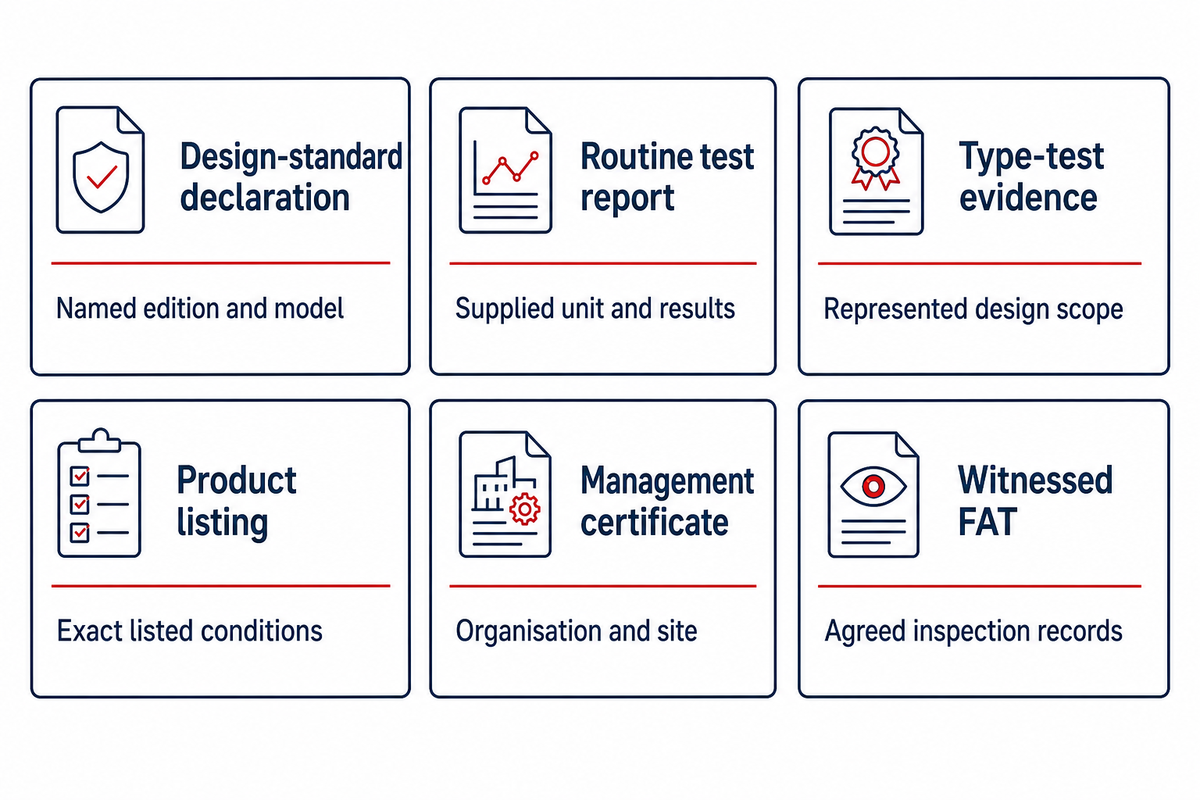
Transformer standards, certification and acceptance testing answer different questions. The purchase specification should indicate the design requirements, routine tests on supplied units, relevant type and special tests, destination efficiency rules and utility approval. A manufacturer’s general compliance statement or management certificate cannot take the place of the evidence required for the exact factory, transformer design and installation.
The IEC 60076 series addresses different aspects of power transformers; the IEEE C57 series and ANSI-related requirements appear in other markets. EN adoptions, GB/T 1094 and applicable Chinese distribution-transformer requirements, Canadian CSA requirements and local utility specifications for power distribution systems may also matter. The contract should state the exact editions and precedence when requirements overlap. A declaration of IEC compliance is not considered approval for global connection.
As reviewed in September 2026, the official catalogues list IEC 60076-1:2011 and IEC 60076-2:2011 as valid editions, with later editions under development. A forecast publication date is not a contractual standard. Review the status once again when the purchase specification is final.
US Department of Energy efficiency rules apply to covered products within their defined scope and exclusions. The amended 2024 distribution-transformer rule has a compliance date that is in the future and is different from its effective date. The agency states:
“Compliance with the amended standards established for distribution transformers in this final rule is required on and after April 23, 2029.”
The June 15, 2026 Federal Register action is a request for information. It should not be considered a final repeal or replacement of the standards. For an order spanning a regulatory transition, establish the relevant manufacture and compliance dates in the contract.
For the European Union, Regulation (EU) No 548/2014, as amended by 2019/1783 describes the ecodesign requirements for transformers in its scope. This framework refers to equipment of a minimum power rating of 1 kVA used in 50 Hz electricity transmission/distribution networks or in industrial applications, subject to certain exceptions and provisions. Assess applicability and obligations of conformity assessment for the equipment. This document does not provide a complete compliance schedule on a jurisdiction-by-jurisdiction basis.
| Document or activity | What to check | What it does not prove |
|---|---|---|
| Design-standard declaration | Edition, model, electrical duty and deviations | Automatic global market or utility approval |
| Routine test report | Supplied unit/serial number, methods, measured results and limits | Every possible type or special test |
| Type-test evidence | Design represented, rating scope, test method and relevance | Testing of every production unit |
| Special-test agreement | Named tests, acceptance criteria and responsibility | Inclusion simply because a catalogue lists the test |
| Third-party laboratory report | Laboratory identity, accreditation scope and represented design | Approval of every factory or later design change |
| ISO 9001 / ISO 14001 / ISO 45001 | Named organisation, site, scope and valid certificate | Product performance certification |
| UL / CSA or other product listing | Exact listed ratings, conditions and current status | Coverage outside the listing |
| CE conformity documentation | Applicable legislation and responsible entity | A universal third-party quality award |
| Efficiency certification filing | Applicable model, rule, test basis and representations | Government validation of every posted value |
| Utility or marine approval | Named authority, product scope and project conditions | Acceptance by unrelated authorities |
| Witnessed FAT | Agreed inspection plan, hold points and signed records | A substitute for an engineering specification |
| RoHS or material declaration | Whether the rule applies and what evidence is supplied | A transformer-wide electrical test certificate |
The Department of Energy certification database disclaimer states that the information provided was submitted by the manufacturers or their agents, and the Department of Energy cannot guarantee the accuracy of the information. Do not include phrases such as “DOE approved” in a supplier comparison unless an actual, applicable approval basis exists. Filing, testing, listing and acceptance are different types of records.
Which tests belong in the purchase specification?
A Factory Acceptance Test (FAT) is an agreed acceptance event and documentation package. The scope should cover winding resistance, voltage-ratio, vector-group confirmation, no-load loss, load loss, and impedance measurement, as well as dielectric tests. The requirements for applied-voltage, induced-voltage, lightning-impulse, and partial-discharge tests will depend on the relevant standard, insulation level, and test category.
Temperature-rise and sound-level testing each have specified conditions and an acceptance basis. If the situation calls for it, insulation resistance, oil dielectric testing, leak testing and pressure testing should also be addressed. For the short-circuit test, documentation should describe the test in the context of the offered design; a short-circuit test on an unrelated transformer does not automatically establish relevance to the offered design. SEA’s technical explanation separates routine, type and special tests, but the actual standard and the contract determine which tests must be performed.
For each test, you should find out if the test will be done on every unit supplied, if it is a type test for which supporting evidence is available, or if it is a special test that has been purchased. You should also ascertain if a buyer’s representative or independent inspector will witness the test, when the report(s) will be available prior to shipment, how nonconformities are addressed, and if retesting is included. Given the differing scopes of the tests, a supplier can quote different prices for different tests; the purchaser should make that difference visible in the comparison.
For a 35 kV class transformer, a buyer should resolve the insulation levels, the appropriate versions and the test schedule, prior to evaluating certificate logos. A generic ISO certificate cannot make up for a missing impulse test. For a proposed report that represents another design, the supplier must explain the technical relevance of the report and obtain the buyer’s acceptance.
Compare Oil Immersed Transformer Cost and Delivered Scope
The cost of an oil immersed transformer is dependent on the electrical design, loss guarantees, cooling equipment, testing scope, and delivery obligations. A preliminary bid comparison should distinguish a purchase cost from transport, installation, commissioning and operating losses. Costs for this project are not published in this directory. Request a quote for the project, and be aware that the cost will be dependent upon rating and specifications.
The design is also influenced by the rating of kVA or MVA, the voltage class, and the primary/secondary ratio. The selection of the core material and whether the windings are made of copper or aluminum, the selection of the insulating fluid (mineral oil or ester fluid), the level of impedance, the rise in temperature, and the level of efficiency affect the cost of the material and the manufacturing process. The OLTC equipment, conservator or sealed tank, radiators, bushings, cable boxes, surge arresters, protection and monitoring devices increase the extent of the work. Quantity, shipping weight and destination are also factors.
Loss guarantees should be evaluated on a declared basis. No-load loss occurs while the transformer is energized; load loss varies with loading and the specified reference conditions. A loss-capitalization method may be chosen by the buyer or required by the solicitation. It should not be considered a general purchasing rule. The BPA/WSU transformer report provides technical background on this distinction, without providing an estimate of the costs of the equipment today.
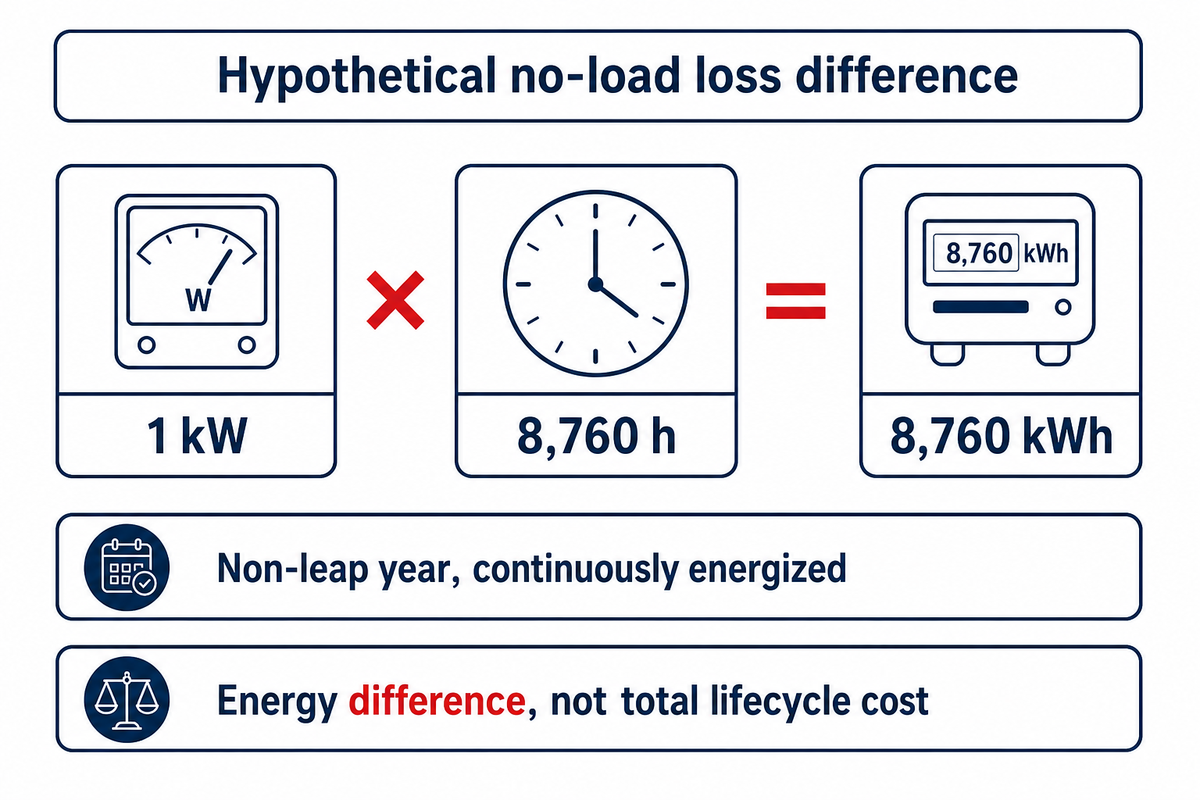
Suppose two hypothetical compliant offers differ by 1 kW in guaranteed no-load loss, and the transformer remains energized for 8,760 hours in a non-leap year. The annual difference in electrical energy lost at no load is 1 kW × 8,760 h = 8,760 kWh. Multiplying this figure by the electricity tariff quantifies the annual energy-cost difference for this loss component. Load loss, auxiliary consumption, loading pattern, evaluation period, and discounting are individual inputs. This example provides procurement with a calculation it can repeat, and it is neither a Toplit saving nor a comparison of two real manufacturers. Prior to using it commercially, ensure that test conditions are the same, and both offers fulfill the same technical requirement in a modern power network.
| Cost / obligation | Comparison basis | Evidence or owner |
|---|---|---|
| Transformer supply | Same rated configuration and quantity | Signed technical/commercial offer |
| Core and conductor | Same loss and thermal guarantees | Guaranteed schedule and material description |
| Insulating fluid | Same fluid specification and delivery condition | Fluid data and supply scope |
| Cooling equipment | Same fan/pump stages and controls | Auxiliary equipment schedule |
| Tap changing | Same OLTC or off-circuit arrangement | Tap range, steps and control description |
| Accessories | Same bushings, cable boxes, arresters and protection | Bill of supply and drawings |
| Testing / certification | Same witness points and evidence package | Inspection and test plan |
| Transport | Same destination, shipping condition and trade term | Transport envelope and logistics offer |
| Site handling | Crane, unloading, placement and assembly responsibilities | Site scope and responsibility schedule |
| Oil handling / commissioning | Processing, filling, site testing and energization support | Method and acceptance responsibilities |
| Service / warranty | Start date, exclusions, response and spare parts | Written warranty and after-sales service terms |
| Operating losses | Same load profile, tariff and evaluation period | Buyer-approved economic assumptions |
The Federal Acquisition Regulation 13.106-2 provides a useful reference for the significance of transportation cost and bid evaluation in covered federal procurement in the United States. Global buyers should not assume that this rule will apply in all their contracts; rather, they should determine their own purchasing terms.
A purchase cost ranking leaves a gap if one 1,000 kVA bid excludes site handling, while the other bid includes it. This gap must be addressed prior to the award of the contract. A 1 kW loss difference may be significant over the evaluation period, but it cannot compensate for a transformer that does not meet the electrical or installation requirements.
Information Needed for an Oil Immersed Transformer Quote
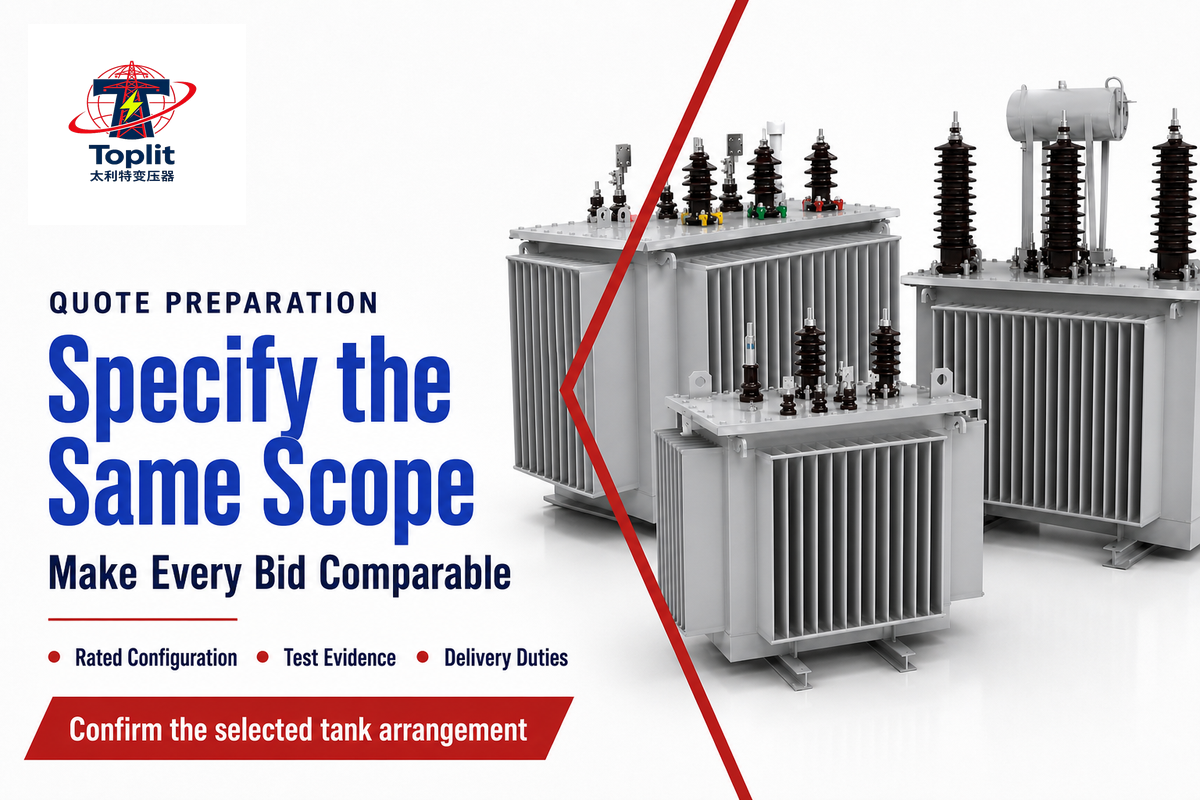
When all bidders use the same operating, electrical and delivery requirements, an oil immersed transformer quote is comparable. State the intended function and provide a parameter schedule, then request exceptions in writing. Engineering values that remain to be resolved should be considered as decisions for the project team that cannot be substituted by different manufacturer assumptions. Reliable power distribution relies on these conditions.
Oil-Immersed Transformer Quote Match
The Oil-Immersed Transformer Quote Match is an editorial checklist for aligning duty, rated configuration, evidence, delivered scope, and acceptance prior to comparison of quotes.
The five checks are sequential. First confirm what the transformer is required to perform. Next freeze the rated configuration used by all bidders. Review the factory and test evidence against that configuration, reconcile what each quote includes, and then define the acceptance and delivery criteria. This is a procurement method and not a validated engineering rating algorithm.
- Define duty. Provide the load profile, power supply system interface and installation conditions.
- Align the rated configuration. Confirm voltage, capacity, fluid, cooling, and guaranteed results.
- Match evidence. Align tests and certificates to the proposed factory and design.
- Reconcile delivered scope. Resolve transport, site work, accessories and service exclusions.
- Agree acceptance. Define drawing approval, witness points, reports and delivery responsibilities.
Copy the inputs below into the Request for Quotation. For typical transformer requirements, indicate the edition of IEC 60076-1 that applies along with the project’s acceptance schedule. The list includes the information for a first offer and the items for which engineering confirmation is usually required to authorize the order.
| Input group | Information to provide | Required response |
|---|---|---|
| Order and rating | Required quantity; rated capacity; primary voltage; secondary voltage | Offered quantity, kVA/MVA and exact voltage ratio |
| Supply system | Frequency; number of phases; vector group; impedance | Connection, neutral arrangement, impedance base and tolerance |
| Voltage adjustment | Tapping range; OLTC or off-circuit tap changer | Tap steps, operating duty, control and maintenance scope |
| Active parts and fluid | Winding material; insulating fluid; cooling method | Actual conductor, liquid specification and each cooling-stage rating |
| Thermal and efficiency | Temperature rise; efficiency requirement; maximum no-load loss; maximum load loss | Guaranteed values with rating, temperature and test basis |
| Sound and insulation | Sound-level requirement; BIL / insulation level; short-circuit level | Method, acceptance limits and design/test evidence |
| Environment | Installation environment; ambient temperature; altitude; indoor or outdoor installation | Thermal, corrosion, enclosure and site assumptions |
| Mechanical package | Tank type; required accessories; monitoring devices | Sealed/conservator arrangement, drawings and itemized supply |
| Compliance and acceptance | Applicable standard; required certifications; FAT requirements | Editions, actual certificate scope, tests and witness plan |
| Delivery | Destination; delivery date | Trade term, transport condition, milestones and exceptions |
These fields should be supported by load cycle, overload profile, harmonics, neutral grounding, protection coordination and inverter duty. Mining, steel mills, cement plants and oil-and-gas facilities can place demands on equipment that differ from those imposed by commercial infrastructure and other industrial facilities. Data centers, ports, railways, EV charging and large manufacturing facilities also need site-specific interfaces. These applications are enquiry categories and do not indicate that every listed manufacturer has approval for each one.
For a sealed tank, indicate the tank arrangement and the anticipated maintenance. As a starting point, Toplit’s closed, hermetically sealed transformer family provides a product-specific reference. A conservator, radiator layout, or fluid selection should not be changed silently; these can adversely affect the service and installation.
A filled initial enquiry with explicit engineering questions
This is a made-up example. The values show how to draft an iterative inquiry. They are not a Toplit model, customer specification, or suggested configuration for an unrated system. The unanswered items are named so the project engineer can resolve them before a compliant order can be submitted.
RFQ checklist: illustrative enquiry values, not general recommendations
| Parameter | Example value, not a recommended range | Why it matters | How to verify |
|---|---|---|---|
| Duty and quantity | Example only: 2 units for conventional distribution | Sets the initial equipment and order scope | Buyer-approved load and system description |
| Rated electrical configuration | Example only: 1,000 kVA; 10/0.4 kV; 50 Hz; three-phase | Prevents different voltage or frequency assumptions | Offered nameplate schedule and ratio-test plan |
| Connection and impedance | Example request: Dyn11; 6% impedance, tolerance and base to be agreed | System studies must confirm connection and fault performance | Engineer-approved specification and test basis |
| Conductor, fluid and cooling | Example request: copper, mineral oil, ONAN at full stated rating | Aligns construction and natural-cooling dependency | Model sheet, thermal evidence and written exceptions |
| Site conditions | Example only: outdoor; 40 °C maximum ambient; 1,000 m altitude | Makes environmental assumptions visible | Site data and factory thermal assessment |
| Acceptance and remaining limits | Engineer to set insulation level, rise/loss/sound limits and short-circuit duty | An initial enquiry is not a released manufacturing specification | Completed guarantee schedule, standards list and FAT plan |
The bidder cannot consider the 6% impedance request approved until the reference basis, tolerance, and system-study fit are agreed upon. The same applies to temperature rise, losses, insulation levels and fault duty.
Request each bidder to submit an exception schedule using the original parameter name. An open insulation level is considered open even if the commercial price is firm. If a supplier offers a different vector group or cooling system, the engineer should evaluate this change prior to the purchase team considering this an equivalent offer.
| Milestone | Buyer-side input | Supplier-side quality control evidence | What remains open if missing |
|---|---|---|---|
| Enquiry issue | Load and site requirements | Questions and assumptions | Comparable technical basis |
| Technical offer | Response to design questions | Guaranteed schedule and exceptions | Compliance review |
| Drawing approval | Timely review and interface decisions | General arrangement and terminal drawings | Manufacturing release |
| Test planning | Witness requirements and acceptance criteria | Inspection/test plan and report schedule | Acceptance scope |
| Factory release | Resolved deviations | Required test results and agreed documents | Shipment authorization |
| Transport / site readiness | Access, foundation and handling arrangements | Shipping envelope and delivery condition | Physical installation |
| Commissioning / handover | Site authority and operating responsibility | Agreed support, records and manuals | Service acceptance |
The requested delivery date should identify the event: factory readiness, port arrival, site delivery or completed commissioning. Drawing approval and unresolved specifications can impact the program, hence a written schedule with dependencies should be obtained. No lead time, warranty period or spare parts response is addressed by the manufacturers’ inclusion in this guide.
For the hypothetical 1,000 kVA enquiry, two quotations become easier to compare once both state ONAN capacity, 10/0.4 kV ratio and the same agreed test basis. The remaining design questions must still be closed. A filled price box cannot substitute for an accepted insulation level, loss guarantee or delivery responsibility.
Industry Outlook: Procurement Signals for 2026 and Beyond
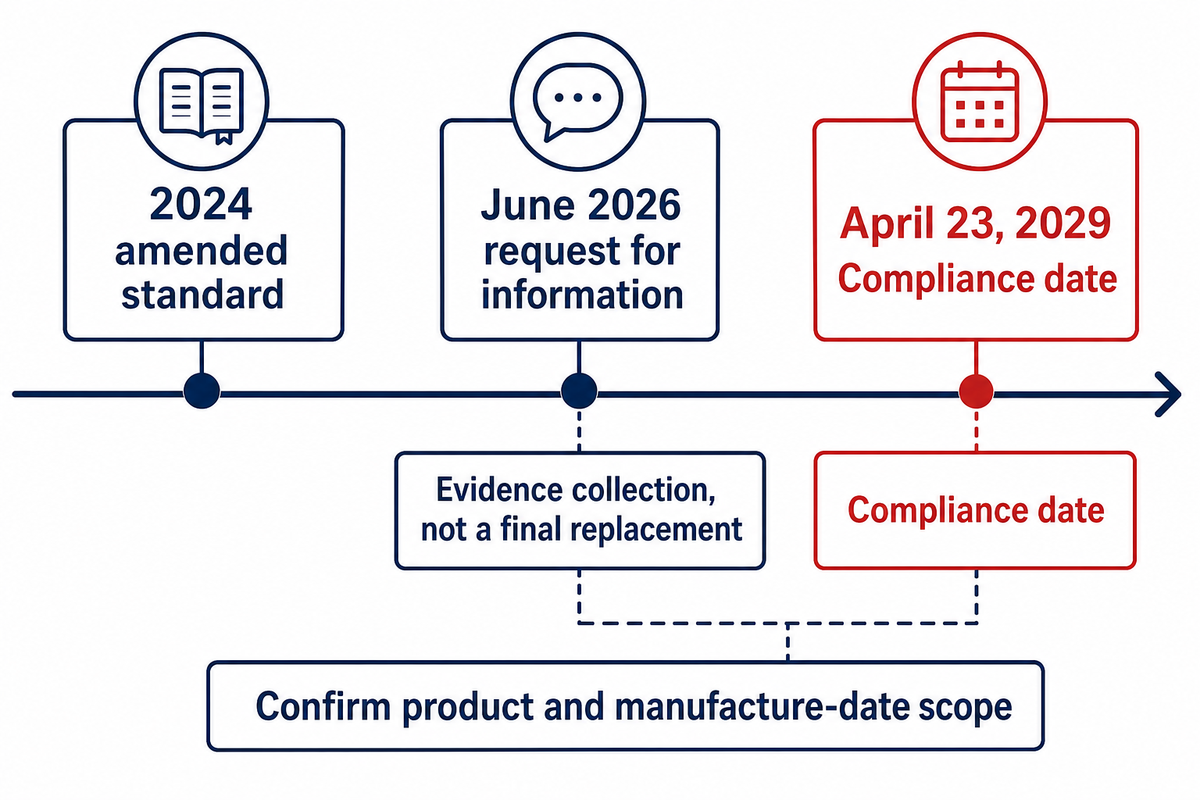
Transformer procurement for 2026 requires attention to changing efficiency requirements, manufacturing announcements and project approval schedules. Buyers should break out an announced investment from available production and a regulatory consultation from an effective rule. Dated evidence is useful when approaching the supplier; written technical and delivery commitments should govern the purchase.
The June 2026 Department of Energy request for information examines distribution-transformer standards and supply-related issues. This is an evidence collection activity. The reviewed agency material states that the latest published future compliance date for the amended 2024 standard is April 23, 2029. Buyers planning equipment across that period should establish which requirements apply to the actual product and manufacturing date.
Another indication is manufacturing investment, but it should be interpreted at a project level. Hitachi Energy announced US manufacturing investment plans in September 2025, including a proposed South Boston facility. The announcement indicates the existence of a plan; it does not indicate that the new capacity is operational, that a specific design is available from that plan, or that a buyer can secure a manufacturing slot.
POWER’s January 2026 review of transformer supply constraints discusses demand, standardization and procurement practices. Its quoted market participants have their own commercial positions, so this guide does not adopt a universal lead-time forecast. Procurement should ask for dates tied to design approval, material availability, factory testing and the stated delivery point.
A May 2025 Toshiba Review paper references Kitashiba’s work on natural-ester transformers and a retrofit investigation. Such work may help answer questions related to fluid compatibility and thermal assessment. This work does not mean that every manufacturer has the same design, nor does it mean that a standard distribution unit is suitable as an inverter-duty transformer.
For a project requiring 35 kV equipment, request the currently issued standard edition and a factory-specific production plan prior to order release. If suppliers mention a new plant or future edition of their catalog, ask which existing factory and approved design is used to support the current offer. A future announcement cannot fulfill a current acceptance or delivery obligation.
Frequently Asked Questions
Which is the largest oil immersed transformer manufacturer?
A largest-manufacturer claim needs a defined metric, year and product scope, with evidence for that same period and equipment category before the term is used to compare suppliers.
To provide a reasonable answer, you need to include a relevant reference, measurement period, and product definition. The revenue for an entire electrical group does not translate to an oil immersed transformer output, and a large power transformer factory does not correlate to a distribution transformer business. Use the list to determine potential sources, and then request evidence for the relevant factory, design and voltage class.
What is an oil-immersed transformer?
An oil-immersed transformer uses insulating liquid around its active parts for insulation and heat transfer, while the complete design also includes solid insulation, windings, a tank and cooling suited to the required duty.
An oil-immersed transformer uses an insulating liquid to provide electrical insulation and heat transfer. The design integrates solid insulation, winding construction, and cooling. This liquid is one of the design elements. Mineral oil is one of the options. Other fluids may be specified. This design and the selection of fluid do not automatically mean that the unit has higher efficiency, longer service life, indoor acceptance or a higher continuous load rating.
Who are the oil-immersed transformer manufacturers in the USA?
A US shortlist depends on the required transformer duty and the actual manufacturing plant, with domestic production, local sales operations and group ownership checked separately for the equipment required by the project.
Your shortlist should distinguish domestic manufacturing, US sales operations, and group ownership. Virginia Transformer, MGM, WEG Transformers USA, and GE Vernova/Prolec are worth checking, based on the product scopes they have outlined. Suppliers oriented towards distribution may be more aligned with another requirement. This guide doesn’t provide a definitive top-ten ranking of the US market – verify the actual manufacturing plant, the rating needed, and the associated approvals before selecting a bidder.
What standards should an oil immersed transformer meet?
The purchase contract should name standards, editions, tests and destination requirements, while design compliance, product listing, factory tests and utility or site acceptance each require evidence tied to the offered design.
Provide the exact editions of IEC, IEEE/ANSI or national standards, the destination efficiency rules, utility requirements and specifications. Separate design compliance, routine tests, type or special tests, product listing and site acceptance. No single certificate satisfies all requirements.
Can an existing mineral-oil transformer use natural ester fluid?
Ester retrofilling requires a project-specific engineering review.
Fluid replacement may impact cooling, material compatibility, seals, monitoring and fire classifications, requiring a project-specific review for compatibility and thermal effects. Obtain the original equipment manufacturer’s engineering assessment and approved conversion procedure.
What information is needed before a manufacturer can quote?
A comparable quotation needs one shared technical, testing and delivery specification, including the intended duty, rated configuration, site conditions, loss guarantees, inspection requirements and responsibility for each delivery milestone.
Send one specification to each bidder. Include application, quantity, rated kVA or MVA, phases, frequency, primary and secondary voltages, vector group and neutral arrangement. Define impedance and tolerances, insulation levels, cooling ratings and characteristics, ambient temperature and altitude. Include the load profile and any harmonics or overload duty. Provide winding requirements, liquid type, tap changer and accessories. Indicate losses and the basis of measurement. Describe the installation, transport limitations, required tests, documentation language, efficiency rules and utility requirements. Define the delivery point, trade term, inspection hold points, warranty responsibilities and required spares. For a given unclear value, give the engineering question instead of allowing bidders to use their own assumptions. Written exceptions will then provide procurement a means to compare apples to apples.
Key takeaway
A 1,000 kVA quotation is comparable only if the voltage, fluid, cooling rating, guarantees, evidence and delivered scope describe the same requirement.
Use the manufacturer profiles to create a shortlist and send a common specification and request for exceptions. When sending a request to Toplit, begin with the oil immersed transformer product range and include the intended duty, rated configuration, and destination requirements. Request specific data and a quote at the item level from the proposed transformer supplier before making the final selection.
References & Sources
- Certification database and disclaimer. US Department of Energy.
- IEC 60076-1:2011 public catalogue. International Electrotechnical Commission.
- Distribution transformers: scope, standards and compliance. US Department of Energy.
- Liquid-Immersed Amorphous-Core Distribution Transformers, 2020 report. Bonneville Power Administration / Washington State University.
- IEC 60076-2:2011 public catalogue. International Electrotechnical Commission.
- Closed 2020 transformer rewind and reconditioning bid. City of Siloam Springs.
- Things to Consider when Retro-filling Transformers with Natural Esters, TechCon 2018. Kerry Williams and Brian Sparling; paper hosted by TJ|H2b.
- Secondary containment for each container under SPCC. US Environmental Protection Agency.
- June 15, 2026 distribution-transformer request for information. Federal Register / US Department of Energy.
- Ecodesign requirements: power transformers. EUR-Lex.
- FAR 13.106-2, evaluation of quotations or offers. Acquisition.gov.
- Transformers in 2026: Shortage, Scramble, or Self-Inflicted Crisis?. POWER.
Why we write this
About Toplit Engineering Insights
Toplit publishes transformer field guides from project routing, factory loss-data discipline, and specification review experience. We help engineering and procurement teams compare transformer types, voltage classes, installation constraints, and quotation evidence before they commit to a build.
- Oil-immersed, dry-type and pad-mounted transformer routes
- Loss data, rating schedules and factory evidence
- IEC / IEEE specification and site-input review
- Factory-direct transformer engineering support
Contact Profile
Talk with the Toplit Transformer Team
Company
Toplit Transformer Engineering Team
Toplit Transformer Engineering Team
Factory base
Hai'an, Nantong, Jiangsu, China
Hai'an, Nantong, Jiangsu, China
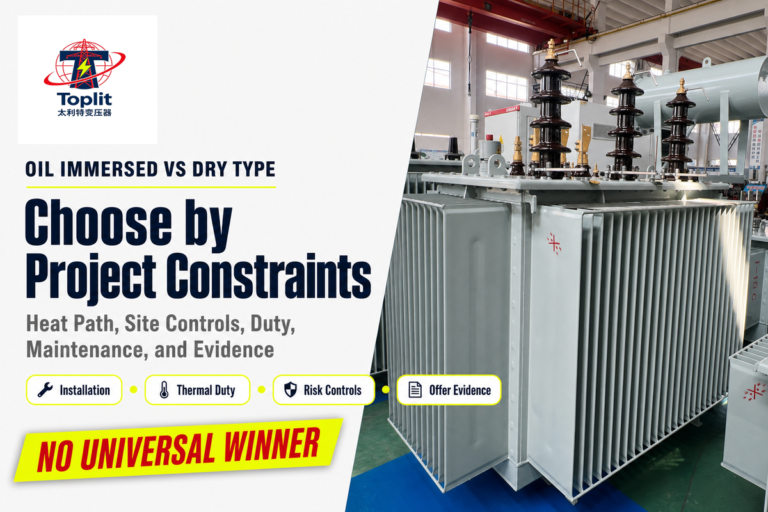
![Pad-Mounted Transformer: How It Works [2026 Guide]](https://toplit-transformer.com/wp-content/uploads/2026/08/pad-mounted-transformer-guide-featured-150x150.png)
![Single Phase Pad Mounted Transformer Guide [2026]](https://toplit-transformer.com/wp-content/uploads/2026/08/single-phase-pad-mounted-transformer-guide-featured-1-150x150.png)