Get in touch with Toplit Transformer Co., Ltd Company

Last updated: September 2026
The best hermetically sealed transformer manufacturers include Toplit for published 6–10 kV distribution schedules, Hitachi Energy for its documented medium-distribution family, Astor for a defined hermetic range, and MGM for liquid-filled padmount layouts, depending on the project. The right choice depends on electrical duty, tank architecture, guaranteed losses and installation requirements.
A sealed oil transformer is a procurement category as opposed to a complete specification. Here we compare 20 actual manufacturers of liquid-filled sealed assemblies and show how to source multiple, comparable offers. The term “best for” defines the application scope of a given manufacturer’s product offering and in no way ranks a manufacturer’s market share or guarantees performance in every environment.
Quick Picks by Project Requirement
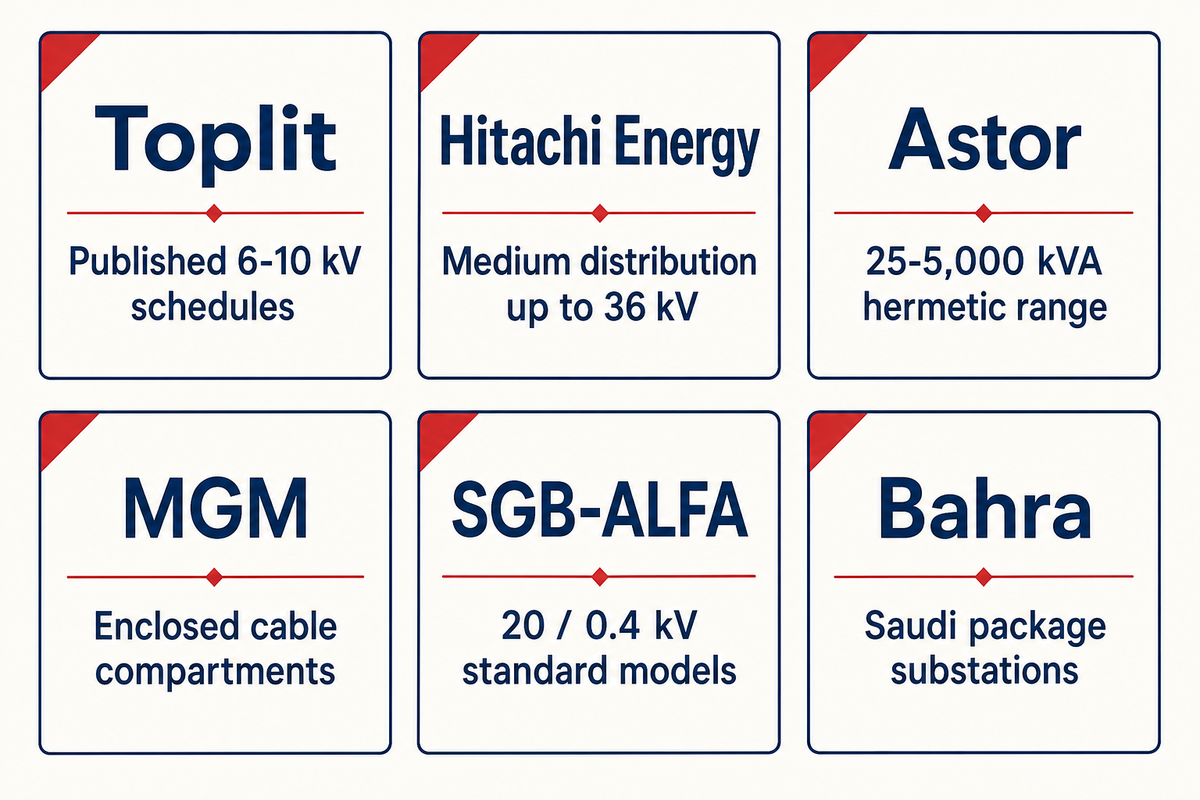
- Best for specification-led 6–10 kV distribution schedules: Toplit.
- Best for a documented medium-distribution family up to 36 kV: Hitachi Energy.
- Best for a separately defined 25–5,000 kVA hermetic range: Astor Enerji.
- Best for ground-level installations with enclosed cable compartments: MGM Transformers.
- Best for European 20 / 0.4 kV standard-model comparisons: SGB-SMIT’s SGB-ALFA family.
- Best for Saudi distribution and package-substation enquiries: Bahra Electric.
Disclosure: This guide is published by Toplit. We list ourselves first because this is our website, not because we claim to be the market leader. The other 19 manufacturers are grouped by what they’re best for, in no particular order within each group.
How We Selected These Manufacturers
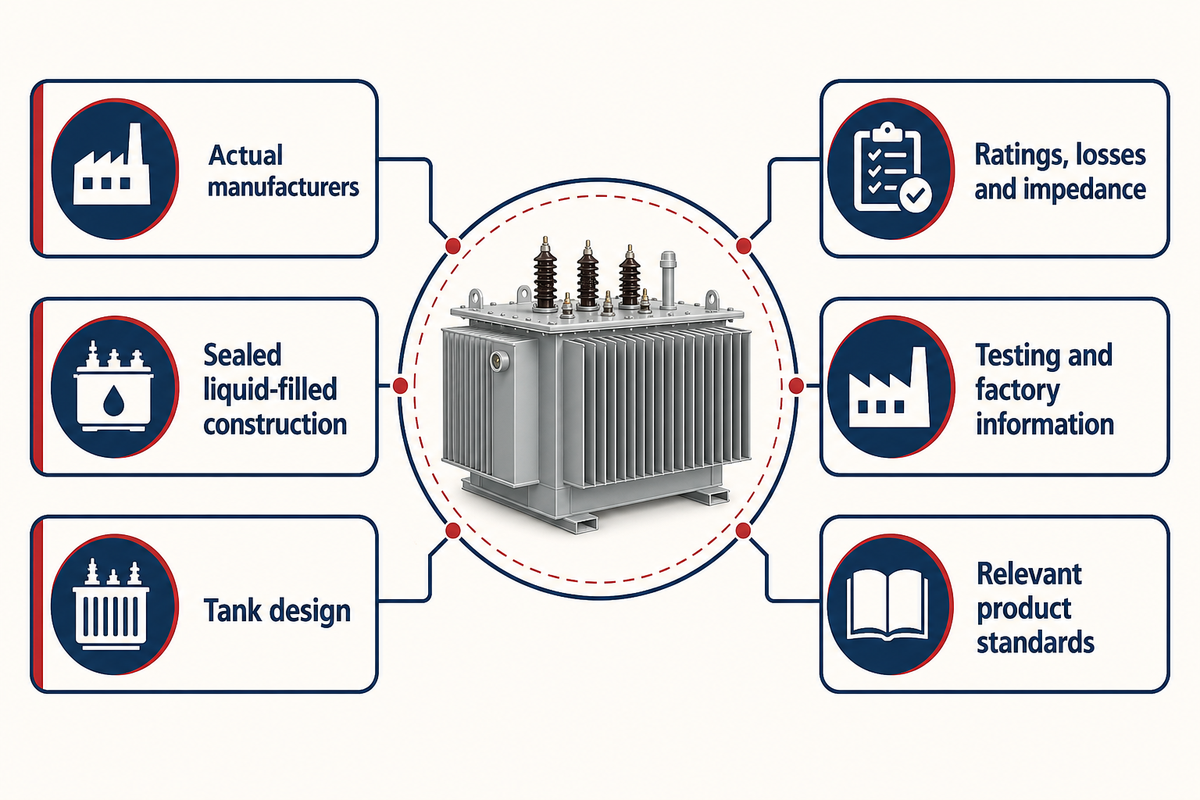
Information was verified against manufacturer websites and reputable public sources, September 2026. Selection focused on sealed products manufactured by actual transformer manufacturers and evidence of oil- or liquid-filled construction. Attention was given to the design and construction of the tank, rating, losses and impedance, testing, factory information and relevant product standards. Inclusions were based on the product’s stated distribution application by the manufacturer and a sealed design.
Classification of an entire product family based only on its maximum MVA, rather than the stated distribution application of a member, was considered inappropriate. The broad upper limits of products offered by SEA and Daelim don’t mean every model is suitable for the distribution projects discussed here. Excluded are conservator- and dry-type-only products, distributors, wholesalers, sourcing agents, repair-only businesses, EPC contractors without manufacturing, directories and marketplaces. Preference was given to product evidence. Listings of group and subsidiary companies were considered as one listing and differentiated, where pertinent, by the factory or product family.
Comparison of 20 Sealed Transformer Manufacturers
Use the enclosed routing guide to assist in your engineering assessment. The family envelope provided describes the range of options. It doesn’t verify that the complete range is available at each voltage level. Voltage figures retain each manufacturer’s published terminology: values such as 33, 34.5, 36, 44 and 52 kV may refer to rated voltage or highest voltage for equipment and shouldn’t be ranked simply by size. Quotes should provide rated HV and LV voltage separately from the highest voltage for equipment. Year of establishment refers to the entity or business history of the organization described in the card. “Not publicly disclosed” is used to represent an uncertain year.
| Number | Company Name | Headquarters | Founded Year | Best For | Brief Introduction | Main Products | Key Advantages | Potential Disadvantages | Official Website |
|---|---|---|---|---|---|---|---|---|---|
| 1 | Toplit | Hai’an, Nantong, Jiangsu, China | Not publicly disclosed | Specification-led 6–10 kV sealed distribution transformer projects requiring published loss, impedance and dimensional data | Chinese manufacturer with published S11-M and S13-M sealed distribution schedules. | S11-M and S13-M hermetically sealed oil-immersed transformers | Published loss, impedance, oil-mass and dimensional schedules | Public sealed S11-M data covers medium-voltage distribution up to 10 kV, not higher-voltage power-transformer classes. | toplit-transformer.com |
| 2 | Daelim Belefic | Beijing, China; factory in Hai’an, Jiangsu | 2010 | Export projects requiring mineral-oil or optional ester sealed designs | Chinese manufacturer publishing a broad hermetic family and several destination-standard options. | Hermetically sealed liquid-filled distribution transformers | Corrugated tank, optional ester and published cooling options | Specify the family’s capacity, voltage, liquid and cooling combination separately. | www.daelimtransformer.com |
| 3 | Unita Electric | Suining, Xuzhou, Jiangsu, China | 2011 | Welded sealed distribution tanks for 10, 20 and 35 kV enquiries | Jiangsu manufacturer offering welded corrugated sealed oil-immersed units. | Hermetically sealed oil-immersed distribution transformers | Welded tank construction and stated leak-testing process | The published sealed range ends at 2,500 kVA. | www.unitatransformer.com |
| 4 | Hitachi Energy | Zurich, Switzerland | 2021 | Medium distribution projects requiring explicit hermetic construction up to 36 kV | Global transformer manufacturer with an explicitly documented hermetic medium-distribution family. | Three-phase liquid-filled medium distribution transformers | Explicit hermetic construction and hot-dip zinc coating option | Conservator construction is an option; specify hermetic preservation in the order. | www.hitachienergy.com |
| 5 | Siemens Energy | Munich, Germany | 2020 | Utility projects comparing hermetic construction with other fluid-immersed configurations | Independent energy company offering multiple fluid-immersed distribution architectures. | Fluid-immersed distribution transformers and FITformers | Corrugated-wall and gas-cushion preservation choices; extensive test programme | Select sealed-family lid and gas-cushion options separately from portfolio-wide maximum ratings. | www.siemens-energy.com |
| 6 | SEA Trasformatori | Arzignano, Italy | 1959 | European projects comparing integral-fill and gas-cushion distribution designs | Italian transformer manufacturer with TTO liquid-filled distribution options. | TTO small and medium liquid-immersed distribution transformers | Integral-fill hermetic design and separate nitrogen or dry-air options | The TTO envelope spans multiple designs; specify integral-fill hermetic construction with the capacity/voltage schedule. | www.seatrasformatori.it |
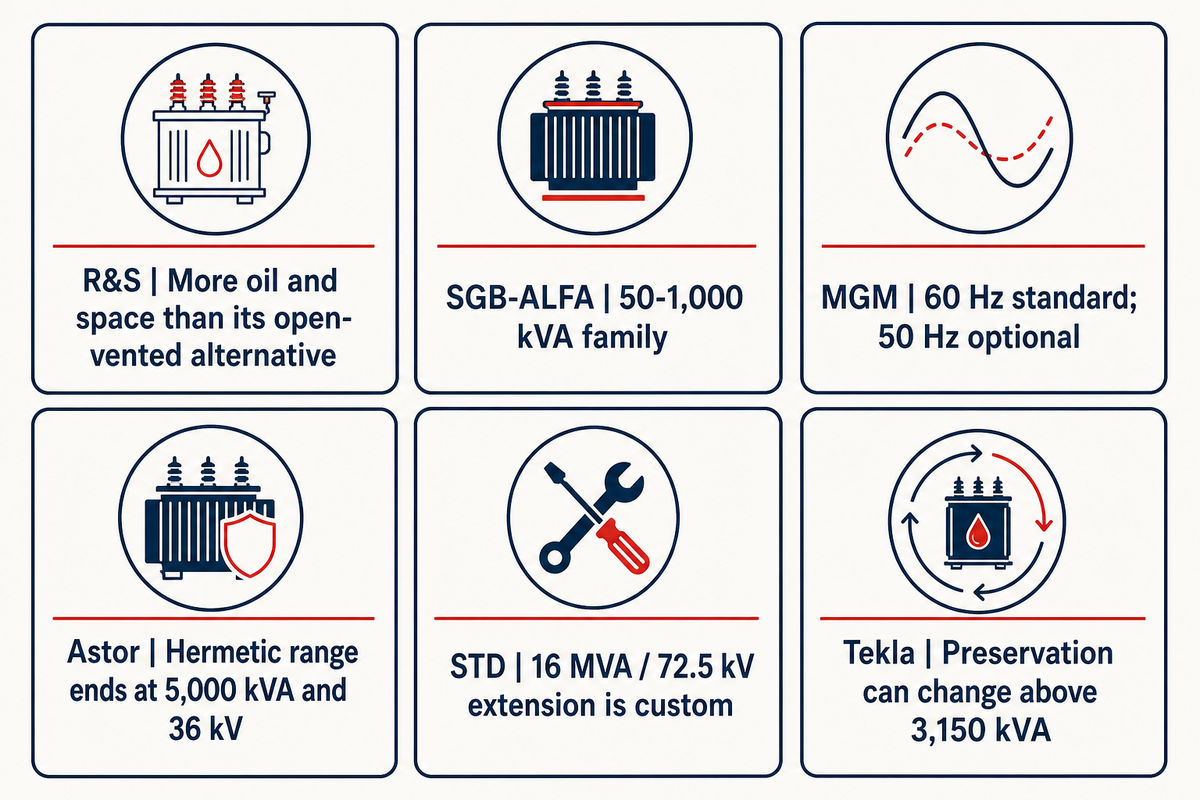
| 7 | R&S Group | Sissach, Switzerland | 2012 | Distribution owners comparing sealed and open-vented equipment footprints | Swiss transformer group offering several oil-type distribution families. | Hermetically sealed and open-vented oil-type distribution transformers | Explicit preservation choices and published installation trade-offs | Sealed construction uses more oil and space than its open-vented alternative. | the-rsgroup.com |
| 8 | SGB-SMIT Group | Regensburg, Germany; shortlisted plant: Botoșani, Romania | 2008 | European distribution projects using documented 20 / 0.4 kV standard models | Transformer group represented here by its Romanian SGB-ALFA sealed distribution family. | SGB-ALFA hermetically sealed corrugated-tank distribution transformers | Model-level distribution schedules and defined routine-test references | The cited SGB-ALFA family covers 50–1,000 kVA. | www.sgb-smit.com |
| 9 | MGM Transformers | Vernon, California, USA | 1974 | North American ground-level installations with enclosed cable compartments | US manufacturer with a sealed liquid-filled padmount compartmental family. | Single- and three-phase liquid-filled padmount compartmental transformers | Welded cover, nitrogen blanket and lockable cable-access compartments | The listed standard frequency is 60 Hz; 50 Hz is an option. | mgmtransformers.com |
| 10 | Astor Enerji | Ankara, Türkiye | 1983 | Distribution tenders requiring a separately defined 25–5,000 kVA hermetic range | Turkish manufacturer publishing separate hermetic and conservator oil-type designs. | Hermetic oil-type distribution transformers | Explicit hermetic range, vacuum filling and flexible corrugated tank | The stated hermetic distribution envelope ends at 5,000 kVA and 36 kV. | astoras.com.tr |
| 11 | STD Transformer | Adana, Türkiye | 2009 | Export distribution projects within a defined 36 kV hermetic family | Adana manufacturer with a dedicated oil-type hermetic product range. | Three-phase hermetic oil-immersed distribution transformers | Vacuum filling and corrugated-wall expansion without an expansion tank | The 16 MVA / 72.5 kV extension is custom, not the standard range. | stdtransformer.com |
| 12 | Martech Trafo | Ankara, Türkiye; manufacturing in Diyarbakır | Not publicly disclosed | Distribution projects comparing mineral-oil and ester-filled hermetic options | Turkish manufacturer with a separately described hermetic distribution line. | Single- and three-phase hermetic oil-type distribution transformers | Mineral-oil or ester options and manual or automatic tap-changing choices | The published hermetic range is limited to 5,000 kVA and 36 kV. | martechtrafo.com |
| 13 | Beta Enerji | Adana, Türkiye | 1997 | Distribution packages combining hermetic transformers with switchgear and kiosks | Adana manufacturer offering hermetic transformers alongside substation equipment. | Hermetic oil-immersed distribution transformers | Vacuum-filled construction plus switchgear and concrete-kiosk manufacturing | Limited public data on the hermetic family’s standard capacity-by-voltage schedule. | betaenerji.com |
| 14 | Bahra Electric | Bahra Industrial City near Jeddah, Saudi Arabia | 2008 | Saudi distribution projects combining sealed transformers and package substations | Saudi electrical manufacturer offering the BOIT oil-immersed transformer family. | BOIT hermetically sealed oil-immersed distribution transformers | Published test categories and package-substation integration | Typical package-substation ratings stop at 2,500 kVA. | bahra-electric.com |
| 15 | Saudi Transformers Company | Dammam, Saudi Arabia | 1982 | Saudi pole-mounted distribution requiring corrugated sealed-tank construction | Dammam transformer manufacturer with explicit hermetic pole-mounted designs. | Hermetically sealed pole-mounted distribution transformers | Corrugated oil-expansion system and bolted or welded tank choices | The sealed pole-mounted line has limited public kVA-by-voltage data. | www.sauditransformers.com |
| 16 | Elsewedy Electric | New Cairo, Egypt | 1938 | Utility distribution requiring both ground- and pole-mounted sealed alternatives | Egyptian electrical group with a documented sealed oil-distribution offering. | Hermetic oil distribution transformers for ground and pole mounting | Two mounting formats and documented historical laboratory testing | The offered sealed configuration requires a hermetic/conservator choice beyond checking historical tested ratings. | www.elsewedyelectric.com |
| 17 | PVJ Power | Nalagarh, Himachal Pradesh, India | 2010 | Indian distribution enquiries requiring defined approval and routine-test documents | Indian manufacturer describing sealed construction and project approval documentation. | Hermetically sealed oil-immersed distribution transformers | Datasheets, guaranteed technical particulars, drawings and routine-test reports | Limited public product data for the hermetic family’s capacity-and-voltage rating envelope. | www.pvjpower.in |
| 18 | Hadron Power | Indore, Madhya Pradesh, India | 2008 | Indian 11 kV enquiries starting from a published 160 kVA example | Indore manufacturer with a specific sealed oil-transformer product listing. | Hermetically sealed oil-filled distribution transformers | Concrete 160 kVA / 11 kV product reference | Public sealed listing: one 160 kVA/11 kV rating, not a complete range. | www.hadronpower.in |
| 19 | Urja Techniques | Mumbai, Maharashtra, India | 1996 | Industrial sites comparing corrugated-tank and nitrogen-cushion preservation | Indian manufacturer offering two described sealed oil-preservation approaches. | Hermetically sealed oil-immersed distribution transformers | Corrugated-wall or permanent nitrogen-cushion arrangements | Published sealed-family upper limits are 3,150 kVA and 33 kV; capacity-by-voltage details remain limited. | www.urjatransformers.com |
| 20 | Tekla Energy | Chopanki / Tijara, Rajasthan, India | 2024 | Sealed distribution enquiries spanning finned tanks and larger nitrogen-cushion designs | Rajasthan company publishing a hermetic family with two expansion arrangements. | Hermetically sealed liquid-filled transformers | Defined family envelope and explicit larger-unit nitrogen arrangement | Above 3,150 kVA, the offered preservation arrangement can change. | www.teklaenergy.in |
Sources: Manufacturer company and product pages, and product literature found in company research. Best-for labels are editorial judgments concerning the scope of a product offering, and don’t represent performance evaluations.
Chinese Manufacturers for Specification-Led Distribution Projects
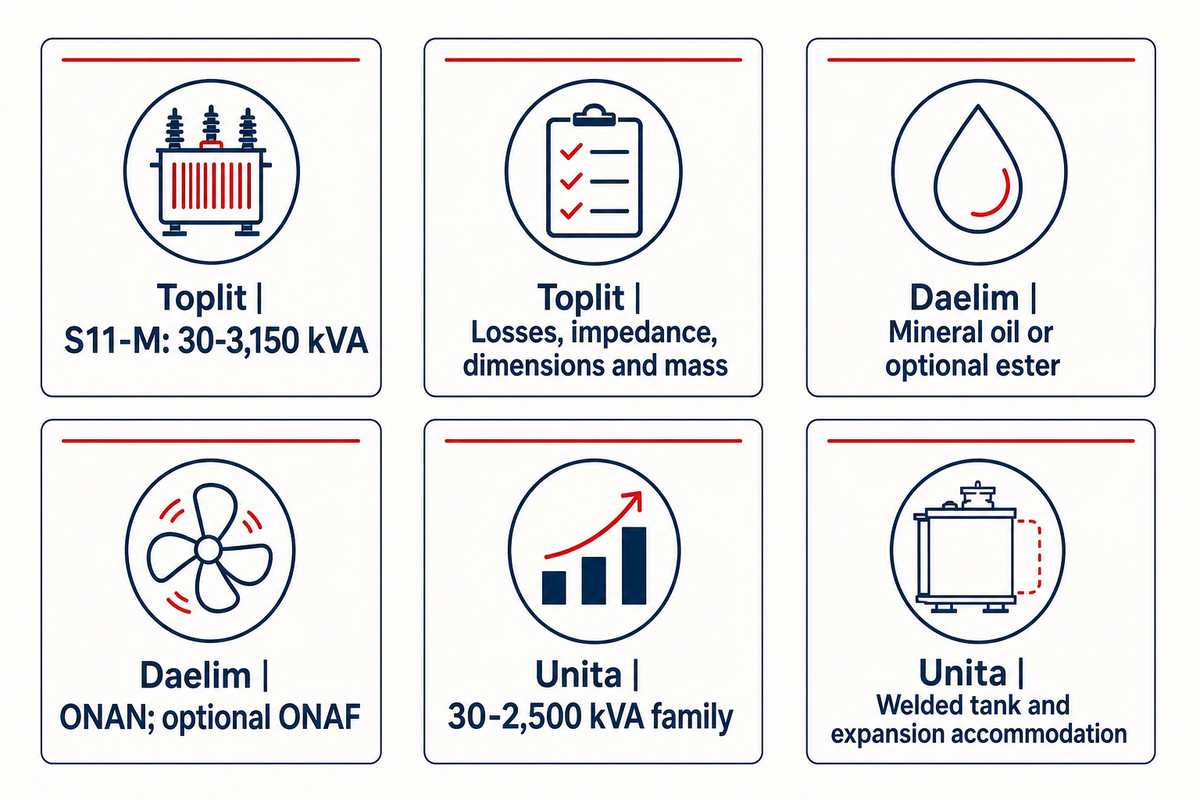
1. Toplit, Best for Specification-led 6–10 kV sealed distribution transformer projects requiring published loss, impedance and dimensional data
Headquarters: Hai’an, Nantong, Jiangsu, China · Founded: Not publicly disclosed · Type: transformer manufacturer
Official website: toplit-transformer.com
Main products: S11-M and S13-M hermetically sealed oil-immersed transformers
Published capability: S11-M: 30–3,150 kVA; S13-M listed ratings: 30–1,600 kVA
Standards, testing or quality context: ISO 9001, ISO 14001 and ISO 45001 management systems and CCC (3C) certification listed on its About page; testing and destination documents follow a project-specific scope covering drawings, tests and deliverable documentation.
Toplit’s About page identifies Jiangsu Toplit Electric Co., Ltd. and describes the company’s roots in its predecessor, Jiangsu Fangteng. The S11-M schedule covers 6 / 6.3 / 10 kV primary options, a 0.4 kV secondary and Yyn0 / Dyn11 connections, while the S13-M table is a separate reference series. A corrugated sealed tank accommodates oil-volume changes without a conventional conservator, and rating-by-rating losses, impedance, dimensions and mass help engineers compare the electrical and installation requirements together. That makes the offer relevant when an enquiry already contains a defined distribution duty and needs a configured drawing and test-document package.
Potential disadvantage: Public sealed S11-M data covers medium-voltage distribution up to 10 kV, not higher-voltage power-transformer classes.
2. Daelim Belefic, Best for Export projects requiring mineral-oil or optional ester sealed designs
Headquarters: Beijing, China; factory in Hai’an, Jiangsu · Founded: 2010 · Type: transformer manufacturer
Official website: www.daelimtransformer.com
Main products: Hermetically sealed liquid-filled distribution transformers
Published capability: Family envelope: 30 kVA to 20 MVA; HV up to 44 kV; LV 230–6,600 V
Standards, testing or quality context: Design references: IEC, ANSI/IEEE, CSA and AS/NZS; IEC 60076-5 short-circuit design.
Founded in April 2010, Daelim Belefic describes a Beijing office and a Jiangsu factory in its European-market company brochure. The hermetic product uses a fully sealed corrugated tank without a conservator or conventional breather, with mineral oil and an optional biodegradable ester offer. Published ONAN cooling and optional ONAF cooling give buyers different thermal configurations to discuss alongside the actual loading pattern. Its combination of liquid options and destination-standard references suits export enquiries where the electrical schedule, cooling arrangement and document list are prepared before commercial comparison.
Potential disadvantage: Specify the family’s capacity, voltage, liquid and cooling combination separately.
3. Unita Electric, Best for Welded sealed distribution tanks for 10, 20 and 35 kV enquiries
Headquarters: Suining, Xuzhou, Jiangsu, China · Founded: 2011 · Type: transformer manufacturer
Official website: www.unitatransformer.com
Main products: Hermetically sealed oil-immersed distribution transformers with corrugated fins or an expansion joint
Published capability: Published family: 30–2,500 kVA; listed voltage classes 10, 20 and 35 kV
Standards, testing or quality context: Product design reference: IEC 60076; the product page describes welding and leak testing.
Unita’s company profile dates the business to 2011 and locates it in the Xuzhou area of Jiangsu. Its sealed oil-immersed family uses a welded tank, with corrugated fins or an expansion joint handling the insulating liquid’s volume change instead of a separate conservator and breather. The combination of a defined distribution-capacity envelope and several listed medium-voltage classes makes it a practical candidate for industrial or commercial projects comparing welded-tank offers. The stated welding and leak-testing process provides a manufacturing focus for buyers comparing the integrity of the completed tank.
Potential disadvantage: The published sealed range ends at 2,500 kVA.
Global and European Sealed Distribution Transformer Manufacturers
4. Hitachi Energy, Best for Medium distribution projects requiring explicit hermetic construction up to 36 kV
Headquarters: Zurich, Switzerland · Founded: 2021 · Type: transformer manufacturer
Official website: www.hitachienergy.com
Main products: Three-phase liquid-filled medium distribution transformers
Published capability: Medium-distribution family: three-phase, oil-immersed; primary voltage up to 36 kV
Standards, testing or quality context: Product standards referenced by the manufacturer: ANSI and IEC.
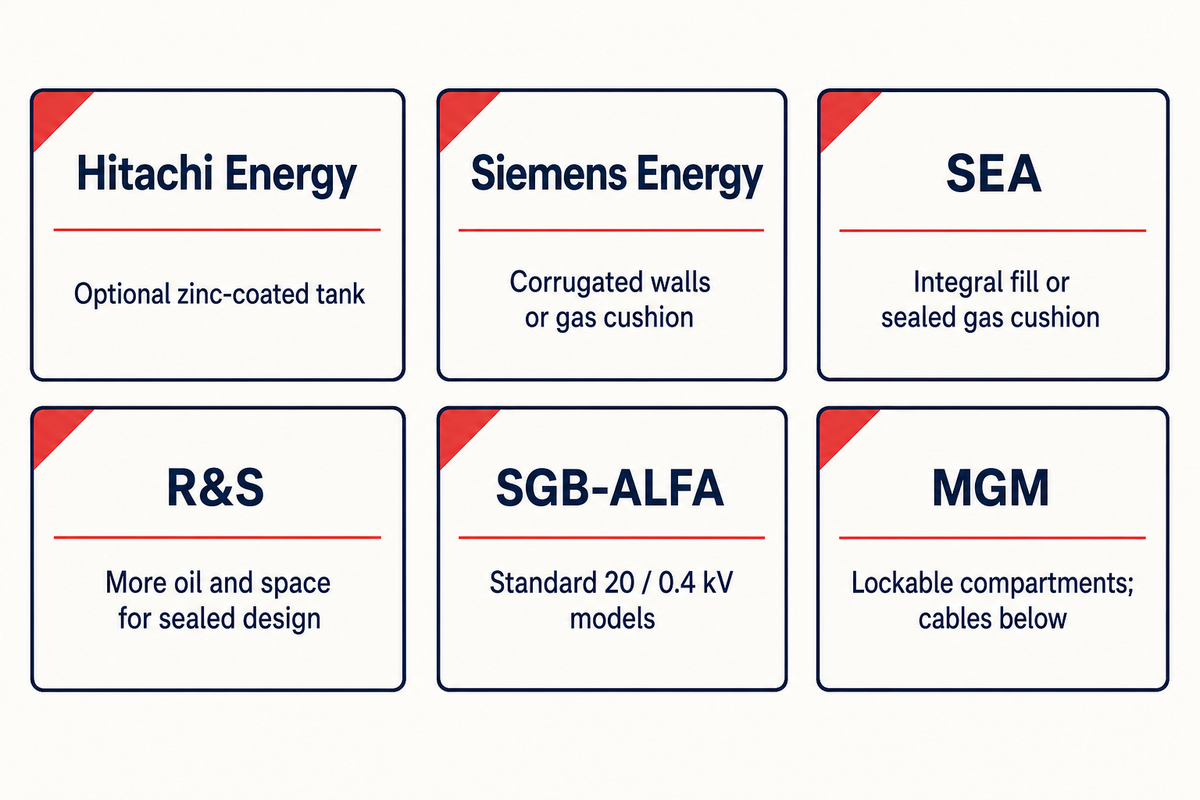
The 2021 date refers to the current Swiss legal company registration, not the beginning of its inherited transformer business. Hitachi Energy describes this medium-distribution family as three-phase, oil-immersed and hermetically sealed, while presenting a conservator as a separate requested configuration. A hot-dip zinc-coated tank is an available option, giving owners a concrete surface-protection feature to consider where outdoor corrosion exposure affects the equipment specification. Buyers can therefore start from an identified medium-distribution range and choose preservation and coating arrangements to match the installation environment.
Potential disadvantage: Conservator construction is an option; specify hermetic preservation in the order.
5. Siemens Energy, Best for Utility projects comparing hermetic construction with other fluid-immersed configurations
Headquarters: Munich, Germany · Founded: 2020 · Type: transformer manufacturer
Official website: www.siemens-energy.com
Main products: Fluid-immersed distribution transformers and FITformers
Published capability: Hermetic corrugated-wall design; optional air or gas cushion; bolted or welded lid
Standards, testing or quality context: Published testing includes temperature-rise, insulation-resistance and noise tests, with specialist short-circuit testing.
Siemens Energy became an independent company in 2020; the much older Siemens group history is a different date. Its fluid-immersed distribution portfolio explains how flexible corrugated walls accommodate liquid expansion and also offers gas-cushion arrangements, so an owner can compare preservation concepts within one manufacturer’s product offering. The published medium and large distribution ratings cover several designs, giving utility buyers a choice of configurations for different positions in the network. Its detailed testing discussion is useful to utility engineers building a factory-acceptance plan around the chosen transformer, including thermal performance, insulation behaviour and specified noise limits.
Potential disadvantage: Select sealed-family lid and gas-cushion options separately from portfolio-wide maximum ratings.
6. SEA Trasformatori, Best for European projects comparing integral-fill and gas-cushion distribution designs
Headquarters: Arzignano, Italy · Founded: 1959 · Type: transformer manufacturer
Official website: www.seatrasformatori.it
Main products: TTO small and medium liquid-immersed distribution transformers
Published capability: TTO family capacity envelope: 25 kVA to 30 MVA
Standards, testing or quality context: Historical management-system record: the company lists ISO 9001:2008 for its new headquarters in 2010.
SEA began as a small workshop in 1959 and records production of its first liquid-immersed transformer in 1963. Within TTO, the integral-fill hermetic arrangement uses flexible corrugated walls to absorb oil-volume movement while keeping the liquid separated from ambient air. Sealed-cover versions with a nitrogen or dry-air cushion and conservator versions are distinct alternatives, making this a useful supplier to approach when the owner is still choosing the preservation architecture. The broad TTO capacity envelope is a starting point for that discussion, while the selected design must establish the actual voltage, cooling and installation interface.
Potential disadvantage: The TTO envelope spans multiple designs; specify integral-fill hermetic construction with the capacity/voltage schedule.
7. R&S Group, Best for Distribution owners comparing sealed and open-vented equipment footprints
Headquarters: Sissach, Switzerland · Founded: 2012 · Type: transformer manufacturer
Official website: the-rsgroup.com
Main products: Hermetically sealed and open-vented oil-type distribution transformers
Published capability: Published family examples: up to 3,150 kVA / 24 kV and 2,500 kVA / 36 kV
Standards, testing or quality context: Quality basis: the distribution page states standardized routine testing.
R&S Group dates its group formation to 2012, separately from the histories of its constituent manufacturers. The distribution offering explicitly includes hermetically sealed tanks that keep the cooling liquid from routine contact with ambient air, alongside open-vented alternatives. Its published ranges belong to different product families, so the 3,150 kVA / 24 kV example and the 2,500 kVA / 36 kV example remain separate comparison points. A useful distinction for substation planners is the manufacturer’s own discussion of the extra liquid, dimensions and weight associated with sealed construction, which makes the tank concept part of layout selection rather than merely a catalogue label.
Potential disadvantage: Sealed construction uses more oil and space than its open-vented alternative.
8. SGB-SMIT Group, Best for European distribution projects using documented 20 / 0.4 kV standard models
Headquarters: Regensburg, Germany; shortlisted plant: Botoșani, Romania · Founded: 2008 · Type: transformer manufacturer
Official website: www.sgb-smit.com
Main products: SGB-ALFA hermetically sealed corrugated-tank distribution transformers
Published capability: SGB-ALFA brochure: 50–1,000 kVA, voltage class up to 36 kV; 20 / 0.4 kV standard models
Standards, testing or quality context: Routine-test reference: DIN EN 60076-1; the brochure separately identifies type tests.
The 2008 year describes the group company, rather than the earlier SMIT and SGB predecessor histories. SGB-ALFA manufactures the shortlisted family in Botoșani, with hermetically sealed corrugated tanks and a defined distribution rating schedule. Standard 20 / 0.4 kV models and an identified routine-test basis provide a concrete starting point for a European distribution equipment schedule. The Romanian family suits owners who can use the documented standard voltage ratio and want to align equipment schedules with an identified manufacturing site.
Potential disadvantage: The cited SGB-ALFA family covers 50–1,000 kVA.
9. MGM Transformers, Best for North American ground-level installations with enclosed cable compartments
Headquarters: Vernon, California, USA · Founded: 1974 · Type: transformer manufacturer
Official website: mgmtransformers.com
Main products: Single- and three-phase liquid-filled padmount compartmental transformers
Published capability: Published padmount envelope: up to 10,000 kVA and 34.5 kV; 46 kV is a separate option
Standards, testing or quality context: Product design reference: IEEE C57.12 series, according to the manufacturer’s product FAQ.
MGM is now part of Forgent; 1974 refers to the transformer business’s history. MGM’s liquid-filled padmount equipment combines the oil-insulation system with an enclosure arranged for underground-distribution connections. The product combines a sealed welded-cover tank and nitrogen blanket with lockable compartments for cables entering from below, addressing both liquid preservation and ground-level access. Listed accessories include an oil sampler, pressure-vacuum gauge and pressure relief valve, which give the maintenance team defined inspection and service interfaces. This construction fits underground-distribution layouts where the foundation, cable bending space and permitted public access need to be coordinated with the transformer package.
Potential disadvantage: The listed standard frequency is 60 Hz; 50 Hz is an option.
Turkish Hermetic Transformer Specialists
10. Astor Enerji, Best for Distribution tenders requiring a separately defined 25–5,000 kVA hermetic range
Headquarters: Ankara, Türkiye · Founded: 1983 · Type: transformer manufacturer
Official website: astoras.com.tr
Main products: Hermetic oil-type distribution transformers
Published capability: Hermetic distribution family: 25–5,000 kVA; voltage class up to 36 kV
Standards, testing or quality context: Manufacturing process: vacuum filling and flexible corrugated tank construction.
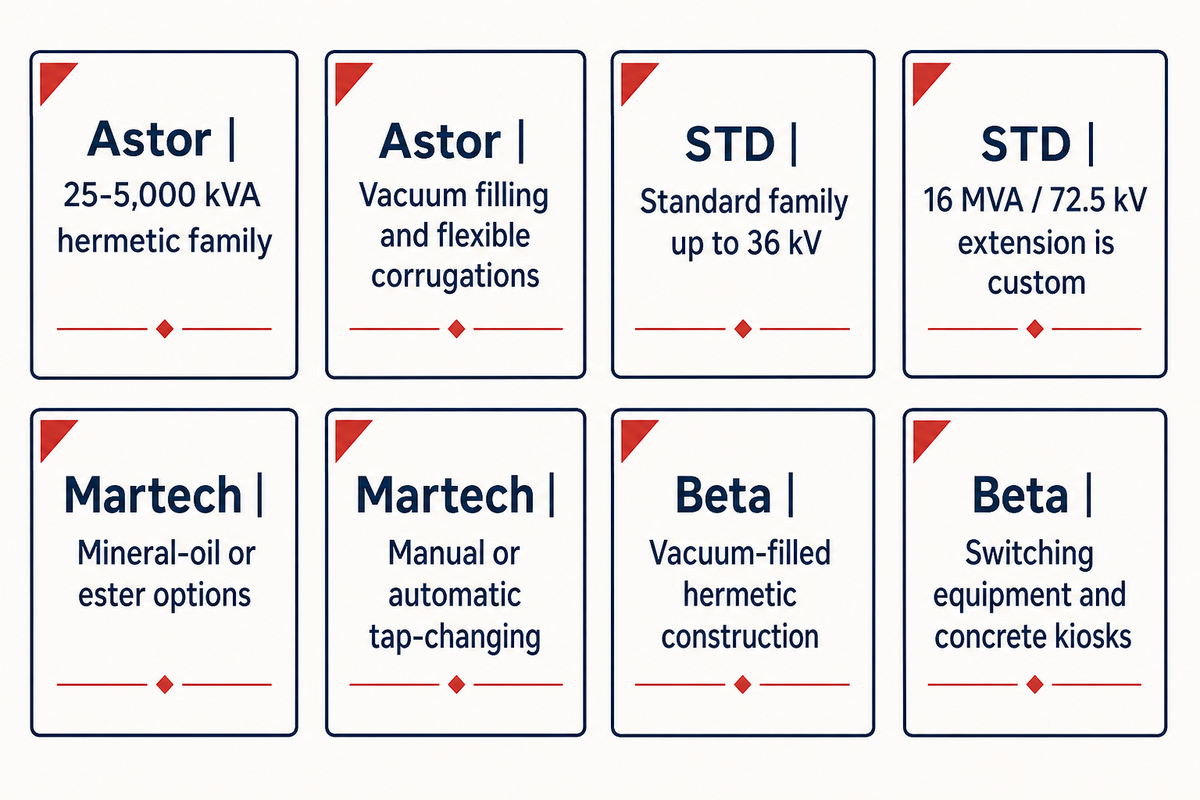
Astor traces its business roots to Transtek in 1983 and the Astor name to 2003, so the table reports the predecessor history rather than a brand-renaming date. The oil-type distribution page separately describes hermetic units, giving a sealed-only tender a defined 25–5,000 kVA capacity envelope. Vacuum filling and flexible corrugations are linked to the actual oil-preservation design: the tank accommodates expansion while the insulating liquid remains within the closed system. The result is a clearly bounded candidate for medium-voltage distribution buyers who need construction and rating scope stated together.
Potential disadvantage: The stated hermetic distribution envelope ends at 5,000 kVA and 36 kV.
11. STD Transformer, Best for Export distribution projects within a defined 36 kV hermetic family
Headquarters: Adana, Türkiye · Founded: 2009 · Type: transformer manufacturer
Official website: stdtransformer.com
Main products: Three-phase hermetic oil-immersed distribution transformers
Published capability: Standard hermetic family: 25–5,000 kVA; up to 36 kV
Standards, testing or quality context: According to its About page: IEC 60076 design references and ISO 9001 / ISO 14001 management certifications.
Established in Adana in 2009, STD describes both manufacturing and transformer service activity on its official company page. Its standard hermetic oil-immersed family uses vacuum filling and corrugated tank walls that move with temperature-driven liquid expansion, without a separate expansion tank. Buyers seeking three-phase distribution equipment can therefore start with a stated 36 kV product boundary and compare the cooling and liquid arrangement appropriate to their project. The company also offers higher custom ratings through a separate engineering scope for projects extending beyond the standard family.
Potential disadvantage: The 16 MVA / 72.5 kV extension is custom, not the standard range.
12. Martech Trafo, Best for Distribution projects comparing mineral-oil and ester-filled hermetic options
Headquarters: Ankara, Türkiye; manufacturing in Diyarbakır · Founded: Not publicly disclosed · Type: transformer manufacturer
Official website: martechtrafo.com
Main products: Single- and three-phase hermetic oil-type distribution transformers
Published capability: Hermetic distribution family: 25–5,000 kVA; up to 36 kV
Standards, testing or quality context: Manufacturing process: vacuum oil filling and corrugated-wall oil-volume compensation.
Martech locates its headquarters in Ankara and production in Diyarbakır, with hermetic and conservator units described as separate oil-immersed designs. In the hermetic version, corrugated tank walls expand and contract with liquid-volume changes after vacuum filling. The published mineral-oil or ester options, single- or three-phase configurations and manual or automatic tap-changing choices allow buyers to discuss more than the headline kVA rating when matching an installation. This makes the line relevant where the owner’s fluid preference and voltage-control arrangement need to be settled together within a defined medium-voltage distribution envelope.
Potential disadvantage: The published hermetic range is limited to 5,000 kVA and 36 kV.
13. Beta Enerji, Best for Distribution packages combining hermetic transformers with switchgear and kiosks
Headquarters: Adana, Türkiye · Founded: 1997 · Type: transformer manufacturer
Official website: betaenerji.com
Main products: Hermetic oil-immersed distribution transformers
Published capability: Fully oil-filled hermetic construction using special vacuum chambers
Standards, testing or quality context: According to its About page: ISO 9001, ISO 14001 and ISO 45001 management systems.
Beta’s corporate history dates to 1997, while its current Adana campus brings transformer production together with high-voltage switching equipment and concrete kiosks. The hermetic distribution page describes filling in special vacuum chambers so the oil-filled enclosure has no normal air-contact space, rather than using a conventional expansion reservoir. For a packaged-substation enquiry, that transformer offer sits alongside equipment needed to complete the surrounding electrical installation. The commercial fit is a coordinated distribution package, with the selected transformer, switching equipment and kiosk matched to the installation’s electrical and space requirements.
Potential disadvantage: Limited public data on the hermetic family’s standard capacity-by-voltage schedule.
Middle Eastern and Indian Distribution Transformer Manufacturers
14. Bahra Electric, Best for Saudi distribution projects combining sealed transformers and package substations
Headquarters: Bahra Industrial City near Jeddah, Saudi Arabia · Founded: 2008 · Type: transformer manufacturer
Official website: bahra-electric.com
Main products: BOIT hermetically sealed oil-immersed distribution transformers
Published capability: BOIT family: 50–5,000 kVA; rated voltage up to 36 kV
Standards, testing or quality context: Published IEC 60076 test categories include temperature rise, impulse, short-circuit withstand and sound level.
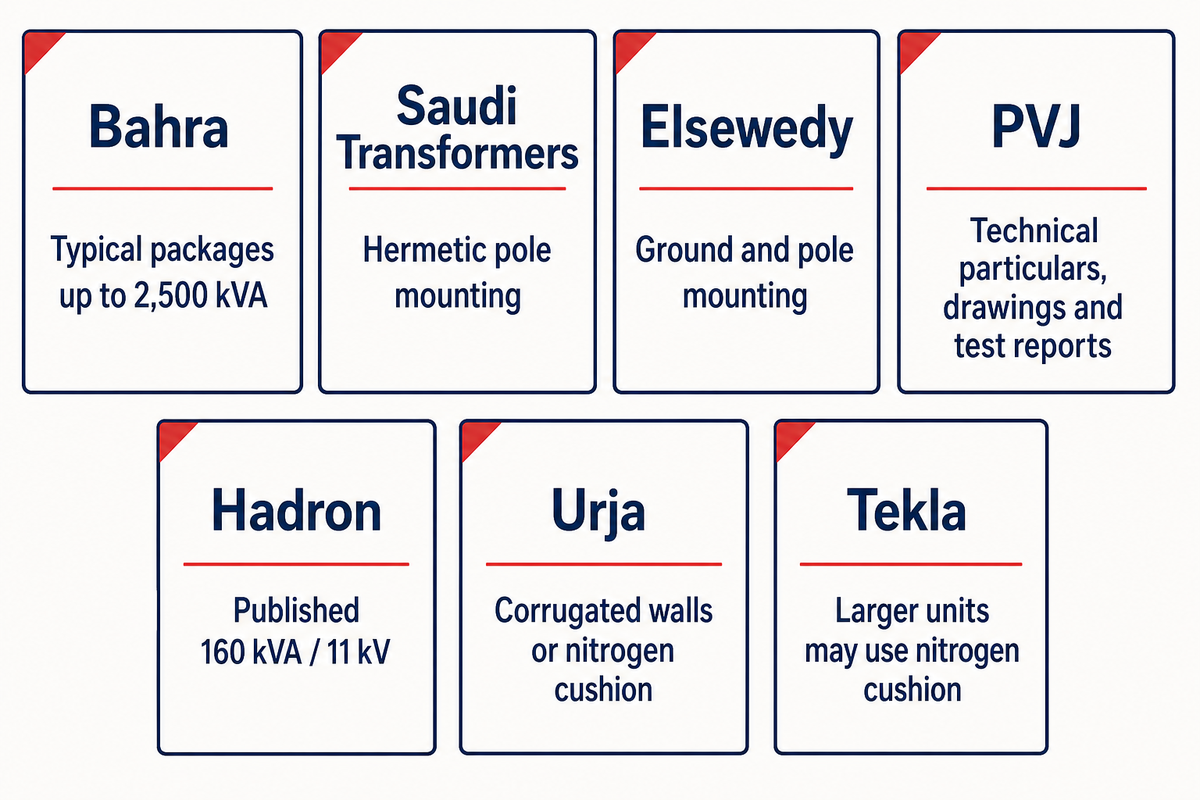
Bahra Electric’s group history begins in 2008, with manufacturing in Bahra Industrial City near Jeddah. The BOIT technical description explicitly identifies hermetically sealed breathing, while the package-substation offer also includes other transformer architectures as distinct alternatives. A published list of thermal, dielectric, short-circuit and acoustic test categories helps a utility or industrial buyer organise the inspection scope around the transformer actually ordered. The distinction between the broader BOIT range and the usual package-substation rating matters when space, switchgear and transformer capacity must be procured as one installation.
Potential disadvantage: Typical package-substation ratings stop at 2,500 kVA.
15. Saudi Transformers Company, Best for Saudi pole-mounted distribution requiring corrugated sealed-tank construction
Headquarters: Dammam, Saudi Arabia · Founded: 1982 · Type: transformer manufacturer
Official website: www.sauditransformers.com
Main products: Hermetically sealed pole-mounted distribution transformers
Published capability: Hermetic pole-mounted design with corrugated steel walls and gasketed bolted or welded closure
Standards, testing or quality context: The manufacturer describes routine testing with IEC / ANSI references.
Saudi Transformers Company has manufactured transformers in Dammam since 1982. The pole-mounted offer explicitly includes a hermetic design whose corrugated steel walls accommodate oil expansion, with a gasketed bolted cover or welded construction. This gives overhead-distribution buyers a choice of cover construction within an explicitly described sealed oil-preservation system. The pole-mounted arrangement makes the line relevant to owners coordinating the transformer’s mounting interface with an overhead network’s electrical schedule.
Potential disadvantage: The sealed pole-mounted line has limited public kVA-by-voltage data.
16. Elsewedy Electric, Best for Utility distribution requiring both ground- and pole-mounted sealed alternatives
Headquarters: New Cairo, Egypt · Founded: 1938 · Type: transformer manufacturer
Official website: www.elsewedyelectric.com
Main products: Hermetic oil distribution transformers for ground and pole mounting
Published capability: Oil distribution catalogue: voltage class up to 36 kV; hermetic and conservator alternatives
Standards, testing or quality context: Historical catalogue statement: KEMA inspection to IEC 60076 for 100 kVA to 2 MVA ratings.
The 1938 year describes Elsewedy’s group history, rather than the commissioning date of an individual transformer plant. Its transformer catalogue explicitly offers hermetically sealed oil-distribution equipment for both ground and pole mounting, alongside a distinct conservator-type option. The catalogue records historical KEMA inspection for 100 kVA to 2 MVA distribution ratings under IEC 60076. This combination of mounting alternatives is useful for utilities planning both overhead-network connections and ground-level distribution installations.
Potential disadvantage: The offered sealed configuration requires a hermetic/conservator choice beyond checking historical tested ratings.
17. PVJ Power, Best for Indian distribution enquiries requiring defined approval and routine-test documents
Headquarters: Nalagarh, Himachal Pradesh, India · Founded: 2010 · Type: transformer manufacturer
Official website: www.pvjpower.in
Main products: Hermetically sealed oil-immersed distribution transformers with guaranteed technical particulars
Published capability: Sealed distribution design; datasheet, GTP, general-arrangement drawing and routine-test report
Standards, testing or quality context: Design/test references: IS 1180, IS 2026 and IEC 60076.
PVJ reports operations from 2010 in Nalagarh; that operating-history date shouldn’t be confused with a legal incorporation date. Its hermetic distribution offer describes a closed tank that limits oil contact with external air and treats tank expansion as part of the transformer design. The documentation package includes guaranteed technical particulars, a general-arrangement drawing and a routine-test report, which is useful when an Indian distribution or industrial project requires technical approval before release. The combination of sealed construction and defined submissions suits projects where drawing approval and the test-document package are part of the procurement schedule.
Potential disadvantage: Limited public product data for the hermetic family’s capacity-and-voltage rating envelope.
18. Hadron Power, Best for Indian 11 kV enquiries starting from a published 160 kVA example
Headquarters: Indore, Madhya Pradesh, India · Founded: 2008 · Type: transformer manufacturer
Official website: www.hadronpower.in
Main products: Hermetically sealed oil-filled distribution transformers
Published capability: Published example: 160 kVA / 11 kV
Standards, testing or quality context: Listed design/test references: IS 1180, IS 2026 and IEC 60076.
The hermetic product page describes an airtight tank separating the insulating oil from the atmosphere and gives a concrete 160 kVA / 11 kV example. That specific reference is useful for buyers comparing small distribution units against a defined local voltage class and an Indian-standard technical schedule. The published example gives the enquiry a concrete capacity and voltage starting point for comparing the required loss, impedance and installation schedule.
Potential disadvantage: Public sealed listing: one 160 kVA/11 kV rating, not a complete range.
19. Urja Techniques, Best for Industrial sites comparing corrugated-tank and nitrogen-cushion preservation
Headquarters: Mumbai, Maharashtra, India · Founded: 1996 · Type: transformer manufacturer
Official website: www.urjatransformers.com
Main products: Hermetically sealed oil-immersed distribution transformers with elastic corrugated walls or a nitrogen cushion
Published capability: Published sealed-family upper limits: 3,150 kVA and 33 kV
Standards, testing or quality context: Product design references: IS, IEC and ANSI.
The current company dates to 1996, with an earlier TC Electricals predecessor history beginning in 1990. Urja describes hermetic designs that accommodate oil expansion through elastic corrugated walls or a permanent nitrogen cushion, giving industrial buyers two distinct preservation concepts to compare. Its product discussion includes humid and chemically exposed locations, but the practical advantage comes from selecting the tank, coating and accessories for the site rather than assuming the sealed label removes environmental risks. The sealed family’s published upper limits give industrial buyers a defined starting point for matching their capacity requirement and voltage class.
Potential disadvantage: Published sealed-family upper limits are 3,150 kVA and 33 kV; capacity-by-voltage details remain limited.
20. Tekla Energy, Best for Sealed distribution enquiries spanning finned tanks and larger nitrogen-cushion designs
Headquarters: Chopanki / Tijara, Rajasthan, India · Founded: 2024 · Type: transformer manufacturer
Official website: www.teklaenergy.in
Main products: Hermetically sealed liquid-filled transformers
Published capability: Family envelope: 50 kVA to 5 MVA; voltage classes 1.1–52 kV
Standards, testing or quality context: Construction: finned sealed tank and a separately described nitrogen-cushion option.
The 2024 date refers to the incorporation year of Tekla Energy Private Limited’s current legal entity. Its hermetic product description covers finned sealed tanks and explains that larger units above 3,150 kVA, or radiator-equipped designs, may use a nitrogen cushion. This distinction is useful when a buyer’s capacity requirement crosses the boundary between a flexible finned tank and another sealed-volume arrangement. The family’s voltage and capacity envelope provides an enquiry boundary, while the selected combination and preservation method remain part of the actual transformer design.
Potential disadvantage: Above 3,150 kVA, the offered preservation arrangement can change.
Hermetically Sealed vs Conservator Transformers
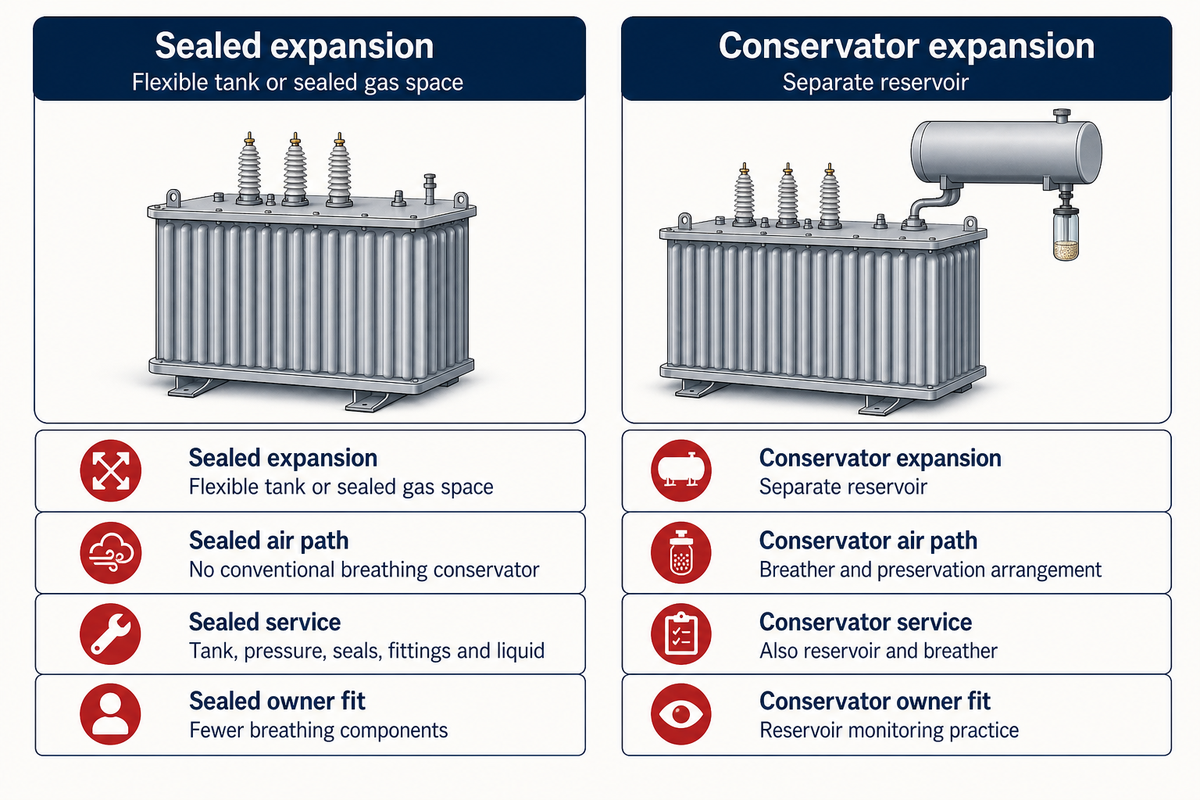
The completely sealed preservation system limits routine contact between the insulating liquid and atmospheric oxygen, and thus helps reduce oxidation and contaminant ingress. The benefit of the preservation system depends on intact seals and a correctly installed and serviced system. The Preservation System doesn’t replace the mandatory inspection of the equipment.
The key difference is in how conservator and hermetic transformer systems address expansion of the insulating liquid. For hermetic systems, the expansion is accommodated within a closed system using flexible walls or an engineered gas space. A conservator type transformer system separates the expansion of the insulating liquid in a dedicated expansion reservoir. The management of the air in this system is dependent on the type of breather or membrane used.
| Decision | Hermetically sealed | Conservator type |
|---|---|---|
| Oil-volume change | Tank flexibility, sealed gas space or another engineered internal allowance | A separate reservoir provides expansion volume |
| Routine air path | No conventional breathing conservator path | Depends on the breather and liquid-preservation arrangement |
| Service attention | Tank integrity, pressure, seals, fittings and liquid condition | Those duties plus the fitted conservator and breather equipment |
| Owner fit | Useful where fewer routine breathing components suit the maintenance plan | Useful where owner standards and oil-monitoring practice favour a reservoir |
Toplit’s sealed-versus-conservator comparison describes these differences in expansion control, breathing paths and service access; accessories and service procedures remain design-specific. Corrugations provide cooling surface and can accommodate oil movement, but their welds and thin-wall geometry also need protection against corrosion, pressure cycling and transport damage. Neither architecture is universally superior. A familiar service arrangement can be more valuable than removing a component the owner already maintains effectively.
How to Choose a Hermetically Sealed Transformer Manufacturer
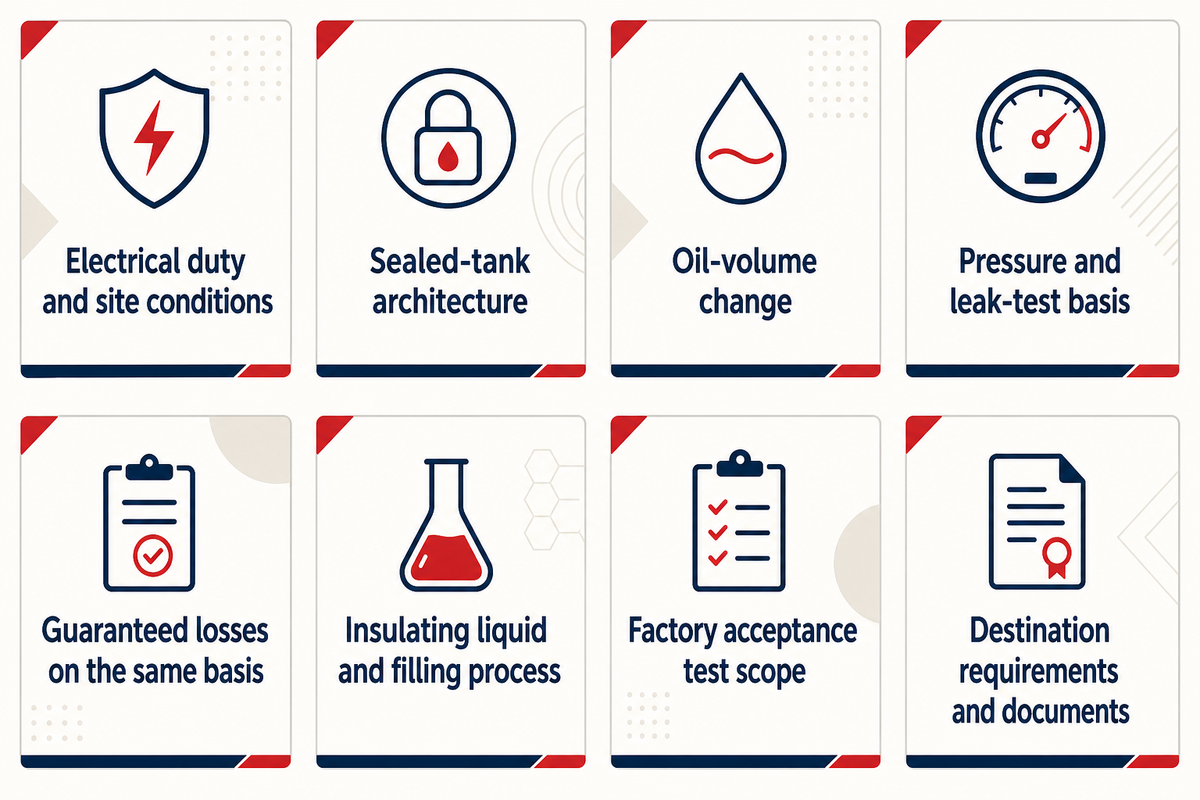
Send the same set of questions to each shortlisted factory. Before evaluating the offer, find out which entity winds and assembles the active part, which entity fabricates or sources the tank, where drying and filling occur, and which factory issues the routine-test report for the product. While a distributor may be strategic for business, the contract and other supporting documents should name the actual manufacturer and should explain the responsibilities of both the manufacturer and distributor.
1. Define the complete electrical duty and site conditions
State kVA, rated primary and secondary voltages, frequency, phase, vector group, tap range, impedance, insulation level and load profile. Specify rated voltages (Ur) of both high- and low-voltage windings separately from the highest voltage for equipment (Um), and state the insulation level for each winding. Identify if the transformer supplies ordinary distribution loads, motor starting and/or variable speed drives and/or renewable energy equipment. A “1,000 kVA hermetic transformer” request for quotation doesn’t allow for a fair comparison of prices.
Group altitude, min/max ambient temp, humidity, pollution, dust, coastal salt, corrosive conditions, seismic requirements, and exposure to the elements (indoor vs. outdoor) with solar loading and installation clearance on the same schedule. Catalogue ratings depend on reference conditions, including altitude; cable access belongs in the installation schedule. Provide access-route, foundation and cable conditions so a technically suitable active part doesn’t arrive in an unusable enclosure.
2. Define the actual sealed-tank architecture
Request drawings showing preservation boundaries, method of expansion and pressure relief, oil-level indication, oil sampling, and whether a breather and/or conservator is fitted. Also show whether the closed-system design uses integral-fill corrugated walls or a sealed gas space. An integral-fill corrugated design and a sealed gas-space design both preserve liquid in closed systems but have different operating and service considerations.
The drawing must show bushings, valves, and gasketed interfaces and indicate the location of removable covers and welded joints. It must also show the locations of places where joints are made with non-metal-to-metal contact. Match the features shown on the drawing with the description given in the offer. The term “sealed transformer” describes some types of dry-type equipment which is beyond the scope of this report, and the presence of constructions marked as S11 or S13 doesn’t provide evidence that hermetic construction is used.
3. Ask what accommodates oil-volume change
The manufacturer should be asked to explain the volume allowance between the minimum design temperature and the maximum operating condition. Expansion and movement of the corrugated tank walls or behavior of a confined gas space should be addressed in relation to oil quantity, temperature rise and the specified loading cycle. The term “Fully sealed” describes the system boundary, but doesn’t explain how its mechanical design accommodates the thermal movement of the oil.
Compression of a sealed gas space can accommodate movement caused by changes in oil volume; keep any proposed overload duty visible in that discussion. Sufficient expansion allowance should account for oil movement through flexible corrugated walls or a sealed gas space, according to the design. A smaller finned-tank unit may use a different preservation method from that used in a larger radiator-equipped design; extra cooling surface alone does not establish sufficient expansion allowance. In such a case, the design and operating manuals should agree.
4. Agree the pressure and leak-test basis
The scope of IEC 60076-1:2011 includes performing leak tests on tanks and testing tank vacuum and pressure. The test conditions should be distinguished from normal operating conditions. Normal operating pressure, design pressure, design vacuum where applicable, and production leak-test conditions should be identified. Also, the setting of any relief devices should be identified. The scope of the test should identify which assembled interfaces are included, and the results of the test should be documented. Weld and gasket inspections and closure should be part of the test.
There’s no single pressure value suitable for all hermetic transformers; the specified pressure depends on the actual design. Agree on the methodology, acceptance criteria and report format prior to purchase. Agree how transport fittings and the final condition of the hermetic transformer will be handled at the time of shipment. The assurance of “leak testing” doesn’t add value to the test report unless it’s specified which tank and serial number was tested.
5. Compare guaranteed losses on the same basis
Measurement quality matters as well as the quoted watts. IEC 60076-19-1:2023 addresses uncertainty in no-load and load-loss measurements during routine testing. Specify the applicable measurement basis when agreeing the guaranteed values.
Prior to comparison of no-load and load losses, agree to the same parameters including kVA, voltage, frequency, reference temperature, load-loss measurement basis and required efficiency. Request agreed tolerances and guaranteed values. Comparison of typical catalogue values from one supplier against another supplier’s contractual maximum isn’t a valid comparison. Impedance should also be agreed to prior to loss comparisons.
For a level playing field, use one owner-approved set of energy-price assumptions, loading assumptions and capitalisation factors for each offer. No-load energy losses continue while the transformer is energised, and load losses vary depending on operating conditions. Purchase price, required testing, installation and freight should be clearly specified as separate cost inputs. The bid comparison shouldn’t reward the lowest bidder for leaving required work out.
6. Specify the insulating liquid and filling process
State the type of mineral oil, inhibited or uninhibited oil as appropriate or the ester oil if offered by the manufacturer. Indicate the applicable specification, test certificate, quantity, and method of addition. Natural ester oil, if offered by the supplier, may be considered for hermetic construction; however, a mineral-oil design may not be presumed suitable for ester applications.
Cooling and insulation are some of the functions provided by the liquid, so its selection affects more than the environmental description. Agree upon records of working procedures for drying, filtration, vacuum processing and filling, as well as how the liquid provided is identified during future service. Only sampling or later topping-up carried out in accordance with the prescribed, manufacturer-approved procedures should be undertaken on the unit.
7. Set the factory acceptance test scope before ordering
Agreement should be reached regarding the type of tests to be routinely performed, e.g. winding resistance, voltage ratio, vector group, no-load and load loss, impedance, and other applicable dielectric tests. Also, type or special tests, e.g. temperature rise, lightning impulse tests, oil tests, sound-level tests, and tank pressure or leak tests, should be specified where required by the project.
The user should identify what test evidence comes from the furnished unit and what test evidence comes from a representative design. The user should define what will be accepted and what won’t be accepted, with acceptance criteria, witness and hold points, reports, calibration records and any third-party inspection specified in the factory acceptance test plan. The user should identify nonconforming test results and resolve them through the agreed acceptance process prior to shipment. Reliance on a certificate title alone shouldn’t confirm acceptance.
8. Match destination requirements and documentary evidence
Identify the destination’s applicable requirements for products pertaining to standards, efficiency, utility specifications, labeling and approvals, with their editions and effective dates. Chinese-market schedules may reference GB/T 6451 and GB 20052; an old catalogue edition or an S-series model label isn’t proof of meeting the requirement applicable to a new order. Similarly, other countries may have different definitions and scope of equipment and exclusions.
Maintain documents pertaining to design and test standards, product certification, utility approval, ISO management certifications, routine-test reports and type-test reports as separate categories. “Designed to IEC 60076” does not mean the equipment comes from an IEC-certified manufacturer and does not signify approval for sale in all countries. Each required product certificate or approval should be submitted with its entity, factory, product scope and validity matched to the actual offer.
Maintenance: A Sealed Tank Still Needs an Inspection Plan
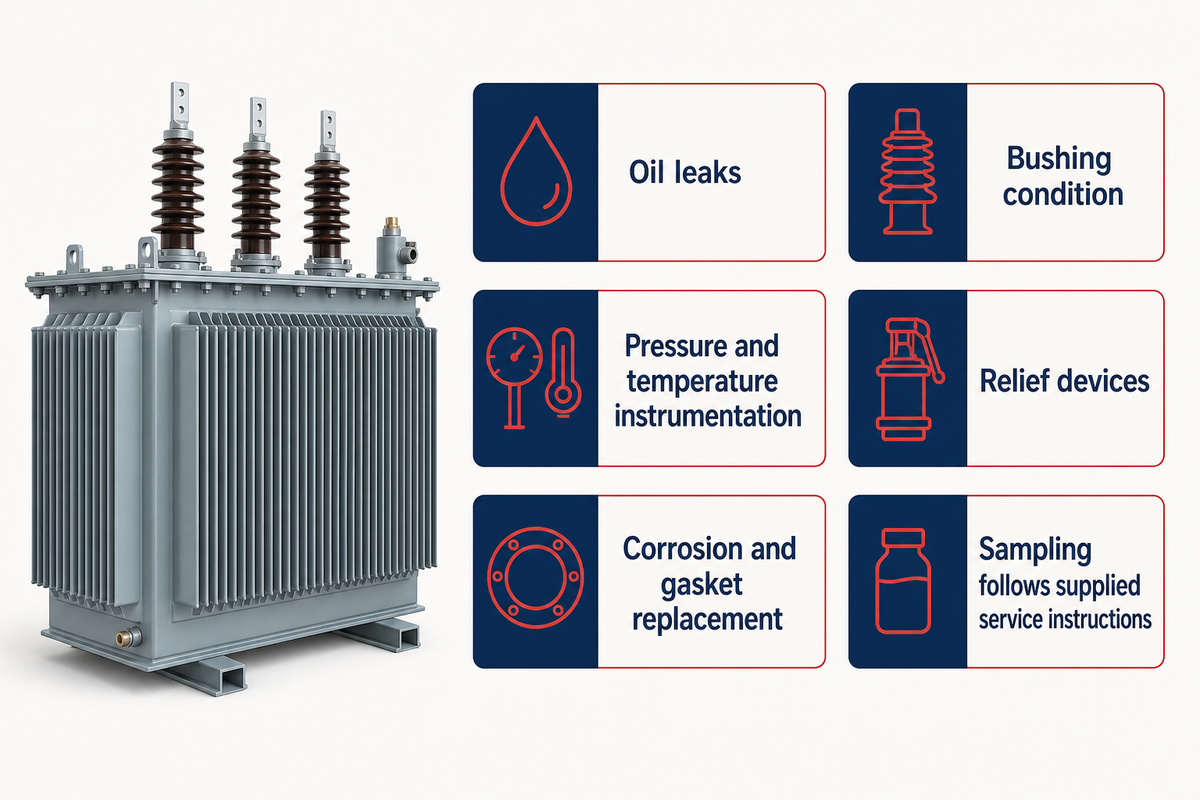
IEC 60422:2024 provides supervision and maintenance guidance for mineral insulating oils, with scope conditions that include whether sampling is reasonably practicable. It does not establish one sampling interval for every sealed transformer; the supplied equipment and its service instructions determine the appropriate approach.
Toplit’s sealed-transformer service guidance identifies continuing inspection and oil-sampling duties. Sealing removes a conventional atmospheric breathing path; it doesn’t create an inspection-free asset. Gaskets can age, welds can be damaged, bushings and valves can develop leakage, and corrosion can attack the enclosure. Moisture can also enter during maintenance if the oil system is opened incorrectly. The absence of a silica-gel breather therefore doesn’t mean the liquid is protected from moisture forever.
Before handover, obtain inspection intervals and procedures for items such as oil leaks, bushing condition, pressure and temperature instrumentation, relief devices, electrical accessories, corrosion and gasket replacement. Find out what sampling of system fluid is permitted and how the condition of the fluid is to be monitored, as part of the Owner’s maintenance policy. The sealed design describes a construction feature; the method of maintenance depends on the supplied design, installation conditions and service history.
Frequently Asked Questions
Which is the best hermetically sealed transformer manufacturer?
The best hermetically sealed transformer manufacturer depends on voltage, kVA, guaranteed losses, tank design, site conditions, testing requirements and destination standards. Toplit offers detailed 6–10 kV distribution schedules, Hitachi Energy documents a medium-distribution family, and MGM provides sealed liquid-filled padmount designs. Compare manufacturers against the same electrical and installation schedule rather than seeking one global winner.
What is a hermetically sealed transformer?
A hermetically sealed transformer is a liquid-filled transformer designed to keep the insulating liquid within a sealed tank system while accommodating temperature-driven fluid-volume changes without a conventional breathing conservator arrangement. System flexibility, expansion and contraction, as well as the behavior of the system and service connections, are defined in the supplied design.
What is the difference between a hermetically sealed transformer and a conservator transformer?
A hermetically sealed design accommodates oil-volume changes inside a sealed system, while a conventional conservator design uses a separate expansion reservoir. The conservator transformer system may incorporate a breather or membrane arrangement, while sealed systems use flexible walls or a gas space to accommodate expansion. Inspection and maintenance requirements for both systems may vary.
Are hermetically sealed transformers maintenance-free?
No. A sealed tank removes some air-exchange components, but the transformer still requires inspection and an appropriate maintenance plan. Seals, leakage, bushings, protection devices, liquid condition and corrosion still require attention. Sampling and any maintenance on the system require adherence to the procedures in the sealed design, as poor maintenance may affect system integrity.
Are Chinese hermetically sealed transformer manufacturers reliable?
Some are, but country of origin alone is not a sufficient supplier qualification criterion. Analyze the actual production facility, documented rating table, guaranteed losses, impedance, tank design, leak testing and Factory Acceptance Test (FAT) scope. The required standards, efficiency performance and destination documentation should apply to the offered equipment configuration. Use the same evidence requirements for Chinese suppliers and manufacturers elsewhere.
How much does a hermetically sealed transformer cost?
There is no universal price because each transformer is priced around its kVA, voltage, guaranteed losses, winding material, liquid, tank, accessories, tests and destination requirements. Compare same-scope quotes including freight, duties, site installation, spares and commissioning. For long-running units, evaluate guaranteed losses using consistent loading and energy-cost assumptions for the service the equipment is intended to perform.
Prepare a Comparable Transformer Enquiry
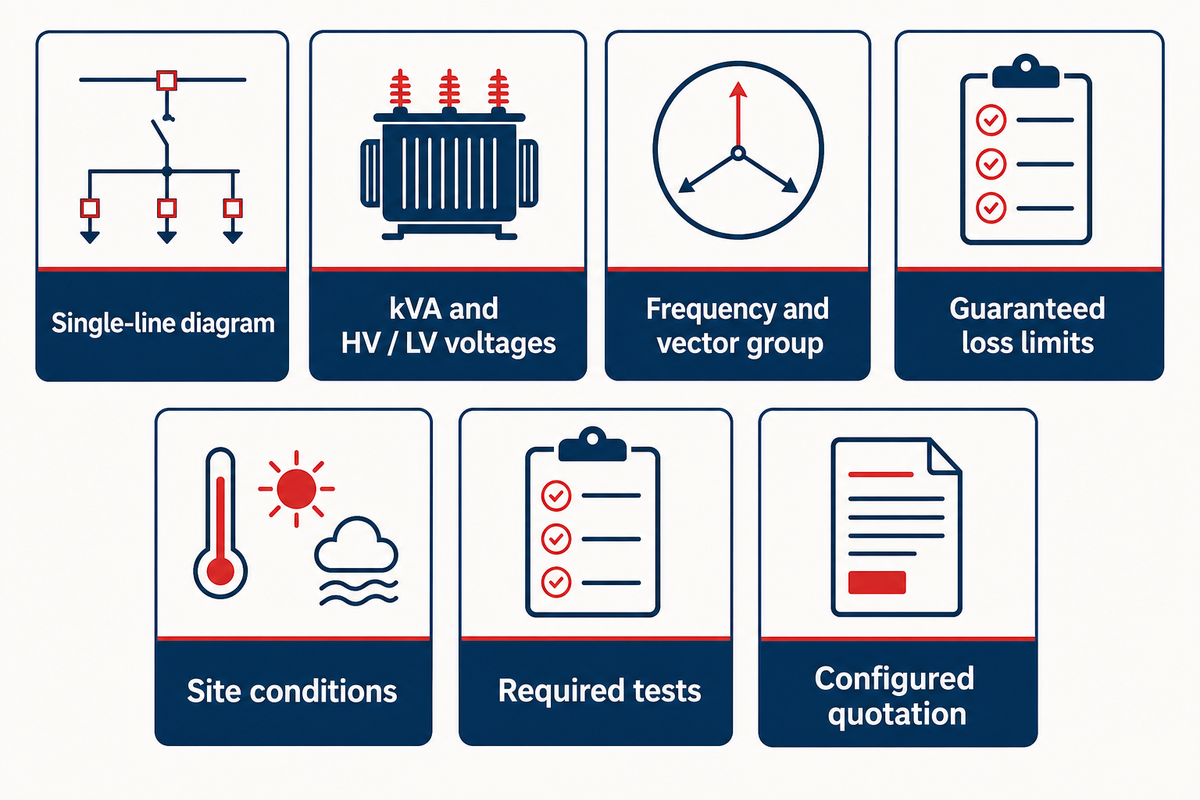
The objective of this evaluation is to identify equipment that best meets the project requirements, in terms of distribution voltage, capacity, owner standards and site conditions. To meet owner standards and project requirements, first define electrical duty, tests, losses, liquid, tank design and destination documents. Once the above are defined, then evaluate manufacturers based on published equipment families.
An equipment comparison should be based on engineering requirements, not just the initial unit price.
For a project within Toplit’s published distribution scope, review the hermetically sealed transformer reference schedules and the broader oil-immersed distribution transformer range. Send your single-line diagram, kVA, HV and LV voltages, frequency, vector group, guaranteed loss limits, site conditions and required tests through the project enquiry page to request a configured quotation.