Get in touch with Talite Transformer Co., Ltd Company

Last updated: September 2026
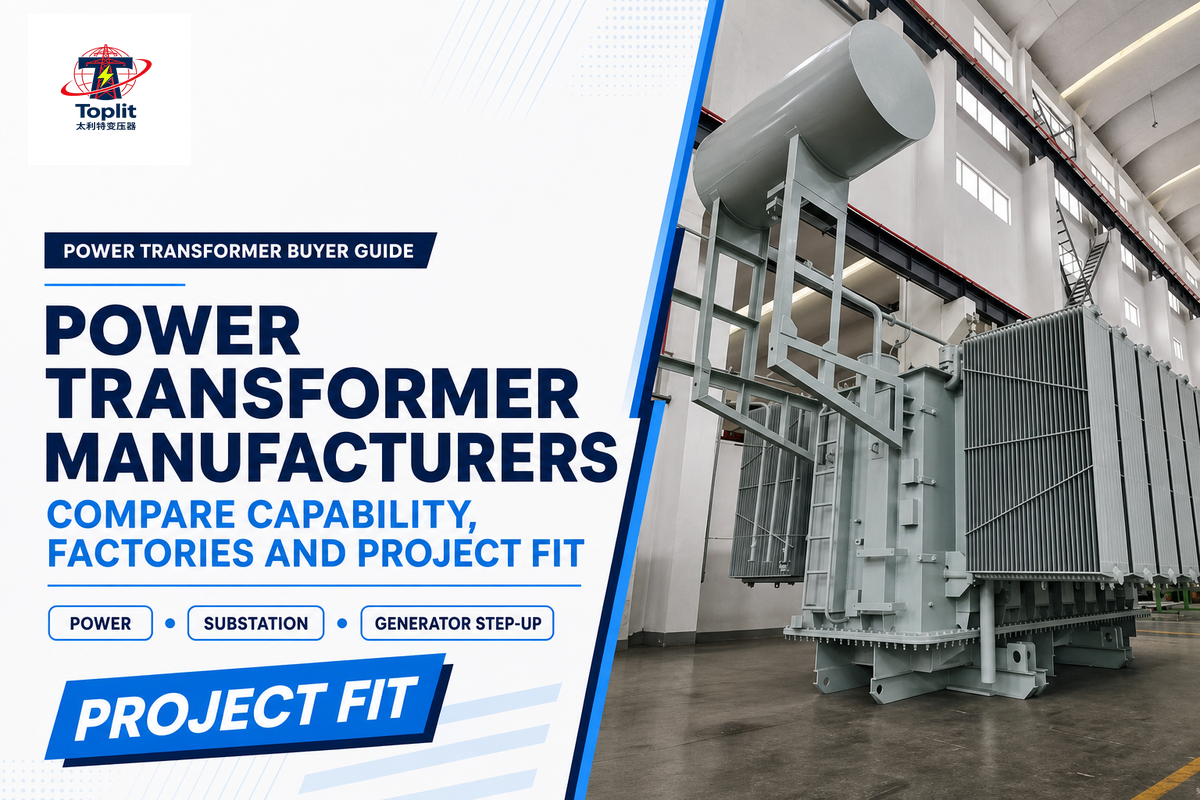
The best power transformer manufacturers include Hitachi Energy for HVDC converter projects, Mitsubishi Electric for high-capacity generator step-up duty, and Toplit for specification-led 35–220 kV projects requiring published rating data and factory acceptance testing. Selection depends on electrical duty, factory capability, testing scope and delivery conditions, rather than a universal winner.
Quick Picks
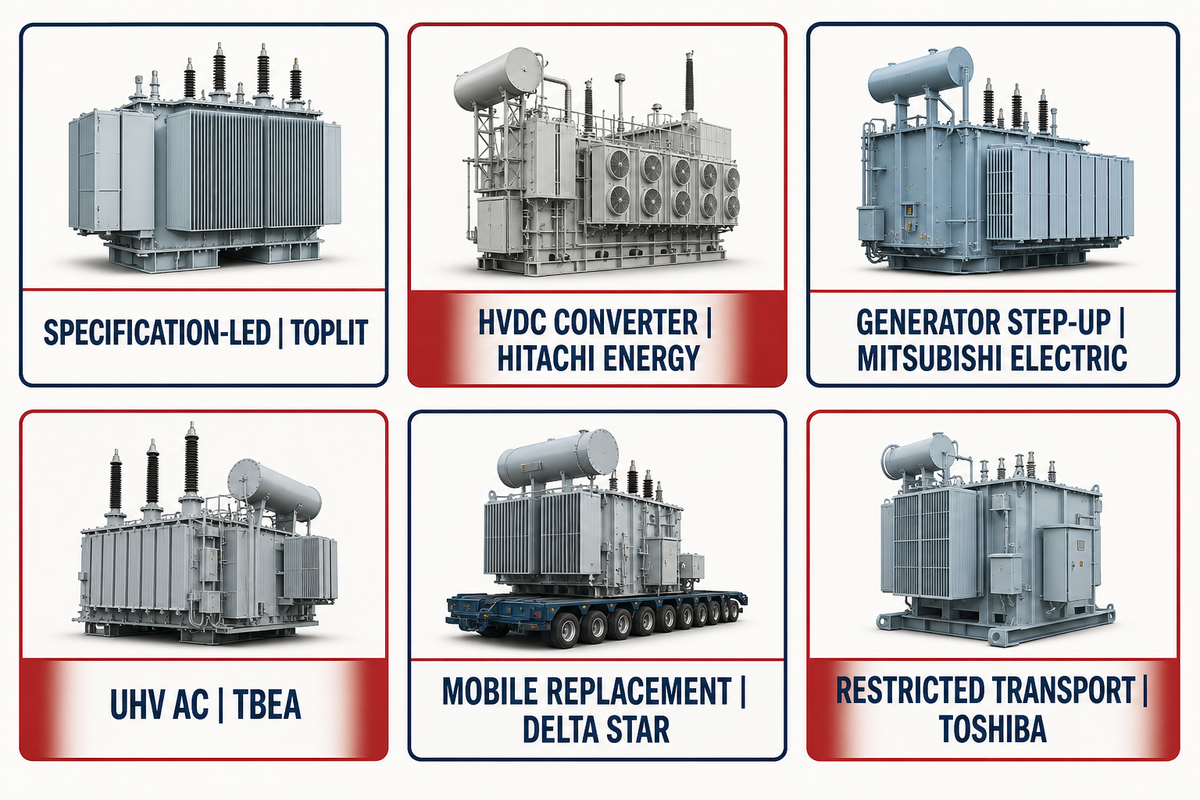
- Best for: Specification-led 35–220 kV power transformer projects requiring published rating data and factory acceptance testing: Toplit
Disclosure: This guide is published by Toplit. We list ourselves first because this is our website, not because we claim to be the market leader. The other 19 manufacturers are grouped by what they are best for, in no particular order within each group.
- Best for HVDC converter and international transmission-grid projects: Hitachi Energy
- Best for high-capacity generator step-up transformers: Mitsubishi Electric
- Best for UHV AC interconnection projects: TBEA
- Best for mobile substations and emergency replacement: Delta Star
- Best for large transformers with restrictive transport routes: Toshiba
How We Selected These Power Transformer Manufacturers
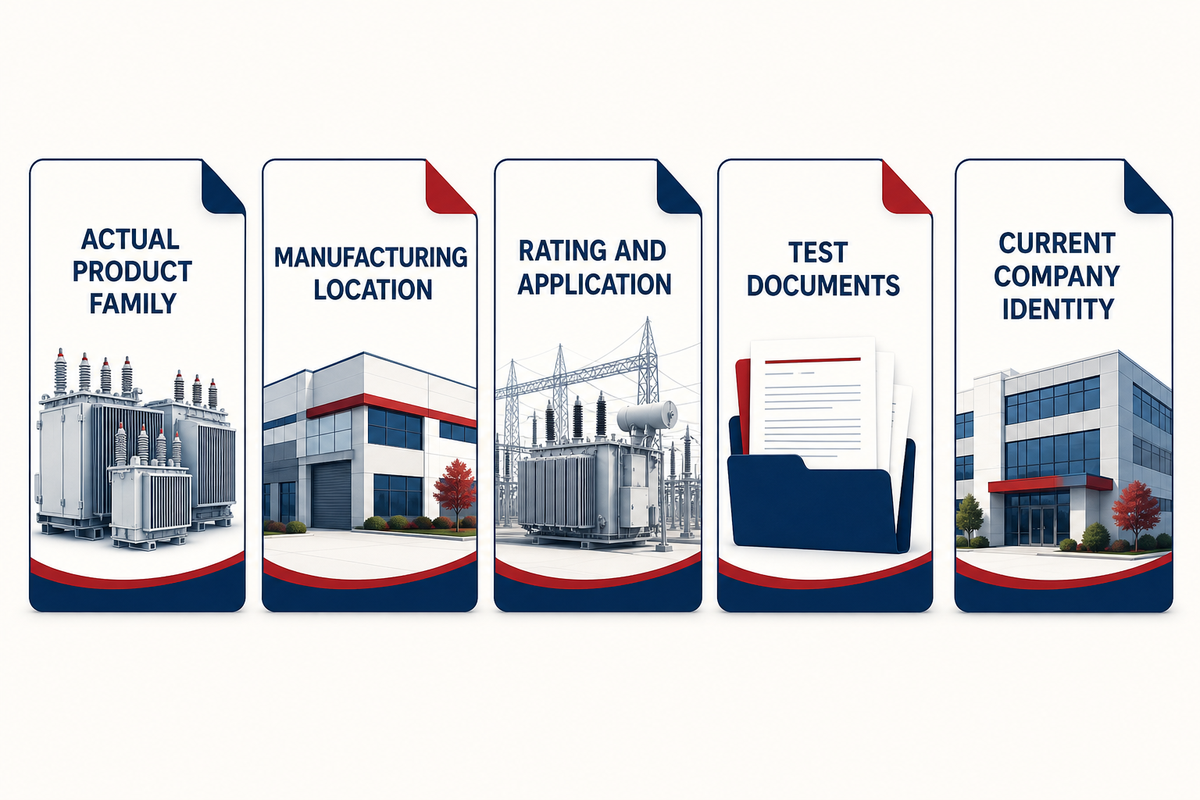
Information was cross-checked with manufacturer websites and trusted public domains in September, 2026. This list of power transformer manufacturers follows the project-fit groups used in Quick Picks. Selection criteria included actual power-transformer product lines, evidence of transformer manufacturing at rated scope, grid or substation applications, testing, standards information, project documentation and published technical evidence.
Covering more ground expanded the candidate pool, while distributors, brokers, repair-only businesses, component makers and distribution-transformer-only companies were excluded. Manufacturing transformers used only for current or voltage measurement, including current and voltage transformers, or other similar instrument uses, wasn’t considered. Founded dates provided by the company were used, distinguishing the current company from predecessor businesses. If dates weren’t provided, it was noted as “Not publicly disclosed”.
20 Power Transformer Manufacturers Compared
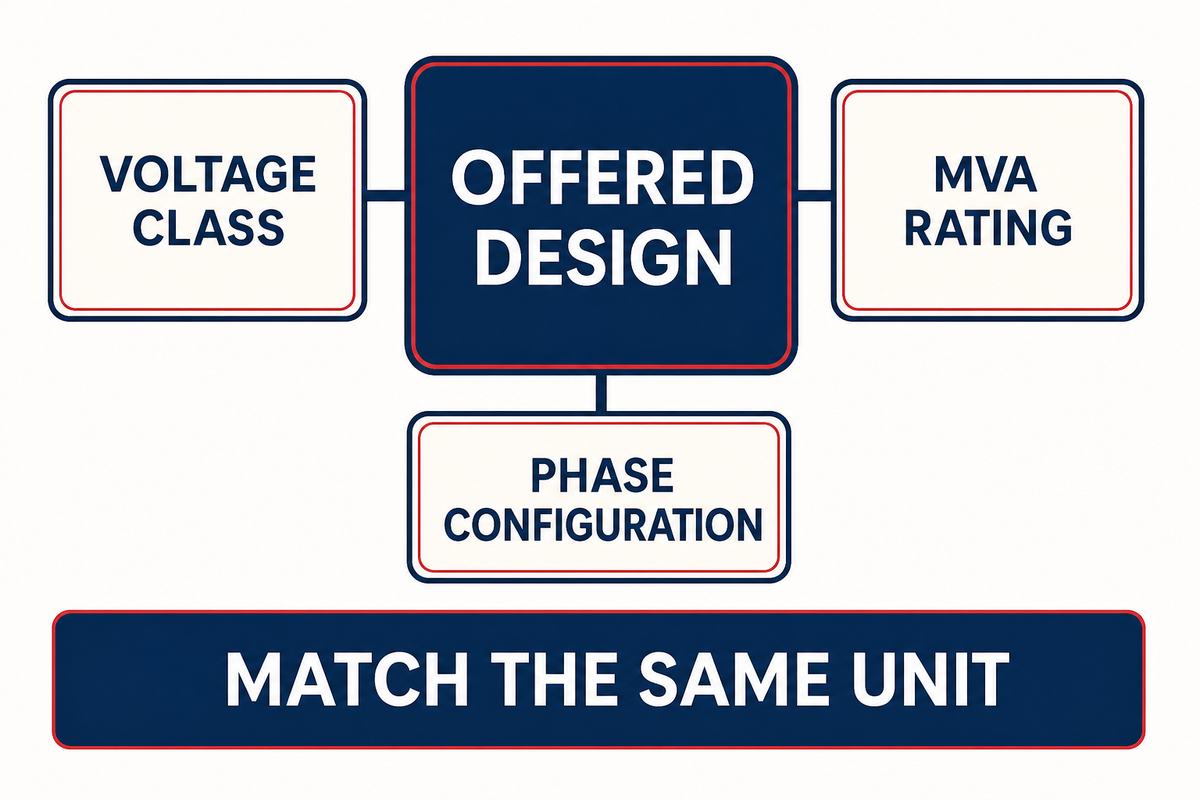
When considering an application, look at the corresponding company profile and any case study provided. When products are manufactured by the same company, information about those products and the manufacturing location can assist procurement teams comparing key players or top companies in the global energy industry. Advertised maximum MVA and maximum voltage of a transformer are disclosed separately and don’t represent a single paired product rating. Toplit’s published rating tables provide a model-specific example. Oil-filled transformers for industrial, transmission, and generation substations are included. Dry-type transformers of a manufacturer, and other power-distribution products, aren’t considered.
Swipe or scroll horizontally to view all ten comparison columns.
| No. | Company Name | Headquarters | Founded Year | Best For | Brief Introduction | Main Products | Key Advantages | Potential Disadvantages | Official Website |
|---|---|---|---|---|---|---|---|---|---|
| 1 | Toplit | Hai’an, Jiangsu, China | Not publicly disclosed | Specification-led 35–220 kV projects with rating data and factory acceptance testing | Jiangsu manufacturer with published oil-immersed power-transformer rating, loss and impedance schedules. | 35 kV, 110 kV and 220 kV power transformers | Published technical schedules and witnessed factory acceptance testing | Published 35–220 kV scope; larger UHV projects require separate supplier qualification | toplit-transformer.com |
| 2 | Hitachi Energy | Zurich, Switzerland | 2020 | HVDC converter and international transmission-grid projects | Manufacturer of converter, generation and substation transformers, with large-power production at Varennes in Canada. | Converter, GSU, shell-form and substation transformers | Delivered 800 kV DC and 735–765 kV AC technology | Converter and conventional AC duties require different engineering and test packages | www.hitachienergy.com |
| 3 | Siemens Energy | Munich, Germany (registered office) | 2020 | Large transmission transformers with natural-ester insulation options | Large-power manufacturer with documented high-voltage natural-ester transformer designs. | Large power, GSU and autotransformers | Documented 400 MVA, 420 kV natural-ester transformer | Natural ester requires fluid-specific design and thermal specifications | www.siemens-energy.com |
| 4 | GE Vernova | Cambridge, Massachusetts, USA | 2024 | Americas grid and GSU projects supported by Prolec manufacturing | Power-transformer group that completed the remaining Prolec GE stake acquisition in February 2026. | Power, GSU and substation transformers | Brochure lists three-phase GSU units up to 1,000 MVA at 550 kV | Americas plants differ in product range and shipment route | www.gevernova.com |
| 5 | Mitsubishi Electric | Tokyo, Japan | 1921 | High-capacity generator step-up transformers for major power stations | Japanese manufacturer with large shell-form designs and a documented nuclear generator step-up reference. | Core-form, shell-form, GSU, autotransformers and gas-insulated transformers | Delivered a 1,510 MVA three-phase nuclear GSU transformer | Gas-insulated options add installation and service gas-handling requirements | www.mitsubishielectric.com |
| 6 | HD Hyundai Electric | Seongnam, South Korea | 2017 | High-capacity GSU and utility power-transformer programs | Korean manufacturer with GSU, converter, phase-shifting and offshore transformer families. | GSU, phase-shifting, converter, offshore and power transformers | Company history records a 1,500 MVA shipment to Australia | Published 800 kV coverage falls below 1,000 kV AC network classes | www.hd-hyundaielectric.com |
| 7 | TBEA | Changji, Xinjiang, China | 1993 | UHV AC interconnection and HVDC converter-transformer projects | Chinese manufacturer publishing model-level data for UHV single-phase autotransformers. | UHV AC, HVDC converter, GSU, mobile and industrial transformers | ODFPS-1000000/1000 has published losses, impedance and cooling details | Single-phase UHV units require bank-level layout and spare planning | en.tbea.com |
| 8 | China XD Electric | Xi’an, Shaanxi, China | 2008 | UHV AC grid projects with documented Chinese utility references | Listed manufacturer represented through transformer businesses including Xi’an XD Transformer. | UHV power, GSU and converter transformers | 1,000 kV, 1,000 MVA units supplied for Nanyang and Wuhu | Large single-phase units require bank-level transport, installation and spare planning | www.xdect.com.cn |
| 9 | Hyosung Heavy Industries | Seoul, South Korea | 2018 | Utility transmission projects specifying ester-filled power transformers | Large-power manufacturer with a named National Grid ester-filled transformer reference. | Large power, ester-filled and transmission transformers | Documented 400 kV, 240 MVA ester-filled National Grid project | Published 765 kV coverage does not reach 1,000 kV AC duty | www.hyosungheavyindustries.com |
| 10 | Toshiba | Kawasaki, Kanagawa, Japan | 1875 | Large transformers with restrictive transport routes and site assembly | Japanese manufacturer offering advanced site-assembly and gas-insulated transformer designs. | Large power, gas-insulated and site-assembly transformers | Documented 500 kV, 1,000 MVA advanced site-assembly design | Site assembly transfers substantial work and resources to the installation site | www.global.toshiba |
| 11 | SGB-SMIT | Regensburg, Germany | 2008 | European large-power projects benefiting from Nijmegen manufacturing and water transport | Transformer group whose Royal SMIT operation manufactures large power transformers in the Netherlands. | Large power, GSU and grid transformers | Nijmegen water access supports heavy transformer shipments | Large-power production is in Nijmegen, separate from German group headquarters | www.sgb-smit.com |
| 12 | WEG | Jaraguá do Sul, Brazil | 1961 | Brazilian transmission and major hydropower transformer projects | Brazilian manufacturer with documented large-transformer production and delivery from Betim. | Transmission, GSU and large power transformers | Assis reference: three single-phase 500 MVA, 525 kV units | Large units require exceptional transport and coordinated commissioning resources | www.weg.net |
| 13 | Virginia Transformer | Roanoke, Virginia, USA | 1971 | Custom North American utility and data-center projects | Custom transformer manufacturer with US facilities and a Chihuahua, Mexico, manufacturing location. | Liquid-filled power, core-form and shell-form transformers | North American manufacturing network and custom transformer designs | Manufacturing and service footprint is concentrated in North America | www.vatransformer.com |
| 14 | Delta Star | Lynchburg, Virginia, USA | 1908 | Mobile substation and emergency-replacement power-transformer programs | Manufacturer combining conventional power-transformer and mobile-substation product lines. | Power transformers, autotransformers and mobile substations | Lynchburg facility lists 1,050 kV BIL test capability | Published power-transformer range stops at 345 kV | www.deltastar.com |
| 15 | Pennsylvania Transformer | Canonsburg, Pennsylvania, USA | 1996 | US-built utility transformers requiring high-voltage domestic factory testing | US manufacturer with current-company formation in 1996 and predecessor history reaching 1929. | Power, GSU and autotransformers | Canonsburg lists 765 kV production and 2,400 kV BIL testing | Highest-voltage testing is at Canonsburg; Raeford covers a lower voltage range | www.patransformer.com |
| 16 | CG Power | Mumbai, India | 1937 | India-manufactured large transformers for grid and data-center programs | Indian manufacturer with a 2026 Tallgrass order covering transformer design, manufacture and testing. | Power transformers, distribution transformers and reactors | Documented India-based manufacturing and testing for the Tallgrass order | Export projects require international shipment and destination-site coordination | www.cgglobal.com |
| 17 | BHEL | New Delhi, India | 1964 | Indian utility projects involving large autotransformers and UHV test-station experience | Indian manufacturer with generation, transmission and UHV autotransformer references. | Generator, transmission and large autotransformers | Published 1,000 MVA/1,200 kV single-phase autotransformer design | 1,200 kV reference is single-phase, requiring a bank configuration | www.bhel.com |
| 18 | Astor Enerji | Ankara, Türkiye | 1983 | Large generator step-up and regional transmission projects from Türkiye | Ankara manufacturer with published large GSU references and an accredited test laboratory. | Large power, GSU and grid transformers | Documented 675 MVA, 400 kV generator step-up transformer | High-capacity Ankara-built units require a project-specific heavy-transport route | astoras.com.tr |
| 19 | BEST Transformer | Balıkesir, Türkiye | 1966 | Large transmission projects with laboratory-backed factory testing | Turkish power-transformer manufacturer with a TÜRKAK-accredited laboratory. | Large power, GSU and grid transformers | ISO/IEC 17025 laboratory and externally tested 450 MVA, 420 kV reference | Mechanical short-circuit tests require external facilities | besttransformer.com |
| 20 | Jiangsu Huapeng Transformer | Liyang, Jiangsu, China | 1967 | High-voltage renewable-grid connections and offshore-wind transformer programs | Chinese manufacturer with large wind-grid transformer references and offshore-wind products. | High-voltage power, GSU, phase-shifting and offshore-wind transformers | Company profile describes a 1,000 MVA, 525 kV wind-grid transformer | Offshore applications add platform-weight and marine-installation constraints | en.china-hp.com |
Specification-Led Power Transformer Projects
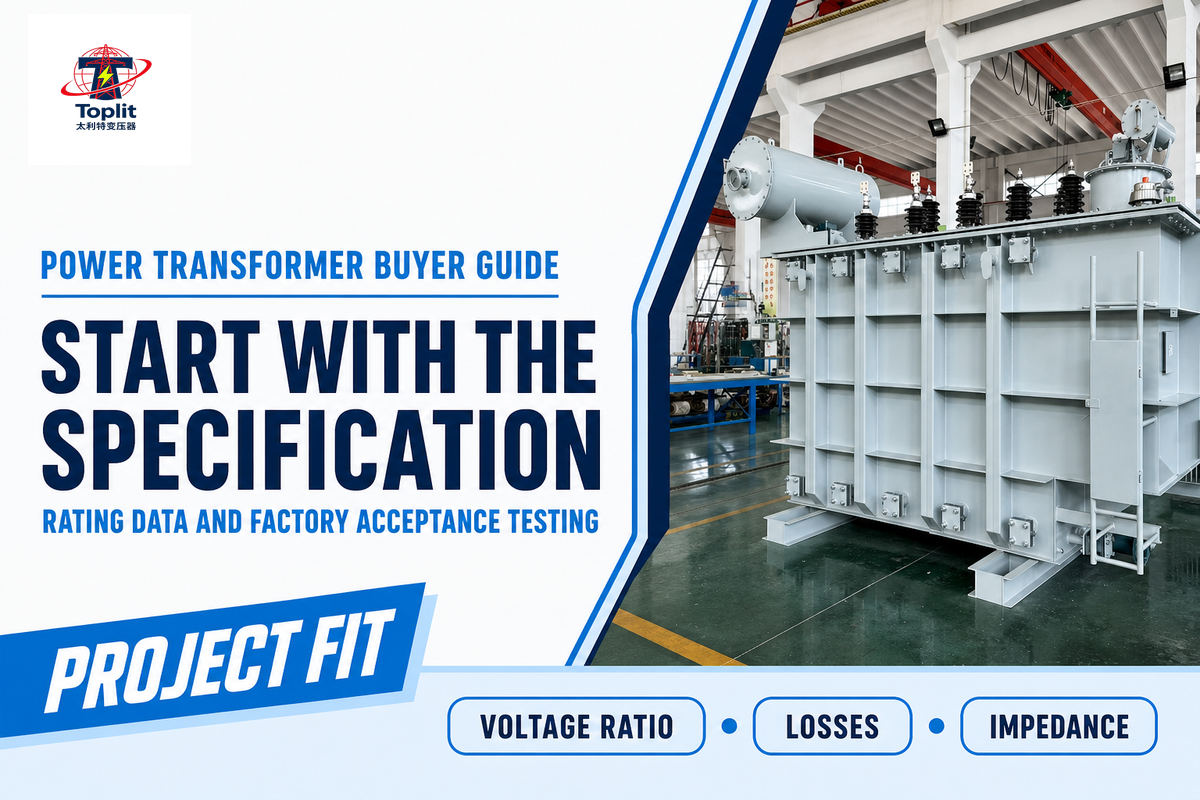
1. Toplit: Best for Specification-Led 35–220 kV Transformer Projects
Headquarters / factory: Hai’an, Nantong, Jiangsu, China · Founded: Not publicly disclosed · Type: Power transformer manufacturer
Official website: toplit-transformer.com
Main products: 35 kV, 110 kV and 220 kV oil-immersed power transformers · Notable capability: Published rating, loss and impedance schedules; witnessed factory acceptance testing
Best for: Specification-led 35–220 kV power transformer projects requiring published rating data and factory acceptance testing
Toplit, the brand used here for Jiangsu Toplit Electric Co., Ltd., gives buyers a parameter-led starting point through its power transformer manufacturing information. Published series data let an engineer compare the requested voltage ratio, rated power, losses and impedance before discussing a quotation. Factory acceptance testing can be witnessed at the Hai’an plant, with third-party inspection where agreed. This combination suits procurement teams developing a defined substation specification around the documented voltage families.
Potential disadvantage: Projects beyond the published 35–220 kV range, including the largest UHV transformer classes, require separate supplier qualification against their specified voltage and duty.
Global EHV and UHV Transformer Manufacturers
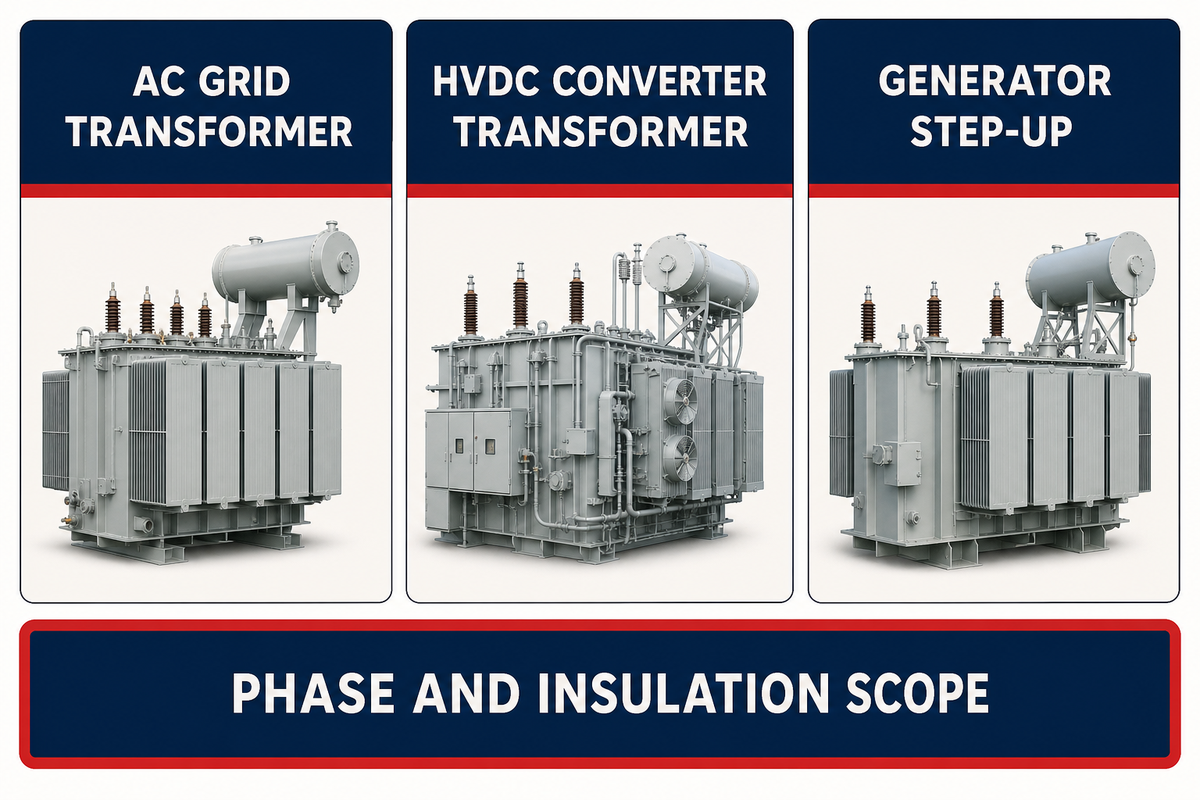
Extra-high-voltage and ultra-high-voltage projects require specific services related to insulation, transport and system integration. Several manufacturers have large power or converter transformer products. When comparing these products, it’s important to distinguish between the level of ratings for AC networks and DC converters as well as the type of tests performed (e.g. impulse tests).
2. Hitachi Energy: Best for HVDC Converter and International Transmission-Grid Projects
Headquarters: Zurich, Switzerland · Founded: 2020 · Type: Power transformer manufacturer
Official website: www.hitachienergy.com
Main products: Generator step-up, converter, shell-form and substation power transformers · Notable work: Large power transformer manufacturing at Varennes, Canada
Hitachi Energy’s product information describes delivered transformer technology for 800 kV DC and 735–765 kV AC applications, giving the company a documented basis for both converter stations and major transmission substations. Varennes adds a specific Canadian manufacturing reference for buyers assessing large power transformers in North America. The current business began as the Hitachi ABB Power Grids joint venture in 2020 and adopted the Hitachi Energy name in 2021, so its formation date doesn’t mark the beginning of its inherited transformer technologies. A portfolio spanning generation, substation and converter duties suits programs that need distinct transformer designs across interconnected energy systems.
Potential disadvantage: Converter-transformer and conventional AC specifications require different engineering and test packages, which complicates a combined procurement package.
3. Siemens Energy: Best for Large Transmission Transformers with Natural-Ester Insulation Options
Headquarters: Munich, Germany (registered office) · Founded: 2020 · Type: Power transformer manufacturer
Official website: www.siemens-energy.com
Main products: Large power transformers, generator step-up transformers and autotransformers · Notable work: A 400 MVA, 420 kV natural-ester transformer described in its brochure
Siemens Energy publishes a power-transformer portfolio exceeding 1,300 MVA and insulation classes reaching 800 kV; these are separate portfolio limits, not a single paired rating. Its documented natural-ester example gives transmission buyers a concrete design reference when the insulating fluid is part of the site specification. That reference is more useful for initial selection than assuming every large transformer uses the same liquid insulation or cooling arrangement. The 2020 date refers to the formation of Siemens Energy as a separate company, while its 2025 financial statements identify Munich as the registered office and the transformer business draws on earlier Siemens operations.
Potential disadvantage: Natural-ester options require a fluid-specific design and thermal specification, so the procurement team can’t simply substitute the fluid in a mineral-oil design.
4. GE Vernova: Best for Americas Grid and GSU Projects Supported by Prolec Manufacturing
Headquarters: Cambridge, Massachusetts, USA · Founded: 2024 · Type: Power transformer manufacturer
Official website: www.gevernova.com
Main products: Power, generator step-up and substation transformers · Notable development: Acquisition of the remaining Prolec GE stake completed in February 2026
GE Vernova’s power-transformer brochure describes three-phase generator step-up units up to 1,000 MVA at 550 kV, a paired application range relevant to large generation projects. This published product range comes from Prolec GE. Prolec manufacturing makes the group a candidate for grid and generation procurement in the Americas, rather than merely a brand with regional sales offices. The February 2026 transaction brings Prolec within GE Vernova’s full ownership, and Prolec is therefore represented in this entry rather than counted as another independent group. GE Vernova’s 2024 formation date concerns the current company, whose electrical equipment businesses have a longer operating history.
Potential disadvantage: Americas manufacturing locations have different product ranges and shipment routes, so a multi-site program can involve different factory and logistics interfaces.
5. Mitsubishi Electric: Best for High-Capacity Generator Step-Up Transformers
Headquarters: Tokyo, Japan · Founded: 1921 · Type: Power transformer manufacturer
Official website: www.mitsubishielectric.com
Main products: Core-form, shell-form, generator step-up, autotransformers and gas-insulated transformers · Notable work: Delivered 1,510 MVA three-phase nuclear generator step-up transformer
Mitsubishi Electric’s nuclear generation reference provides a concrete reason to consider the company for high-capacity generator connections. Large shell-form designs are part of the published offering, alongside core-form equipment and other transformer configurations used in power transmission. For a power-plant procurement team, the attraction is the connection between a named transformer construction and a documented generating-station duty, rather than a broad claim about electrical equipment experience. Gas-insulated transformers give the portfolio an additional construction option for projects where the installation arrangement drives equipment selection, although that choice changes the operating and maintenance plan.
Potential disadvantage: Gas-insulated options add gas-handling requirements to installation and service, creating a separate resource requirement for the plant owner.
6. HD Hyundai Electric: Best for High-Capacity GSU and Utility Transformer Programs
Headquarters: Seongnam, South Korea · Founded: 2017 · Type: Power transformer manufacturer
Official website: www.hd-hyundaielectric.com
Main products: Generator step-up, phase-shifting, converter, offshore and power transformers · Quality systems: The company states ISO 9001 quality-management and KEPIC quality activities
HD Hyundai Electric publishes family ceilings of 800 kV and 1,500 MVA, which describe separate capability limits rather than a standard unit available at both values. A shipment of a 1,500 MVA transformer to Australia appears in the company’s history and gives the capacity claim a specific delivery reference. Beyond generator step-up duty, phase-shifting and converter families address different power-system functions within the same manufacturer’s portfolio. Its 2017 corporate formation date should be read separately from the earlier Hyundai electrical-equipment business history when comparing manufacturers’ dates.
Potential disadvantage: The published transformer voltage coverage reaches 800 kV, below 1,000 kV AC network classes; that product boundary matters for UHV interconnection shortlists.
7. TBEA: Best for UHV AC Interconnection and HVDC Converter-Transformer Projects
Headquarters: Changji, Xinjiang, China · Founded: 1993 · Type: Power transformer manufacturer
Official website: en.tbea.com
Main products: UHV AC, HVDC converter, generator step-up, mobile and industrial transformers · Notable model: ODFPS-1000000/1000 with published loss, impedance and cooling data
TBEA’s ODFPS-1000000/1000 is a documented 1,000 kV-class, 1,000 MVA single-phase autotransformer, giving utility engineers a model-level reference for UHV AC work. Its published loss and impedance details connect the headline rating to the electrical characteristics needed for network studies and tender comparison. Converter transformers form a separate part of the portfolio, covering DC duties with their own voltage ratings alongside the AC autotransformer product family. The breadth of its transformer families supports consideration across interconnection, generation and industrial projects, while the named UHV model supplies electrical data for UHV AC network studies.
Potential disadvantage: That UHV autotransformer is single-phase, so a three-phase system requires bank-level layout, installation and spare planning.
8. China XD Electric: Best for UHV AC Grids with Documented Chinese Utility References
Headquarters: Xi’an, Shaanxi, China · Founded: 2008 · Type: Power transformer manufacturer
Official website: www.xdect.com.cn
Main products: UHV power, generator step-up and converter transformers · Notable work: Xi’an XD Transformer supplied 1,000 kV, 1,000 MVA units for Nanyang and Wuhu
China XD Electric’s transformer manufacturing businesses include Xi’an XD Transformer, whose UHV products serve large grid interconnection projects. Xi’an XD Transformer’s published history records the Nanyang UHV transformer entering operation in December 2011, a specific grid reference beyond a product catalogue. Those large AC transformer deliveries support consideration for utility interconnections where proven voltage class and bank configuration are central to supplier selection. Generator step-up and converter transformers broaden the offering, but their application ratings remain separate from the cited UHV AC reference.
Potential disadvantage: Large UHV single-phase units require bank-level transport, installation and spare planning, increasing the coordination needed beyond purchasing an individual transformer.
Utility and Substation Power Transformer Specialists
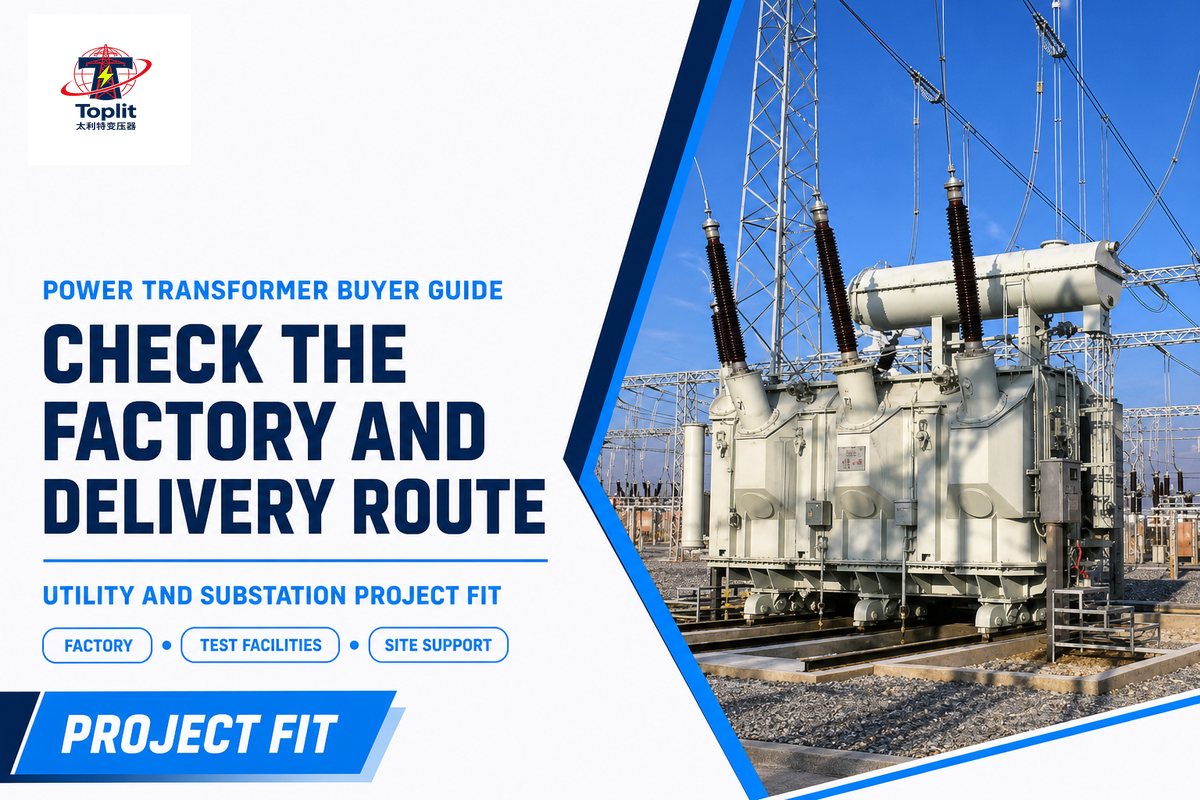
For utility products, the brand often plays a role, but so do the location of the factories and test facilities as well as the terms of the shipment. This group comprises utility and substation products, including mobile substations and products for the North American market. For projects in the U.S., the ownership and location of the factories also play a role. It’s important to distinguish a company’s market presence through office branches from the location of its factories and field service facilities.
9. Hyosung Heavy Industries: Best for Utility Transmission Projects Specifying Ester-Filled Transformers
Headquarters: Seoul, South Korea · Founded: 2018 · Type: Power transformer manufacturer
Official website: www.hyosungheavyindustries.com
Main products: Large power, ester-filled and transmission transformers · Quality systems: The company lists ISO 9001, ISO 14001 and ISO 45001 management systems
Hyosung Heavy Industries describes a National Grid project using a 400 kV, 240 MVA ester-filled transformer, providing a named utility reference for this insulation choice. Published family limits extend to 765 kV and 1,500 MVA separately; the National Grid example is a defined pairing within the broader portfolio. For buyers considering liquid-filled transformers with an ester specification, a completed utility application helps distinguish a delivered design from a general material option. The current company’s 2018 formation reflects corporate restructuring and doesn’t imply that its transformer manufacturing experience began in that year.
Potential disadvantage: Published 765 kV family coverage doesn’t extend to 1,000 kV AC grid duty, which limits its fit for that particular UHV application.
10. Toshiba: Best for Large Transformers with Restrictive Transport Routes and Site Assembly
Headquarters: Kawasaki, Kanagawa, Japan · Founded: 1875 · Type: Power transformer manufacturer
Official website: www.global.toshiba
Main products: Large power, gas-insulated and advanced site-assembly transformers · Quality / testing: Toshiba T&D Systems India’s EHV division lists ISO 9001, ISO 14001 and ISO 45001; its laboratory lists ISO/IEC 17025 accreditation
Toshiba publishes a 500 kV, 1,000 MVA advanced site-assembly transformer design for projects where transport restrictions shape the equipment solution. A separate gas-insulated design reaches 275 kV and 300 MVA, addressing a different installation format within the portfolio. Advanced site assembly changes the delivery method by moving assembly activities to the destination, which can make route constraints a design input rather than a late shipping problem. Toshiba Energy Systems & Solutions was integrated into Toshiba in 2026.
Potential disadvantage: Advanced site assembly places substantial assembly work, resources and coordination at the project site.
11. SGB-SMIT: Best for European Large-Power Projects Benefiting from Nijmegen Water Transport
Headquarters: Regensburg, Germany · Founded: 2008 · Type: Power transformer manufacturer
Official website: www.sgb-smit.com
Main products: Large power, generator step-up and grid transformers · Quality systems: The company lists ISO 9001 and ISO 14001 for named facilities, including Nijmegen
Royal SMIT, the group’s large-power transformer operation in Nijmegen, publishes voltage-class coverage up to 765 kV. Access to water transport at the Netherlands factory is a useful physical feature for heavy transformer shipments, because the exit route from a plant can affect the feasible delivery plan. That combination makes SGB-SMIT relevant to European projects where both electrical scope and movement of a large unit are central buying concerns. The 2008 group-formation date identifies the combined business rather than the start of every member company’s manufacturing history.
Procurement limitation: Large-power production is centered on Royal SMIT in Nijmegen, separate from the German group headquarters, so the manufacturing and delivery interface is with the Netherlands operation.
12. WEG (Brazil): Best for Brazilian Transmission and Major Hydropower Transformer Projects
Headquarters: Jaraguá do Sul, Brazil · Founded: 1961 · Type: Power transformer manufacturer
Official website: www.weg.net
Main products: Transmission, generator step-up and large power transformers · Notable work: Three single-phase 500 MVA, 525 kV transformers supplied for Assis substation
WEG’s Assis project documents both the electrical rating and the manufacturing location: the units were built at Betim in Brazil. According to the company’s account, the shipment traveled about 800 km, connecting its large-transformer capability to a concrete delivery undertaking. For grid and hydropower procurement teams, this reference provides more useful context than the group’s broader electrical product range, since it concerns equipment of the relevant transmission class. Generation and transmission transformer products make WEG a candidate for projects that connect major generating assets with the power grid, especially where Brazilian manufacturing and delivery experience are useful.
Procurement limitation: Large units can require exceptional road transport and coordinated commissioning resources, so equipment delivery must be planned alongside site readiness.
13. Virginia Transformer: Best for Custom North American Utility and Data-Center Projects
Headquarters: Roanoke, Virginia, USA · Founded: 1971 · Type: Power transformer manufacturer
Official website: www.vatransformer.com
Main products: Custom liquid-filled power, core-form and shell-form transformers · Quality statement: The company describes its Chihuahua facility as ISO certified
Virginia Transformer describes core-form capability through 400 MVA and voltage classes through 525 kV, presented separately rather than as one universal rating. Its manufacturing network includes US sites and Chihuahua, Mexico, giving a concrete regional basis for the North American project-fit recommendation. Custom transformers are relevant when utility interfaces or a data center’s incoming supply determine the winding arrangement and other equipment requirements.
Procurement limitation: Manufacturing and service are concentrated in North America, which makes the regional footprint less directly aligned with projects on other continents.
14. Delta Star: Best for Mobile Substation and Emergency-Replacement Transformer Programs
Headquarters: Lynchburg, Virginia, USA · Founded: 1908 · Type: Power transformer manufacturer
Official website: www.deltastar.com
Main products: Power transformers, autotransformers and mobile substations · Testing capability: Lynchburg manufacturing facility lists 1,050 kV BIL testing
Delta Star combines conventional power-transformer manufacturing with mobile-substation products, a relevant pairing for utilities developing replacement and emergency-response equipment programs. Its published range covers conventional transformers up to 200 MVA, autotransformers up to 300 MVA, and voltage classes through 345 kV; these describe different parts of the range. Lynchburg’s listed BIL test capability is an insulation-test parameter, distinct from the transformer’s operating voltage. The mobile-substation offering is the reason for this entry’s application label, while the conventional families remain relevant to planned substation procurement and replacement projects.
Procurement limitation: The published power-transformer range stops at 345 kV, so projects requiring a higher network voltage fall outside the stated offering used in this comparison.
15. Pennsylvania Transformer: Best for US-Built Utility Transformers with Domestic High-Voltage Testing
Headquarters: Canonsburg, Pennsylvania, USA · Founded: 1996 · Type: Power transformer manufacturer
Official website: www.patransformer.com
Main products: Power, generator step-up and autotransformers · Quality system: The company lists ISO 9001:2015 with Design for its manufacturing operation
Pennsylvania Transformer Technology publishes a power-transformer range of 5–750 MVA and voltage coverage through 765 kV, with factory scope differentiated by location. Canonsburg lists 765 kV production and a 2,400 kV BIL test capability, giving buyers a specific US manufacturing and high-voltage testing reference. The current company was founded in 1996, while its predecessor business dates to 1929. For domestic utility procurement, the connection between named plant, product range and test equipment is a useful basis for choosing a manufacturing route.
Procurement limitation: The highest-voltage test capability is at Canonsburg; Raeford covers a lower voltage range, so the factories aren’t interchangeable for all orders.
Regional Grid Transformer Manufacturers
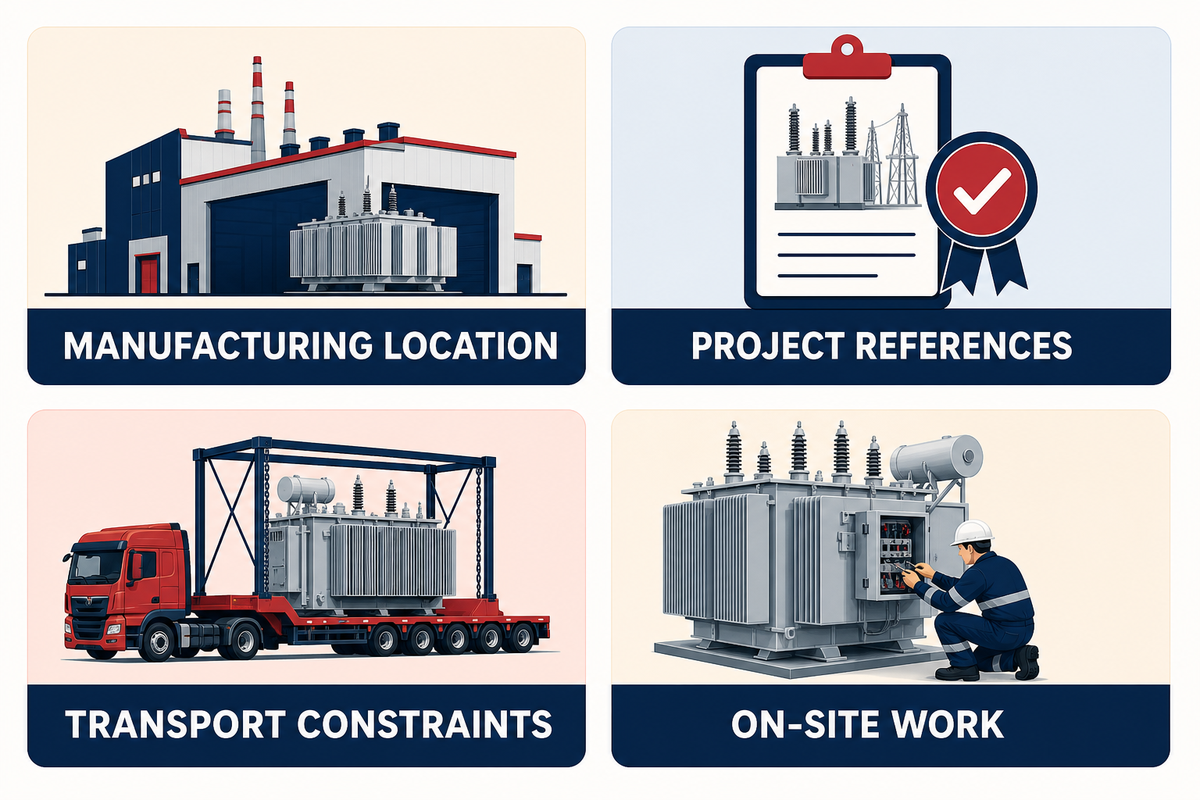
Manufacturing products in a particular region often doesn’t limit the electrical scope of the projects for which the products are used. For transmission, generation and renewable energy projects, for instance, several manufacturers offer large power products. Manufacturing know-how, together with the location of the factories, often plays a role in the division of work and in determining the most convenient location for the support facilities. This is particularly relevant for projects related to grid modernization initiatives.
16. CG Power: Best for India-Manufactured Large Transformers for Grid and Data-Center Programs
Headquarters: Mumbai, India · Founded: 1937 · Type: Power transformer manufacturer
Official website: www.cgglobal.com
Main products: Power transformers, distribution transformers and reactors · Notable work: January 2026 Tallgrass order schedules transformer design, manufacture and testing in India
CG Power’s published portfolio spans voltage classes through 765 kV and capacity classes through 1,500 MVA separately, establishing a power-transformer scope beyond its distribution products. The Tallgrass order is a current example connecting design and manufacturing with testing in India for a data-center-related program. That named order supports consideration by project teams assessing India-based transformer production for grid and large-load connections. Transformers and reactors serve different functions in power systems.
Procurement limitation: India-built export projects require international shipment and destination-site coordination, adding logistics interfaces between factory acceptance and the unit’s readiness for energization.
17. BHEL: Best for Indian Utility Projects with Large Autotransformers and UHV Experience
Headquarters: New Delhi, India · Founded: 1964 · Type: Power transformer manufacturer
Official website: www.bhel.com
Main products: Generator, transmission and large autotransformers · Quality / testing: BHEL reports ISO 9001:2015 for 29 divisions and NABL-accredited major laboratories
BHEL lists a 1,000 MVA/400 kV three-phase autotransformer and a separate 1,000 MVA/1,200 kV single-phase design, with their configurations stated explicitly. Its Bina UHV test-station reference used a 333 MVA transformer, providing a named project context for the company’s UHV work. These references are relevant to Indian utility programs where the connection between a transformer design and the intended network arrangement matters more than a general corporate product catalogue. Generation and transmission transformer families extend the company’s electrical power offering across power-station and grid-substation duties.
Procurement limitation: The 1,200 kV reference is a single-phase UHV design, so the project needs bank-level engineering rather than the layout of a compact three-phase unit.
18. Astor Enerji: Best for Large Generator Step-Up and Regional Transmission Projects from Türkiye
Headquarters: Ankara, Türkiye · Founded: 1983 · Type: Power transformer manufacturer
Official website: astoras.com.tr
Main products: Large power, generator step-up and grid transformers · Quality / testing: The company lists ISO 9001, and its test laboratory describes ISO/IEC 17025 accreditation
Astor Enerji’s published 2024 generator step-up reference is a 675 MVA, 400 kV transformer, a defined pairing for buyers examining large generation connections. The broader product information lists family limits of 1,000 MVA and 800 kV separately, which shouldn’t be substituted for that specific example. Ankara manufacturing and a laboratory with a stated accreditation provide a concrete production-and-testing context for its regional transmission offering. For a power-station team, the GSU reference connects the proposed application with equipment already described by the manufacturer, without relying on the scale of its unrelated electrical products.
Procurement limitation: High-capacity Ankara-built units require a project-specific heavy-transport route, making factory dispatch only one part of the delivery plan.
19. BEST Transformer: Best for Large Transmission Projects with Laboratory-Backed Factory Testing
Headquarters: Balıkesir, Türkiye · Founded: 1966 · Type: Power transformer manufacturer
Official website: besttransformer.com
Main products: Large power, generator step-up and grid transformers · Testing: TÜRKAK-accredited laboratory operating to ISO/IEC 17025
BEST Transformer publishes a manufacturing and test envelope reaching 1,250 MVA and 765 kV separately, giving large transmission buyers a stated scope for initial selection. Its reported externally tested 450 MVA, 420 kV transformer is a specific paired reference within that wider envelope. The company’s laboratory capability is relevant to projects that put substantial emphasis on test execution and the resulting documentation during factory acceptance. External testing also appears in the company’s record, so the documented testing route includes both work at its own laboratory and work at another facility, depending on the test concerned.
Procurement limitation: Mechanical short-circuit tests use external facilities rather than the in-house laboratory, adding another location and scheduling interface when such testing is required.
20. Jiangsu Huapeng Transformer: Best for High-Voltage Renewable-Grid and Offshore-Wind Projects
Headquarters: Liyang, Jiangsu, China · Founded: 1967 · Type: Power transformer manufacturer
Official website: en.china-hp.com
Main products: High-voltage power, generator step-up, phase-shifting and offshore-wind transformers · Notable work: A 1,000 MVA, 525 kV wind-grid transformer described in the company profile
Jiangsu Huapeng Transformer connects its high-voltage offering with wind power through a large renewable-grid reference. Company history also records delivery of a 500 kV-class, 1,000 MVA renewable-energy transformer in 2021, giving a dated account of that application area. Offshore-wind products and phase-shifting transformers address different grid requirements, which makes product-family selection more useful than treating every renewable connection as the same transformer duty. For renewable-energy developers, the published wind-grid equipment gives the shortlist a project-specific basis beyond the company’s general transformer manufacturing history.
Procurement limitation: Offshore applications add platform-weight and marine-installation constraints to transformer selection, so electrical suitability must be assessed together with the offshore installation arrangement.
How to Choose a Power Transformer Manufacturer
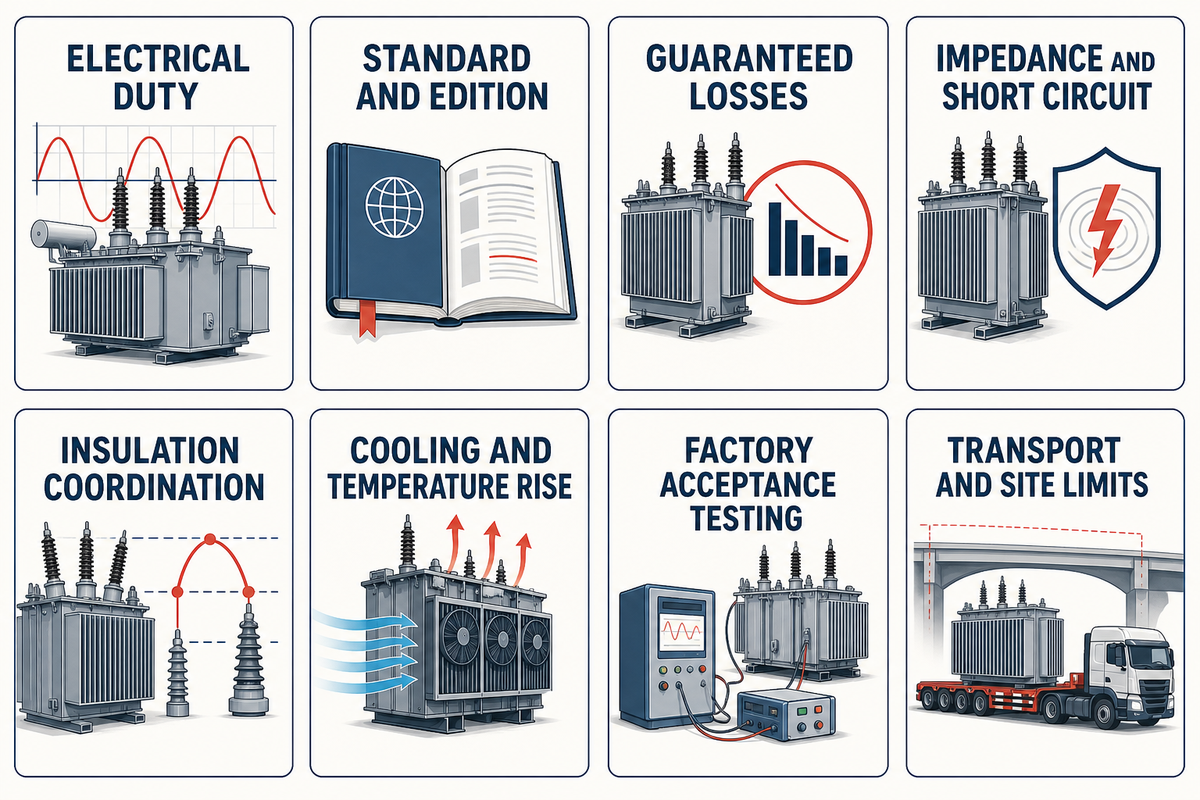
A complete comparison of suppliers should begin with electrical duty and end with a ready-to-use transformer. Use the following points to evaluate bids. Make sure to indicate the deviations of each supplier against the requirements. An attractive power rating may camouflage other requirements such as the scope and limitations of testing, delivery and commissioning. Substation transformer manufacturers should quote against the same site duty and acceptance criteria. Likewise, statements such as medium power or large power transformer also need a defined rating. Catalog descriptions don’t convey the equipment required for a transmission and distribution project.
1. State the electrical power rating and the HV, LV and required tertiary winding voltages. Give the frequency, phase and vector group, state the system grounding, and define the tap range. State if an on-load tap changer (OLTC) or a de-energized tap changer (DETC) is required. For a step-up transformer, give the operating conditions and state the system grounding and tap range. This also applies to other power transformers. Give the operating conditions and describe the system to which the power is to be connected. For example, is it to be used for a generator step-up transformer or a substation step-down transformer? For energy storage, alternative energy and industrial electrification systems, describe the service conditions for the intended power applications. Give the power rating in MVA or kVA and state the cooling requirement for each.
2. Agree the applicable standard and edition. Identify the relevant parts and editions of IEC 60076 or the appropriate IEEE C57 documents, along with utility specifications, applicable ANSI requirements and destination-market requirements. “IEC compliant” is too broad for an acceptance plan. Translate claims about high-quality transformers into guaranteed losses, temperature rise and agreed test results. IEEE C57.12.00 concerns general requirements for liquid-immersed distribution, power and regulating transformers; the order still needs its own specified scope. Separate design and test standards from ISO management systems, laboratory accreditation and utility approved-vendor status. ISO’s certification guidance explains certification without turning a management-system certificate into transformer product approval. Review certificate entity, site and scope, relevant test reports, and the individual utility’s qualification requirements here.
“ISO does not perform certification or issue certificates” ISO certification guidance.
For a certificate, check the issuing body, certified entity, site and scope against the offered manufacturing operation.
3. Compare guaranteed losses on the same basis. Request no-load loss, load loss and auxiliary loss, with reference temperature, tolerances and the operating conditions used for each guarantee. Fans and pumps belong in the energy comparison when their operation differs between bids. Apply the project’s agreed loss-capitalization or total-owning-cost method to assess energy efficiency over the expected operating profile. Keep the purchase price and evaluated operating cost visible as separate figures. For early rating comparisons, Toplit publishes technical information for 35 kV oil-immersed power transformers, 110 kV substation transformers and 220 kV power transformer models.
4. Check impedance and short-circuit duty. Indicate the guaranteed value, tolerance, and reference rating for each of the taps. The manufacturer must design the mechanical winding construction to withstand system fault levels and short circuit duties. Transformers designed for a particular network must be built to withstand that network’s specified duty, and support their case with evidence under the applicable standard. An engineering analysis and justification must establish whether evidence from another transformer design or rating can support the service for which the offered transformer is designed or rated. This justification must address whether the transformer short circuit duty matches that evaluated in the supporting network study.
5. Establish Insulation Coordination. State the highest voltage for equipment and required power-frequency, lightning impulse and applicable switching impulse withstand duties as part of the insulation levels. Identify impulse withstand levels separately from operating voltage levels. If environmental conditions and contaminants affect the insulation, these also must be stated, together with creepage distance and altitude correction. Insulation coordination is part of the design of the electrical system, which includes the equipment and protection systems located at the substation. An engineering analysis must justify how the result of a transformer test supports the required levels of voltage and withstand duties. It also is important to take environmental conditions into account to support the case for the required voltage and withstand duties, using BIL where IEEE terminology applies.
6. Describe cooling methods for the transformer and state the required ONAN, ONAF, OFAF, ODAF or other applicable cooling classes. Provide ambient temperatures, altitude, and permissible temperature rise. State cooling requirements for overload conditions. Indicate pump and fan redundancy and the expected capacity when one or more auxiliary system components aren’t available. Discuss the adequacy of the cooling system at each rated cooling stage and state any limitations in the use of system components. Cooling auxiliaries should be evaluated in terms of energy consumption and maintenance.
Discuss anticipated operating conditions of renewable energy and power equipment. For renewable energy sources and changing industrial loads, state the operating profile and permissible temperature rise. If high-performance power equipment is to be used for sustained loading, state the permissible temperature rise.
7: Agree the FAT before placing the order: define the routine, type and special test classifications under the applicable standard and equipment scope, covering routine tests such as winding resistance, voltage ratio, vector group, impedance, load loss, no-load loss and dielectric routine tests; type tests such as temperature rise, lightning impulse and sound level where required, and project-specific special tests; agree witness points, acceptance criteria, report format, third-party inspection and retest responsibility.
8. Include transport and site constraints. Provide the maximum mass and dimensions of the transport packages, and describe road access, bridge and route limitations, crane capacity and installation clearances. State whether oil travels in the transformer or separately, and identify any bushings, conservators or other parts that must be removed for shipping. Identify the work allocated to the client and manufacturer for unloading, assembling, oil filling and processing, site testing and commissioning. The cost of transporting the transformer must be considered in relation to the availability of heavy haul routes to the manufacturing location. Reliable power and safe and efficient operation of the equipment depend partly on the correct treatment of interfaces and on the client’s ability to operate the equipment. The equipment must also fit the electrical interface. The substation, the route over which equipment will be transported, and the plan for energization must also be considered.
Compare Total Delivered and Commissioned Cost
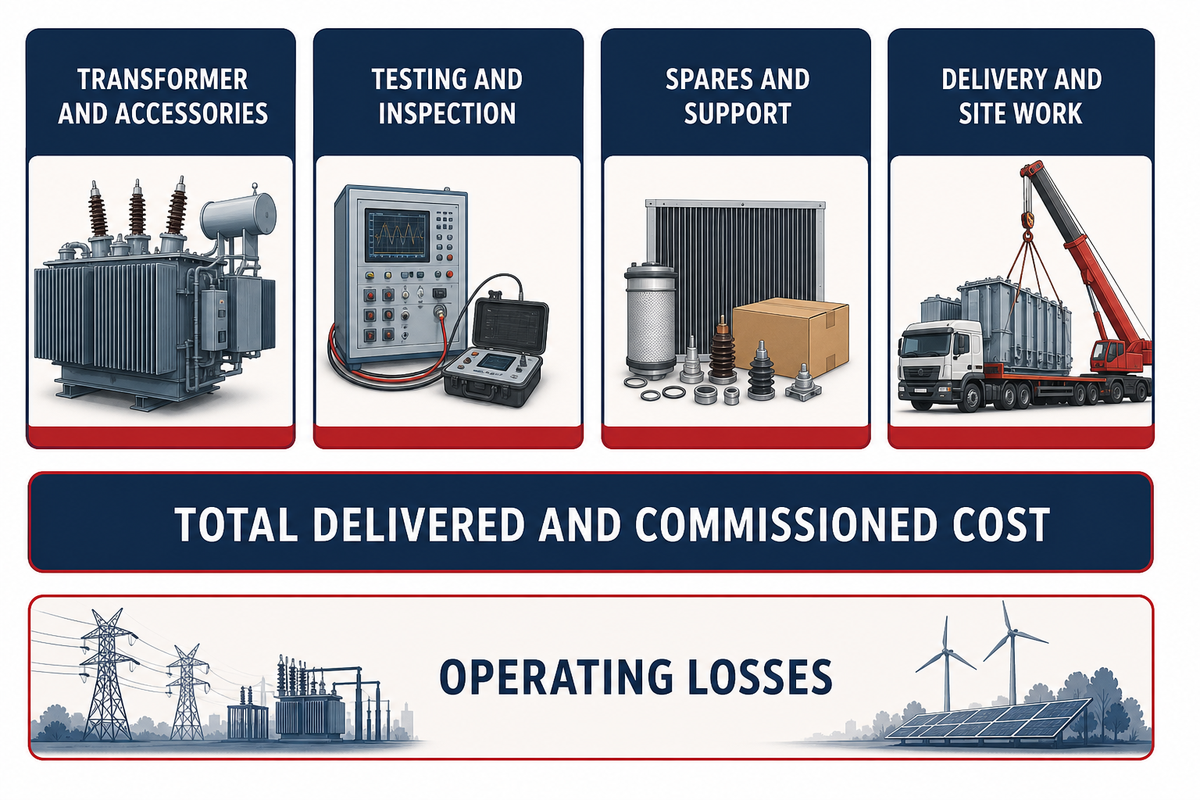
The cost of transport and the cost of commissioning must be considered when evaluating quotations. The factory price of a transformer doesn’t capture every cost of engineering and other expenses which must be considered by the client; broad transformer market data cannot price a specific engineered unit. Consider quotations based on the same technical requirements and standards. The comparison must also consider the costs related to operating losses and long term expenses incurred by the client.
- Check whether the transformer proposal includes the base unit, copper or aluminum windings, steel core, OLTC equipment, auxiliary equipment for winding and/or dielectric cooling, and associated control and protection equipment. State the type of equipment and identify differences in losses or cooling capacity between bids. If the customer requests smart transformers, mention the types of sensors, variables to be monitored, alarm settings, and communication interfaces.
- State the test and acceptance activities included in the proposal. Identify activities which the manufacturer won’t perform and activities which will be performed for an additional fee.
- Spares and support: State the spares, tools and equipment, and on-site support services to be provided by the manufacturer after transformer delivery. Check the quoted scope for spare bushings, fans, pumps, tap-changer accessories, commissioning supervision and long-term spare-parts support. Identify the spares package.
- Check whether the proposal includes performing site activities, assembly, testing and commissioning the transformer. State the transportation and site activities allocated to each quote. Include packing, inland transport, sea freight where relevant, heavy haul, customs handling, unloading, oil processing and site tests in that comparison.
Standardize the evaluation of delivery schedules. Milestones like dispatch, site arrival and readiness to be used differ, especially when there are external tests or site works to be completed. Request project-specific lead times. Where a bid involves long lead times, coordinate the various milestones. Long lead time activities, outage works and balance of plant (BOP) construction are to be synchronized. This method provides an EPC contractor a means of undertaking a commercial evaluation of the project.
A manufacturer’s focus on innovation must be considered when evaluating costs if the equipment included in the bid changes. When assessing a bid for a project with demand for advanced monitoring, this specification should be interpreted to include the integration of data and the support required for commissioning and maintenance.
FAQ: Buyer Questions About Power Transformer Manufacturers
Which is the best power transformer manufacturer?
The best power transformer manufacturer depends on voltage class, MVA rating, grid duty, required standards, testing scope and project location. No single manufacturer fits every project.
The best power transformer manufacturer depends on voltage class, MVA rating, grid duty, required standards, testing scope and project location. Hitachi Energy has documented converter-transformer capability, Mitsubishi Electric has large generator step-up references, and Toplit publishes 35–220 kV rating information with factory acceptance testing. Compare the offered design and delivery scope against the same project specification before choosing a manufacturer.
Which manufacturer is best for high-voltage power transformers?
The best high-voltage manufacturer is the one whose proven voltage and MVA scope matches the project’s insulation, testing and grid requirements. Factory scope matters as much as advertised voltage.
The best high-voltage manufacturer is the one whose proven voltage and MVA scope matches the project’s insulation, testing and grid requirements. TBEA and China XD Electric have documented UHV AC references; Siemens Energy and Hyosung publish high-voltage ester-filled examples. A lower-voltage substation may need a different shortlist. Compare the relevant product family and factory capability rather than selecting by a company’s highest advertised voltage. The relevant insulation levels and tests belong to the offered unit, not the brand.
Who is the largest power transformer manufacturer in the world?
No single manufacturer can be named the largest here without current, comparable global data measured on the same basis. For the largest power transformer manufacturers, group revenues and transformer capacity measure different things.
Total revenues, transformer sales volumes, production capacity, product installations and market share measure different things, so consistent market data are needed to rank competitors. Just because a company has a large electrical equipment business, for example, doesn’t mean it would be the leader within the power-transformer segment. Any 2026 comparison needs consistent product boundaries, reporting periods and treatment of group subsidiaries. A factory’s annual MVA output is not directly comparable with a group’s revenue or worldwide installed base.
Are Chinese power transformer manufacturers reliable?
Some are, but country of origin alone is not a sufficient supplier qualification criterion. Reliability depends on relevant product experience, factory testing and project support.
Some are, but country of origin alone is not a sufficient supplier qualification criterion. Voltage and MVA references, standards, laboratory capability, FAT, loss guarantees and short-circuit evidence describe project-specific technical suitability; utility approvals, project documentation and service support establish project fit.
How much does a power transformer cost?
There is no universal power-transformer price because each unit is engineered around its electrical duty and project specification. Compare delivered cost against matching technical specifications.
There is no universal power-transformer price because each unit is engineered around its electrical duty and project specification. Compare prices between units against the same specification and delivery scope. MVA, voltage, materials, OLTC and cooling affect quotations. Compare total delivered and commissioned prices, including testing, accessories, transport and installation; evaluate operating losses separately.
What is the difference between a power transformer manufacturer and a supplier?
A manufacturer designs and builds the transformer, while a supplier may manufacture, distribute, integrate or source equipment from another factory. Production, testing and warranty responsibilities can sit with different entities.
A manufacturer designs and builds the transformer, while a supplier may manufacture, distribute, integrate or source equipment from another factory. Manufacturer of record, factory location and nameplate manufacturer identify production; Factory Acceptance Tests (FAT) location and warranty provider identify testing and contractual responsibility.
Match the Manufacturer to the Electrical Duty
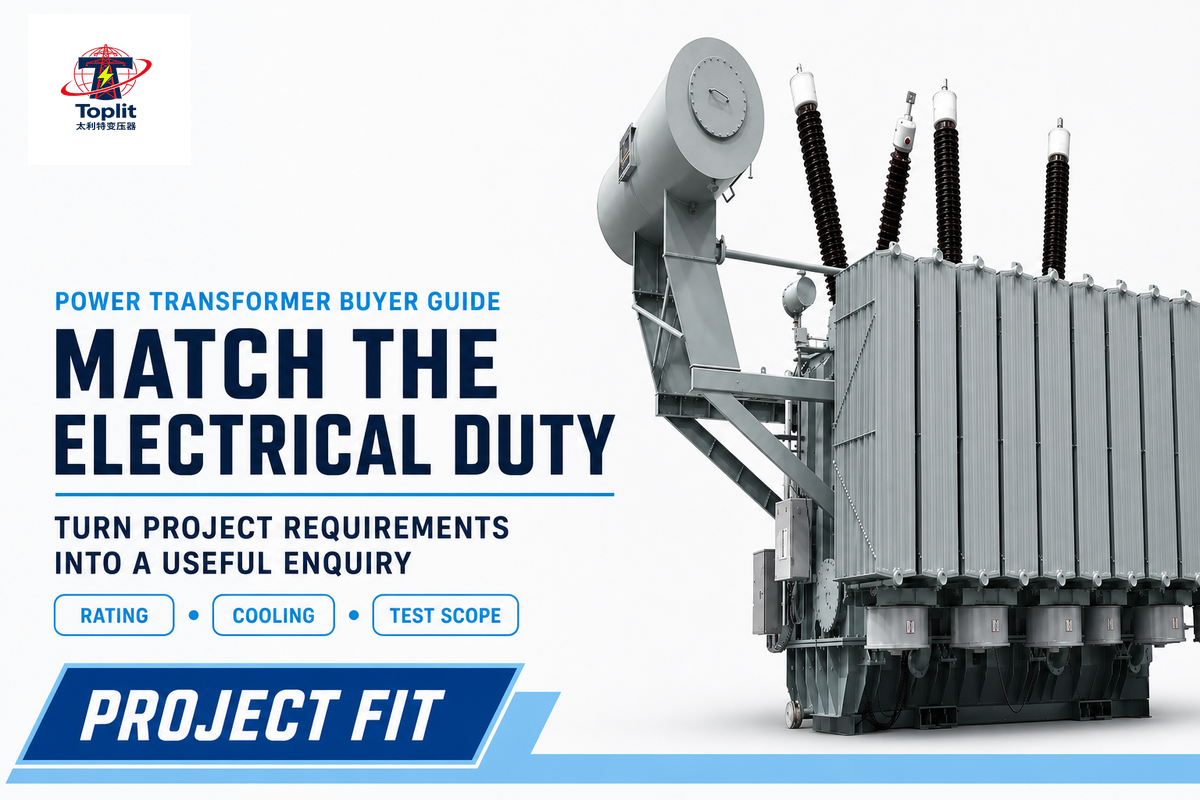
The short list should be determined by factors such as voltage class, MVA rating, grid role, generator step-up or converter duty, applicable standards, tests, and site conditions. Decision-making is further aided by the geographic location of factories and the schedule of equipment shipments. An electrical mismatch risks delaying approval because a factory’s portfolio maximum does not establish the offered unit’s suitability. Modern energy infrastructure and energy transition projects need power solutions specified around their electrical duty. Equipment procurement for large transmission projects and mobile substations is governed by different project requirements, rather than the assumption that both are developed from the same generic design.
For a specification-led 35–220 kV project, review Toplit’s power transformer range and send the transformer specification or single-line diagram for a rating review. Include MVA, voltage ratio, frequency, vector group, impedance, cooling, guaranteed loss requirements, FAT scope and site conditions. Those inputs give the factory a useful basis for discussing the design and preparing a quotation.
References & Sources
Manufacturer profiles draw on the companies’ official product pages, corporate histories, factory information and published project accounts checked in September 2026. September 2026 was the last date these documents were consulted. The comparative table and each company profile provide the company’s current web address.
- IEC 60076-1: Power transformers, general requirements: Identification of the IEC transformer standard and its edition.
- IEEE C57.12.00: General requirements for liquid-immersed transformers is an IEEE specification for liquid-immersed transformers.
- ISO: Certification: description of certification, and discussion of the relationship between standards and certification.
![Pad-Mounted Transformer: How It Works [2026 Guide]](https://toplit-transformer.com/wp-content/uploads/2026/08/pad-mounted-transformer-guide-featured-150x150.png)
![Single Phase Pad Mounted Transformer Guide [2026]](https://toplit-transformer.com/wp-content/uploads/2026/08/single-phase-pad-mounted-transformer-guide-featured-1-150x150.png)